2013 NISSAN MAXIMA steering
[x] Cancel search: steeringPage 376 of 444
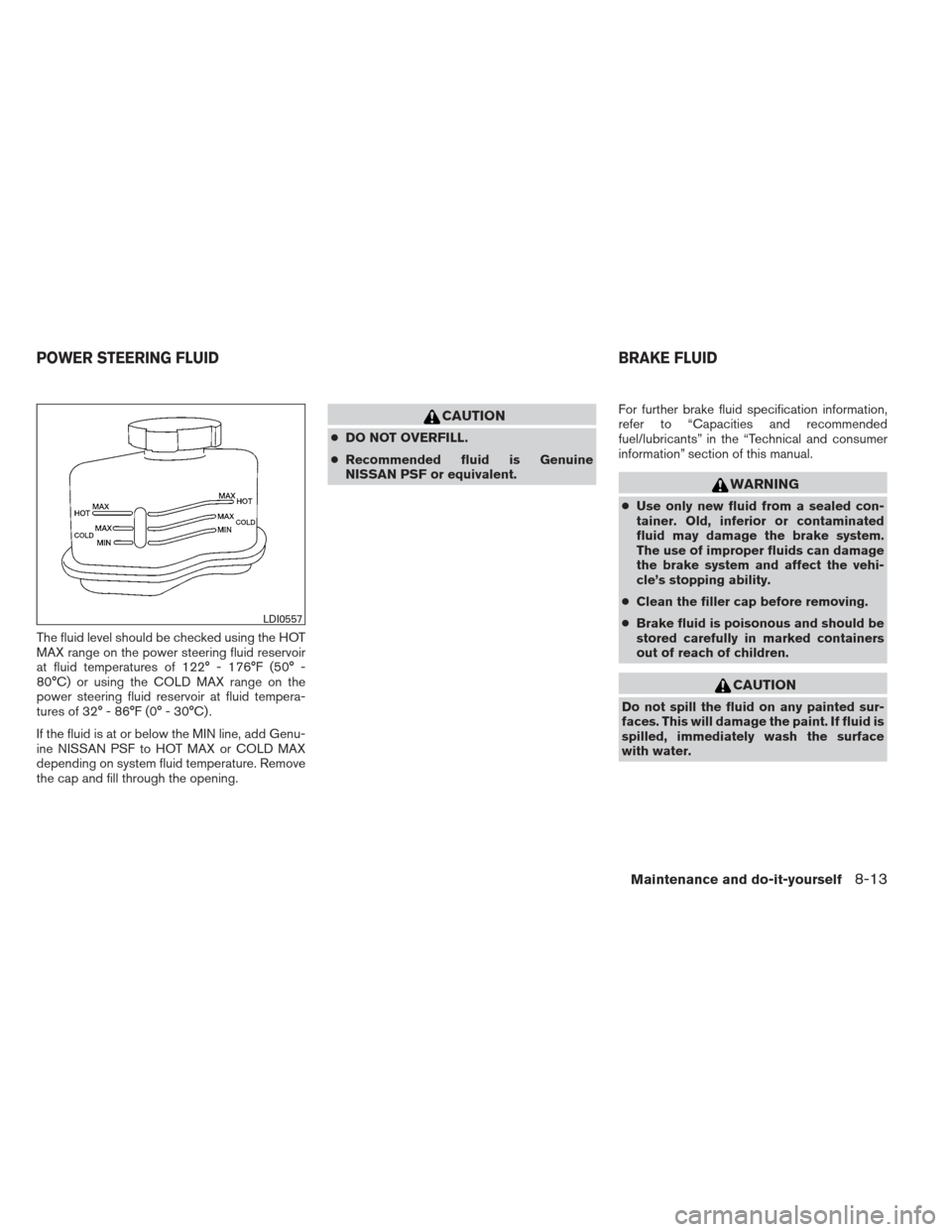
The fluid level should be checked using the HOT
MAX range on the power steering fluid reservoir
at fluid temperatures of 122° - 176°F (50° -
80°C) or using the COLD MAX range on the
power steering fluid reservoir at fluid tempera-
tures of 32° - 86°F (0° - 30°C) .
If the fluid is at or below the MIN line, add Genu-
ine NISSAN PSF to HOT MAX or COLD MAX
depending on system fluid temperature. Remove
the cap and fill through the opening.
CAUTION
●DO NOT OVERFILL.
● Recommended fluid is Genuine
NISSAN PSF or equivalent. For further brake fluid specification information,
refer to “Capacities and recommended
fuel/lubricants” in the “Technical and consumer
information” section of this manual.
WARNING
●
Use only new fluid from a sealed con-
tainer. Old, inferior or contaminated
fluid may damage the brake system.
The use of improper fluids can damage
the brake system and affect the vehi-
cle’s stopping ability.
● Clean the filler cap before removing.
● Brake fluid is poisonous and should be
stored carefully in marked containers
out of reach of children.
CAUTION
Do not spill the fluid on any painted sur-
faces. This will damage the paint. If fluid is
spilled, immediately wash the surface
with water.
LDI0557
POWER STEERING FLUID BRAKE FLUID
Maintenance and do-it-yourself8-13
Page 380 of 444
CAUTION
●Do not ground accessories directly to
the battery terminal. Doing so will by-
pass the variable voltage control sys-
tem and the vehicle battery may not
charge completely.
● Use electrical accessories with the en-
gine running to avoid discharging the
vehicle battery.
Your vehicle is equipped with a variable voltage
control system. This system measures the
amount of electrical discharge from the battery
and controls voltage generated by the generator.
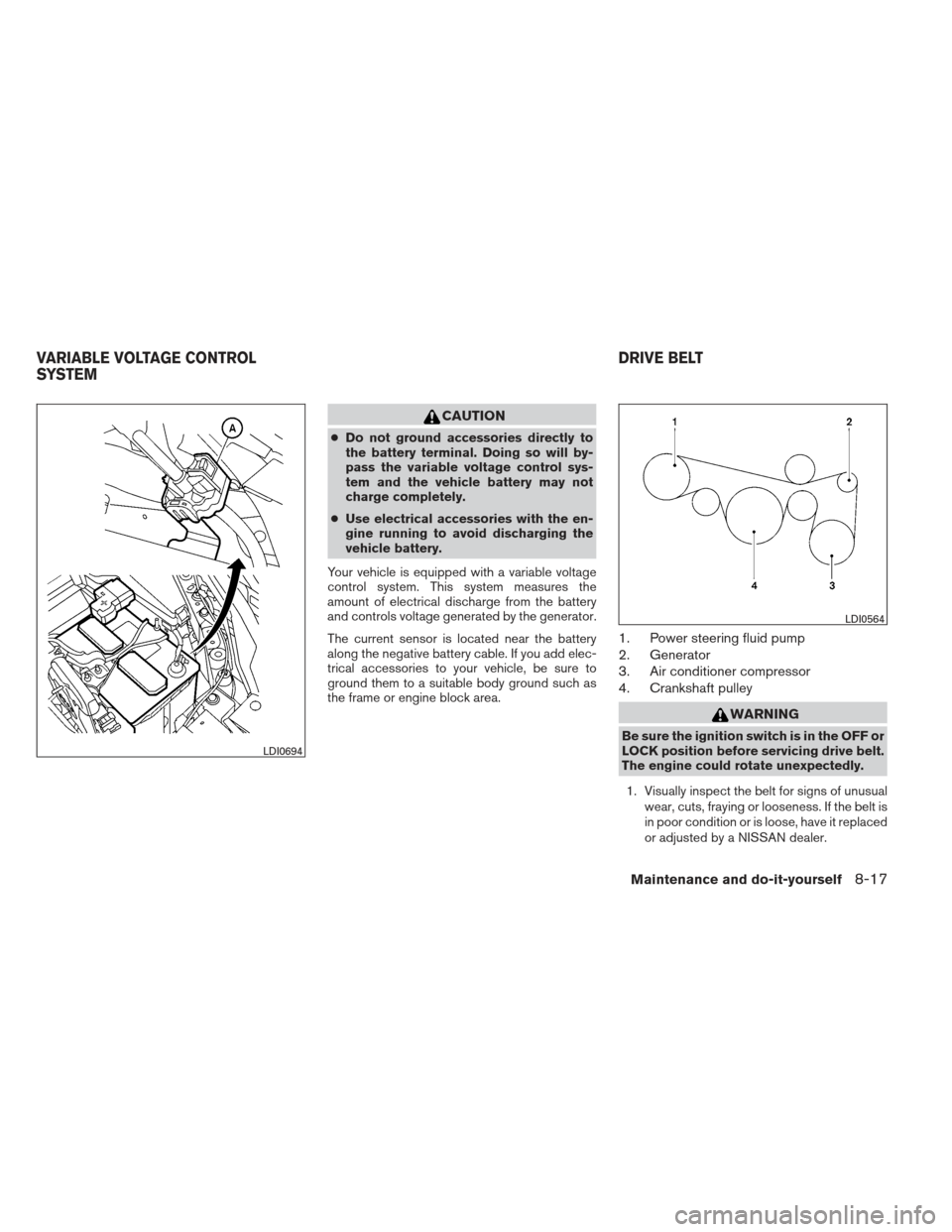
The current sensor is located near the battery
along the negative battery cable. If you add elec-
trical accessories to your vehicle, be sure to
ground them to a suitable body ground such as
the frame or engine block area.
1. Power steering fluid pump
2. Generator
3. Air conditioner compressor
4. Crankshaft pulley
WARNING
Be sure the ignition switch is in the OFF or
LOCK position before servicing drive belt.
The engine could rotate unexpectedly.
1. Visually inspect the belt for signs of unusual wear, cuts, fraying or looseness. If the belt is
in poor condition or is loose, have it replaced
or adjusted by a NISSAN dealer.LDI0694
LDI0564
VARIABLE VOLTAGE CONTROL
SYSTEM DRIVE BELT
Maintenance and do-it-yourself8-17
Page 409 of 444
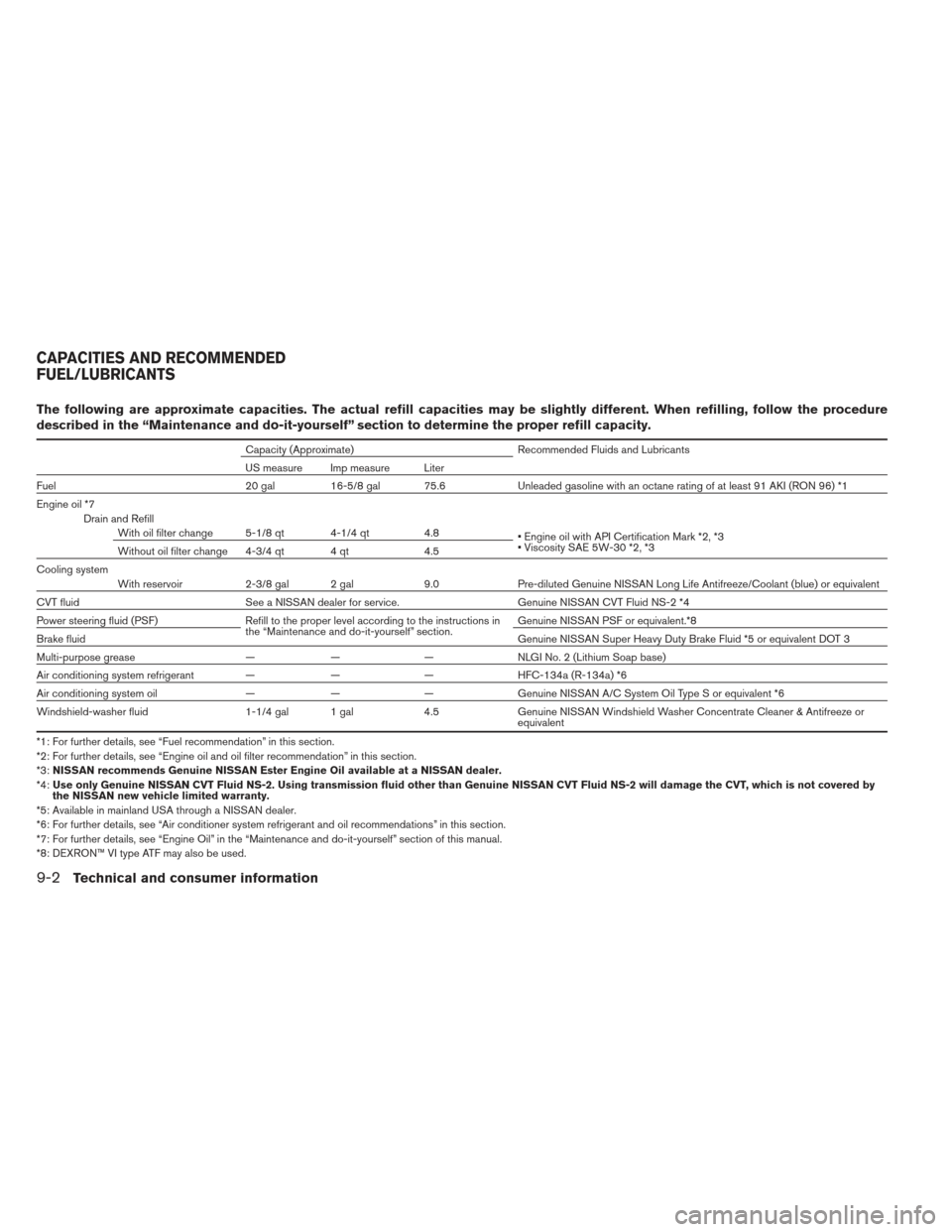
The following are approximate capacities. The actual refill capacities may be slightly different. When refilling, follow the procedure
described in the “Maintenance and do-it-yourself” section to determine the proper refill capacity.
Capacity (Approximate)Recommended Fluids and Lubricants
US measure Imp measure Liter
Fuel 20 gal16-5/8 gal 75.6 Unleaded gasoline with an octane rating of at least 91 AKI (RON 96) *1
Engine oil *7 Drain and RefillWith oil filter change 5-1/8 qt 4-1/4 qt 4.8
Engine oil with API Certification Mark *2, *3
Viscosity SAE 5W-30 *2, *3
Without oil filter change 4-3/4 qt 4 qt 4.5
Cooling system With reservoir 2-3/8 gal 2 gal 9.0Pre-diluted Genuine NISSAN Long Life Antifreeze/Coolant (blue) or equivalent
CVT fluid See a NISSAN dealer for service. Genuine NISSAN CVT Fluid NS-2 *4
Power steering fluid (PSF) Refill to the proper level according to the instructions in
the “Maintenance and do-it-yourself” section. Genuine NISSAN PSF or equivalent.*8
Brake fluid Genuine NISSAN Super Heavy Duty Brake Fluid *5 or equivalent DOT 3
Multi-purpose grease —— —NLGI No. 2 (Lithium Soap base)
Air conditioning system refrigerant — ——HFC-134a (R-134a) *6
Air conditioning system oil —— —Genuine NISSAN A/C System Oil Type S or equivalent *6
Windshield-washer fluid 1-1/4 gal 1 gal4.5Genuine NISSAN Windshield Washer Concentrate Cleaner & Antifreeze or
equivalent
*1: For further details, see “Fuel recommendation” in this section.
*2: For further details, see “Engine oil and oil filter recommendation” in this section.
*3: NISSAN recommends Genuine NISSAN Ester Engine Oil available at a NISSAN dealer.
*4: Use only Genuine NISSAN CVT Fluid NS-2. Using transmission fluid other than Genuine NISSAN CVT Fluid NS-2 will damage the CVT, which is not covered by
the NISSAN new vehicle limited warranty.
*5: Available in mainland USA through a NISSAN dealer.
*6: For further details, see “Air conditioner system refrigerant and oil recommendations” in this section.
*7: For further details, see “Engine Oil” in the “Maintenance and do-it-yourself” section of this manual.
*8: DEXRON™ VI type ATF may also be used.
CAPACITIES AND RECOMMENDED
FUEL/LUBRICANTS
9-2Technical and consumer information
Page 423 of 444
WARNING
Overloading or improper loading of a
trailer and its cargo can adversely affect
vehicle handling, braking and perfor-
mance and may lead to accidents.
CAUTION
●Do not tow a trailer or haul a heavy load
for the first 500 miles (800 km) . Your
engine, axle or other parts could be
damaged.
● For the first 500 miles (800 km) that you
tow a trailer, do not drive over 50 mph
(80 km/h) and do not make starts at full
throttle. This helps the engine and other
parts of your vehicle wear in at the
heavier loads.
Your new vehicle was designed to be used pri-
marily to carry passengers and cargo. Remember
that towing a trailer places additional loads on
your vehicle’s engine, drive train, steering, brak-
ing and other systems.
A NISSAN Towing Guide (U.S. only) is available
on the website at www.nissanusa.com. This
guide includes information on trailer towing ca-
pability and the special equipment required for
proper towing.
MAXIMUM LOAD LIMITS
Maximum trailer loads
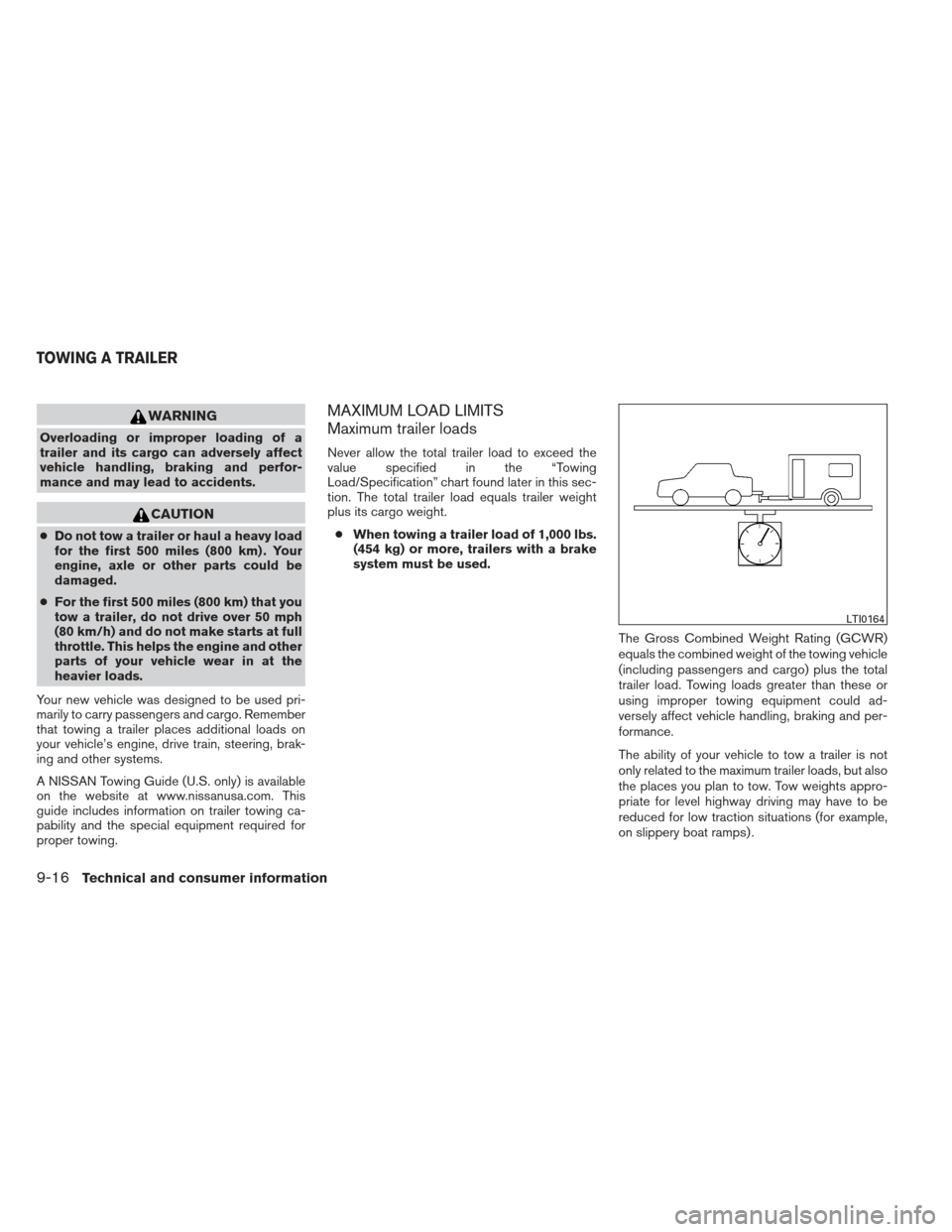
Never allow the total trailer load to exceed the
value specified in the “Towing
Load/Specification” chart found later in this sec-
tion. The total trailer load equals trailer weight
plus its cargo weight. ● When towing a trailer load of 1,000 lbs.
(454 kg) or more, trailers with a brake
system must be used.
The Gross Combined Weight Rating (GCWR)
equals the combined weight of the towing vehicle
(including passengers and cargo) plus the total
trailer load. Towing loads greater than these or
using improper towing equipment could ad-
versely affect vehicle handling, braking and per-
formance.
The ability of your vehicle to tow a trailer is not
only related to the maximum trailer loads, but also
the places you plan to tow. Tow weights appro-
priate for level highway driving may have to be
reduced for low traction situations (for example,
on slippery boat ramps) .
LTI0164
TOWING A TRAILER
9-16Technical and consumer information
Page 428 of 444
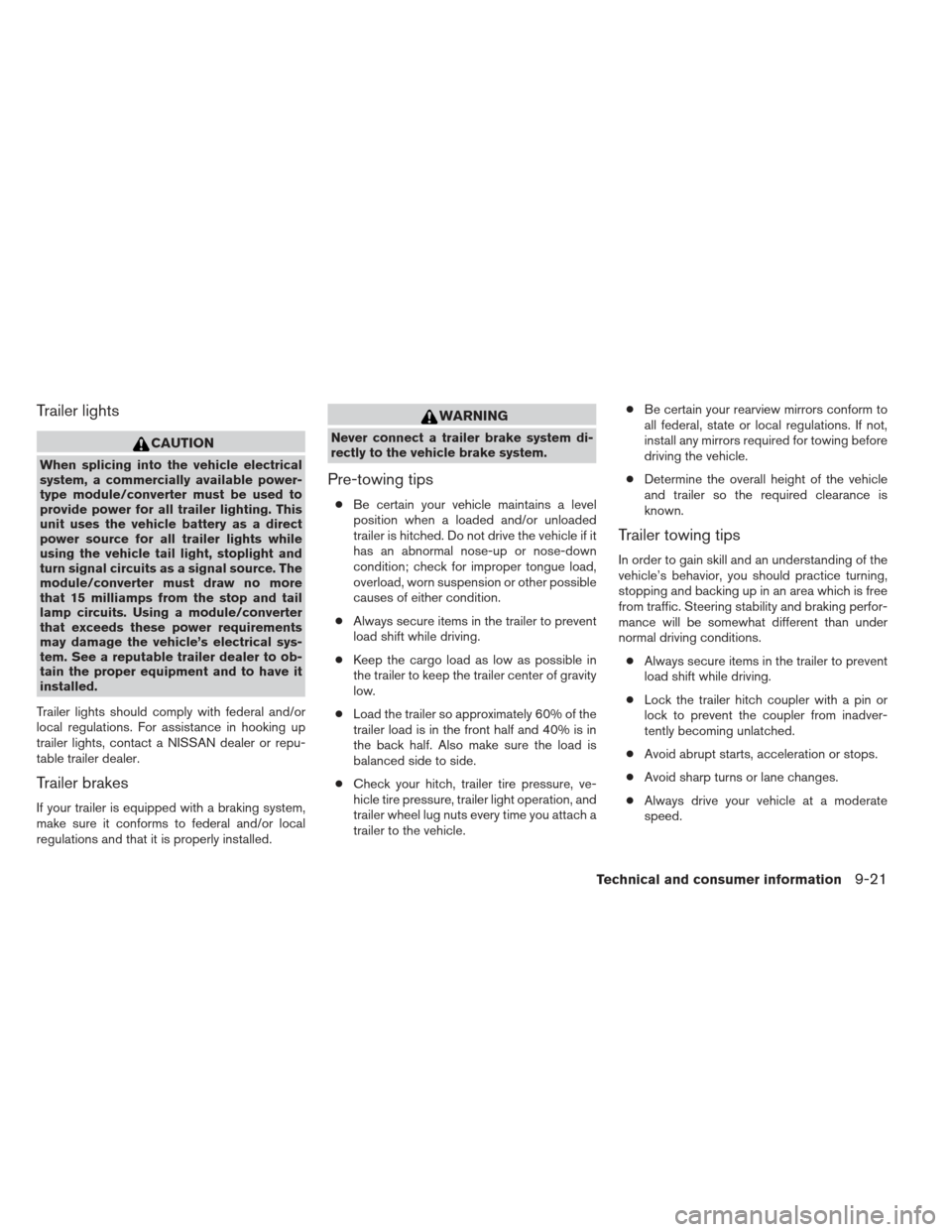
Trailer lights
CAUTION
When splicing into the vehicle electrical
system, a commercially available power-
type module/converter must be used to
provide power for all trailer lighting. This
unit uses the vehicle battery as a direct
power source for all trailer lights while
using the vehicle tail light, stoplight and
turn signal circuits as a signal source. The
module/converter must draw no more
that 15 milliamps from the stop and tail
lamp circuits. Using a module/converter
that exceeds these power requirements
may damage the vehicle’s electrical sys-
tem. See a reputable trailer dealer to ob-
tain the proper equipment and to have it
installed.
Trailer lights should comply with federal and/or
local regulations. For assistance in hooking up
trailer lights, contact a NISSAN dealer or repu-
table trailer dealer.
Trailer brakes
If your trailer is equipped with a braking system,
make sure it conforms to federal and/or local
regulations and that it is properly installed.
WARNING
Never connect a trailer brake system di-
rectly to the vehicle brake system.
Pre-towing tips
● Be certain your vehicle maintains a level
position when a loaded and/or unloaded
trailer is hitched. Do not drive the vehicle if it
has an abnormal nose-up or nose-down
condition; check for improper tongue load,
overload, worn suspension or other possible
causes of either condition.
● Always secure items in the trailer to prevent
load shift while driving.
● Keep the cargo load as low as possible in
the trailer to keep the trailer center of gravity
low.
● Load the trailer so approximately 60% of the
trailer load is in the front half and 40% is in
the back half. Also make sure the load is
balanced side to side.
● Check your hitch, trailer tire pressure, ve-
hicle tire pressure, trailer light operation, and
trailer wheel lug nuts every time you attach a
trailer to the vehicle. ●
Be certain your rearview mirrors conform to
all federal, state or local regulations. If not,
install any mirrors required for towing before
driving the vehicle.
● Determine the overall height of the vehicle
and trailer so the required clearance is
known.
Trailer towing tips
In order to gain skill and an understanding of the
vehicle’s behavior, you should practice turning,
stopping and backing up in an area which is free
from traffic. Steering stability and braking perfor-
mance will be somewhat different than under
normal driving conditions.
● Always secure items in the trailer to prevent
load shift while driving.
● Lock the trailer hitch coupler with a pin or
lock to prevent the coupler from inadver-
tently becoming unlatched.
● Avoid abrupt starts, acceleration or stops.
● Avoid sharp turns or lane changes.
● Always drive your vehicle at a moderate
speed.
Technical and consumer information9-21
Page 429 of 444
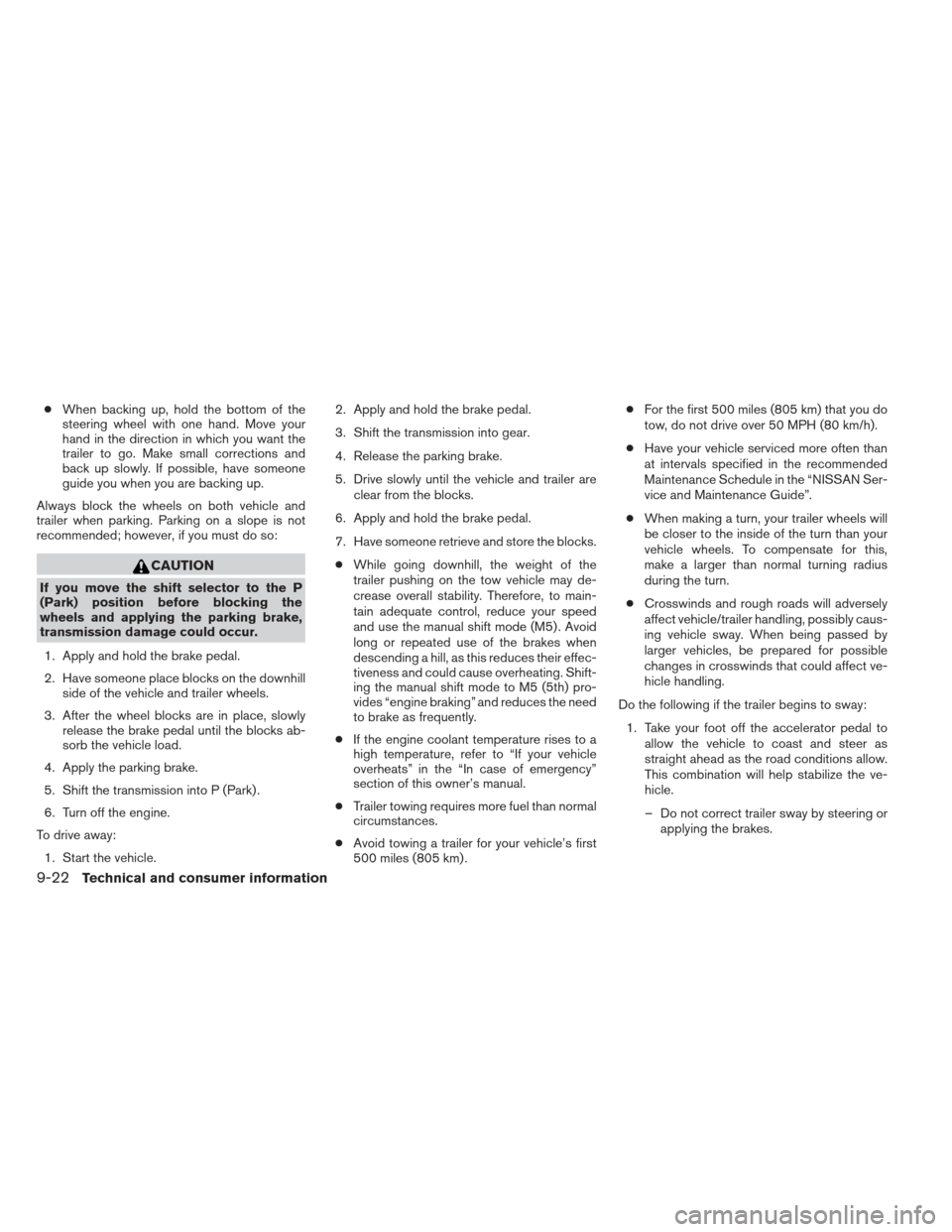
●When backing up, hold the bottom of the
steering wheel with one hand. Move your
hand in the direction in which you want the
trailer to go. Make small corrections and
back up slowly. If possible, have someone
guide you when you are backing up.
Always block the wheels on both vehicle and
trailer when parking. Parking on a slope is not
recommended; however, if you must do so:
CAUTION
If you move the shift selector to the P
(Park) position before blocking the
wheels and applying the parking brake,
transmission damage could occur.
1. Apply and hold the brake pedal.
2. Have someone place blocks on the downhill side of the vehicle and trailer wheels.
3. After the wheel blocks are in place, slowly release the brake pedal until the blocks ab-
sorb the vehicle load.
4. Apply the parking brake.
5. Shift the transmission into P (Park) .
6. Turn off the engine.
To drive away: 1. Start the vehicle. 2. Apply and hold the brake pedal.
3. Shift the transmission into gear.
4. Release the parking brake.
5. Drive slowly until the vehicle and trailer are
clear from the blocks.
6. Apply and hold the brake pedal.
7. Have someone retrieve and store the blocks. ● While going downhill, the weight of the
trailer pushing on the tow vehicle may de-
crease overall stability. Therefore, to main-
tain adequate control, reduce your speed
and use the manual shift mode (M5) . Avoid
long or repeated use of the brakes when
descending a hill, as this reduces their effec-
tiveness and could cause overheating. Shift-
ing the manual shift mode to M5 (5th) pro-
vides “engine braking” and reduces the need
to brake as frequently.
● If the engine coolant temperature rises to a
high temperature, refer to “If your vehicle
overheats” in the “In case of emergency”
section of this owner’s manual.
● Trailer towing requires more fuel than normal
circumstances.
● Avoid towing a trailer for your vehicle’s first
500 miles (805 km) . ●
For the first 500 miles (805 km) that you do
tow, do not drive over 50 MPH (80 km/h).
● Have your vehicle serviced more often than
at intervals specified in the recommended
Maintenance Schedule in the “NISSAN Ser-
vice and Maintenance Guide”.
● When making a turn, your trailer wheels will
be closer to the inside of the turn than your
vehicle wheels. To compensate for this,
make a larger than normal turning radius
during the turn.
● Crosswinds and rough roads will adversely
affect vehicle/trailer handling, possibly caus-
ing vehicle sway. When being passed by
larger vehicles, be prepared for possible
changes in crosswinds that could affect ve-
hicle handling.
Do the following if the trailer begins to sway: 1. Take your foot off the accelerator pedal to allow the vehicle to coast and steer as
straight ahead as the road conditions allow.
This combination will help stabilize the ve-
hicle.
– Do not correct trailer sway by steering or applying the brakes.
9-22Technical and consumer information
Page 436 of 444
10 Index
A
Air bag (See supplemental restraint
system) .....................1-37
Air bag system Front (See supplemental front impact
air bag system) ...............1-44
Airbagwarninglight...........1-51,2-14
Air cleaner housing filter ............8-19
Air conditioner Air conditioner service ...........4-47
Air conditioner specification label .....9-11
Air conditioner system refrigerant and
oil recommendations .............9-6
Heater and air conditioner
controls................4-42,4-45
Servicing air conditioner ..........4-47
Alarm system
(See vehicle security system) .........2-26
Anchor point locations .............1-24
Antenna....................4-103
Anti-lock brake warning light ......2-10,2-11
Anti-lock Braking System (ABS) ........5-25
Armrests .....................1-7
Audible reminders ...............2-16
Audio system ..................4-47
Bluetooth®audio..............4-98
Compact Disc (CD) changer .......4-66
Compact disc (CD) player .....4-72,4-80
FM-AM radio with compact disc
(CD) changer ................4-64
FM/AM/SAT radio with CD/DVD player . .4-76 FM/AM/SAT radio with compact disc (CD)
player ....................4-69
Audio System iPod®Player.............4-92,4-94
Audio system Radio ....................4-47
Audio System Settings ...............4-70,4-76
Audio system Steering wheel audio control switch . . .4-102
USB interface ............4-87,4-88
Autolight switch .................2-31
Automatic Automatic drive positioner .........3-28
Automatic power window switch .....2-45
Automatic transmission position indicator
light .....................2-14
Transmission shift selector lock release . .5-17
Automatic anti-glare inside mirror .......3-25
Automatic door locks ..............3-6
AUXjack ....................4-68
B
Battery ......................8-15
Chargewarninglight............2-11
Before starting the engine ...........5-11
Belt (See drive belt) ..............8-17
Block heater Engine ....................5-29
Bluetooth®audio................4-98 Bluetooth® hands-free phone
system
.................4- 104, 4-118
Boosterseats..................1-34
Brake Anti-lock Braking System (ABS) ......5-25
Brakefluid..................8-13
Brakelight(Seestoplight).........8-28
Brake system ................5-24
Brake warning light .............2-11
Brake wear indicators ........2-16,8-21
Parking brake operation ..........5-18
Self-adjusting brakes ............8-21
Brakes ......................8-21
Break-inschedule ...............5-21
Brightness/contrast button .......4-15,4-31
Brightness control Instrument panel ..............2-33
Bulb check/instrument panel ..........2-10
Bulbreplacement................8-28
C
Capacities and recommended
fuel/lubricants ...................9-2
C
argonet....................2-42
Cargo (See vehicle loading information) . . .9-12
CarphoneorCBradio............4-104
CDcareandcleaning.............4-101
CD changer (See audio system) .......4-66
CD player (See audio system) .....4-72,4-80
Check tire pressure ...............2-25
Child restraints .......1-18,1-19,1-20,1-22
Page 437 of 444
Precautions on child
restraints.........1-20,1-26,1-30,1-34
Top tether strap anchor point locations . .1-24
Child safety rear door lock ............3-6
Chimes, audible reminders ...........2-16
Cleaningexteriorandinterior...........7-2
Clock (models with navigation system) . . .4-11, 4-26
Clockset .................4-11,4-26
C.M.V.S.S. certification label ..........9-10
Cold weather driving ..............5-28
Compact disc (CD) player ........4-72,4-80
Console box ...................2-41
Continuously Variable Transmission (CVT). . .5-12 Continuously Variable Transmission
(CVT) fluid ..................8-12
Driving with Continuously Variable
Transmission (CVT) .............5-12
Transmission shift selector lock release . .5-17
Controlpanelbuttons..............4-16 Brightness/contrast button ......4-15,4-31
Enterbutton...............4-4,4-16
Setting button .............4-9,4-24
Without navigation system ..........4-4
Controls Audiocontrols(steeringwheel)......4-102
Heater and air conditioner
controls ................4-42,4-45
Coolant Capacities and recommended
fuel/lubricants .................9-2
Changing engine coolant ...........8-9
Checking engine coolant level ........8-9
Engine coolant temperature gauge .....2-5
Corrosionprotection ...............7-6
Cruise control ..................5-19 Cupholders................2-40,2-41
D
Daytime running light system (Canada only) . .2-33
Defroster switch Rear window and outside mirror defroster
switch.....................2-29
Digital Versatile Disc (DVD) player .......4-84
Dimensionsandweights.............9-8
Dimmer switch for instrument panel ......2-33
Display controls
(seecontrolpanelbuttons) ........4-4,4-16
Distance to empty .............4-7,4-21
Door locks .....................3-4
Drive belt .....................8-17
Drive positioner, Automatic ...........3-28
Driving Cold weather driving ............5-28
Driving with Continuously Variable
Transmission (CVT) .............5-12
Precautions when starting and driving ....5-2
E
Economy - fuel ..................5-22
Emission control information label .......9-10
Emission control system warranty .......9-25
Engine Before starting the engine ..........5-11
Block heater .................5-29
Capacities and recommended
fuel/lubricants .................9-2
Changing engine coolant ...........8-9 Changingengineoil.............8-11
Changing engine oil filter
..........8-12
Checking engine coolant level ........8-9
Checking engine oil level ..........8-10
Engine compartment check locations ....8-6
Engine coolant temperature gauge .....2-5
Engine cooling system ............8-7
Engine oil ...................8-10
Engine oil and oil filter recommendation . . .9-5
Engine
oil pressure warning light ......2-12
Engine oil viscosity ..............9-5
Engine serial number ............9-10
Engine specifications .............9-7
Starting the engine .............5-11
Enterbutton.................4-4,4-16
Eventdatarecorders ..............9-26
Exhaust gas (Carbon monoxide) .........5-2
Extended storage switch ............8-25
Eyeglass case ..................2-39
F
Flashers (See hazard warning flasher switch) . .6-2
Flat tire .......................6-3
Floor mat positioning aid .............7-5
Fluid Brake fluid ..................8-13
Capacities and recommended
fuel/lubricants .................9-2
Continuously Variable Transmission
(CVT)fluid..................8-12
Engine coolant .................8-7
Engine oil ...................8-10
Power steering fluid .............8-13
Windshield-washer fluid ...........8-14
10-2