Page 370 of 444
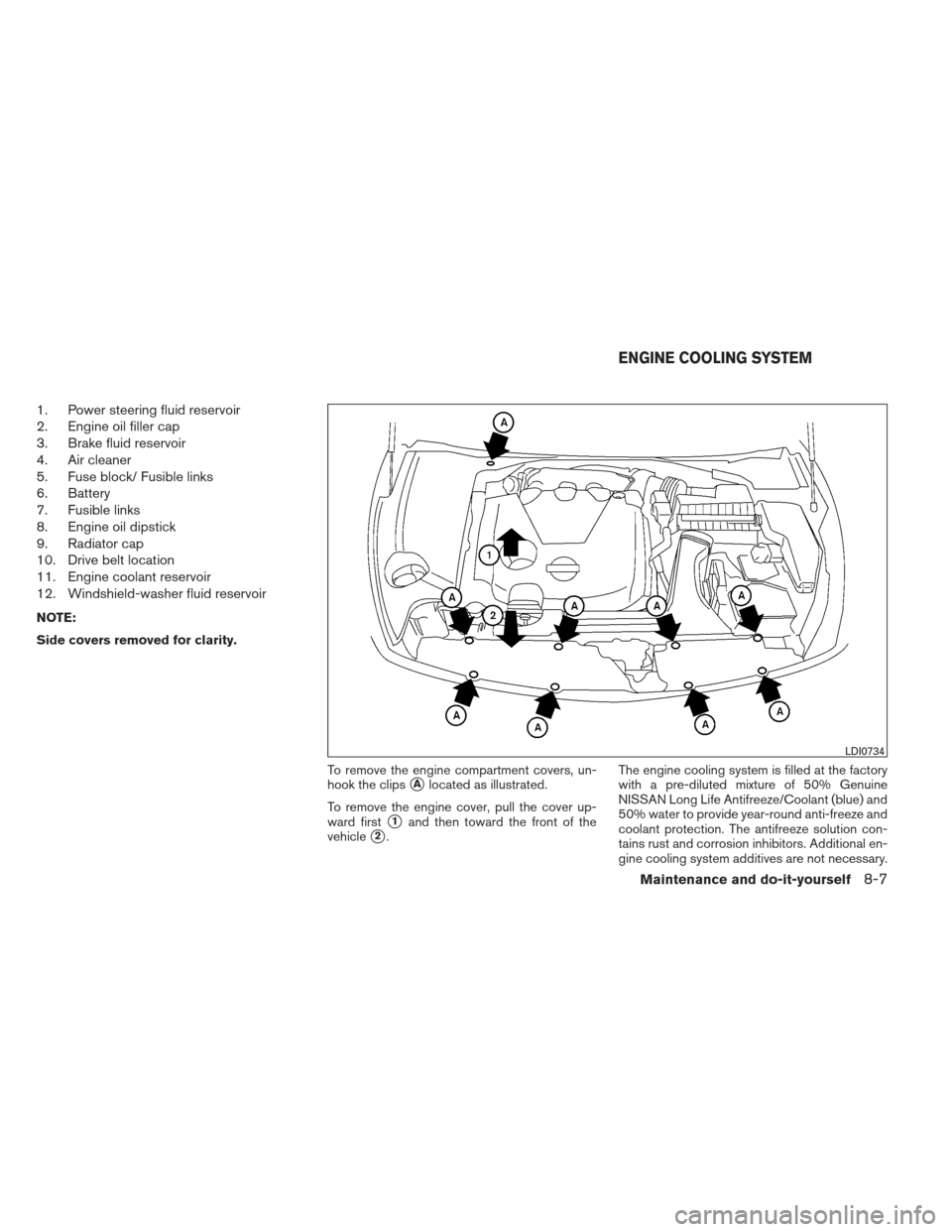
1. Power steering fluid reservoir
2. Engine oil filler cap
3. Brake fluid reservoir
4. Air cleaner
5. Fuse block/ Fusible links
6. Battery
7. Fusible links
8. Engine oil dipstick
9. Radiator cap
10. Drive belt location
11. Engine coolant reservoir
12. Windshield-washer fluid reservoir
NOTE:
Side covers removed for clarity.To remove the engine compartment covers, un-
hook the clips
�Alocated as illustrated.
To remove the engine cover, pull the cover up-
ward first
�1and then toward the front of the
vehicle
�2. The engine cooling system is filled at the factory
with a pre-diluted mixture of 50% Genuine
NISSAN Long Life Antifreeze/Coolant (blue) and
50% water to provide year-round anti-freeze and
coolant protection. The antifreeze solution con-
tains rust and corrosion inhibitors. Additional en-
gine cooling system additives are not necessary.
LDI0734
ENGINE COOLING SYSTEM
Maintenance and do-it-yourself8-7
Page 374 of 444
CHANGING ENGINE OIL
1. Park the vehicle on a level surface and applythe parking brake.
2. Start the engine and let it idle until it reaches operating temperature. 3. Turn the engine off and
wait more than
10 minutes.
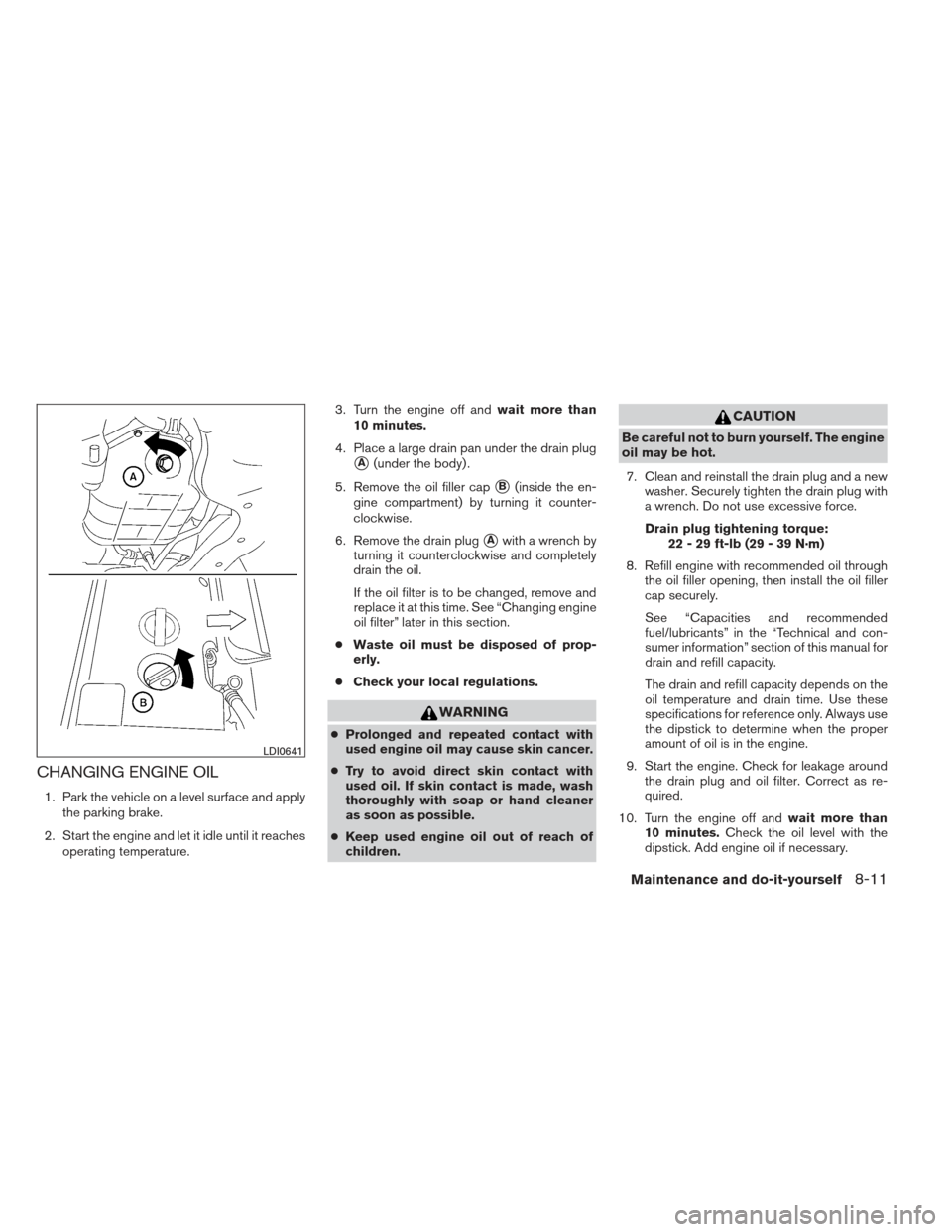
4. Place a large drain pan under the drain plug
�A(under the body) .
5. Remove the oil filler cap
�B(inside the en-
gine compartment) by turning it counter-
clockwise.
6. Remove the drain plug
�Awith a wrench by
turning it counterclockwise and completely
drain the oil.
If the oil filter is to be changed, remove and
replace it at this time. See “Changing engine
oil filter” later in this section.
● Waste oil must be disposed of prop-
erly.
● Check your local regulations.
WARNING
●Prolonged and repeated contact with
used engine oil may cause skin cancer.
● Try to avoid direct skin contact with
used oil. If skin contact is made, wash
thoroughly with soap or hand cleaner
as soon as possible.
● Keep used engine oil out of reach of
children.
CAUTION
Be careful not to burn yourself. The engine
oil may be hot.
7. Clean and reinstall the drain plug and a new washer. Securely tighten the drain plug with
a wrench. Do not use excessive force.
Drain plug tightening torque: 22 - 29 ft-lb (29 - 39 N·m)
8. Refill engine with recommended oil through the oil filler opening, then install the oil filler
cap securely.
See “Capacities and recommended
fuel/lubricants” in the “Technical and con-
sumer information” section of this manual for
drain and refill capacity.
The drain and refill capacity depends on the
oil temperature and drain time. Use these
specifications for reference only. Always use
the dipstick to determine when the proper
amount of oil is in the engine.
9. Start the engine. Check for leakage around the drain plug and oil filter. Correct as re-
quired.
10. Turn the engine off and wait more than
10 minutes. Check the oil level with the
dipstick. Add engine oil if necessary.
LDI0641
Maintenance and do-it-yourself8-11
Page 385 of 444
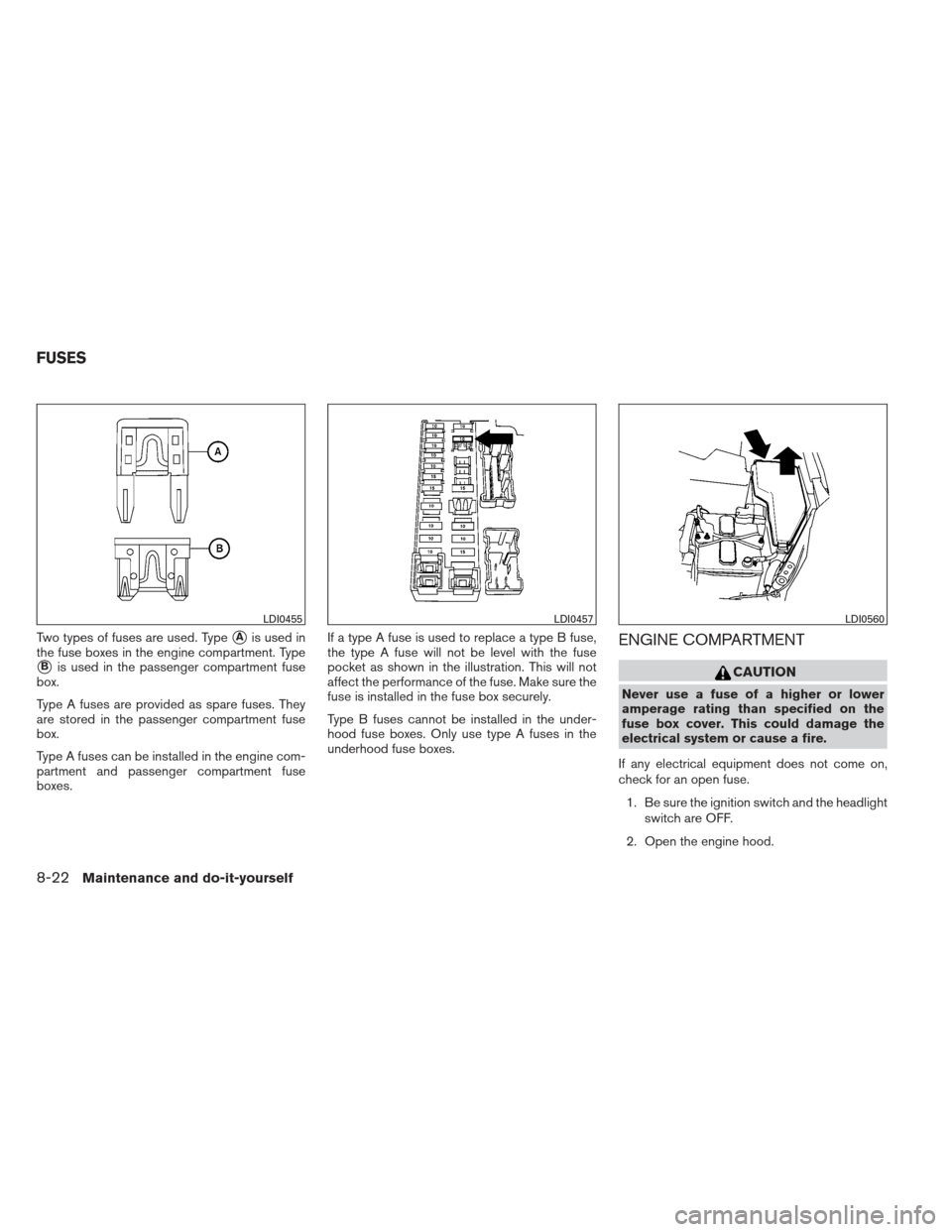
Two types of fuses are used. Type�Ais used in
the fuse boxes in the engine compartment. Type
�Bis used in the passenger compartment fuse
box.
Type A fuses are provided as spare fuses. They
are stored in the passenger compartment fuse
box.
Type A fuses can be installed in the engine com-
partment and passenger compartment fuse
boxes. If a type A fuse is used to replace a type B fuse,
the type A fuse will not be level with the fuse
pocket as shown in the illustration. This will not
affect the performance of the fuse. Make sure the
fuse is installed in the fuse box securely.
Type B fuses cannot be installed in the under-
hood fuse boxes. Only use type A fuses in the
underhood fuse boxes.
ENGINE COMPARTMENT
CAUTION
Never use a fuse of a higher or lower
amperage rating than specified on the
fuse box cover. This could damage the
electrical system or cause a fire.
If any electrical equipment does not come on,
check for an open fuse. 1. Be sure the ignition switch and the headlight switch are OFF.
2. Open the engine hood.
LDI0455LDI0457LDI0560
FUSES
8-22Maintenance and do-it-yourself
Page 437 of 444
Precautions on child
restraints.........1-20,1-26,1-30,1-34
Top tether strap anchor point locations . .1-24
Child safety rear door lock ............3-6
Chimes, audible reminders ...........2-16
Cleaningexteriorandinterior...........7-2
Clock (models with navigation system) . . .4-11, 4-26
Clockset .................4-11,4-26
C.M.V.S.S. certification label ..........9-10
Cold weather driving ..............5-28
Compact disc (CD) player ........4-72,4-80
Console box ...................2-41
Continuously Variable Transmission (CVT). . .5-12 Continuously Variable Transmission
(CVT) fluid ..................8-12
Driving with Continuously Variable
Transmission (CVT) .............5-12
Transmission shift selector lock release . .5-17
Controlpanelbuttons..............4-16 Brightness/contrast button ......4-15,4-31
Enterbutton...............4-4,4-16
Setting button .............4-9,4-24
Without navigation system ..........4-4
Controls Audiocontrols(steeringwheel)......4-102
Heater and air conditioner
controls ................4-42,4-45
Coolant Capacities and recommended
fuel/lubricants .................9-2
Changing engine coolant ...........8-9
Checking engine coolant level ........8-9
Engine coolant temperature gauge .....2-5
Corrosionprotection ...............7-6
Cruise control ..................5-19 Cupholders................2-40,2-41
D
Daytime running light system (Canada only) . .2-33
Defroster switch Rear window and outside mirror defroster
switch.....................2-29
Digital Versatile Disc (DVD) player .......4-84
Dimensionsandweights.............9-8
Dimmer switch for instrument panel ......2-33
Display controls
(seecontrolpanelbuttons) ........4-4,4-16
Distance to empty .............4-7,4-21
Door locks .....................3-4
Drive belt .....................8-17
Drive positioner, Automatic ...........3-28
Driving Cold weather driving ............5-28
Driving with Continuously Variable
Transmission (CVT) .............5-12
Precautions when starting and driving ....5-2
E
Economy - fuel ..................5-22
Emission control information label .......9-10
Emission control system warranty .......9-25
Engine Before starting the engine ..........5-11
Block heater .................5-29
Capacities and recommended
fuel/lubricants .................9-2
Changing engine coolant ...........8-9 Changingengineoil.............8-11
Changing engine oil filter
..........8-12
Checking engine coolant level ........8-9
Checking engine oil level ..........8-10
Engine compartment check locations ....8-6
Engine coolant temperature gauge .....2-5
Engine cooling system ............8-7
Engine oil ...................8-10
Engine oil and oil filter recommendation . . .9-5
Engine
oil pressure warning light ......2-12
Engine oil viscosity ..............9-5
Engine serial number ............9-10
Engine specifications .............9-7
Starting the engine .............5-11
Enterbutton.................4-4,4-16
Eventdatarecorders ..............9-26
Exhaust gas (Carbon monoxide) .........5-2
Extended storage switch ............8-25
Eyeglass case ..................2-39
F
Flashers (See hazard warning flasher switch) . .6-2
Flat tire .......................6-3
Floor mat positioning aid .............7-5
Fluid Brake fluid ..................8-13
Capacities and recommended
fuel/lubricants .................9-2
Continuously Variable Transmission
(CVT)fluid..................8-12
Engine coolant .................8-7
Engine oil ...................8-10
Power steering fluid .............8-13
Windshield-washer fluid ...........8-14
10-2