Page 351 of 402
PASSENGER COMPARTMENT
CAUTION
Never use a fuse of a higher or lower
amperage rating than that specified on
the fuse box cover. This could damage
the electrical system or cause a fire.
If any electrical equipment does not operate,
check for an open fuse.
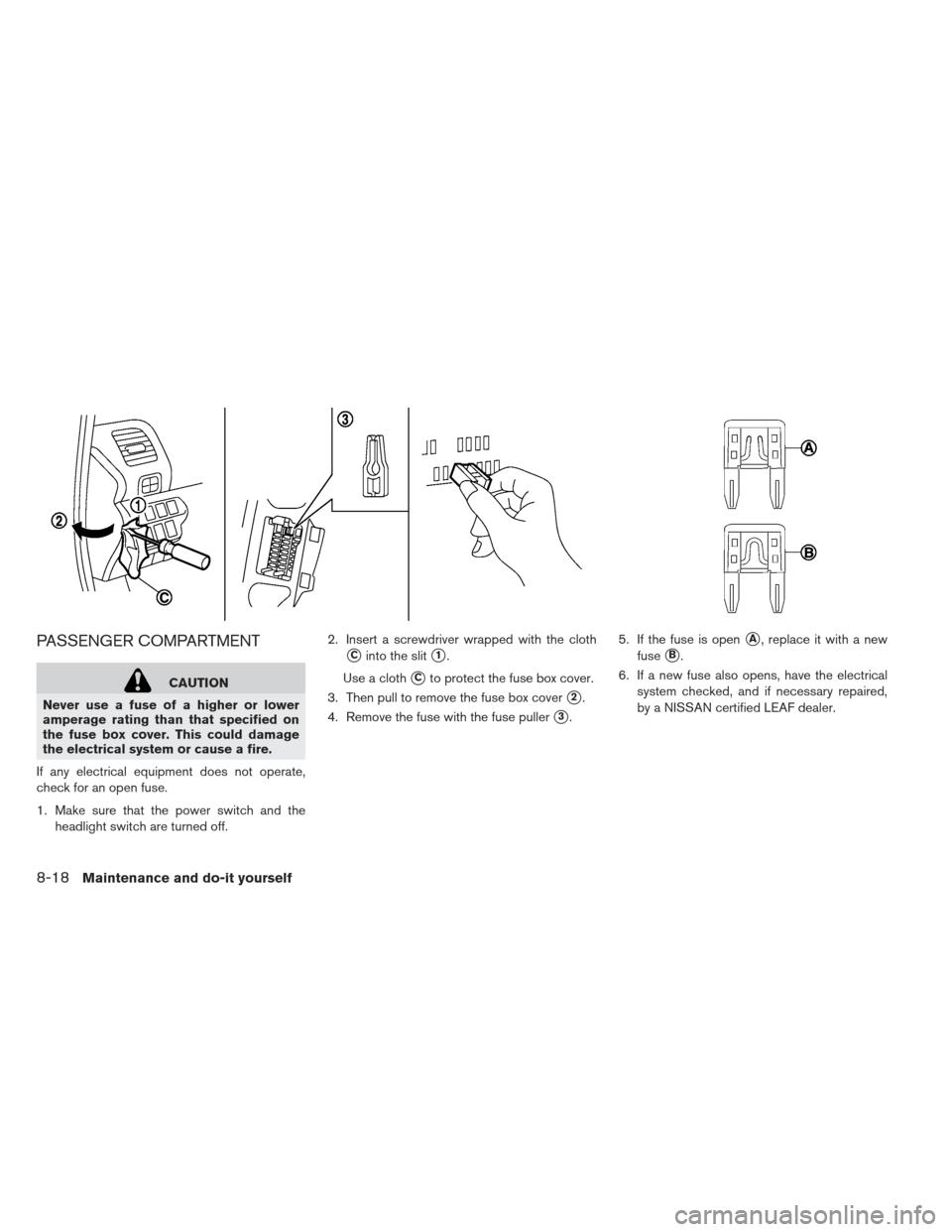
1. Make sure that the power switch and the headlight switch are turned off. 2. Insert a screwdriver wrapped with the cloth
�Cinto the slit�1.
Use a cloth
�Cto protect the fuse box cover.
3. Then pull to remove the fuse box cover
�2.
4. Remove the fuse with the fuse puller
�3. 5. If the fuse is open
�A, replace it with a new
fuse
�B.
6. If a new fuse also opens, have the electrical system checked, and if necessary repaired,
by a NISSAN certified LEAF dealer.
8-18Maintenance and do-it yourself
Page 354 of 402
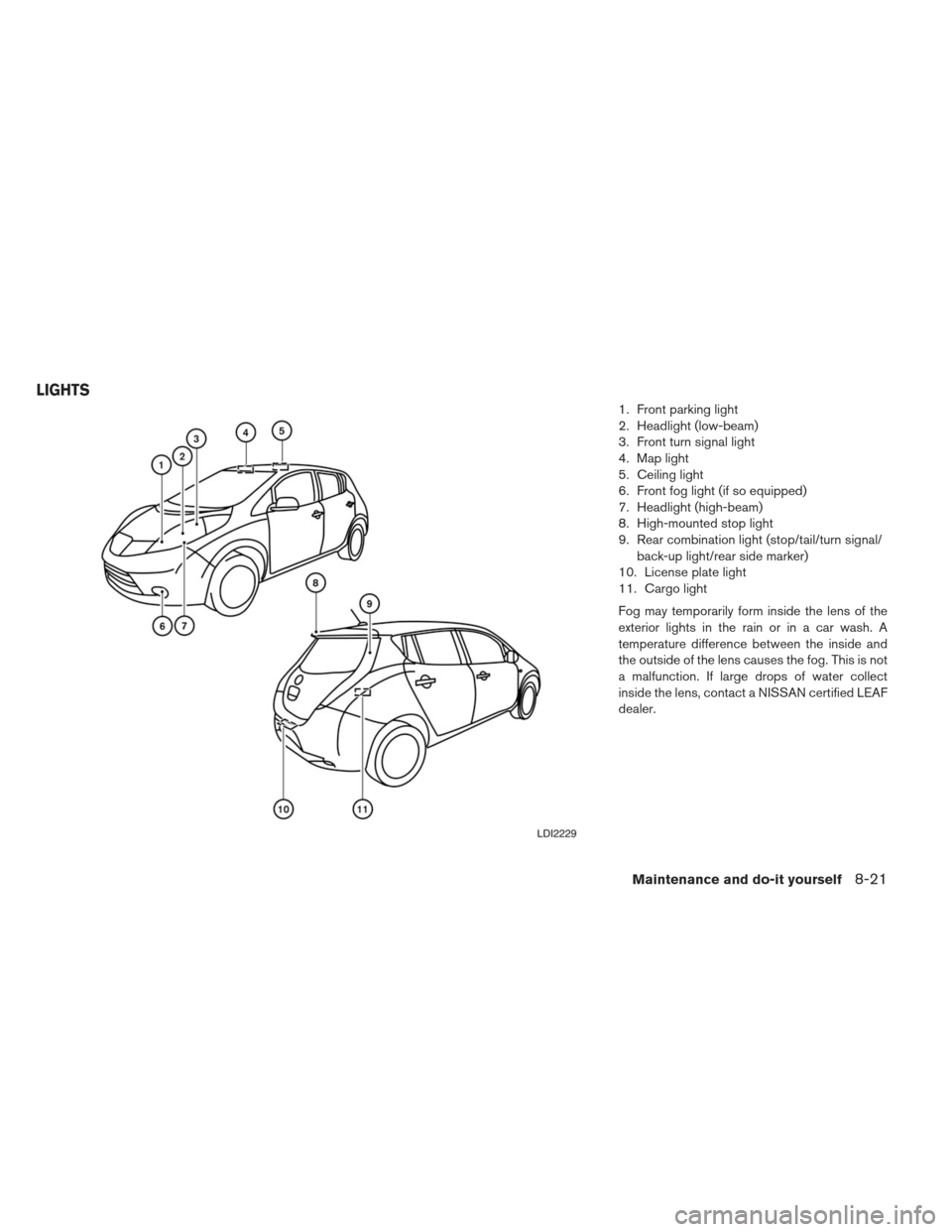
1. Front parking light
2. Headlight (low-beam)
3. Front turn signal light
4. Map light
5. Ceiling light
6. Front fog light (if so equipped)
7. Headlight (high-beam)
8. High-mounted stop light
9. Rear combination light (stop/tail/turn signal/back-up light/rear side marker)
10. License plate light
11. Cargo light
Fog may temporarily form inside the lens of the
exterior lights in the rain or in a car wash. A
temperature difference between the inside and
the outside of the lens causes the fog. This is not
a malfunction. If large drops of water collect
inside the lens, contact a NISSAN certified LEAF
dealer.
LIGHTS
Maintenance and do-it yourself8-21
Page 355 of 402
HEADLIGHTS
Replacing
Halogen headlight (high-beam):
The headlight high-beam is a semi-sealed beam
type that uses a replaceable headlight (halogen)
bulb.
CAUTION
Do not leave the bulb out of the head- light reflector for a long period of time.
Dust, moisture, smoke, etc. entering
the headlight body may affect bulb
performance.
High-pressure halogen gas is sealed inside the halogen bulb. The bulb may
break if the glass envelope is
scratched or the bulb is dropped.
Only touch the base when handling the bulb. Never touch the glass envelope.
Touching the glass envelope could sig-
nificantly affect bulb life and/or head-
light performance.
Aiming is not necessary after replac- ing the bulb. When aiming adjustment
is necessary, contact a NISSAN certi-
fied LEAF dealer.
Use the same number and wattage as originally
installed as shown in the chart. Disconnect the battery negative cable before
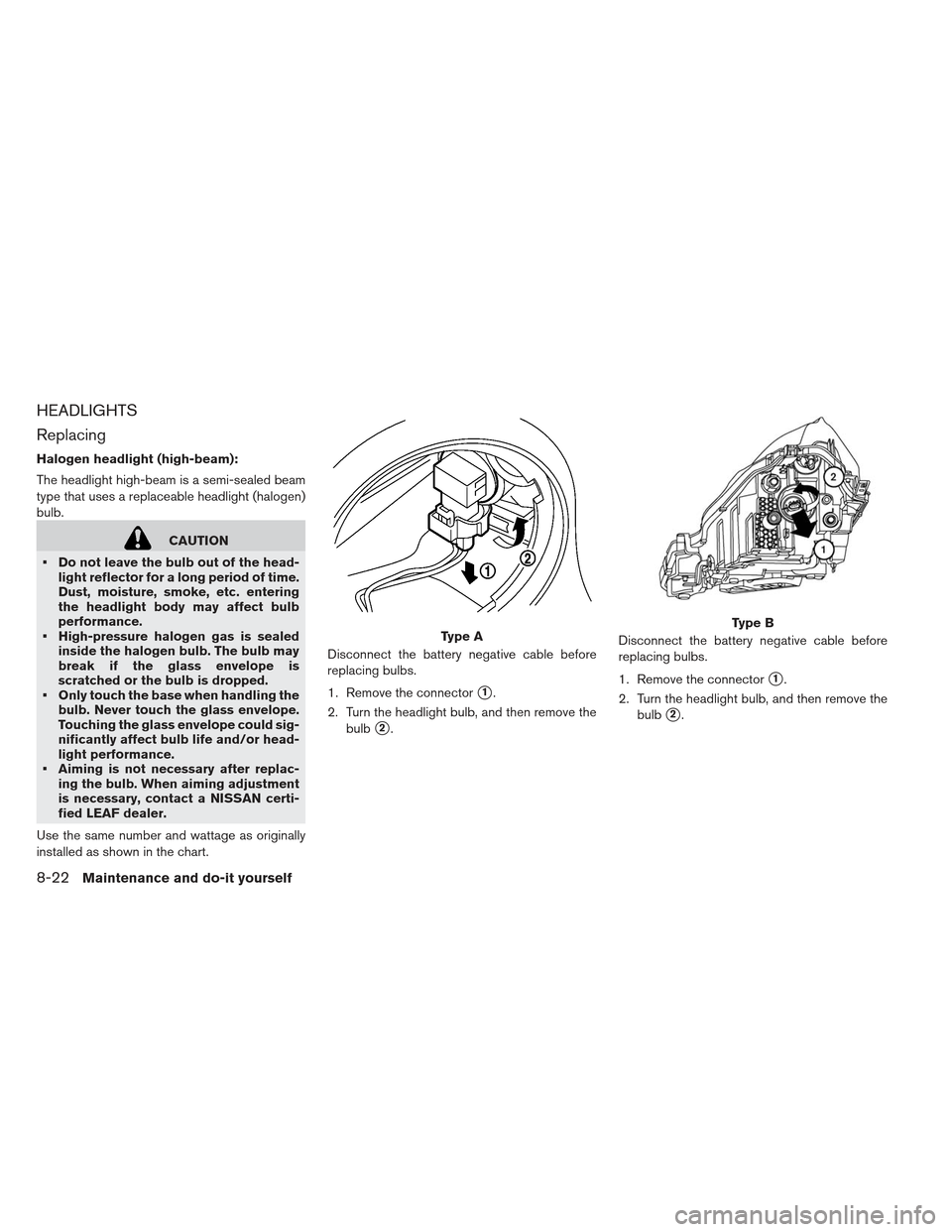
replacing bulbs.
1. Remove the connector
�1.
2. Turn the headlight bulb, and then remove the bulb
�2. Disconnect the battery negative cable before
replacing bulbs.
1. Remove the connector
�1.
2. Turn the headlight bulb, and then remove the bulb
�2.
Type AType B
8-22Maintenance and do-it yourself
Page 356 of 402
EXTERIOR AND INTERIOR LIGHTS
ItemWattage (W)Bulb No.
Headlight low beams (Type A)* LED—
Headlight high beams (Halogen) (Type A) 65H9
Headlight (Type B) 60/55H13
Front turn signal light 273457NAK
Front fog light (if so equipped)* 55H11
Front park light 5W5W
Rear combination light Turn signal 21WY21W
Stop/tail* LED—
Back-up 16W16W
License plate light* 5W5W
Map light LED—
High-mounted stop light* LED—
Ceiling light 8—
Cargo light 5—
*: Contact a NISSAN certified LEAF dealer for replacement.
NOTE: Always check with the Parts Department at a NISSAN certified LEAF dealer for the latest
information about parts.
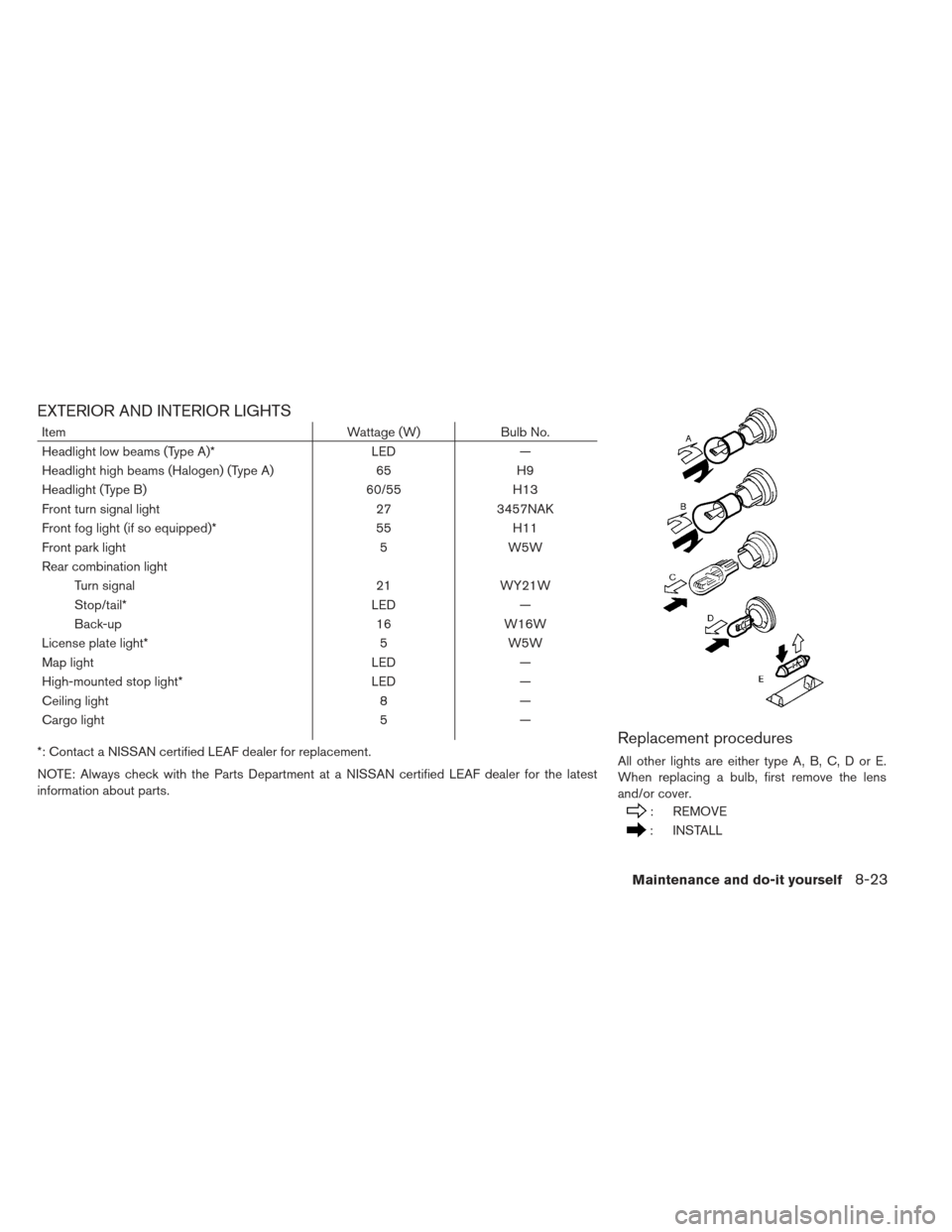
Replacement procedures
All other lights are either type A, B, C, D or E.
When replacing a bulb, first remove the lens
and/or cover.
: REMOVE
: INSTALL
Maintenance and do-it yourself8-23
Page 357 of 402
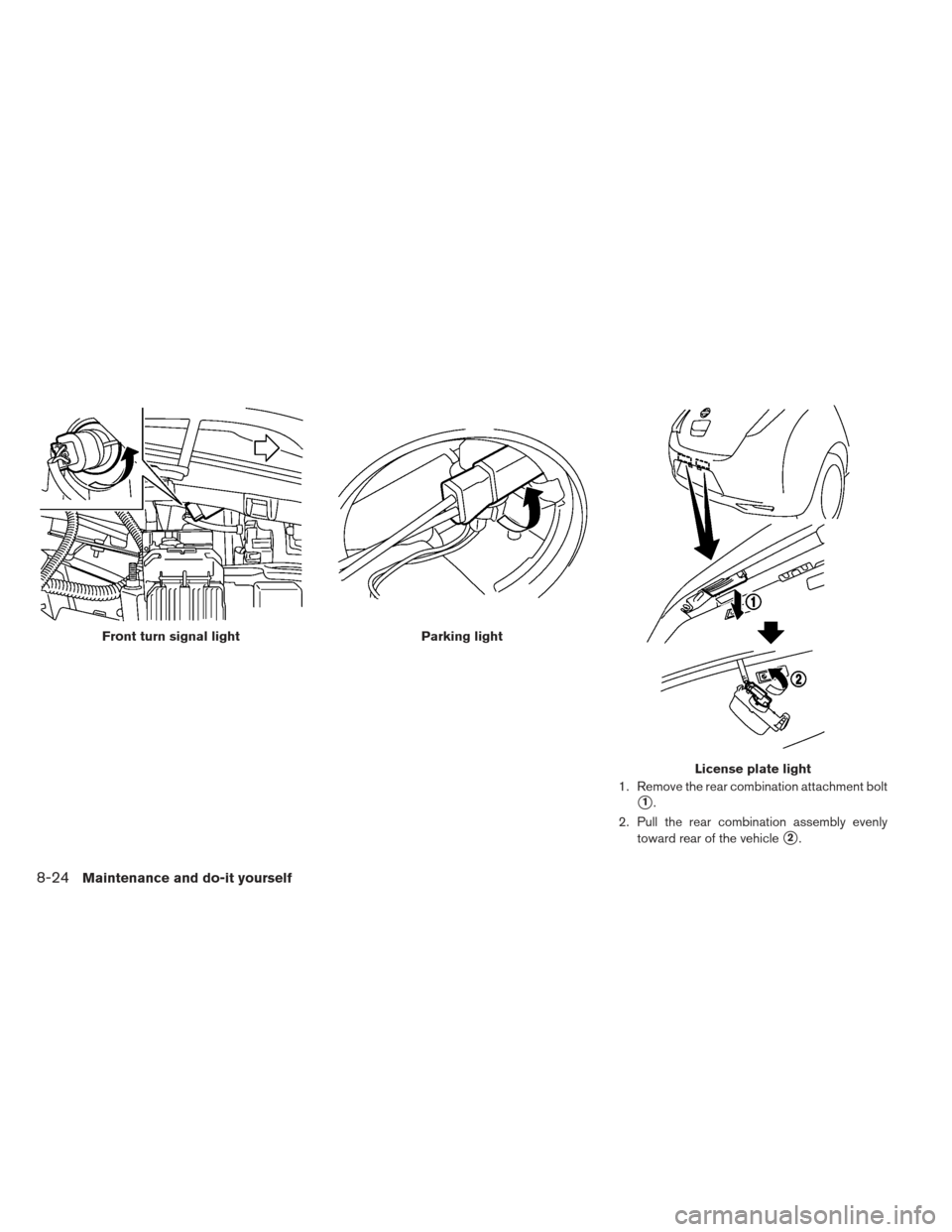
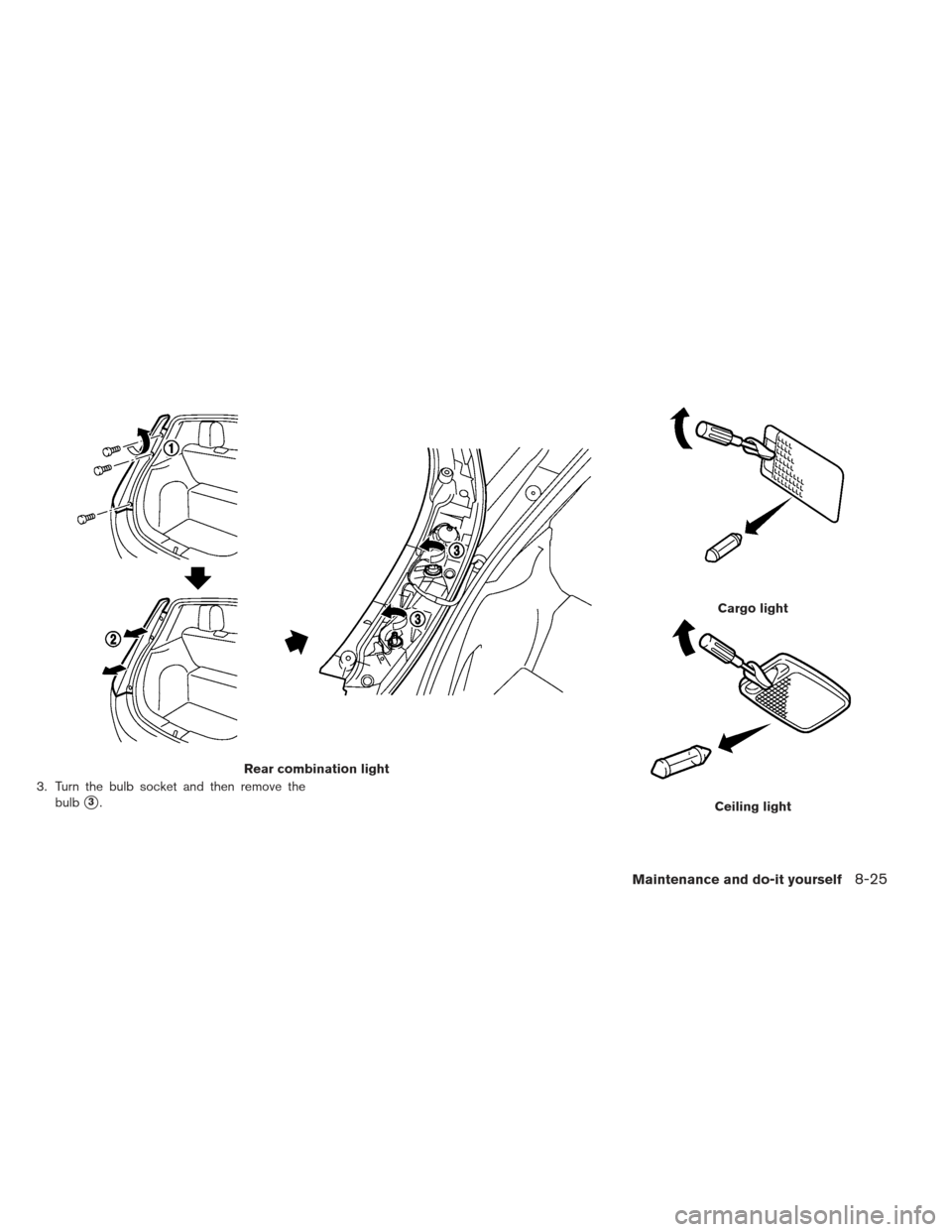
1. Remove the rear combination attachment bolt
�1.
2. Pull the rear combination assembly evenly toward rear of the vehicle
�2.
Front turn signal lightParking light
License plate light
8-24Maintenance and do-it yourself
Page 358 of 402
3. Turn the bulb socket and then remove thebulb
�3.
Rear combination light
Cargo light
Ceiling light
Maintenance and do-it yourself8-25
Page 359 of 402
If you have a flat tire, see�Flat tire�in the�In
case of emergency� section.
TIRE PRESSURE
Tire Pressure Monitoring System
(TPMS)
This vehicle is equipped with the Tire Pressure
Monitoring System (TPMS) . It monitors tire pres-
sure of all tires. When the low tire pressure warn-
ing light is lit, and the CHECK TIRE PRESSURE
warning appears on the dot matrix liquid crystal
display, one or more of your tires is significantly
under-inflated.
The TPMS will activate only when the vehicle is
driven at speeds above 16 MPH (25 km/h) . Also,
this system may not detect a sudden drop in tire
pressure (for example a flat tire while driving) .
For more details, see�Low tire pressure warning
light� in the �Instruments and controls� section,
�Tire Pressure Monitoring System (TPMS)� in the
�Starting and driving� section and�Tire Pressure
Monitoring System (TPMS)� in the�In case of
emergency� section.
Tire inflation pressure
Check the pressure of the tires often and always
prior to long distance trips. The recommended tire pressure specifications are shown on the Tire
and Loading Information label under the “Cold
Tire Pressure” heading. The Tire and Loading
Information label is affixed to the driver side cen-
ter pillar. Tire pressures should be checked regu-
larly because:
Most tires naturally lose air over time.
Tires can lose air suddenly when driven over
potholes or other objects or if the vehicle strikes
a curb while parking.
The tire pressures should be checked when the
tires are cold. The tires are considered COLD
after the vehicle has been parked for 3 or more
hours, or driven less than 1 mile (1.6 km) at
moderate speeds.
The TPMS with Easy Fill Tire Alert also provides
visual and audible signals outside the vehicle for
inflating the tires to the recommended COLD tire
pressure. (See �TPMS with Easy Fill Tire Alert� in
the �Starting and driving� section.)
Incorrect tire pressure, including under in-
flation, may adversely affect tire life and
vehicle handling.
WARNING
Improperly inflated tires can fail sud- denly and cause an accident.
The Gross Vehicle Weight rating (GVWR) is located on the F.M.V.S.S.
certification label. The vehicle weight
capacity is indicated on the Tire and
Loading Information label. Do not load
your vehicle beyond this capacity.
Overloading your vehicle may result in
reduced tire life, unsafe operating con-
ditions due to premature tire failure, or
unfavorable handling characteristics
and could also lead to a serious acci-
dent. Loading beyond the specified ca-
pacity may also result in failure of
other vehicle components.
Before taking a long trip, or whenever you heavily load your vehicle, use a tire
pressure gauge to ensure that the tire
pressures are at the specified level.
For additional information regarding tires, refer to “Important Tire Safety
Information” (US) or “Tire Safety Infor-
mation” (Canada) in the Warranty In-
formation Booklet.
WHEELS AND TIRES
8-26Maintenance and do-it yourself
Page 366 of 402
The original tires have built-in treadwear indicators. When wear indicators
are visible, the tire(s) should be re-
placed.
Tires degrade with age and use. Have tires, over 6 years old checked by a
qualified technician, because some
tire damage may not be obvious. Re-
place the tires as necessary to prevent
tire failure and possible personal in-
jury.
For additional information regarding tires, refer to “Important Tire Safety
Information” (US) or “Tire Safety Infor-
mation” (Canada) in the Warranty In-
formation Booklet.
Replacing wheels and tires
When replacing a tire, use the same size, tread
design, speed rating and load carrying capacity
as originally equipped. See �Specifications�in
the �Technical and consumer information� sec-
tion for recommended types and sizes of tires
and wheels.
WARNING
The use of tires other than those rec- ommended or the mixed use of tires of
different brands, construction (bias,
bias-belted or radial) , or tread patterns
can adversely affect the ride, braking,
handling, ground clearance, body-to-
tire clearance, tire chain clearance,
speedometer calibration, headlight
aim and bumper height. Some of these
effects may lead to accidents and
could result in serious personal injury.
If your vehicle was originally equipped with 4 tires that were the same size
and you are only replacing 2 of the 4
tires, install the new tires on the rear
axle. Placing new tires on the front
axle may cause loss of vehicle control
in some driving conditions and cause
an accident and personal injury. If the wheels are changed for any rea-
son, always replace with wheels which
have the same off-set dimension.
Wheels of a different off-set could
cause premature tire wear, degrade
vehicle handling characteristics
and/or interference with the brake
discs. Such interference can lead to
decreased braking efficiency and/or
early brake pad/shoe wear. See
�Wheels and tires� in the�Technical
and consumer information
�section of
this manual for wheel off-set dimen-
sions.
When a wheel is replaced, the TPMS will not function and the low tire pres-
sure warning light will flash for ap-
proximately 1 minute. The light will re-
main on after 1 minute. Contact your
NISSAN certified LEAF dealer as soon
as possible for tire replacement
and/or system resetting.
Replacing tires with those not origi- nally specified by NISSAN could affect
the proper operation of the TPMS.
Do not install a damaged or deformed wheel or tire even if it has been re-
paired. Such wheels or tires could
have structural damage and could fail
without warning.
Maintenance and do-it yourself8-33