Page 320 of 402
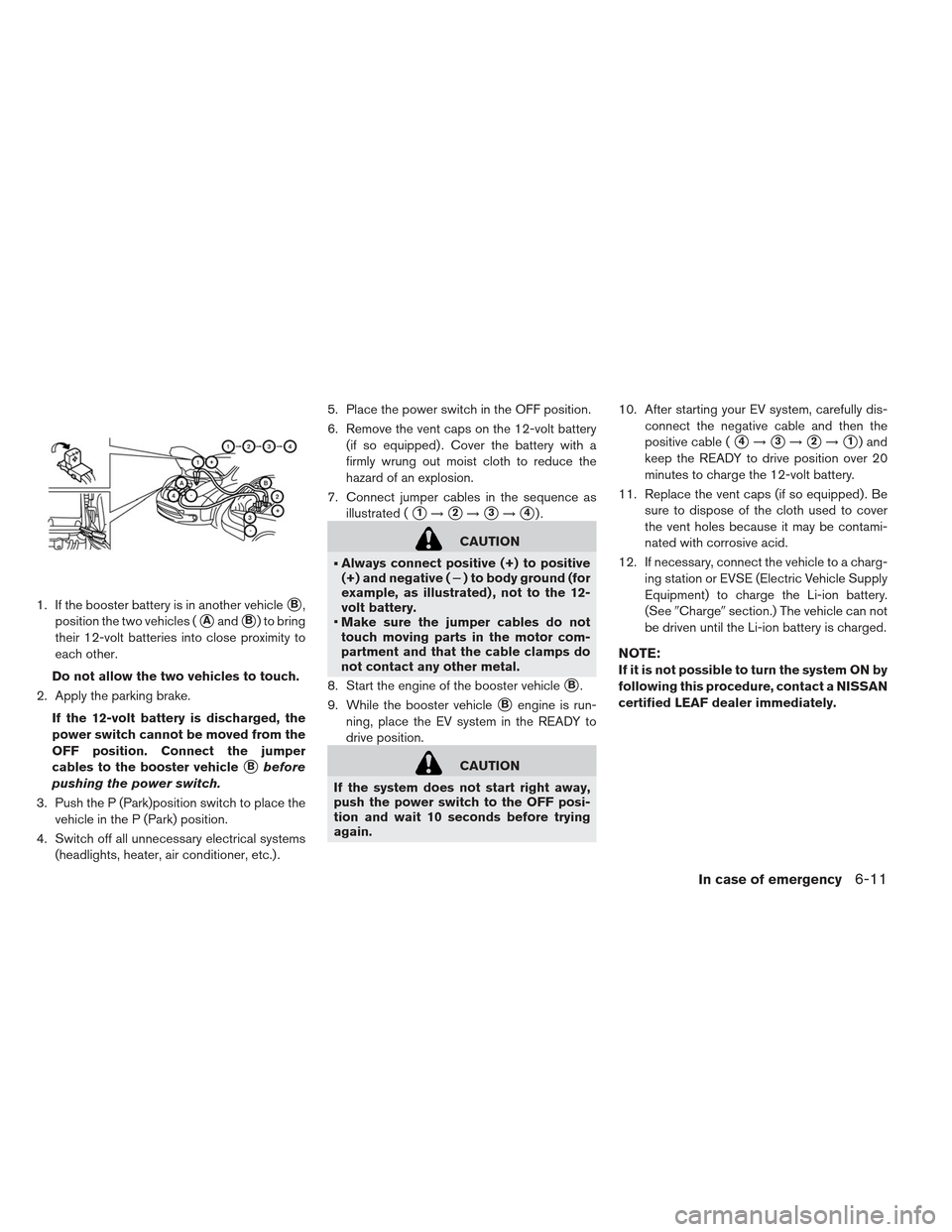
1. If the booster battery is in another vehicle�B,
position the two vehicles (
�Aand�B) to bring
their 12-volt batteries into close proximity to
each other.
Do not allow the two vehicles to touch.
2. Apply the parking brake.
If the 12-volt battery is discharged, the
power switch cannot be moved from the
OFF position. Connect the jumper
cables to the booster vehicle
�Bbefore
pushing the power switch.
3. Push the P (Park)position switch to place the vehicle in the P (Park) position.
4. Switch off all unnecessary electrical systems (headlights, heater, air conditioner, etc.) . 5. Place the power switch in the OFF position.
6. Remove the vent caps on the 12-volt battery
(if so equipped) . Cover the battery with a
firmly wrung out moist cloth to reduce the
hazard of an explosion.
7. Connect jumper cables in the sequence as illustrated (
�1→�2→�3→�4).
CAUTION
Always connect positive (+) to positive
(+) and negative (�) to body ground (for
example, as illustrated) , not to the 12-
volt battery.
Make sure the jumper cables do not
touch moving parts in the motor com-
partment and that the cable clamps do
not contact any other metal.
8. Start the engine of the booster vehicle
�B.
9. While the booster vehicle
�Bengine is run-
ning, place the EV system in the READY to
drive position.
CAUTION
If the system does not start right away,
push the power switch to the OFF posi-
tion and wait 10 seconds before trying
again. 10. After starting your EV system, carefully dis-
connect the negative cable and then the
positive cable (
�4→�3→�2→�1) and
keep the READY to drive position over 20
minutes to charge the 12-volt battery.
11. Replace the vent caps (if so equipped) . Be sure to dispose of the cloth used to cover
the vent holes because it may be contami-
nated with corrosive acid.
12. If necessary, connect the vehicle to a charg- ing station or EVSE (Electric Vehicle Supply
Equipment) to charge the Li-ion battery.
(See �Charge� section.) The vehicle can not
be driven until the Li-ion battery is charged.
NOTE:
If it is not possible to turn the system ON by
following this procedure, contact a NISSAN
certified LEAF dealer immediately.
In case of emergency6-11
Page 337 of 402
Seat belts:Check that all parts of the seat belt
system (for example, buckles, anchors, adjusters
and retractors) operate properly and smoothly,
and are installed securely. Check the belt web-
bing for cuts, fraying, wear or damage.
Steering wheel: Check for changes in the
steering conditions, such as excessive free play,
hard steering or strange noises.
Warning lights and chimes: Make sure that all
warning lights and chimes are operating properly.
Windshield defroster: Check that the air emits
from the defroster outlets properly and in suffi-
cient quantity when operating the heater or air
conditioner.
Windshield wiper and washer*: Check that
the wipers and washers operate properly and
that the wipers do not streak.
Under hood and vehicle
The maintenance items listed here should be
checked periodically.
12-volt battery (for serviceable battery)*:
Check the fluid level in each cell.
It should be between the MAX and MIN lines.
Vehicles operated in high temperatures or under severe conditions require frequent checks of the
12-volt battery fluid level.
NOTE:
Care should be taken to avoid situations
that can lead to potential battery discharge
and potential no-start conditions such as:
1. Installation or extended use of electronic ac-
cessories that consume battery power when
the engine is not running (Phone chargers,
GPS, DVD players, etc.)
2. Vehicle is not driven regularly and/or only driven short distances.
In these cases, the battery may need to be
charged to maintain battery health.
Brake fluid level*: Make sure that the brake
fluid level is between the MAX and MIN lines on
the reservoir.
Coolant level*: Check the coolant level when
the motor compartment is cold.
Fluid leaks: Check under the vehicle for water
or other fluid leaks after the vehicle has been
parked for a short period of time. Water dripping
from the air conditioner after use is normal. If you
notice any leaks, check for the cause and have it
corrected immediately. Radiator and hoses:
Check the front of the
radiator and clean off any dirt, insects, leaves,
etc., that may have accumulated. Make sure that
the hoses have no cracks, deformation, rot or
loose connections.
Underbody: The underbody is frequently ex-
posed to corrosive substances such as those
used on icy roads or to control dust. It is very
important to remove these substances, other-
wise rust will form on the floor pan and frame. At
the end of winter, the underbody should be thor-
oughly flushed with plain water, being careful to
clean those areas where mud and dirt may accu-
mulate. For additional information, see �Cleaning
exterior� in the�Appearance and care� section.
Windshield washer fluid*: Check that there is
an adequate amount of fluid in the reservoir.
8-4Maintenance and do-it yourself
Page 344 of 402
To fill the window washer fluid reservoir, lift the
cap and pour the window washer fluid into the
reservoir opening.
Add a washer solvent to the washer for better
cleaning. In the winter season, add a windshield
washer antifreeze. Follow the manufacturer’s in-
structions for the mixture ratio.
Fill the window washer fluid reservoir periodically.
Refill the reservoir more frequently when driving
conditions require an increased amount of win-
dow washer fluid.
Recommended fluid:
Genuine NISSAN Windshield Washer Concen-
trate Cleaner & Antifreeze or equivalent
CAUTION
Do not substitute anti-freeze coolant for window washer solution. This may
result in damage to the paint.
Do not fill the window washer reservoir tank with washer fluid concentrates at
full strength. Some methyl alcohol
based washer fluid concentrates may
permanently stain the grille if spilled
while filling the window washer reser-
voir tank. Pre-mix washer fluid concentrates
with water to the manufacturer’s rec-
ommended levels before pouring the
fluid into the window washer reservoir
tank. Do not use the window washer
reservoir tank to mix the washer fluid
concentrate and water. Keep the 12-volt battery surface clean and dry.
Clean the 12-volt battery with a solution of
baking soda and water.
Make certain the terminal connections are clean and securely tightened.
NOTE:
Care should be taken to avoid situations
that can lead to potential battery discharge
and potential no-start conditions such as:
1. Installation or extended use of electronic ac- cessories that consume battery power when
the engine is not running (Phone chargers,
GPS, DVD players, etc.)
2. Vehicle is not driven regularly and/or only driven short distances.
In these cases, the battery may need to be
charged to maintain battery health.
WARNING
Do not expose the 12-volt battery to flames or electrical sparks. Hydrogen
gas generated by the 12-volt battery is
explosive. Do not allow 12-volt battery
fluid to contact your skin, eyes, fabrics
or painted surfaces. After touching a
12-volt battery or 12-volt battery cap,
12-VOLT BATTERY
Maintenance and do-it yourself8-11