2013 NISSAN GT-R Tire
[x] Cancel search: TirePage 33 of 346
GTR-26GT-R Overview
For the first 3,000-6,000 miles (5,000-
10,000 km) of the vehicle’s service life,
and for the first 3,000-6,000 miles (5,000-
10,000 km) after a brake replacement, the
brake pad to brake rotor clearance is very
small. When parking, apply the parking
brake and move the shift lever to the
&Pposition. Idle the engine for more than 20
seconds without depressing the brake
pedal. This allows the brake pads to move
away from the rotor so the pad does not
contact the rotor.
Additionally, the brakes must be dry before
parking the vehicle after driving on wet roads
or after washing the vehicle. If the roads are
wet, lightly apply the brakes for a short
distance before parking the vehicle to dry
the brakes. After washing the vehicle, dry the
brakes by driving on a dry road for a few
miles and apply the brakes normally based
on traffic and road conditions.
The metallic brake pads and brake disc rotor
may rust together when the brakes are not
applied:
— If the vehicle is not idled for 20 secondswithout the brakes applied, or if the
brakes are applied when the vehicle is
shut off, the rotor and pads can rust
together, even when the brake pads are dry.
— If the brakes are wet when the vehicle is parked and the parking brake is applied
for a long time.
— The hill start assist system can apply the brakes even if the brake pedal is not
depressed. The brake pads and rotors
can rust together if the parking proce-
dure previously described is not fol-
lowed.
Contact a GT-R certified NISSAN dealer if
the brake pads and brake rotor have rusted
together.
NOTICE
To help reduce the possibility of the
rotors and brake pads rusting:
Have the brake pads and/or rotors
quenched when the brake pads are
replaced. For detailed information
about quenching, contact a GT-R certi-
fied NISSAN dealer.
After quenching the brake pads and/or
rotors, apply a brake of 0.5G to stop the
vehicle 6-7 times at least once a week
in a safe location. G-force can be
checked on the multi function display. Refer to the separate Multi Function
Display Owner’s Manual.
. To maintain steady braking performance in
both extremely high and low temperatures,
the gap between the brake pad and caliper
is larger than normal and large-size brake
pads are used. When driving over a bump, a
light rattling sound may be heard from the
brake pad. This does not indicate that there
is a malfunction.
. When the brake disc rotor undergoes
thermal expansion, a ticking noise may be
heard from the engaging portion of the
wheel and the brake disc rotor. This does
not indicate that there is a malfunction. The
noise will reduce when the temperature
decreases.
. In addition to noise resulting from uneven
tire wear discussed in the previous section,
the GT-R tires are more rigid than a typical
passenger car tire and are made from a
specially formulated rubber to maximize the
vehicle’s performance capabilities. These
characteristics cause the GT-R tires to have
more road noise than a typical passenger
car tire. This road noise is normal.
. Due to the performance capabilities and
Page 36 of 346
TRANSMISSION OPERATION CHARACTERISTICS
MechanismOperation characteristics
Base Manual transmission
.The GT-R transmission design is different from transmissions used in conventional passenger cars. The GT-R uses a transmission gear
design, light flywheel and a dry sump lubrication system to provide maximum vehicle performance. Because the GT-R Transmission design
is different, noises may be louder. When the transmission temperature is high, rattling, shaking and jarring noises may be heard.
.Clattering noises may be heard while shifting..Appropriate gaps are provided between gears to achieve smooth gear rotation and steady tooth surface lubrication under the high-load
driving condition. However, this causes a rattling noise.
.If the shift lever is moved from&Rto&A↔&Mposition, or&A↔&Mto&Rposition before the vehicle stops, you may not be able to shift gear
or it may take longer to shift gear. Make sure to depress the brake pedal and check that the vehicle has stopped before shifting.
Multiple disc wet clutch
.When stopping the vehicle with the shift lever in the&Ror&A↔&Mposition, be sure to firmly depress the brake pedal. The vehicle may
slowly move if the brake pedal is not depressed.
.Avoid depressing the brake and accelerator pedals at the same time. Depressing the brake and accelerator pedals at the same time could
cause the clutch to overheat and accelerate deterioration.
.When the vehicle is stopped on a hill, do not hold the vehicle in place by depressing the accelerator pedal. Doing so may cause the clutch
to overheat and result in transmission damage. Use the brakes to prevent the vehicle from moving.
Electronic oil pressure
control The following conditions are caused due to changes in fluid viscosity as a result of temperature changes.
.When the transmission oil is extremely cold or extremely hot, the transmission may feel like it is slipping during shifts or there may be hard
shifts. This is normal. Transmission shifting should return to normal when the transmission oil returns to normal operating temperatures.
.When the transmission oil temperature is extremely cold, the time required to run a system check may increase. During the system check,
the shift lever must stay in the&Pposition. Move the shift lever after turning off the system check display. Also, it is normal to hear clicking
noises during the transmission systems check.
Changing modes
.The higher shift speeds in the&Mposition may result in shift shock and jerkiness when starting or shifting..The quickest shifting in the R mode with the transmission in the&Mposition is available when the engine speed is high. However, the
transmission may shift more slowly when the engine speed is low.
Mechanical Limited Slip
Differential (LSD) If the vehicle accelerates from a stop with the steering wheel turned half a turn in cold temperatures, the inner wheel tire may slip and some
noise or vibration may be heard. This phenomenon occurs because the viscosity of the differential oil becomes thicker and the Limited Slip
Differential (LSD) operates with increasing load. When the steering wheel is returned to the straight ahead position or the differential oil warms
up, the noise and vibration decrease.
GT-R OverviewGTR-29
Page 41 of 346
0-4Illustrated table of contents
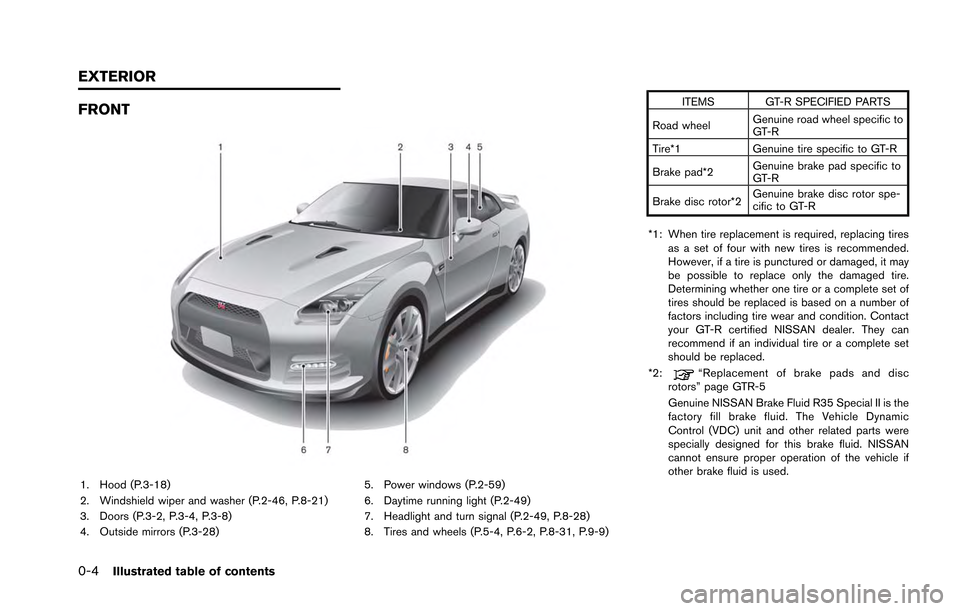
FRONT
1. Hood (P.3-18)
2. Windshield wiper and washer (P.2-46, P.8-21)
3. Doors (P.3-2, P.3-4, P.3-8)
4. Outside mirrors (P.3-28)5. Power windows (P.2-59)
6. Daytime running light (P.2-49)
7. Headlight and turn signal (P.2-49, P.8-28)
8. Tires and wheels (P.5-4, P.6-2, P.8-31, P.9-9) ITEMS GT-R SPECIFIED PARTS
Road wheel Genuine road wheel specific to
GT-R
Tire*1 Genuine tire specific to GT-R
Brake pad*2 Genuine brake pad specific to
GT-R
Brake disc rotor*2 Genuine brake disc rotor spe-
cific to GT-R
*1: When tire replacement is required, replacing tires as a set of four with new tires is recommended.
However, if a tire is punctured or damaged, it may
be possible to replace only the damaged tire.
Determining whether one tire or a complete set of
tires should be replaced is based on a number of
factors including tire wear and condition. Contact
your GT-R certified NISSAN dealer. They can
recommend if an individual tire or a complete set
should be replaced.
*2:
“Replacement of brake pads and disc
rotors” page GTR-5
Genuine NISSAN Brake Fluid R35 Special II is the
factory fill brake fluid. The Vehicle Dynamic
Control (VDC) unit and other related parts were
specially designed for this brake fluid. NISSAN
cannot ensure proper operation of the vehicle if
other brake fluid is used.
EXTERIOR
Page 48 of 346
Warninglight Name
Page
All-Wheel Drive (AWD) warning
light 2-24
Anti-lock Braking System
(ABS) warning light2-25
Brake warning light
2-25
Charge warning light 2-26
Engine oil pressure warning
light 2-26
Intelligent Key warning light 2-26
Low tire pressure warning light 2-26
Master warning light
2-28
Seat belt warning light 2-28
Supplemental air bag warning
light 2-28
Transmission warning light 2-29 Warning
light Name
Page
Vehicle Dynamic Control (VDC)
warning light 2-30
Indicator light Name
Page
Cruise main switch indicator
light 2-30
Cruise set switch indicator light 2-30
Exterior light indicator
2-30
Front passenger air bag status
light 2-30
High beam indicator light 2-30
Malfunction Indicator Light
(MIL)2-30
Turn signal/hazard indicator
lights
2-31
Vehicle Dynamic Control (VDC)
off indicator light2-31
Illustrated table of contents0-11
WARNING AND INDICATOR LIGHTS
Page 56 of 346
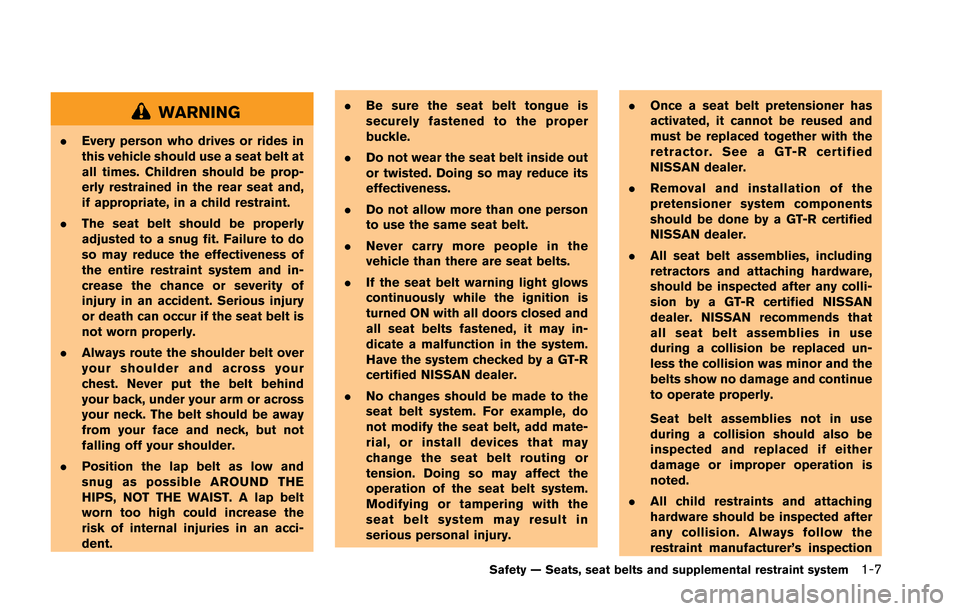
WARNING
.Every person who drives or rides in
this vehicle should use a seat belt at
all times. Children should be prop-
erly restrained in the rear seat and,
if appropriate, in a child restraint.
. The seat belt should be properly
adjusted to a snug fit. Failure to do
so may reduce the effectiveness of
the entire restraint system and in-
crease the chance or severity of
injury in an accident. Serious injury
or death can occur if the seat belt is
not worn properly.
. Always route the shoulder belt over
your shoulder and across your
chest. Never put the belt behind
your back, under your arm or across
your neck. The belt should be away
from your face and neck, but not
falling off your shoulder.
. Position the lap belt as low and
snug as possible AROUND THE
HIPS, NOT THE WAIST. A lap belt
worn too high could increase the
risk of internal injuries in an acci-
dent. .
Be sure the seat belt tongue is
securely fastened to the proper
buckle.
. Do not wear the seat belt inside out
or twisted. Doing so may reduce its
effectiveness.
. Do not allow more than one person
to use the same seat belt.
. Never carry more people in the
vehicle than there are seat belts.
. If the seat belt warning light glows
continuously while the ignition is
turned ON with all doors closed and
all seat belts fastened, it may in-
dicate a malfunction in the system.
Have the system checked by a GT-R
certified NISSAN dealer.
. No changes should be made to the
seat belt system. For example, do
not modify the seat belt, add mate-
rial, or install devices that may
change the seat belt routing or
tension. Doing so may affect the
operation of the seat belt system.
Modifying or tampering with the
seat belt system may result in
serious personal injury. .
Once a seat belt pretensioner has
activated, it cannot be reused and
must be replaced together with the
retractor. See a GT-R certified
NISSAN dealer.
. Removal and installation of the
pretensioner system components
should be done by a GT-R certified
NISSAN dealer.
. All seat belt assemblies, including
retractors and attaching hardware,
should be inspected after any colli-
sion by a GT-R certified NISSAN
dealer. NISSAN recommends that
all seat belt assemblies in use
during a collision be replaced un-
less the collision was minor and the
belts show no damage and continue
to operate properly.
Seat belt assemblies not in use
during a collision should also be
inspected and replaced if either
damage or improper operation is
noted.
. All child restraints and attaching
hardware should be inspected after
any collision. Always follow the
restraint manufacturer’s inspection
Safety — Seats, seat belts and supplemental restraint system1-7
Page 61 of 346
1-12Safety — Seats, seat belts and supplemental restraint system
SEAT BELT EXTENDERS
If, because of body size or driving position, it is
not possible to properly fit the lap-shoulder belt
and fasten it, an extender that is compatible with
the installed seat belts is available that can be
purchased. The extender adds approximately 8
in (200 mm) of length and may be used for either
the driver or front passenger seating position.
See a GT-R certified NISSAN dealer for
assistance with purchasing an extender if an
extender is required.
WARNING
.Only NISSAN seat belt extenders,
made by the same company which
made the original equipment seat
belts, should be used with the
NISSAN seat belts.
. Adults and children who can use the
standard seat belt should not use an
extender. Such unnecessary use
could result in serious personal
injury in the event of an accident.
. Never use seat belt extenders to
install child restraints. If the child
restraint is not secured properly, the
child could be seriously injured in a collision or a sudden stop.
SEAT BELT MAINTENANCE
.
To clean the seat belt webbing, apply a
mild soap solution or any solution recom-
mended for cleaning upholstery or carpets.
Then, wipe with a cloth and allow the seat
belts to dry in the shade. Do not allow the
seat belts to retract until they are completely
dry.
. If dirt builds up in the shoulder belt
guide of the seat belt anchors, the seat
belts may retract slowly. Wipe the shoulder
belt guide with a clean, dry cloth.
. Periodically check to see that the seat
belt and the metal components such as
buckles, tongues, retractors, flexible wires
and anchors work properly. If loose parts,
deterioration, cuts or other damage on the
webbing is found, the entire seat belt
assembly should be replaced.
WARNING
Do not allow children to play with the
seat belts. Most seating positions are
equipped with Automatic Locking Re-
tractor (ALR) mode seat belts. If the
seat belt becomes wrapped around a
child’s neck with the ALR mode acti-
vated, the child can be seriously injured
or killed if the seat belt retracts and
becomes tight. This can occur even if
the vehicle is parked. Unbuckle the seat
belt to release the child. If the seat belt
can not be unbuckled or is already
unbuckled, release the child by cutting
the seat belt with a suitable tool (such
as a knife or scissors) to release the
seat belt.
Children need adults to help protect them.
They need to be properly restrained.
In addition to the general information in this
manual, child safety information is available from
many other sources, including doctors, teachers,
government traffic safety offices, and community
organizations. Every child is different, so be sure
to learn the best way to transport your child.
There are three basic types of child restraint
CHILD SAFETY
Page 96 of 346

2 Instruments and controls
Cockpit ........................................................................\
............... 2-3
Instrument panel ....................................................................... 2-4
Meters and gauges .................................................................. 2-5Speedometer ....................................................................... 2-6
Odometer/twin trip odometer ......................................... 2-6
Tachometer ........................................................................\
.. 2-7
Engine coolant temperature gauge ............................... 2-7
Fuel gauge ........................................................................\
... 2-8
Transmission position indicator ...................................... 2-8
Upshift indicator ................................................................. 2-9
Instrument brightness control ...................................... 2-11
Vehicle information display ................................................. 2-11 Engine oil level display ................................................... 2-12
Transmission system check display ............................ 2-13
Drive computer ...................................................................... 2-14 Current fuel consumption ............................................. 2-15
Vehicle speed ................................................................... 2-15
Cruise control ................................................................... 2-15
Average fuel consumption and speed ....................... 2-16
Elapsed time and trip odometer .................................. 2-16
Distance to empty ........................................................... 2-17
Outside air temperature ................................................ 2-17
Setting (drive computer) ............................................... 2-18
Warning (drive computer) ............................................. 2-23 Warning/indicator lights and audible reminders .......... 2-24
Checking bulbs ............................................................. 2-24
Warning lights ................................................................ 2-24
Indicator lights ............................................................... 2-61
Audible reminders ......................................................... 2-31
Warning display .................................................................... 2-32
Engine oil low pressure warning ............................... 2-33
Engine system warning ............................................... 2-33
Shift lever position warning ........................................ 2-34
Transmission system warning .................................... 2-34
Transmission oil high temperature warning ............ 2-34
Transmission clutch high temperature warning ..... 2-35Parking brake release warning .................................. 2-35
Low brake fluid warning .............................................. 2-35
Anti-lock Braking System (ABS) warning .............. 2-36
Vehicle Dynamic Control (VDC)
system warning .............................................................. 2-36
AWD clutch high temperature warning ................... 2-36
Front/rear tire size discrepancy warning ................. 2-37
AWD system warning .................................................. 2-37
Low tire pressure warning .......................................... 2-38
Run-flat tire warning ..................................................... 2-38Tire Pressure Monitoring System
(TPMS) warning ............................................................ 2-38
Page 117 of 346
2-22Instruments and controls
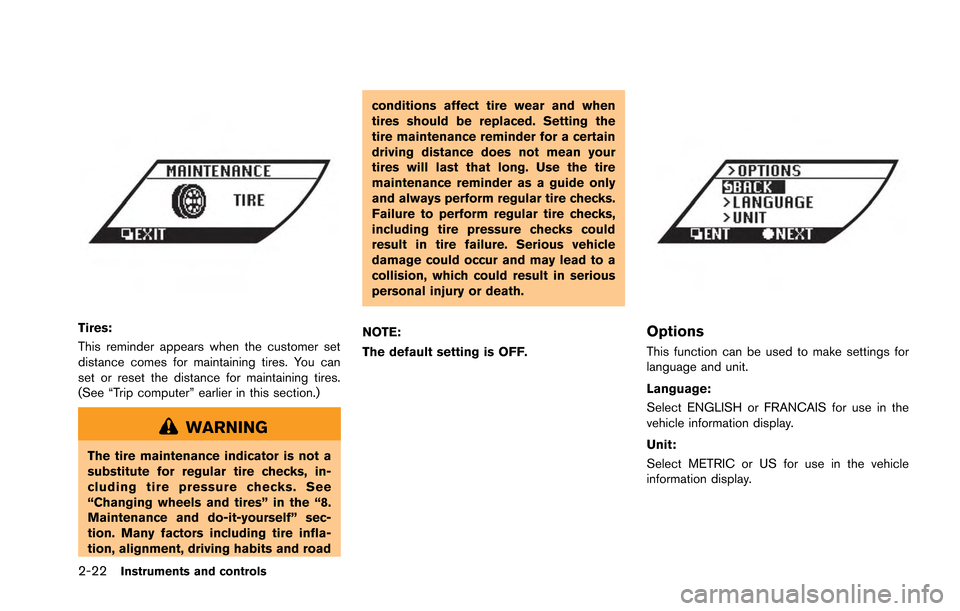
Tires:
This reminder appears when the customer set
distance comes for maintaining tires. You can
set or reset the distance for maintaining tires.
(See “Trip computer” earlier in this section.)
WARNING
The tire maintenance indicator is not a
substitute for regular tire checks, in-
cluding tire pressure checks. See
“Changing wheels and tires” in the “8.
Maintenance and do-it-yourself” sec-
tion. Many factors including tire infla-
tion, alignment, driving habits and roadconditions affect tire wear and when
tires should be replaced. Setting the
tire maintenance reminder for a certain
driving distance does not mean your
tires will last that long. Use the tire
maintenance reminder as a guide only
and always perform regular tire checks.
Failure to perform regular tire checks,
including tire pressure checks could
result in tire failure. Serious vehicle
damage could occur and may lead to a
collision, which could result in serious
personal injury or death.
NOTE:
The default setting is OFF.
Options
This function can be used to make settings for
language and unit.
Language:
Select ENGLISH or FRANCAIS for use in the
vehicle information display.
Unit:
Select METRIC or US for use in the vehicle
information display.