2013 NISSAN GT-R service
[x] Cancel search: servicePage 21 of 346

GTR-14GT-R Overview
vehicle is refueled when the vehicle is hot, the
fuel pump may automatically shut off before the
tank is full. This does not indicate that there is a
malfunction. Refuel slowly or refuel after the
vehicle has cooled.
INSPECTION AND ADJUSTMENTS
BEFORE DRIVING
The information and specifications in this
section apply only when engaging in
performance driving.
Fluids
.Check the engine, transmission, differential
and under vehicle surfaces for oil and
coolant leaks.
. Check the fluid levels and adjust as neces-
sary using the specified fluid as described
under the conditions listed in this section.
(
“Recommended fluids and mainte-
nance interval” page GTR-20 ) If you do
not drive under the conditions listed, refer to
the 2013 NISSAN Service and Maintenance
Guide.
. NISSAN recommends to adjust the engine
oil level
*1to be 0.39 in (10 mm) (1/8 gal
(0.5 liters))
*2below the H mark on the
engine oil dipstick. (
*3range is 1.18 in (30
mm)) Before checking the oil level, run the
engine until it reaches operating tempera-
ture and wait at least 5 minutes after turning
off the engine. Make sure the oil level always
remains above the L mark.
When the vehicle is delivered, the engine oil
is set to “H- 0.39 in (10 mm)” for optimal
high performance driving.
. Some amount of oil is consumed by your
engine under normal operating conditions,
and oil consumption by itself does not necessarily indicate any malfunction. If your
rate of oil consumption increases suddenly
or without explanation, NISSAN recom-
mends that you have your vehicle inspected
by a GT-R certified NISSAN dealer.
Page 26 of 346

the wheels. The tire may slip on the wheel if
the vehicle is driven in these conditions
before 48 hours have passed. If the tire slips
on the wheel, the wheel/tire assembly will be
out of balance and will require rebalancing.
Brakes
The information and specifications in this
section apply only when engaging in
performance driving.
.Check for the heat deterioration of the
brakes and parts around the brakes.
. It is recommended that you remove air from
the brake system after any of the following:
— When engaging in high performance
driving for the first time after purchasing
a new vehicle.
— After replacing the brake fluid.
— When engaging in high performance driving for a sustained period of time. It
is recommended that bleeding the brake
be performed when the brake calipers
are hot (about 2128F (1008C)) .
Brake pad:
NISSAN recommends adding an additional
cross spring to the front calipers before enga-
ging in performance driving. The additional
spring reduces brake pad movement resulting from cornering forces and will reduce the stroke
of the brake pedal. Contact a GT-R certified
NISSAN dealer to purchase the spring and
arrange installation. If a cross spring is added, a
clattering or squeaking sound may be heard on
rare occasions.
Brake pad break-in procedure:
NISSAN recommends that a special brake pad
break-in procedure be performed before enga-
ging in performance driving. Contact a GT-R
certified NISSAN dealer for details.
INSPECTION AND ADJUSTMENTS
AFTER DRIVING
The information and specifications in this
section apply only when engaging in
performance driving.
NOTICE
At the completion of performance driv-
ing, all fluid and other adjustments
should be returned to the normal fluid
specifications as shown in the “Main-
tenance and do-it-yourself” section of
this manual.
Fluids
The information and specifications in this
section apply only when engaging in
performance driving.
.
Check the engine, transmission, differential
and under the vehicle for oil and coolant
leaks.
. Check the fluid levels and adjust as neces-
sary using the specified fluid as described
under the conditions listed in this section.
(
“Recommended fluids and mainte-
nance interval” page GTR-20) If you do not
drive under the conditions listed, refer to the
2013 NISSAN Service and Maintenance
Guide.
. When changing fluids, be sure to use the
specified fluids as described in this Owner’s
manual. (
“Capacities and recom-
mended fuel/lubricants” page 9-2)
GT-R OverviewGTR-19
Page 27 of 346

GTR-20GT-R Overview
Recommended fluids and maintenance interval
The information and specifications in this section apply only when engaging in performance driving.
ITEMSEngine Oil
GT-R SPECIFIED FLUIDS Mobil 1 (0W-40)*1
MAINTENANCE INTERVAL
.When the oil temperature stays
below 2308F (1108C) while driving Change engine oil and engine oil filter at the same interval as Schedule 1 and
2 in the 2013 NISSAN GT-R Service and Maintenance Guide.
.When the oil temperature reaches
between 2308F (1108C) and 2668F (1308C) while
drivingChange engine oil and engine oil filter every 3,000 miles (5,000 km).
.When the oil temperature exceeds
2668F (1308C) while driving
Change engine oil and engine oil filter immediately after stopping.
*1: Mobil 1 (0W-40) (100% synthetic) is the factory fill oil. The VR38 engine with its plasma-sprayed bores was developed using this oil. NISSAN cannot ensure proper engine operation and durability if other 0W-40 synthetic oil is used. If Mobil 1 (0W-40) is not available, Mobil 1 (10W-40) (100% synthetic) may be used; however, some
performance loss may be noticed.
Page 28 of 346

ITEMSTransmission Oil
GT-R SPECIFIED FLUIDS Genuine NISSAN Transmission Oil R35 Special
MAINTENANCE INTERVAL
.When the oil temperature stays
below 2488F (1208C) while driving Change transmission oil at the same interval as Schedule 1 and 2 in the 2013
NISSAN GT-R Service and Maintenance Guide.
.When the oil temperature reaches
between 2488F (1208C) and 2848F (1408C) while
drivingChange transmission oil every 3,000 miles (5,000 km) .
.When the oil temperature exceeds
2848F (1408C) while drivingChange both transmission oil and differential oil immediately after stopping.
Differential oil temperature usually increases concurrently.
ITEMS Differential Oil (front and rear)
GT-R SPECIFIED FLUIDS Differential Oil R35 COMPETITION type 2189E*2
MAINTENANCE INTERVAL
.When the oil temperature stays
below 2488F (1208C) while driving Change differential oil at the same interval as Schedule 1 and 2 in the 2013
NISSAN GT-R Service and Maintenance Guide .
.When the oil temperature reaches
between 2488F (1208C) and 2848F (1408C) while
drivingChange transmission oil every 3,000 miles (5,000 km) .
.When the oil temperature exceeds
2848F (1408C) while drivingChange both transmission oil and differential oil immediately after stopping.
Differential oil temperature usually increases concurrently as the transmission
oil temperature.
*2: The differential oil temperature cannot be displayed on the multi function display. The differential oil temperature can be checked with the transmission oil temperature since both usually increases or decrease concurrently.
GT-R OverviewGTR-21
Page 33 of 346
GTR-26GT-R Overview
For the first 3,000-6,000 miles (5,000-
10,000 km) of the vehicle’s service life,
and for the first 3,000-6,000 miles (5,000-
10,000 km) after a brake replacement, the
brake pad to brake rotor clearance is very
small. When parking, apply the parking
brake and move the shift lever to the
&Pposition. Idle the engine for more than 20
seconds without depressing the brake
pedal. This allows the brake pads to move
away from the rotor so the pad does not
contact the rotor.
Additionally, the brakes must be dry before
parking the vehicle after driving on wet roads
or after washing the vehicle. If the roads are
wet, lightly apply the brakes for a short
distance before parking the vehicle to dry
the brakes. After washing the vehicle, dry the
brakes by driving on a dry road for a few
miles and apply the brakes normally based
on traffic and road conditions.
The metallic brake pads and brake disc rotor
may rust together when the brakes are not
applied:
— If the vehicle is not idled for 20 secondswithout the brakes applied, or if the
brakes are applied when the vehicle is
shut off, the rotor and pads can rust
together, even when the brake pads are dry.
— If the brakes are wet when the vehicle is parked and the parking brake is applied
for a long time.
— The hill start assist system can apply the brakes even if the brake pedal is not
depressed. The brake pads and rotors
can rust together if the parking proce-
dure previously described is not fol-
lowed.
Contact a GT-R certified NISSAN dealer if
the brake pads and brake rotor have rusted
together.
NOTICE
To help reduce the possibility of the
rotors and brake pads rusting:
Have the brake pads and/or rotors
quenched when the brake pads are
replaced. For detailed information
about quenching, contact a GT-R certi-
fied NISSAN dealer.
After quenching the brake pads and/or
rotors, apply a brake of 0.5G to stop the
vehicle 6-7 times at least once a week
in a safe location. G-force can be
checked on the multi function display. Refer to the separate Multi Function
Display Owner’s Manual.
. To maintain steady braking performance in
both extremely high and low temperatures,
the gap between the brake pad and caliper
is larger than normal and large-size brake
pads are used. When driving over a bump, a
light rattling sound may be heard from the
brake pad. This does not indicate that there
is a malfunction.
. When the brake disc rotor undergoes
thermal expansion, a ticking noise may be
heard from the engaging portion of the
wheel and the brake disc rotor. This does
not indicate that there is a malfunction. The
noise will reduce when the temperature
decreases.
. In addition to noise resulting from uneven
tire wear discussed in the previous section,
the GT-R tires are more rigid than a typical
passenger car tire and are made from a
specially formulated rubber to maximize the
vehicle’s performance capabilities. These
characteristics cause the GT-R tires to have
more road noise than a typical passenger
car tire. This road noise is normal.
. Due to the performance capabilities and
Page 121 of 346
2-26Instruments and controls
WARNING
.Your brake system may not be
working properly if the warning light
is on. Driving could be dangerous. If
you judge it to be safe, drive care-
fully to the nearest service station
for repairs. Otherwise, have your
vehicle towed because driving it
could be dangerous.
. Pressing the brake pedal with the
engine stopped and/or low brake
fluid level may increase your stop-
ping distance and braking will re-
quire greater pedal effort as well as
pedal travel.
. If the brake fluid level is below the
minimum or MIN mark on the brake
fluid reservoir, do not drive until the
brake system has been checked at a
GT-R certified NISSAN dealer.
Charge warning light
If the light comes on while the engine is running,
it may indicate the charging system is not
functioning properly. Turn the engine off and
check the alternator belt. If the belt is loose, broken, missing or if the light remains on, see a
GT-R certified NISSAN dealer immediately.
NOTICE
Do not continue driving if the alternator
belt is loose, broken or missing.
Engine oil pressure warning
light
This light warns of low engine oil pressure. If the
light flickers or comes on during normal driving,
pull off the road in a safe area, stop the engine
immediately and call a GT-R certified NISSAN
dealer.
The engine oil pressure warning light is
not designed to indicate a low oil level.
Check the vehicle information display or
use the dipstick to check the oil level.
(
“Engine oil level display” page 2-12)
(“Checking engine oil level” page 8-12)
NOTICE
Running the engine with the engine oil
pressure warning light on could cause
serious damage to the engine almost
immediately. Turn off the engine as soon as it is safe to do so.
Intelligent Key warning light
After the ignition switch is pushed to the ON
position, this light comes on for about 2 seconds
and then turns off.
This light warns of a malfunction with the
electrical steering lock system or the Intelligent
Key system.
If the light comes on while the engine is
stopped, it may be impossible to free the
steering lock or to start the engine. If the light
comes on while the engine is running, you can
drive the vehicle. However in these cases,
contact a GT-R certified NISSAN dealer for
repair as soon as possible.
Low tire pressure warning light
Your vehicle is equipped with a Tire Pressure
Monitoring System (TPMS) that monitors the tire
pressure of all tires.
The low tire pressure warning light warns of low
tire pressure and flat tire, or indicates that the
TPMS is not functioning properly.
After the ignition switch is pushed ON, this light
illuminates for about 1 second and turns off.
Page 141 of 346
2-46Instruments and controls
Security indicator light
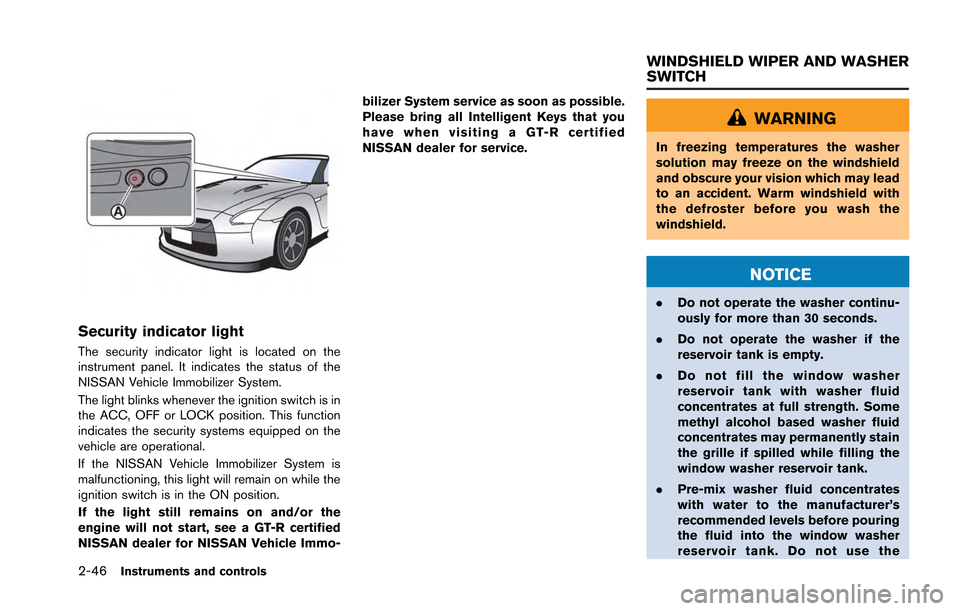
The security indicator light is located on the
instrument panel. It indicates the status of the
NISSAN Vehicle Immobilizer System.
The light blinks whenever the ignition switch is in
the ACC, OFF or LOCK position. This function
indicates the security systems equipped on the
vehicle are operational.
If the NISSAN Vehicle Immobilizer System is
malfunctioning, this light will remain on while the
ignition switch is in the ON position.
If the light still remains on and/or the
engine will not start, see a GT-R certified
NISSAN dealer for NISSAN Vehicle Immo-bilizer System service as soon as possible.
Please bring all Intelligent Keys that you
have when visiting a GT-R certified
NISSAN dealer for service.
WARNING
In freezing temperatures the washer
solution may freeze on the windshield
and obscure your vision which may lead
to an accident. Warm windshield with
the defroster before you wash the
windshield.
NOTICE
.
Do not operate the washer continu-
ously for more than 30 seconds.
. Do not operate the washer if the
reservoir tank is empty.
. Do not fill the window washer
reservoir tank with washer fluid
concentrates at full strength. Some
methyl alcohol based washer fluid
concentrates may permanently stain
the grille if spilled while filling the
window washer reservoir tank.
. Pre-mix washer fluid concentrates
with water to the manufacturer’s
recommended levels before pouring
the fluid into the window washer
reservoir tank. Do not use the
WINDSHIELD WIPER AND WASHER
SWITCH
Page 196 of 346
WARNING
.Do not leave children or adults who
would normally require the support
of others alone in your vehicle. Pets
should not be left alone either. They
could accidentally injure themselves
or others through inadvertent op-
eration of the vehicle. Also, on hot,
sunny days, temperatures in a
closed vehicle could quickly become
high enough to cause severe or
possibly fatal injuries to people or
animals.
. Closely supervise children when
they are around cars to prevent
them from playing and becoming
locked in the trunk where they could
be seriously injured. Keep the car
locked, with the rear seatback and
trunk lid securely latched when not
in use, and prevent children’s access
to car keys.
EXHAUST GAS (carbon monoxide)
WARNING
.Do not breathe exhaust gases; they
contain colorless and odorless car-
bon monoxide. Carbon monoxide is
dangerous. It can cause uncon-
sciousness or death.
. If you suspect that exhaust fumes
are entering the vehicle, drive with
all windows fully open, and have the
vehicle inspected immediately.
. Do not run the engine in closed
spaces such as a garage.
. Do not park the vehicle with the
engine running for any extended
length of time.
. Keep the trunk lid closed while
driving, otherwise exhaust gases
could be drawn into the passenger
compartment. If you must drive with
the trunk lid open, follow these
precautions:
a. Open all the windows.
b. Set the
air recirculation to
off and the fan control to high to circulate the air.
. The exhaust system and body
should be inspected by a qualified
mechanic whenever:
— The vehicle is raised for service.
— You suspect that exhaust fumes
are entering into the passenger
compartment.
— You notice a change in the sound of the exhaust system.
— You have had an accident invol- ving damage to the exhaust
system, underbody, or rear of
the vehicle.
THREE-WAY CATALYST
The three-way catalyst is an emission control
device installed in the exhaust system. Exhaust
gases in the three-way catalyst are burned at
high temperatures to help reduce pollutants.
Starting and driving5-3
PRECAUTIONS WHEN STARTING
AND DRIVING