2013 NISSAN GT-R fuel cap
[x] Cancel search: fuel capPage 185 of 346

3-24Pre-driving checks and adjustments
.Never pour fuel into the throttle
body to attempt to start your vehi-
cle.
. Do not fill a portable fuel container
in the vehicle or trailer. Static elec-
tricity can cause an explosion of
flammable liquid, vapor or gas in
any vehicle or trailer. To reduce the
risk of serious injury or death when
filling portable fuel containers:
— Always place the container on
the ground when filling.
— Do not use electronic devices when filling.
— Keep the pump nozzle in contact with the container while you are
filling it.
— Use only approved portable fuel containers for flammable liquid.
NOTICE
. If fuel is spilled on the vehicle body,
flush it away with water to avoid
paint damage.
. Insert the cap straight into the fuel- filler tube, then tighten until the
fuel-filler cap clicks. Failure to tight-
en the fuel-filler cap properly may
cause the
Malfunction Indicator
Light (MIL) to illuminate. If the
light illuminates because the fuel-
filler cap is loose or missing, tighten
or install the cap and continue to
drive the vehicle. The
light
should turn off after a few driving
trips. If the
light does not turn
off after a few driving trips, have the
vehicle inspected by a GT-R certified
NISSAN dealer.
(
“Malfunction Indicator Light
(MIL)” page 2-30)
. This vehicle includes a system that
can supply fuel even during high-G
(gravity) turns. The fuel tank pres-
sure is higher when the vehicle is
hot. If the vehicle is refueled when
the vehicle is hot, the fuel pump may
automatically shut off before the
tank is full. This does not indicate
that there is a malfunction.
OPENING THE FUEL FILLER DOOR
1. Unlock the fuel-filler door by using one of the
following operations.
.Push the door handle request switch
with the Intelligent Key carried with you.
.Push the UNLOCK button on the In-
telligent Key.
.Push the power door lock switch to the
UNLOCK position.
Page 186 of 346

2. Press the rear side of the fuel-filler door torelease the door lock, and open the door.3. Turn the cap*1slowly counterclockwise to
remove it.
During refueling, place the cap on the inside
of the door
*2.
CLOSING THE FUEL-FILLER DOOR
1. Turn the cap clockwise until a single click
sound is heard.
2. Close the door. Lock the fuel-filler door by using one of the following operations.
. Push the door handle request switch with
the Intelligent Key carried with you.
. Push the LOCK button on the Intelligent
Key. .
Push the power door lock switch to the
LOCK position.
NOTE:
After a single click is heard and the cap is
released it may move slightly. This is not a
malfunction.
Pre-driving checks and adjustments3-25
Page 273 of 346
8-6Maintenance and do-it-yourself
notice any leaks or if gasoline fumes are evident,
check for the cause and have it corrected
immediately.
Power steering fluid level* and lines:Check
the level when the fluid is cold, with the engine
off. Check the lines for proper attachment, leaks,
cracks, etc.
Radiator and hoses: Check the front of the
radiator and clean off any dirt, insects, leaves,
etc., that may have accumulated. Make sure the
hoses have no cracks, deformation, rot or loose
connections.
Underbody: The underbody is frequently ex-
posed to corrosive substances such as those
used on icy roads or to control dust. It is very
important to remove these substances, other-
wise rust will form on the floor pan, frame, fuel
lines and around the exhaust system. At the end
of winter, the underbody should be thoroughly
flushed with plain water, being careful to clean
those areas where mud and dirt may accumu-
late. (
“Underbody” page 7-3)
Windshield washer fluid*: Check that there is
adequate fluid in the reservoir.
When performing any inspection or mainte-
nance work on your vehicle, always take care
to prevent serious accidental injury to yourself or
damage to the vehicle. The following are general
precautions which should be closely observed.
WARNING
. Park the vehicle on a level surface,
apply the parking brake securely
and block the wheels to prevent
the vehicle from moving. Move the
shift lever to the
&Pposition.
. Be sure the ignition switch is in the
OFF or LOCK position when per-
forming any parts replacement or
repairs.
. If you must work with the engine
running, keep your hands, clothing,
hair and tools away from moving
fans, belts and any other moving
parts.
. It is advisable to secure or remove
any loose clothing and remove any
jewelry, such as rings, watches, etc.
before working on your vehicle.
. Always wear eye protection when-
ever you work on your vehicle. .
If you must run the engine in an
enclosed space such as a garage, be
sure there is proper ventilation for
exhaust gases to escape.
. Never get under the vehicle while it
is supported only by a jack. If it is
necessary to work under the vehicle,
support it with safety stands.
. Keep smoking materials, flame and
sparks away from fuel tank and the
battery.
. Your vehicle is equipped with an
automatic engine cooling fan. It may
come on at any time without warn-
ing, even if the ignition key is in the
OFF position and the engine is not
running. To avoid injury, always
disconnect the negative battery
cable before working near the fan.
. The fuel filter or fuel lines should be
serviced by a GT-R certified NISSAN
dealer because the fuel lines are
under high pressure even when the
engine is off.
MAINTENANCE PRECAUTIONS
Page 282 of 346
For further brake fluid information, see the
following section. (“Capacities and recom-
mended fuel/lubricants” page 9-2)
WARNING
. Use only new fluid from a sealed
container. Old, inferior or contami-
nated fluid may damage the brake
system. The use of improper fluids
can damage the brake system and
affect the vehicle’s stopping ability.
. Clean the filler cap before removing.
. Brake fluid is poisonous and should
be stored carefully in marked con-
tainers out of the reach of children.
CAUTION
Genuine NISSAN Brake Fluid R35 Spe-
cial II is the factory fill brake fluid. The
Vehicle Dynamic Control (VDC) unit and
other related parts were specially de-
signed for this brake fluid and NISSAN
cannot ensure proper operation of the
vehicle if other brake fluid is used.
NOTICE
Do not spill the fluid on any painted
surfaces. This will damage the paint. If
fluid is spilled, wash the surface with
water.
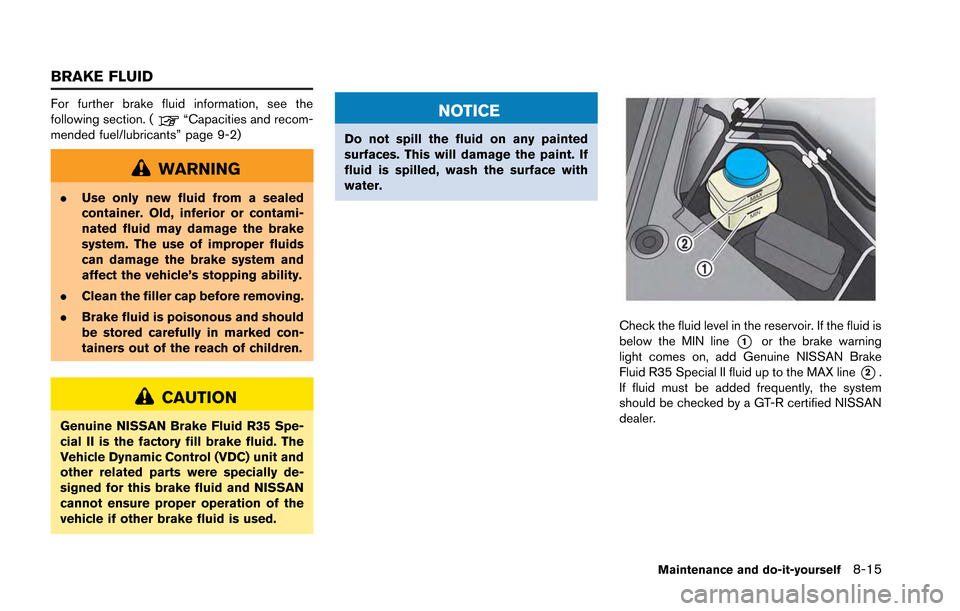
Check the fluid level in the reservoir. If the fluid is
below the MIN line
*1or the brake warning
light comes on, add Genuine NISSAN Brake
Fluid R35 Special II fluid up to the MAX line
*2.
If fluid must be added frequently, the system
should be checked by a GT-R certified NISSAN
dealer.
Maintenance and do-it-yourself8-15
BRAKE FLUID
Page 314 of 346
9 Technical and consumer information
Capacities and recommended fuel/lubricants .................. 9-2Fuel recommendation ........................................................ 9-4
Engine oil and oil filter recommendation ...................... 9-6
Air conditioning system refrigerant and
lubricant recommendations .............................................. 9-7
Specifications ........................................................................\
.... 9-8
Engine ........................................................................\
........... 9-8
Wheels and tires ................................................................ 9-9
Dimensions ....................................................................... 9-11
When traveling or registering your vehicle in
another country ...................................................................... 9-11 Vehicle identification ............................................................. 9-11 Vehicle Identification Number (VIN) plate ................. 9-11
Vehicle identification number (chassis number) ..... 9-12
Engine serial number ...................................................... 9-12
F.M.V.S.S./C.M.V.S.S. certification label ................... 9-12
Emission control information label .............................. 9-13
Tire and loading information label ............................... 9-13
Air conditioner specification label ............................... 9-13 Installing front license plate ............................................... 9-14
Vehicle loading information ................................................ 9-14
Terms ........................................................................\
........ 9-14
Vehicle load capacity ................................................... 9-15
Loading tips .................................................................... 9-16
Measurement of weights ............................................. 9-16
Towing a trailer ...................................................................... 9-17
Flat towing ........................................................................\
...... 9-17
Uniform tire quality grading ................................................ 9-18 Treadwear ....................................................................... 9-18
Traction AA, A, B and C ............................................. 9-18
Temperature A, B and C ............................................. 9-18
Emission control system warranty .................................... 9-19
Reporting safety defects .................................................... 9-19
Readiness for Inspection/Maintenance (I/M) test
(US only) ........................................................................\
........ 9-20
Event Data Recorders (EDR) ............................................ 9-21
Vehicle status data recorder (VSDR) ............................. 9-21 Handling of data ............................................................ 9-21
Owner’s Manual/Service Manual order information .... 9-22
Page 315 of 346

9-2Technical and consumer information
The following are approximate capacities. The actual refill capacities may be a little different. When refilling, follow the procedure
instructed in the “8. Maintenance and do-it-yourself” section to determine the proper refill capacity.
Capacity (Approximate)Recommended specifications
US measure Imp measure Liter
Fuel 19-1/2 gal 16-1/4 gal73.8 (
“Fuel recommendation” page 9-4)
Engine oil*3
Mobil 1 (0W-40)*1
Drain and refill
With oil filter change 5-1/4 qt4-3/8 qt 5.0
Without oil filter change 4-3/4 qt4 qt4.5
Cooling system With reservoir 12 qt10 qt 11.3
Genuine NISSAN Long Life Antifreeze/Coolant (blue) or equivalent*6
Reservoir 1-1/2 qt1-1/4 qt 1.4
Transmission oil (Drain and refill)*8 10 qt8-1/4 qt 9.4 Genuine NISSAN Transmission Oil R35 Special*2
Differential oil (Drain and refill)
Front 1-3/8 pt1-1/8 pt 0.65
Genuine NISSAN Differential Oil R35 COMPETITION type 2189E*2
Rear 2-7/8 pt2-3/8 pt 1.35
Power steering fluid (PSF) Refill to the proper oil level according to the instructions in the “8.
Maintenance and do-it-yourself” section. Genuine NISSAN PSF or equivalent*5
Brake fluid Genuine NISSAN Brake Fluid R35 Special II*7
Multi-purpose grease —— — NLGI No. 2 (Lithium soap base)
Air conditioning system refrigerant —— — HFC-134a (R-134a)*4
Air conditioning system lubricants —— —NISSAN UV Luminous Oil
Type S or exact equivalent
Window washer fluid —— —Genuine NISSAN Windshield Washer Concentrate Cleaner & Antifreeze or equivalent
*1: Mobil 1 (0W-40) (100% synthetic) is the factory fill oil. The VR38 engine with its plasma-sprayed bores was developed using this oil. NISSAN cannot ensure proper engine operation and durability if other 0W-40 synthetic oil is used. If Mobil 1 (0W-40) is not available, Mobil 1 (10W-40) (100% synthetic) may be used; however, some performance loss may be noticed. For additional information, see the following section.
(
“Engine oil and oil filter recommendation” page 9-6)
*2: The use of fluids and lubricants other than the specified may cause vehicle malfunctions and result in non-warranty vehicle repairs.
*3: The recommended oil capacity level is 0.39 in (10mm) (0.5 L) below the H mark on the engine oil dipstick. For additional information, see the following section. (
“Engine oil” page 8-12)
CAPACITIES AND RECOMMENDED
FUEL/LUBRICANTS
Page 319 of 346

9-6Technical and consumer information
Octane rating tips
Using unleaded gasoline with an octane
rating lower than recommended above can
cause persistent, heavy spark knock.
(Spark knock is a metallic rapping noise.)
If severe, this can lead to engine damage.
If you detect a persistent heavy spark
knock even when using gasoline of the
stated octane rating, or if you hear steady
spark knock while holding a steady speed
on level roads, have a GT-R certified
NISSAN dealer correct the condition. Fail-
ure to correct the condition is misuse of
the vehicle, for which NISSAN is not
responsible.
Incorrect ignition timing will result in knocking,
after-run or overheating. This in turn may cause
excessive fuel consumption or damage to the
engine. If any of the above symptoms are
encountered, have your vehicle checked at a
GT-R certified NISSAN dealer or other compe-
tent service facility.
However, now and then you may notice
light spark knock for a short time while
accelerating or driving up hills. This is no
cause for concern, because you get the
greatest fuel benefit when there is light
spark knock for a short time under heavy
engine load.
ENGINE OIL AND OIL FILTER RE-
COMMENDATION
Selecting the correct oil
It is essential to choose the correct grade,
quality, and viscosity engine oil to ensure
satisfactory engine life and performance.
(
“Capacities and recommended fuel/lubri-
cants” page 9-2)
Mobil 1 (0W-40) (100% synthetic) is the factory
fill oil. The VR38 engine with its plasma-sprayed
bores was developed using this oil. NISSAN
cannot ensure proper engine operation and
durability if other 0W-40 synthetic oil is used.
If Mobil 1 (0W-40) is not available, Mobil 1
(10W-40) (100% synthetic) may be used;
however, some performance loss may be
noticed.
NOTICE
Using an engine oil other than that
specified could adversely affect the
engine. See the 2013 NISSAN GT-R
Warranty Information Booklet for de-
tails and exclusions.
Oil additives
NISSAN does not recommend the use of oil
additives. The use of an oil additive is not
necessary when the proper oil type is used and
maintenance intervals are followed.
Oil which may contain foreign matter or has
been previously used should not be used.
Oil viscosity
The engine oil viscosity or thickness changes
with temperature. Because of this, it is important
that the engine oil viscosity be selected based
on the temperatures at which the vehicle will be
operated before the next oil change. Choosing
an oil viscosity other than that recommended
could cause serious engine damage.
Selecting the correct oil filter
Your new vehicle is equipped with a high-quality
genuine NISSAN oil filter. NISSAN recommends
to use the genuine NISSAN oil filter for the
reason described in change intervals.
Change intervals
The oil and oil filter change intervals for your
engine are based on the use of the specified
quality oils and filters. Oil and filter other than the
specified quality, or oil and filter change intervals
longer than recommended could reduce engine
Page 336 of 346

10 Index
A
Additional maintenance items............................ GTR-12
Air cleaner..................................................................... 8-20
Air conditionerAir conditioner specification label.................... 9-13
Air conditioning system refrigerant and
lubricant recommendations......................................... 9-7
Air fresheners................................................................. 7-5
All-season tires...................................................... GTR-11
All-Wheel Drive............................................................ 5-41
All-Wheel Drive driving safety precautions ............ 5-9
Anti-freeze..................................................................... 5-51
Anti-lock Braking System.......................................... 5-48
Anti-lock Braking System warning.......................... 2-36
Audible reminders....................................................... 2-31
Automatic Automatic door lock system................................. 3-5
Average fuel consumption and speed................... 2-16
Avoiding body damage........................................ GTR-11
Avoiding collision and rollover ................................... 5-7
AWD clutch high temperature warning................. 2-36
AWD system characteristics.................................... 5-43
AWD system warning ................................................ 2-37
AWD warning light ..................................................... 5-41
B
Battery................................................................ 5-51, 8-17 Intelligent Key battery discharge...................... 5-11
Intelligent Key battery discharge indicator..... 2-43
Intelligent Key battery replacement ................. 8-26 Before starting the engine........................................ 5-13
Body repair ............................................................. GTR-12
Booster seats............................................................... 1-28
Brake
Brake assist........................................................... 5-48
Brake fluid............................................... GTR-4, 8-15
Brake pad wear warning.................................... 8-22
Brake system......................................................... 5-47
Brakes..................................................................... 8-22
High performance brake system ...................... 8-22
Low brake fluid warning ..................................... 2-35
Parking brake ........................................................ 5-33
Parking brake break-in........................................ 5-47
Parking brake release warning ......................... 2-35
Replacing the brake pads.................................. 8-23
Self-adjusting brakes .......................................... 8-22
Brake dust............................................................... GTR-27
Brake pad................................................................ GTR-15
Brake pad and disc rotor...................................... GTR-5
Brake pad break-in procedure........................... GTR-15
Brake system information.................................... GTR-27
Brakes.................................................... GTR-19, GTR-23
Braking precautions.................................................... 5-47
Break-in schedule ........................................ GTR-9, 5-39
C
Capacities and recommended fuel/lubricants ....... 9-2
Changing Changing engine coolant................................... 8-12
Changing engine oil and filter........................... 8-13 Changing wheels and tires................................ 8-39
Checking Checking bulbs..................................................... 2-24
Checking engine coolant level.......................... 8-11
Checking engine oil level................................... 8-12
Checking the tire pressure................................ 8-34
Checking the exhaust finisher and rear
bumper clearance ................................................... GTR-9
Child restraints............................................................. 1-14
Child safety................................................................... 1-12
Chrome parts ................................................................. 7-4
Cleaning ........................................................................ 8-21
Cleaning exterior ........................................................... 7-2
Cleaning interior ............................................................ 7-5
Clearing the programmed information................... 2-66
Closing the fuel-filler door ........................................ 3-25
Closing the hood......................................................... 3-19
Coat hooks ................................................................... 2-58
Cockpit ............................................................................ 2-3
Cold weather driving.................................................. 5-51
Console box ................................................................. 2-58
Cool down .............................................................. GTR-13
Coolant Changing engine coolant................................... 8-12
Checking engine coolant level.......................... 8-11
Draining of coolant water................................... 5-51
Engine coolant temperature gauge .................... 2-7
Coolant level and mixture ratio.......................... GTR-15
Corrosion protection .................................................... 7-8
Cracks on brake pad ........................................... GTR-27
Cracks on the disc rotors................................... GTR-27