2013 NISSAN GT-R clutch
[x] Cancel search: clutchPage 35 of 346

GTR-28GT-R Overview
The GT-R dual clutch transmission is a newly-
developed system that uses an electronically
controlled multiple-disc wet clutch attached to
the highly efficient manual transmission. This
transmission has two driving modes.
.
&Aposition (Automatic gearshift):
allows automatic shifting of the manual
transmission.
.
&Mposition (Manual gearshift):
allows quick shifting of the manual transmis-
sion.
NOTE:
When starting or driving on a steep uphill
grade, shift to the
&Mposition and operate
the paddle shifter to shift down to 1st gear
similar to a manual transmission vehicle.
The GT-R dual clutch transmission was devel-
oped specifically to maximize vehicle perfor-
mance and driving enjoyment. The GT-R
transmission components were designed using
different engineering standards than typical
passenger car transmissions. Because of this,
the GT-R has different operating characteristics,
and various rattle noises may be heard during
some driving conditions because of the follow-
ing items:
. Gear clearances .
Ultralight flywheel
. Dry sump lubrication
These noises do not indicate that there is a
malfunction.
DUAL CLUTCH TRANSMISSION
Page 36 of 346
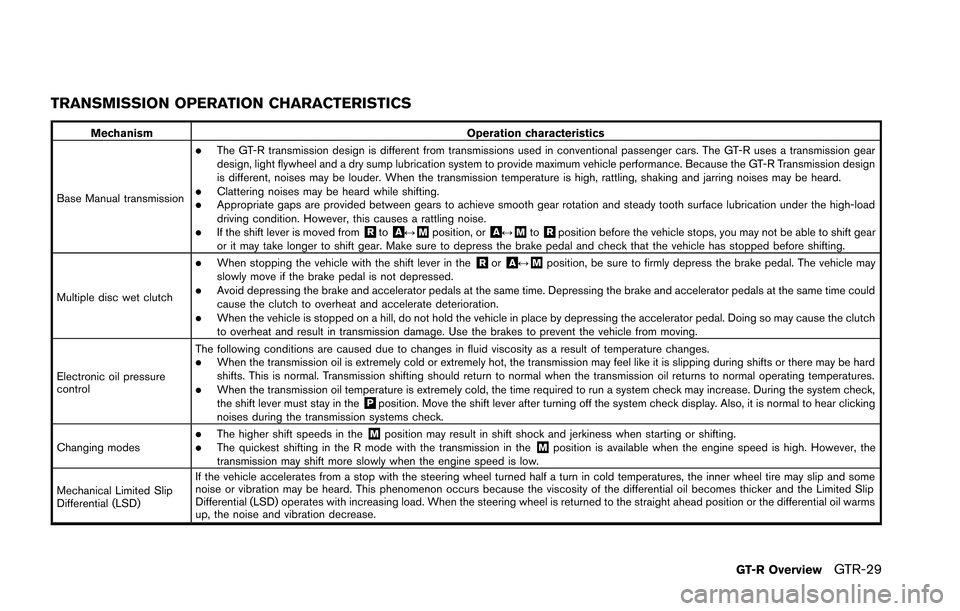
TRANSMISSION OPERATION CHARACTERISTICS
MechanismOperation characteristics
Base Manual transmission
.The GT-R transmission design is different from transmissions used in conventional passenger cars. The GT-R uses a transmission gear
design, light flywheel and a dry sump lubrication system to provide maximum vehicle performance. Because the GT-R Transmission design
is different, noises may be louder. When the transmission temperature is high, rattling, shaking and jarring noises may be heard.
.Clattering noises may be heard while shifting..Appropriate gaps are provided between gears to achieve smooth gear rotation and steady tooth surface lubrication under the high-load
driving condition. However, this causes a rattling noise.
.If the shift lever is moved from&Rto&A↔&Mposition, or&A↔&Mto&Rposition before the vehicle stops, you may not be able to shift gear
or it may take longer to shift gear. Make sure to depress the brake pedal and check that the vehicle has stopped before shifting.
Multiple disc wet clutch
.When stopping the vehicle with the shift lever in the&Ror&A↔&Mposition, be sure to firmly depress the brake pedal. The vehicle may
slowly move if the brake pedal is not depressed.
.Avoid depressing the brake and accelerator pedals at the same time. Depressing the brake and accelerator pedals at the same time could
cause the clutch to overheat and accelerate deterioration.
.When the vehicle is stopped on a hill, do not hold the vehicle in place by depressing the accelerator pedal. Doing so may cause the clutch
to overheat and result in transmission damage. Use the brakes to prevent the vehicle from moving.
Electronic oil pressure
control The following conditions are caused due to changes in fluid viscosity as a result of temperature changes.
.When the transmission oil is extremely cold or extremely hot, the transmission may feel like it is slipping during shifts or there may be hard
shifts. This is normal. Transmission shifting should return to normal when the transmission oil returns to normal operating temperatures.
.When the transmission oil temperature is extremely cold, the time required to run a system check may increase. During the system check,
the shift lever must stay in the&Pposition. Move the shift lever after turning off the system check display. Also, it is normal to hear clicking
noises during the transmission systems check.
Changing modes
.The higher shift speeds in the&Mposition may result in shift shock and jerkiness when starting or shifting..The quickest shifting in the R mode with the transmission in the&Mposition is available when the engine speed is high. However, the
transmission may shift more slowly when the engine speed is low.
Mechanical Limited Slip
Differential (LSD) If the vehicle accelerates from a stop with the steering wheel turned half a turn in cold temperatures, the inner wheel tire may slip and some
noise or vibration may be heard. This phenomenon occurs because the viscosity of the differential oil becomes thicker and the Limited Slip
Differential (LSD) operates with increasing load. When the steering wheel is returned to the straight ahead position or the differential oil warms
up, the noise and vibration decrease.
GT-R OverviewGTR-29
Page 96 of 346

2 Instruments and controls
Cockpit ........................................................................\
............... 2-3
Instrument panel ....................................................................... 2-4
Meters and gauges .................................................................. 2-5Speedometer ....................................................................... 2-6
Odometer/twin trip odometer ......................................... 2-6
Tachometer ........................................................................\
.. 2-7
Engine coolant temperature gauge ............................... 2-7
Fuel gauge ........................................................................\
... 2-8
Transmission position indicator ...................................... 2-8
Upshift indicator ................................................................. 2-9
Instrument brightness control ...................................... 2-11
Vehicle information display ................................................. 2-11 Engine oil level display ................................................... 2-12
Transmission system check display ............................ 2-13
Drive computer ...................................................................... 2-14 Current fuel consumption ............................................. 2-15
Vehicle speed ................................................................... 2-15
Cruise control ................................................................... 2-15
Average fuel consumption and speed ....................... 2-16
Elapsed time and trip odometer .................................. 2-16
Distance to empty ........................................................... 2-17
Outside air temperature ................................................ 2-17
Setting (drive computer) ............................................... 2-18
Warning (drive computer) ............................................. 2-23 Warning/indicator lights and audible reminders .......... 2-24
Checking bulbs ............................................................. 2-24
Warning lights ................................................................ 2-24
Indicator lights ............................................................... 2-61
Audible reminders ......................................................... 2-31
Warning display .................................................................... 2-32
Engine oil low pressure warning ............................... 2-33
Engine system warning ............................................... 2-33
Shift lever position warning ........................................ 2-34
Transmission system warning .................................... 2-34
Transmission oil high temperature warning ............ 2-34
Transmission clutch high temperature warning ..... 2-35Parking brake release warning .................................. 2-35
Low brake fluid warning .............................................. 2-35
Anti-lock Braking System (ABS) warning .............. 2-36
Vehicle Dynamic Control (VDC)
system warning .............................................................. 2-36
AWD clutch high temperature warning ................... 2-36
Front/rear tire size discrepancy warning ................. 2-37
AWD system warning .................................................. 2-37
Low tire pressure warning .......................................... 2-38
Run-flat tire warning ..................................................... 2-38Tire Pressure Monitoring System
(TPMS) warning ............................................................ 2-38
Page 124 of 346
.The supplemental air bag warning light
remains on after approximately 7 seconds.
. The supplemental air bag warning light
flashes intermittently.
. The supplemental air bag warning light does
not come on at all.
Unless checked and repaired, the supplemental
restraint system (air bag system) and/or the
pretensioners may not function properly.
(
“Supplemental restraint system” page 1-
31)
WARNING
If the supplemental air bag warning
light is on, it could mean that the front
air bag, side air bag, curtain air bag
and/or pretensioner systems will not
operate in an accident. To help avoid
injury to yourself or others, have your
vehicle checked by a GT-R certified
NISSAN dealer as soon as possible.
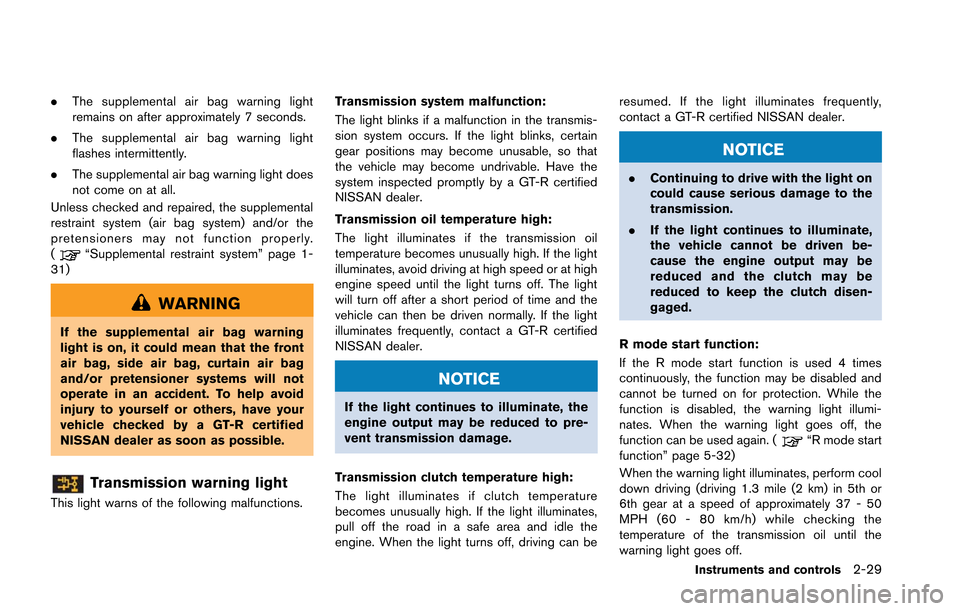
Transmission warning light
This light warns of the following malfunctions. Transmission system malfunction:
The light blinks if a malfunction in the transmis-
sion system occurs. If the light blinks, certain
gear positions may become unusable, so that
the vehicle may become undrivable. Have the
system inspected promptly by a GT-R certified
NISSAN dealer.
Transmission oil temperature high:
The light illuminates if the transmission oil
temperature becomes unusually high. If the light
illuminates, avoid driving at high speed or at high
engine speed until the light turns off. The light
will turn off after a short period of time and the
vehicle can then be driven normally. If the light
illuminates frequently, contact a GT-R certified
NISSAN dealer.
NOTICE
If the light continues to illuminate, the
engine output may be reduced to pre-
vent transmission damage.
Transmission clutch temperature high:
The light illuminates if clutch temperature
becomes unusually high. If the light illuminates,
pull off the road in a safe area and idle the
engine. When the light turns off, driving can be resumed. If the light illuminates frequently,
contact a GT-R certified NISSAN dealer.
NOTICE
.
Continuing to drive with the light on
could cause serious damage to the
transmission.
. If the light continues to illuminate,
the vehicle cannot be driven be-
cause the engine output may be
reduced and the clutch may be
reduced to keep the clutch disen-
gaged.
R mode start function:
If the R mode start function is used 4 times
continuously, the function may be disabled and
cannot be turned on for protection. While the
function is disabled, the warning light illumi-
nates. When the warning light goes off, the
function can be used again. (
“R mode start
function” page 5-32)
When the warning light illuminates, perform cool
down driving (driving 1.3 mile (2 km) in 5th or
6th gear at a speed of approximately 37 - 50
MPH (60 - 80 km/h) while checking the
temperature of the transmission oil until the
warning light goes off.
Instruments and controls2-29
Page 130 of 346
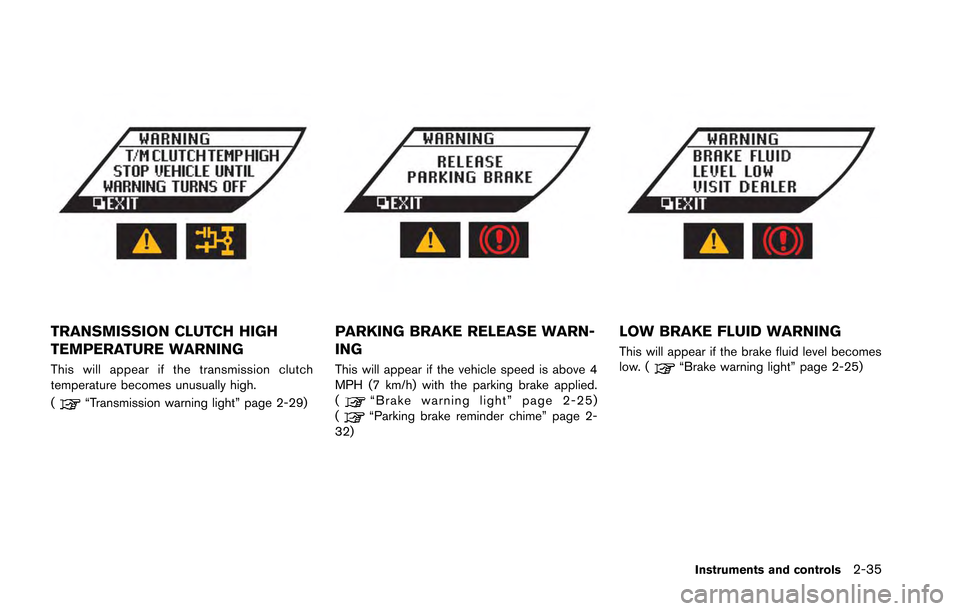
TRANSMISSION CLUTCH HIGH
TEMPERATURE WARNING
This will appear if the transmission clutch
temperature becomes unusually high.
(
“Transmission warning light” page 2-29)
PARKING BRAKE RELEASE WARN-
ING
This will appear if the vehicle speed is above 4
MPH (7 km/h) with the parking brake applied.
(
“Brake warning light” page 2-25)
(“Parking brake reminder chime” page 2-
32)
LOW BRAKE FLUID WARNING
This will appear if the brake fluid level becomes
low. (“Brake warning light” page 2-25)
Instruments and controls2-35
Page 131 of 346

2-36Instruments and controls
ANTI-LOCK BRAKING SYSTEM
(ABS) WARNING
This will appear if the Anti-lock Braking System
(ABS) is not functioning properly. (“Anti-
lock Braking System (ABS) warning light” page
2-25) (
“Brake warning light” page 2-25)
VEHICLE DYNAMIC CONTROL (VDC)
SYSTEM WARNING
This will appear if the Vehicle Dynamic Control
(VDC) system or the hill start assist system is
not functioning properly. (
“Vehicle Dynamic
Control (VDC) warning light” page 2-30)
(
“Vehicle Dynamic Control (VDC) off in-
dicator light” page 2-31)
AWD CLUTCH HIGH TEMPERATURE
WARNING
This will appear if the temperature of the AWD
clutch becomes unusually high. (“All-
Wheel Drive (AWD) warning light” page 2-24)
NOTE:
If the vehicle is driven in a way which
causes the rear wheels to slip, the AWD
clutch temperature will increase and the
warning indicator may flash. Continuing to
drive in a way that causes the warning light
to flash may cause the clutch to reach
excessive temperatures that could result in
Page 194 of 346
5 Starting and driving
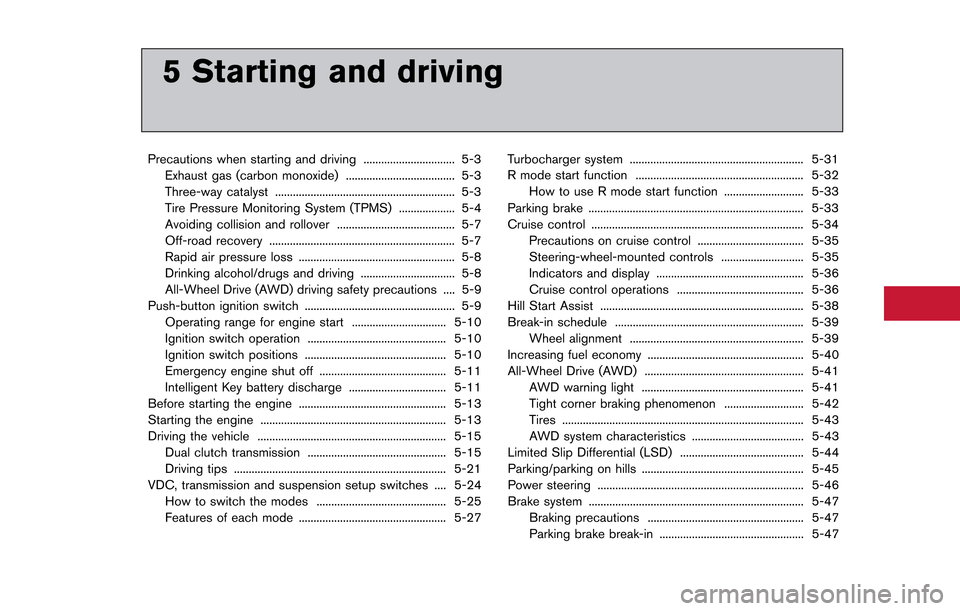
Precautions when starting and driving ............................... 5-3Exhaust gas (carbon monoxide) ..................................... 5-3Three-way catalyst ............................................................. 5-3
Tire Pressure Monitoring System (TPMS) ................... 5-4
Avoiding collision and rollover ........................................ 5-7
Off-road recovery ............................................................... 5-7
Rapid air pressure loss ..................................................... 5-8
Drinking alcohol/drugs and driving ................................ 5-8All-Wheel Drive (AWD) driving safety precautions .... 5-9
Push-button ignition switch ................................................... 5-9
Operating range for engine start ................................ 5-10
Ignition switch operation ............................................... 5-10
Ignition switch positions ................................................ 5-10
Emergency engine shut off ........................................... 5-11
Intelligent Key battery discharge ................................. 5-11
Before starting the engine .................................................. 5-13
Starting the engine ............................................................... 5-13
Driving the vehicle ................................................................ 5-15 Dual clutch transmission ............................................... 5-15
Driving tips ........................................................................\
5-21
VDC, transmission and suspension setup switches .... 5-24 How to switch the modes ............................................ 5-25
Features of each mode .................................................. 5-27 Turbocharger system ........................................................... 5-31
R mode start function ......................................................... 5-32
How to use R mode start function ........................... 5-33
Parking brake ........................................................................\
. 5-33
Cruise control ........................................................................\
5-34 Precautions on cruise control .................................... 5-35
Steering-wheel-mounted controls ............................ 5-35
Indicators and display .................................................. 5-36
Cruise control operations ........................................... 5-36
Hill Start Assist ..................................................................... 5-38
Break-in schedule ................................................................ 5-39 Wheel alignment ........................................................... 5-39
Increasing fuel economy ..................................................... 5-40
All-Wheel Drive (AWD) ...................................................... 5-41 AWD warning light ....................................................... 5-41
Tight corner braking phenomenon ........................... 5-42
Tires ........................................................................\
.......... 5-43AWD system characteristics ...................................... 5-43
Limited Slip Differential (LSD) .......................................... 5-44
Parking/parking on hills ....................................................... 5-45
Power steering ...................................................................... 5-46
Brake system ........................................................................\
. 5-47 Braking precautions ..................................................... 5-47
Parking brake break-in ................................................. 5-47
Page 208 of 346
DUAL CLUTCH TRANSMISSION
The GT-R dual clutch transmission is a newly-
developed system that uses an electronically
controlled multiple-disc wet clutch attached to
the highly efficient manual transmission. This
transmission has two driving modes.
.
&Aposition (Automatic gearshift):
allows automatic shifting of the manual
transmission.
.
&Mposition (Manual gearshift):
allows quick shifting of the manual transmis-
sion.
NOTE:
When starting or driving on a steep uphill
grade, shift to the
&Mposition and operate
the paddle shifter to shift down to 1st gear
similar to a manual transmission vehicle.
The GT-R dual clutch transmission was devel-
oped specifically to maximize vehicle perfor-
mance and driving enjoyment. The GT-R
transmission components were designed using
different engineering standards than typical
passenger car transmissions. Because of this,
the GT-R has different operating characteristics,
and various rattle noises may be heard during
some driving conditions because of the follow-
ing items: .
Gear clearances
. Ultralight flywheel
. Dry sump lubrication
These noises do not indicate that there is a
malfunction.
WARNING
. Do not depress the accelerator
pedal while shifting from the&Por
&Nposition to the&Ror&A↔&Mposition. Always depress the brake
pedal until shifting is completed.
Failure to do so could cause loss
of control and an accident.
. Cold engine idle speed is high, so
use caution when shifting into a
forward or reverse gear before the
engine has warmed up.
. Never shift to the
&Por&Rposition
while the vehicle is moving forward.
Never shift to the
&Por&A↔&Mposition while the vehicle is moving
rearward. Doing so could cause loss
of control and an accident.
. The shift lever contains a powerful
magnet. Do not place electronic medical devices or other electronic
products that are susceptible to
magnetic force close to the shift
lever.
. Do not downshift abruptly on slip-
pery roads. This may cause a loss of
control.
. If the shift lever is moved from
&Rto
&A↔&Mposition, or&A↔&Mto&Rposition before the vehicle stops,
you may not be able to shift gear or
it may take longer to shift gear.
Make sure to depress the brake
pedal and check that the vehicle
has stopped before shifting.
CAUTION
.Because the vehicle includes a dual
clutch transmission that automati-
cally controls the clutch and shifting
operation of the manual transmis-
sion, whenever the shift lever is in a
position other then
&Por&N, the
vehicle will begin to move slowly, in
the same way as when the clutch in
a manual transmission vehicle is
Starting and driving5-15
DRIVING THE VEHICLE