Page 617 of 706
7-36 Vehicle care and maintenance
7
Tire rotation
N00939900491
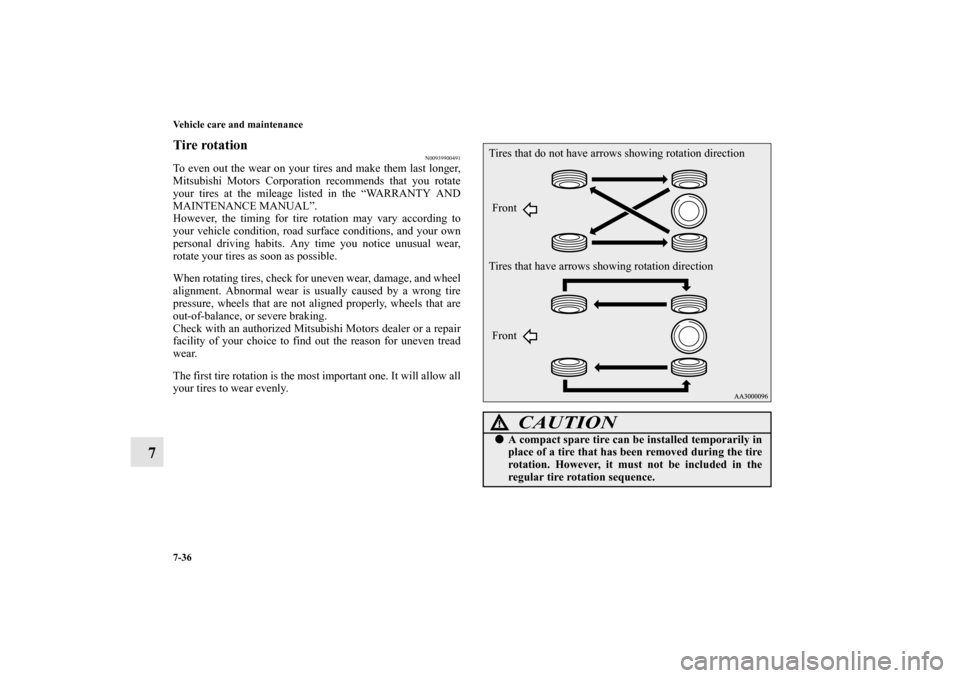
To even out the wear on your tires and make them last longer,
Mitsubishi Motors Corporation recommends that you rotate
your tires at the mileage listed in the “WARRANTY AND
MAINTENANCE MANUAL”.
However, the timing for tire rotation may vary according to
your vehicle condition, road surface conditions, and your own
personal driving habits. Any time you notice unusual wear,
rotate your tires as soon as possible.
When rotating tires, check for uneven wear, damage, and wheel
alignment. Abnormal wear is usually caused by a wrong tire
pressure, wheels that are not aligned properly, wheels that are
out-of-balance, or severe braking.
Check with an authorized Mitsubishi Motors dealer or a repair
facility of your choice to find out the reason for uneven tread
wear.
The first tire rotation is the most important one. It will allow all
your tires to wear evenly.
CAUTION
!�A compact spare tire can be installed temporarily in
place of a tire that has been removed during the tire
rotation. However, it must not be included in the
regular tire rotation sequence.Tires that do not have arrows showing rotation direction
Tires that have arrows showing rotation directionFront
Front
BK0151000US.book 36 ページ 2012年3月29日 木曜日 午後6時8分
Page 618 of 706
Vehicle care and maintenance
7-37
7
CAUTION
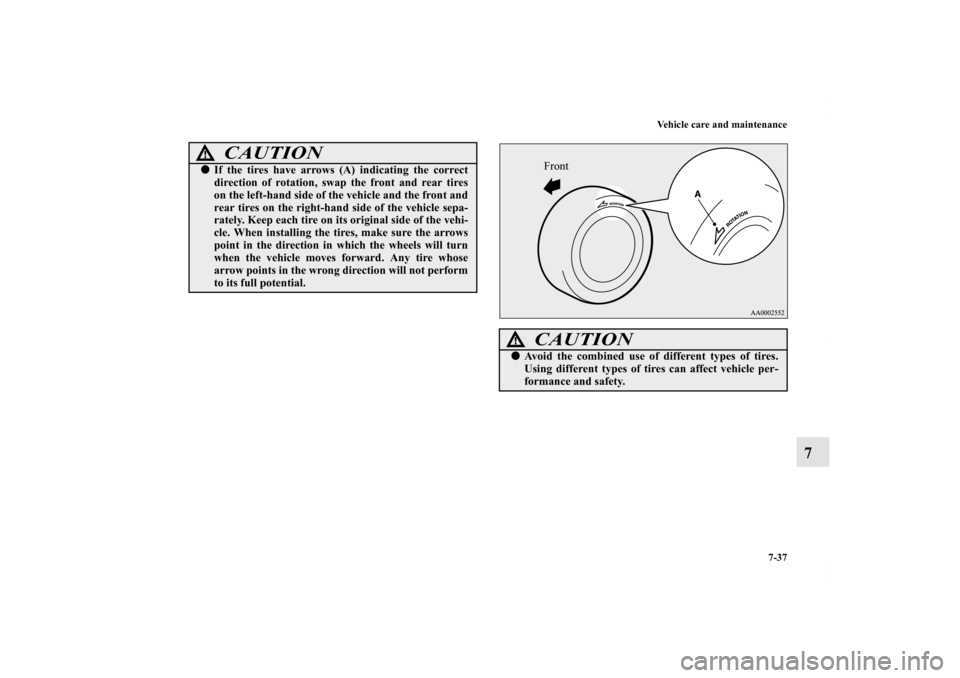
!�If the tires have arrows (A) indicating the correct
direction of rotation, swap the front and rear tires
on the left-hand side of the vehicle and the front and
rear tires on the right-hand side of the vehicle sepa-
rately. Keep each tire on its original side of the vehi-
cle. When installing the tires, make sure the arrows
point in the direction in which the wheels will turn
when the vehicle moves forward. Any tire whose
arrow points in the wrong direction will not perform
to its full potential.
CAUTION
!�Avoid the combined use of different types of tires.
Using different types of tires can affect vehicle per-
formance and safety.
Front
BK0151000US.book 37 ページ 2012年3月29日 木曜日 午後6時8分
Page 619 of 706
7-38 Vehicle care and maintenance
7
Snow tires
N00940000359
In some areas of the country, snow tires are required for winter
driving. If snow tires are required in your area, you must
choose snow tires of the same size and type as the original tires
provided with your vehicle. Snow tires should also be installed
on all four wheels. Otherwise your safety and vehicle handling
can be reduced.
Even where laws may permit it, snow tires should not be oper-
ated at sustained speeds over 75 mph (120 km/h).Tire chains
N00940100129
Clutch pedal free play
(if so equipped)
N00940200061
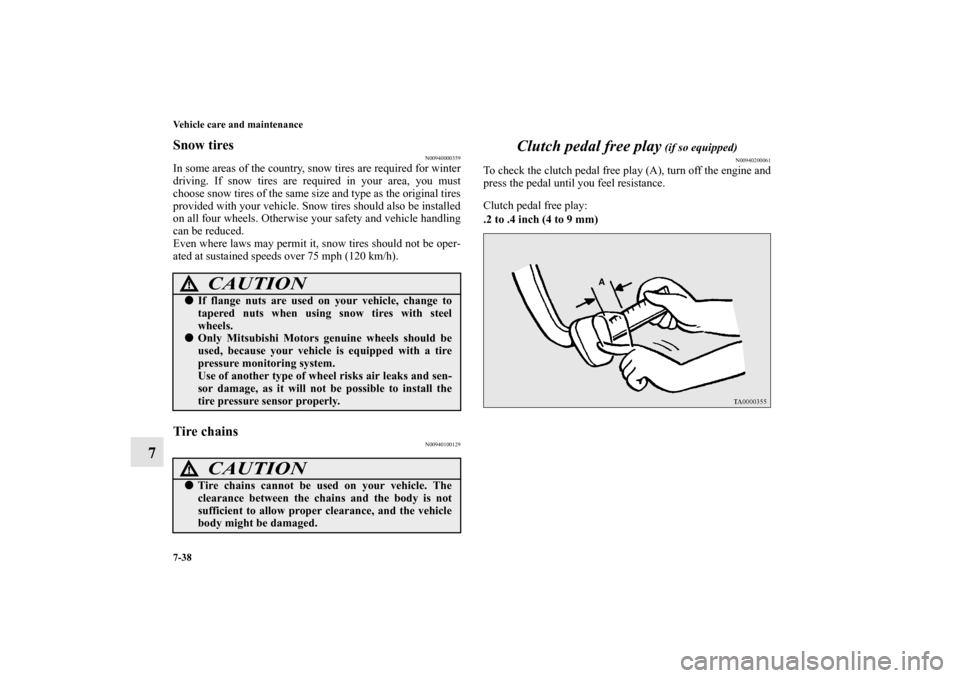
To check the clutch pedal free play (A), turn off the engine and
press the pedal until you feel resistance.
Clutch pedal free play:
.2 to .4 inch (4 to 9 mm)
CAUTION
!�If flange nuts are used on your vehicle, change to
tapered nuts when using snow tires with steel
wheels. �Only Mitsubishi Motors genuine wheels should be
used, because your vehicle is equipped with a tire
pressure monitoring system.
Use of another type of wheel risks air leaks and sen-
sor damage, as it will not be possible to install the
tire pressure sensor properly.
CAUTION
!�Tire chains cannot be used on your vehicle. The
clearance between the chains and the body is not
sufficient to allow proper clearance, and the vehicle
body might be damaged.
BK0151000US.book 38 ページ 2012年3月29日 木曜日 午後6時8分
Page 676 of 706
Vehicle care and maintenance
7-95
7
NOTE�When the door is frozen, opening it by force may tear off
or crack the rubber gasket installed around the door. Pour
warm water to melt the ice. Be sure to thoroughly wipe off
the water after opening the door. To prevent freezing of
the weatherstripping on the doors, hood, etc., treat with
silicone lubricant.Waxi n g
N00946000218
Wax your vehicle once or twice a year, or when water does not
bead up on the paint.
Use a soft cloth to put a small amount of wax on the painted
surfaces. After the wax has dried, polish with a dry soft cloth.
Do not wax your vehicle in direct sunlight.
You should wax when the painted surfaces are cool.
Polishing
N00946100059
If painted surfaces have been severely damaged and lost their
original luster and color tone, polish the surface lightly with a
fine polishing compound. Avoid limiting your polishing to the
damaged surface only; polish a somewhat wider area, moving
the polishing cloth in one direction. After polishing, flush the
compound from the surface and apply a coat of wax to regain a
beautiful luster.Damaged paint
N00946200063
Small cracks and scratches in the paint coat should be touched
up as soon as possible with touch-up paint to prevent corrosion.
Check body areas facing the road or the tires carefully for dam-
age to the paint caused by flying stones, etc. The paint code
number for your vehicle can be found on the vehicle informa-
tion code plate in the engine compartment.
CAUTION
!�Waxes containing high abrasive compounds should
not be used. These waxes remove rust and stain
effectively from the paintwork, but are harmful to
the finish on the paint and the plate, because they
also remove clearcoat.
They are also harmful to other glossy surfaces such
as the grille, trim, moldings, etc.�Do not use gasoline, kerosene, benzine or paint thin-
ners to remove road tar or other dirt from the vehi-
cle surface.
�Do not put wax on the areas having black matte
coating because it can cause uneven discoloration,
patches, blurs, etc. If these get wax on them, wipe
the wax off right away with a soft cloth and warm
water.�On vehicles equipped with sunroof, be careful not to
apply any wax on the weatherstrip (black rubber)
when waxing the area around the sunroof opening.
If stained with wax, the weatherstrip cannot main-
tain a weatherproof seal with the sunroof.
CAUTION
!
BK0151000US.book 95 ページ 2012年3月29日 木曜日 午後6時8分
Page 681 of 706
8-2 Customer assistance/Reporting Safety Defects
8Consumer information (For vehicles sold in
U.S.A.)
N01047100100
This information is provided in compliance with the require-
ments of the National Highway Traffic Safety Administration,
Department of Transportation. It provides the purchasers
and/or prospective purchasers with information on reporting
safety defects. Uniform tire quality gradingDOT quality grades - All passenger vehicle tires must conform
to Federal Safety Requirements in addition to these grades. The
specific grade rating in each grade category is shown on the
side wall of the tires on your vehicle. Treadwear The treadwear grade is a comparative rating based on the wear
rate of the tire when tested under controlled conditions on a
specified government test course. For example, a tire graded
150 would wear one and one-half (1
1/2) times as well on the
government course as a tire graded 100. The relative perfor-
mance of tires depends upon the actual conditions of their use,
however, and may depart significantly from the norm due to
variations in driving habits, service practices and differences in
road characteristics and climate.
Traction AA, A, B, C The traction grades, from highest to lowest, are AA, A, B and
C. Those grades represent the tire’s ability to stop on wet pave-
ment as measured under controlled conditions on specified
government test surfaces of asphalt and concrete. A tire
marked C may have poor traction performance.
Temperature A, B, CThe temperature grades are A (the highest), B and C, represent-
ing the tire’s resistance to the generation of heat and its ability
to dissipate heat when tested under controlled conditions on a
specified indoor laboratory test wheel. Sustained high tempera-
ture can cause the material of the tire to degenerate and reduce
tire life, and excessive temperature can lead to sudden tire fail-
ure. The grade C corresponds to a level of performance which
all passenger car tires must meet under the Federal Motor Vehi-
cle Safety Standard No. 109. Grades B and A represent higher
levels of performance on the laboratory test wheel than the
minimum required by law.
WA R N I N G
!�The traction grade assigned to this tire is based on
straight-ahead braking traction tests, and does not
include acceleration, cornering, hydroplaning, or
peak traction characteristics.
WA R N I N G
!�The temperature grade for this tire is established for
a tire that is properly inflated and not overloaded.
Excessive speed, underinflation, or excessive load-
ing, either separately or in combination, can cause
heat buildup and possible tire failure.
BK0151000US.book 2 ページ 2012年3月29日 木曜日 午後6時8分
Page 686 of 706
9
Specifications
Vehicle labeling . . . . . . . . . . . . . . . . . . . . . . . . . . .9- 2
Vehicle dimensions . . . . . . . . . . . . . . . . . . . . . . . .9- 6
Vehicle weights . . . . . . . . . . . . . . . . . . . . . . . . . . .9- 7
Engine specifications . . . . . . . . . . . . . . . . . . . . . . .9- 8
Battery . . . . . . . . . . . . . . . . . . . . . . . . . . . . . . . . . .9- 9
Tires and wheels. . . . . . . . . . . . . . . . . . . . . . . . . . .9- 9
Refill capacities . . . . . . . . . . . . . . . . . . . . . . . . . . .9- 10
BK0151000US.book 1 ページ 2012年3月29日 木曜日 午後6時8分
Page 694 of 706
Specifications
9-9
9 Battery
N01147800182
Battery is a 12 volt type.
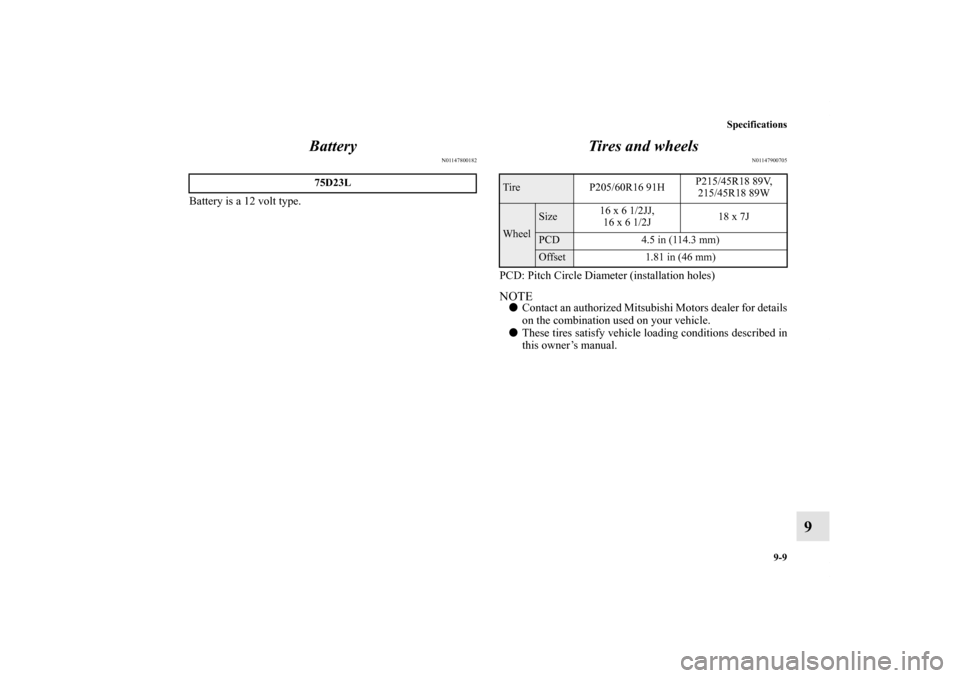
Tires and wheels
N01147900705
PCD: Pitch Circle Diameter (installation holes)NOTE�Contact an authorized Mitsubishi Motors dealer for details
on the combination used on your vehicle.
�These tires satisfy vehicle loading conditions described in
this owner’s manual.
75D23L
Tire P205/60R16 91HP215/45R18 89V,
215/45R18 89WWheel
Size16 x 6 1/2JJ,
16 x 6 1/2J18 x 7JPCD 4.5 in (114.3 mm)Offset 1.81 in (46 mm)
BK0151000US.book 9 ページ 2012年3月29日 木曜日 午後6時8分
Page 702 of 706
Alphabetical index
5
Shift points (recommended speed) 3-96
Mirror
Inside day/night rearview mirror 3-79
Outside rearview mirrors 3-83
Modification of your vehicle 1-7
Multi-information display 3-177
O
Oil
Engine oil 7-8
,9-10
Manual transaxle oil 7-17
,9-10
Rear axle oil 7-19
,9-10
Transfer oil 7-18
,9-10
Operation under adverse driving conditions 6-23
Outside rearview mirrors 3-83
Overheating 6-5
P
Parking 4-8
Parking brake 3-76
Parking brake break-in 7-40
Parking brake lever stroke 7-39
Polishing 7-95
Power brakes 3-140
Power door locks 3-56
Power outlet 3-287
Power steering
Fluid 7-22
,9-10
System 3-147Power windows 3-69
Puncture (Tire changing) 6-8
R
Radiator cap 7-13
Radio
AM/FM electronically tuned radio with CD player 5-46
AM/FM electronically tuned radio with 6 CD autochanger 5-
74
General information about your radio 5-142
Rain sensor 3-244
Rear hatch 3-59
Inside rear hatch release 3-61
Rear shelf panel 3-301
Rear side-marker lights
Bulb capacity 7-56
Replacement 7-81
Rear turn signal lights
Bulb capacity 7-56
Replacement 7-81
Rear window defogger switch 3-251
Rear-view camera 3-169
Rearview mirror
Inside 3-79
Outside 3-83
Refrigerant (air conditioning) 9-10
Replacement of light bulbs 7-56
Replacing tires and wheels 7-34
Reporting Safety Defects 8-3
BK0151000US.book 5 ページ 2012年3月29日 木曜日 午後6時8分