Page 83 of 626
2-56 Seat and restraint systems
2
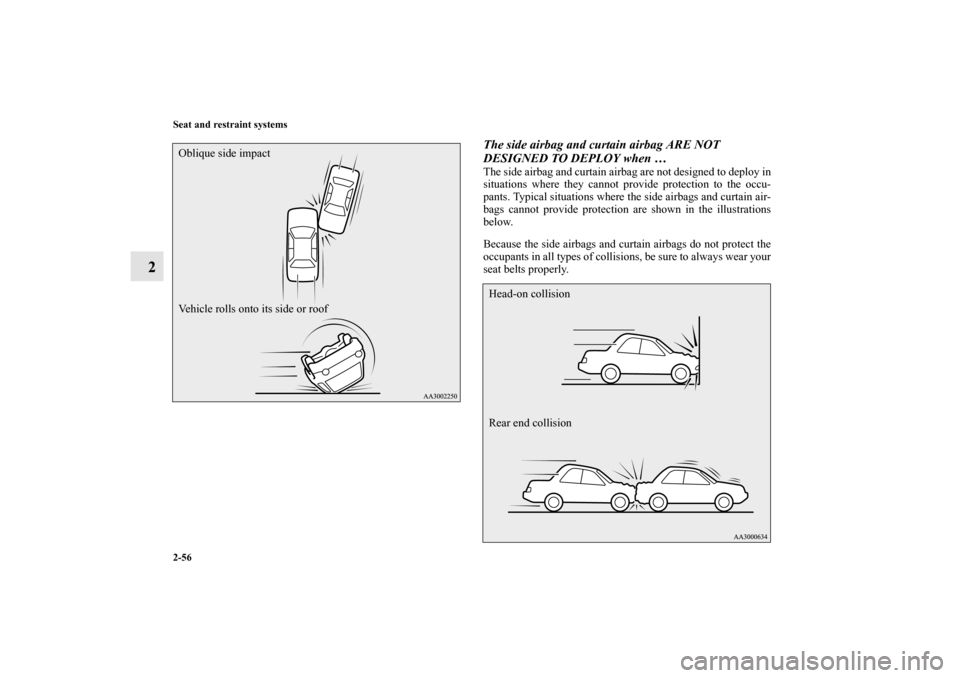
The side airbag and curtain airbag ARE NOT
DESIGNED TO DEPLOY when …The side airbag and curtain airbag are not designed to deploy in
situations where they cannot provide protection to the occu-
pants. Typical situations where the side airbags and curtain air-
bags cannot provide protection are shown in the illustrations
below.
Because the side airbags and curtain airbags do not protect the
occupants in all types of collisions, be sure to always wear your
seat belts properly.
Oblique side impact
Vehicle rolls onto its side or roof
Head-on collision
Rear end collision
BK0150900US.book 56 ページ 2012年5月7日 月曜日 午後12時9分
Page 84 of 626

Seat and restraint systems
2-57
2
SRS servicing
N00408500672
NOTE�When you transfer ownership of the vehicle to another
person, we urge you to alert the new owner that it is
equipped with the SRS and refer that owner to the applica-
ble sections in this owner’s manual.
�If you decide to junk or scrap your vehicle, we urge you to
first take it to an authorized Mitsubishi Motors dealer so
that the SRS can be made safe for disposal.
�If any of the following parts needs to be modified for use
by a handicapped person, the advanced airbag system will
be greatly affected. Please consult an authorized
Mitsubishi Motors dealer for assistance.
• Driver’s seat
• Front passenger seat
• Front seat belt
• Steering wheel
• Instrument panel
WA R N I N G
!�Any maintenance performed on or near the compo-
nents of the SRS should be performed only by an
authorized Mitsubishi Motors dealer. Do not permit
anyone else to do any service, inspection, mainte-
nance or repair on any SRS components or wiring.
Similarly, no part of the SRS should ever be han-
dled, removed or disposed by anyone except an
authorized Mitsubishi Motors dealer.
Improper work methods on the SRS components or
wiring could result in an accidental airbag deploy-
ment or could make the SRS inoperable. Either of
these situations could result in serious injury or
death. �Do not modify your steering wheel or any other SRS
component or related vehicle part. For example,
replacement of the steering wheel, or modifications
to the front bumper or body structure can adversely
affect SRS performance and may lead to injury.�If your vehicle has received any damage, you should
have the SRS inspected by an authorized Mitsubishi
Motors dealer to make sure it is in proper working
order.
�Do not modify your front seats, center pillar or cen-
ter console. Such modifications can adversely affect
SRS performance and may lead to injury.
Also, if you discover any tear or open seam in the
seat fabric near the side airbag, have the seat
inspected by an authorized Mitsubishi Motors
dealer. �If you find a crack in or damage to the front pillar,
rear pillar, or roof side rail where the curtain airbag
is located, have the SRS inspected by an authorized
Mitsubishi Motors dealer.
WA R N I N G
!
BK0150900US.book 57 ページ 2012年5月7日 月曜日 午後12時9分
Page 118 of 626

Features and controls
3-31
3
Starting the engineYour vehicle is equipped with an electronically controlled fuel
injection system. This is a system that automatically controls
fuel injection. There is no need to depress the accelerator pedal
when starting the engine.
The starter motor should not be run for more than 15 seconds at
a time.
To prevent battery drain, wait a few seconds between attempts
to restart the engine.
1. Make sure all occupants are properly seated with seat
belts fastened.
2. Press and hold the brake pedal down with your right foot.
3. Press and hold the clutch pedal all the way down (manual
transaxle).NOTE�For models equipped with a manual transaxle, the starter
will not operate unless the clutch pedal is fully depressed
(Clutch interlock). This is a safety feature.
4. On vehicles with manual transaxle, place the gearshift
lever in the “N” (Neutral) position.
On vehicles with Twin Clutch SST, make sure the gear-
shift lever is in the “P” (PARK) position.NOTE�On vehicles with Twin Clutch SST, the starter will not
operate unless the gearshift lever is in the “P” (PARK)
position or the gearshift lever is in the “N” (NEUTRAL)
position with the brake pedal depressed.
For safety reasons, start the engine in the “P” (PARK)
position so that the wheels are locked.
WA R N I N G
!�Never run the engine in a closed or poorly ventilated
area any longer than is needed to move your vehicle
out of the area. Carbon monoxide gas, which is
odorless and extremely poisonous, could build up
and cause serious injury or death.
CAUTION
!�Do not push-start the vehicle.�Do not run the engine at high rpms or drive at high
speeds until the engine has had a chance to warm
up.�Release the ignition switch as soon as the engine
starts. Otherwise, the starter motor will be dam-
aged.
BK0150900US.book 31 ページ 2012年5月7日 月曜日 午後12時9分
Page 125 of 626

3-38 Features and controls
3
Starting the engine
The vehicle is equipped with an electronically controlled fuel
injection system. This is a system that automatically controls
the fuel injection. There is no need to depress the accelerator
pedal when starting the engine.
The starter motor should not be run for more than 15 seconds at
a time.
To prevent battery drain, wait a few seconds between attempts
to restart the engine.
1. Make sure all occupants are properly seated with seat
belts fastened.
2. While pushing the lock release buttons (A), remove the
cover of the ignition switch.
WA R N I N G
!�Never run the engine in a closed or poorly ventilated
area any longer than is needed to move your vehicle
out of the area. Carbon monoxide gas, which is
odorless and extremely poisonous, could build up
and cause serious injury or death.
CAUTION
!�Do not push-start the vehicle.�Do not run the engine at high rpms or drive at high
speeds until the engine has had a chance to warm
up.�Release the emergency key as soon as the engine
starts. It will damage the starter motor.
BK0150900US.book 38 ページ 2012年5月7日 月曜日 午後12時9分
Page 139 of 626

3-52 Features and controls
3
4. Install a new battery with the + side (A) up.
5. Close the remote control transmitter case firmly.
6. Check the keyless entry system to see that it works.NOTE�You may purchase a replacement battery at an electric
appliance store.
�An authorized Mitsubishi Motors dealer can replace the
battery for you if you prefer.
Door locks
N00509200518
CAUTION
!�When the remote control transmitter case is opened,
be careful to keep water, dust, etc. out. Also, do not
touch the internal components.
Coin type battery
CR2032+ side
- side
WA R N I N G
!�Make sure all doors are tightly closed and locked
while driving.
• Locked doors, in combination with the use of seat
belts, can help reduce the risk of ejection in an
accident.
• Locked doors can help keep passengers, especially
small children, from opening doors and falling out
of moving vehicles.
• Locked doors can help prevent outsiders from
gaining access to your vehicle when you slow or
come to a stop.
�Lock your vehicle whenever you leave it. Children
who get into unlocked vehicles may not be able to
get out. Children trapped inside vehicles can quickly
be overcome by heat and suffer serious injury or
death due to heat stroke.�Never leave children unattended inside a vehicle. In
addition to the risk of heat stroke, children can acti-
vate switches and controls, resulting in an injury or
fatal accident.
BK0150900US.book 52 ページ 2012年5月7日 月曜日 午後12時9分
Page 175 of 626
![MITSUBISHI LANCER EVOLUTION 2013 10.G Owners Manual 3-88 Features and controls
3
Starting the engine
N00542200133
[For vehicles equipped with the F.A.S.T.-key]
For information on operation for vehicles equipped with the
F.A.S.T.-key, refer to “F.A.S.](/manual-img/19/7472/w960_7472-174.png "MITSUBISHI LANCER EVOLUTION 2013 10.G Owners Manual 3-88 Features and controls
3
Starting the engine
N00542200133
[For vehicles equipped with the F.A.S.T.-key]
For information on operation for vehicles equipped with the
F.A.S.T.-key, refer to “F.A.S.")
3-88 Features and controls
3
Starting the engine
N00542200133
[For vehicles equipped with the F.A.S.T.-key]
For information on operation for vehicles equipped with the
F.A.S.T.-key, refer to “F.A.S.T.-key: Starting the engine” on
page 3-30.
[Except for vehicles equipped with the F.A.S.T.-key]
Your vehicle is equipped with an electronically controlled fuel
injection system, which automatically controls the release of
fuel. There is usually no need to depress the accelerator pedal
when starting the engine.
The starter should not be run for more than 15 seconds at a
time.
To prevent battery drain, wait a few seconds between attempts
to restart the engine.
1. Make sure all occupants are properly seated with seat
belts fastened.
2. Insert the ignition key.
3. Make sure the parking brake is applied.
4. Press and hold the brake pedal down with your right foot.
5. Press and hold the clutch pedal all the way down (manual
transaxle).NOTE�For models equipped with a manual transaxle, the starter
will not operate unless the clutch pedal is fully depressed
(Clutch interlock). This is a safety feature.
WA R N I N G
!�Never run the engine in a closed or poorly ventilated
area any longer than is needed to move your vehicle
out of the area. Carbon monoxide gas, which is
odorless and extremely poisonous, could build up
and cause serious injury or death.
CAUTION
!�Do not push-start the vehicle.�Do not run the engine at high rpms or drive at high
speeds until the engine has had a chance to warm
up.�Release the ignition switch as soon as the engine
starts. Otherwise, the starter motor will be dam-
aged.
BK0150900US.book 88 ページ 2012年5月7日 月曜日 午後12時9分
Page 273 of 626
3-186 Features and controls
3Indicator light, warning light, and information screen display list
N00557700019
Indicator and warning light list
N00557800212
Type 1 Type 21- Position indicator → P.3-198
2- High beam indicator → P.3-198
3- Charging system warning light → P.3-200
4- Turn signal indicator/Hazard warning light → P.3-198
5- Front fog light indicator → P.3-198
6- Anti-lock braking system warning light → P.3-127, 3-128
7- Tire pressure monitoring system warning light → P.3-146
8- Brake warning light → P. 3 - 1 9 8
9- Cruise control indicator → P.3-139
10- Seat belt reminder/warning light → P.2-16
11- Supplemental Restraint System (SRS) warning light → P. 2 -
4212- Engine malfunction indicator (“SERVICE ENGINE SOON”
or “Check engine light”) → P.3-199
13- Active stability control (ASC) indicator → P.3-133
14- Information screen display list → P. 3 - 1 8 7
BK0150900US.book 186 ページ 2012年5月7日 月曜日 午後12時9分
Page 280 of 626
Features and controls
3-193
3
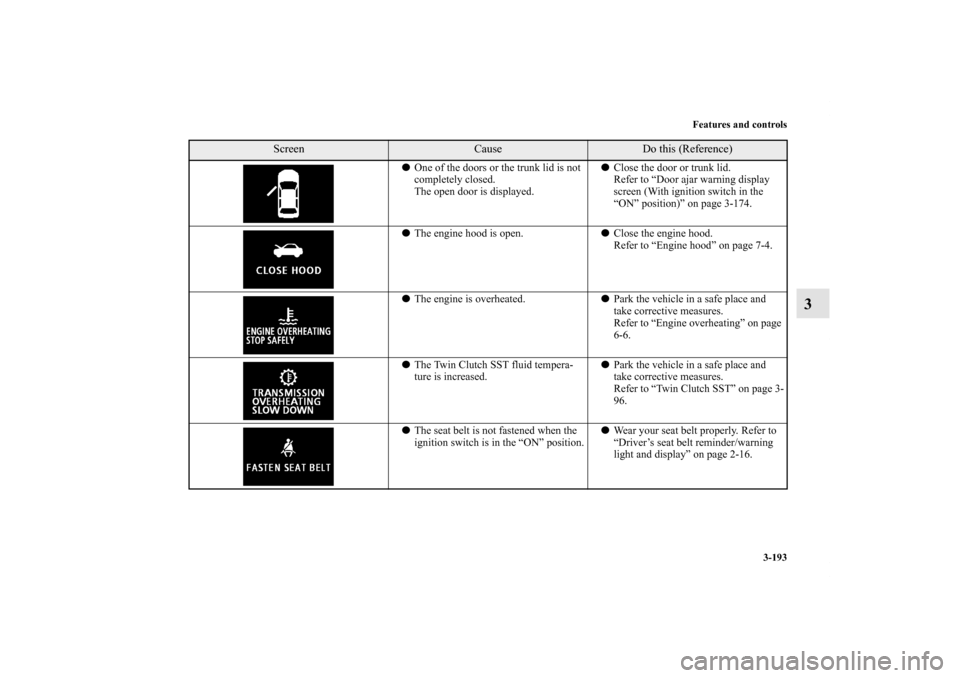
�One of the doors or the trunk lid is not
completely closed.
The open door is displayed.�Close the door or trunk lid.
Refer to “Door ajar warning display
screen (With ignition switch in the
“ON” position)” on page 3-174.
�The engine hood is open.�Close the engine hood.
Refer to “Engine hood” on page 7-4.
�The engine is overheated.�Park the vehicle in a safe place and
take corrective measures.
Refer to “Engine overheating” on page
6-6.
�The Twin Clutch SST fluid tempera-
ture is increased.�Park the vehicle in a safe place and
take corrective measures.
Refer to “Twin Clutch SST” on page 3-
96.
�The seat belt is not fastened when the
ignition switch is in the “ON” position.�Wear your seat belt properly. Refer to
“Driver’s seat belt reminder/warning
light and display” on page 2-16.
Screen
Cause
Do this (Reference)
BK0150900US.book 193 ページ 2012年5月7日 月曜日 午後12時9分