Page 265 of 626
3-178 Features and controls
3
4. Lightly press the multi-information meter switch to switch
in sequence from km/L → L/100 km → mpg (US) → mpg
(UK) → RETURN → km/L.
5. Press and hold the multi-information meter switch (for
about 2 seconds or more) to change the setting to the
selected unit.
NOTE�The display units for the driving range, the average fuel
consumption, the average speed and the momentary fuel
consumption are changed, but the units for the indicating
needle (speedometer), the odometer and the trip odometer
will remain unchanged.
�If the battery is disconnected, the memory of the unit set-
ting is erased and is automatically set to {mpg (US) or
L/100 km}.
The distance and speed units are also changed in the following
combinations to match the selected fuel consumption unit.
Fuel
economy
Distance
(driving range)
Speed
(average speed)
mpg (US) mile (s) mph
mpg (UK) mile (s) mph
km / L km km / h
L / 100 km km km / h
BK0150900US.book 178 ページ 2012年5月7日 月曜日 午後12時9分
Page 271 of 626

3-184 Features and controls
3
Changing the turn signal sound
N00563500067
It is possible to change the turn signal sound.
1. Press and hold the multi-information meter switch for
about 2 seconds or more to switch from the setting mode
screen to the menu screen.
Refer to “Changing the function settings (With ignition
switch in the “ON” position)” on page 3-174.
2. Lightly press the multi-information meter switch to select
. (changing the turn signal sound)
3. Press and hold the multi-information meter switch for
about 2 seconds or more to switch in sequence from 1
(turn signal sound 1) → 2 (turn signal sound 2) → 1 (turn
signal sound 1).
The setting changes to the selected turn signal sound.
Changing the momentary fuel consumption display
N00563600026
It is possible to change the bar graph setting of the momentary
fuel consumption display.
1. Press and hold the multi-information meter switch for
about 2 seconds or more to switch from the setting mode
screen to the menu screen.
Refer to “Changing the function settings (With ignition
switch in the “ON” position)” on page 3-174.
2. Lightly press the multi-information meter switch to select
. (changing the momentary fuel consumption display)
3. Press and hold the multi-information meter switch for
about 2 seconds or more to switch in sequence from ON
(with the green bar graph) → OFF (without the green bar
graph) → ON (with the green bar graph).
The setting changes to the selected bar graph setting.
BK0150900US.book 184 ページ 2012年5月7日 月曜日 午後12時9分
Page 272 of 626

Features and controls
3-185
3
Returning to the factory settings
N00557600177
All of the function settings can be returned to their factory set-
tings.
1. Press and hold the multi-information meter switch (for
about 2 seconds or more) to switch from the setting mode
screen to the menu screen.
Refer to “Changing the function settings (With ignition
switch in the “ON” position)” on page 3-174.
2. Lightly press the multi-information meter switch to select
“RESET” (return to the factory settings).3. Press and hold the multi-information meter switch (for
about 5 seconds or more), the buzzer sounds and all of the
function settings are returned to the factory settings.
NOTE�The factory settings are as follows.
• Average fuel consumption and average speed reset
mode: A (Auto reset)
• Fuel consumption display unit: mpg (US) or (L/100 km)
• Temperature unit: °F (Fahrenheit) or {°C (Celsius)}
• Display language: ENGLISH
• Cooperative language setting: A
• Operation sounds: ON (Operation sound on)
• “REST REMINDER” display: OFF
• Turn signal sound: Turn signal sound 1
• Momentary fuel consumption with the green bar graph
: ON
BK0150900US.book 185 ページ 2012年5月7日 月曜日 午後12時9分
Page 281 of 626

3-194 Features and controls
3
�There is a fault in the fuel system.�Contact an authorized Mitsubishi
Motors dealer or a repair facility of
your choice to have the system
checked.
�The vehicle is being driven with the
parking brake still applied.�Release the parking brake. Refer to
“Brake warning display” on page 3-
201.
�There is a fault in the engine oil circu-
lation system.�Park your vehicle in a safe place as
soon as possible and contact an autho-
rized Mitsubishi Motors dealer or a
repair facility of your choice to have
the system checked.
Refer to “Oil pressure warning” on
page 3-203.
�There is a fault in the charging system.�Park your vehicle in a safe place as
soon as possible and contact an autho-
rized Mitsubishi Motors dealer or a
repair facility of your choice for assis-
tance.
Refer to “Charging system warning
display” on page 3-200.
�There is a fault in the SRS airbag or the
pre-tensioner system.�Contact an authorized Mitsubishi
Motors dealer or a repair facility of
your choice to have the system
checked.
Refer to “SRS warning light/display”
on page 2-42.
Screen
Cause
Do this (Reference)
BK0150900US.book 194 ページ 2012年5月7日 月曜日 午後12時9分
Page 282 of 626

Features and controls
3-195
3
�There is a fault in the Active stability
control (ASC).�Contact an authorized Mitsubishi
Motors dealer or a repair facility of
your choice to have the system
checked.
Refer to “Active stability control
(ASC)” on page 3-130.
�There is a fault in the S-AWC (Super-
All Wheel Control).�Contact an authorized Mitsubishi
Motors dealer or a repair facility of
your choice to have the system
checked.
Refer to “S-AWC (Super-All Wheel
Control)” on page 3-120.
�A safety device in the Twin Clutch SST
has been activated due to a possible
malfunction in the Twin Clutch SST or
in the engine electronic control mod-
ule.�Contact an authorized Mitsubishi
Motors dealer or a repair facility of
your choice to have the system
checked.
Refer to “Twin Clutch SST” on page 3-
96.
�The fuel is running low.�Refuel as soon as possible. Refer to
“Fuel remaining warning display” on
page 3-170.
�The outside temperature is 37°F (3°C)
or less.�Be careful driving on frozen ground.
�The ground may be frozen even when
this warning is not displayed, so drive
carefully.
Screen
Cause
Do this (Reference)
BK0150900US.book 195 ページ 2012年5月7日 月曜日 午後12時9分
Page 286 of 626

Features and controls
3-199
3
Engine malfunction indicator (“SERVICE
ENGINE SOON” or “Check engine light”)
N00520500787
This indicator is a part of the onboard diagnostic (OBD) sys-
tem which monitors the emissions, engine control system or
Twin Clutch SST control system. If a problem is detected in
one of these systems, this indicator illuminates or flashes.
When the ignition switch is turned to the “ON” position, this
indicator normally comes on and goes off after the engine has
started.
This indicator will come on if the fuel tank filler cap is not
properly tightened. If this indicator comes on and stays on after
refueling, stop the engine and check that the cap is properly
tightened. (Turn the cap clockwise until you hear clicking
sounds.)
If this indicator does not go off after several seconds or lights
up while driving, have the system checked as soon as possible
at an authorized Mitsubishi Motors dealer or a repair facility of
your choice.
CAUTION
!�If the brake warning light and the Anti-lock braking
system warning light are illuminated at the same
time, the braking force distribution function will not
operate, so the vehicle may be destabilized during
sudden braking under the following conditions.
• When the brake warning light does not go out even
when the parking brake is released.
• When the brake warning light stays on while driv-
ing.
• If the above occurs, avoid sudden braking and
high-speed driving. Park the vehicle in a safe
place, and contact an authorized Mitsubishi
Motors dealer or a repair facility of your choice as
soon as possible.
�The vehicle should be brought to a halt in the follow-
ing manner when brake performance is deterio-
rated.
• Confirm that the vehicle slows down when you
press down on the brake pedal harder than usual.
In some cases, the brake pedal may go all the way
to the floor.
• Should the brakes fail, use engine braking to
reduce your speed and slowly apply the parking
brake.
Depress the brake pedal to illuminate the stop
lights to alert the vehicles behind you.
CAUTION
!�Driving for a long time with the engine malfunction
indicator on may cause more damage to the emission
control system. This could also affect fuel economy
and drivability.�If this indicator does not come on when the ignition
switch is turned to the “ON” position, have the sys-
tem checked at an authorized Mitsubishi Motors
dealer or a repair facility of your choice.
BK0150900US.book 199 ページ 2012年5月7日 月曜日 午後12時9分
Page 360 of 626
4
Driving safety
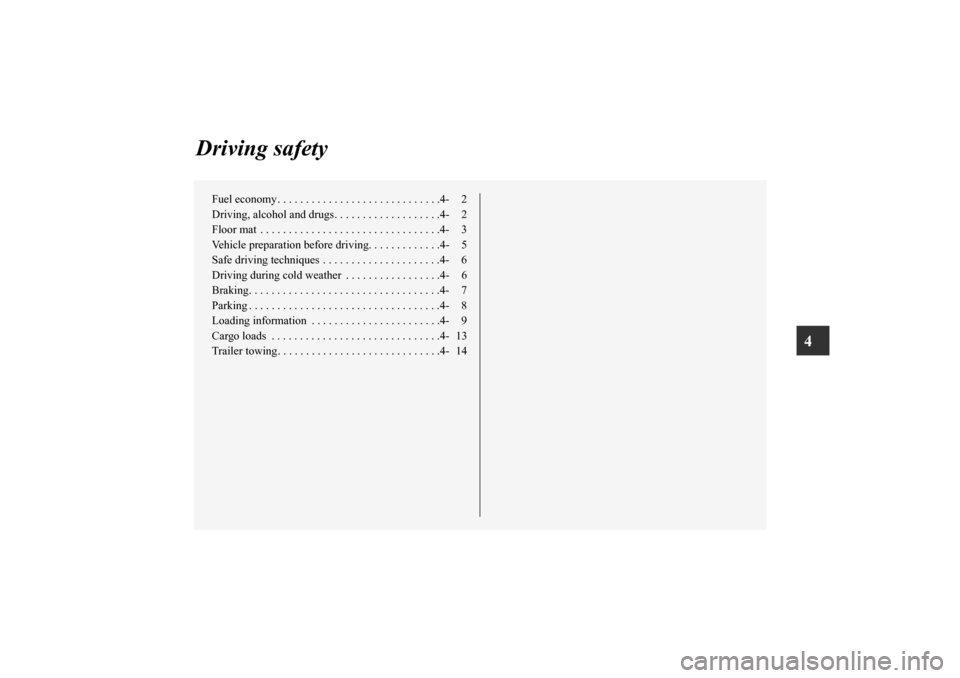
Fuel economy . . . . . . . . . . . . . . . . . . . . . . . . . . . . .4- 2
Driving, alcohol and drugs. . . . . . . . . . . . . . . . . . .4- 2
Floor mat . . . . . . . . . . . . . . . . . . . . . . . . . . . . . . . .4- 3
Vehicle preparation before driving. . . . . . . . . . . . .4- 5
Safe driving techniques . . . . . . . . . . . . . . . . . . . . .4- 6
Driving during cold weather . . . . . . . . . . . . . . . . .4- 6
Braking. . . . . . . . . . . . . . . . . . . . . . . . . . . . . . . . . .4- 7
Parking . . . . . . . . . . . . . . . . . . . . . . . . . . . . . . . . . .4- 8
Loading information . . . . . . . . . . . . . . . . . . . . . . .4- 9
Cargo loads . . . . . . . . . . . . . . . . . . . . . . . . . . . . . .4- 13
Trailer towing. . . . . . . . . . . . . . . . . . . . . . . . . . . . .4- 14
BK0150900US.book 1 ページ 2012年5月7日 月曜日 午後12時9分
Page 361 of 626
4-2 Driving safety
4Fuel economy
N00628800107
Fuel economy is dependent on many factors. Your personal
driving habits can have a significant effect on your fuel use.
Several recommendations for achieving the greatest fuel econ-
omy are listed below.
�Whenever accelerating from a stop, always accelerate
slowly and smoothly.
�When parked for even a short period, do not idle the
engine. Shut it off.
�Plan your trips to avoid unnecessary stops.
�Keep your tires inflated to the recommended pressures.
�For freeway driving, maintain a speed of approximately
50 mph (80 km/h) when traffic, roadway and weather con-
ditions safely permit.
�Keep your air filter clean and your vehicle lubricated
according to the recommendations in this manual.
�Always keep your vehicle well maintained. A poorly
maintained engine wastes fuel and costs money.
�Do not overload your vehicle.
Driving, alcohol and drugs
N00628900010
Drunk driving is one of the most frequent causes of accidents.
Your driving ability can be seriously impaired even with blood
alcohol levels far below the legal minimum. If you have been
drinking, don’t drive. Ride with a designated non-drinking
driver, call a cab or a friend, or use public transportation.
Drinking coffee or taking a cold shower will not make you
sober.
Similarly, prescription and nonprescription drugs affect your
alertness, perception and reaction time. Consult with your doc-
tor or pharmacist before driving while under the influence of
any of these medications.
WA R N I N G
!�NEVER DRINK AND DRIVE.
Your perceptions are less accurate, your reflexes are
slower and your judgment is impaired.
BK0150900US.book 2 ページ 2012年5月7日 月曜日 午後12時9分