2013 MITSUBISHI L200 transmission
[x] Cancel search: transmissionPage 284 of 362

Operation under adverse drivingconditions E00801702762
If your vehicle becomes stuck in sand,
mud or snow
If the vehicle becomes stuck in snow, sand, or
mud, it can often be moved with a rocking motion.
Move the selector lever alternately between the
Sport Mode and “R” (REVERSE) position (with
manual transmission, between 1 st
and Reverse),
while applying slight pressure to the accelerator ped-
al.
Avoid racing the engine or spinning the wheels. Pro-
longed efforts to free a stuck vehicle may result in
overheating and transmission failure. Allow the en-
gine to idle for a few minutes to let the transmis-
sion cool between rocking attempts.
If the vehicle remains stuck after several rocking at-
tempts, seek other assistance.WARNINGl When attempting to rock your vehicle out
of a stuck position, be sure that the area
around the vehicle is clear of people and
physical objects. The rocking motion may
cause the vehicle to suddenly launch for-
ward or backward, causing injury or dam-
age to nearby people or objects.
On 2WD vehicles, it is recommended to start the ve-
hicle with parking brake partially, but not complete-
ly, applied by slightly pulling the parking brake lev-
er.
After the vehicle has become free, do not forget to
release the parking brake.
NOTE
l Depress the accelerator pedal gradually when
starting the vehicle.
On a flooded road l Avoid flooded roads. Water could enter the
brake discs, resulting in temporarily ineffec-
tive brakes. In such cases, lightly depress the
brake pedal to see if the brakes operate prop-
erly. If they do not, lightly depress the pedal
several times while driving in order to dry
the brake pads.
l When driving in rain or on a road with many
puddles a layer of water may form between
the tyres and the road surface.
This reduces a tyre’s frictional resistance on
the road, resulting in loss of steering stability
and braking capability.
To cope with this, observe the following items: (a)Drive your vehicle at slow speed. (b)Do not drive on worn tyres. Always
maintain the specified tyre inflation
pressures.
On a snow-covered or frozen road
l When driving on a snow-covered or frozen
road, it is recommended that you use snow
tyres or tyre chains.
Refer to the “Snow tyres” and “Tyre chains”
sections.
l Avoid high-speed operation, sudden acceler-
ation, abrupt brake application and sharp cor-
nering.
l Depressing the brake pedal during travel on
snowy or icy roads may cause tyre slippage
and skidding. When traction between the
tyres and the road is reduced the wheels may
skid and the vehicle cannot readily be
brought to a stop by conventional braking
techniques. Braking will differ, depending
upon whether you have anti-lock brake sys-
tem (ABS). If you do have ABS, brake by
pressing the brake system pedal hard, and
keeping it pressed. If you do not have ABS,
pump the brake pedal with short rapid jabs,
each time fully applying and fully releasing
for greatest effect.
l Allow extra distance between your vehicle
and the vehicle in front of you, and avoid sud-
den braking.
l Accumulation of ice on the braking system
can cause the wheels to lock. Pull away from
a standstill slowly after confirming safety
around the vehicle.CAUTIONl Do not press the accelerator pedal rapid-
ly. If the wheels break free of the ice, the
vehicle could suddenly start moving and
possibly cause an accident.
On a bumpy or rutted road
l Drive as slow as possible when driving on
bumpy or rutted roads.
For emergencies
6-24 OKTE13E1
6
Page 293 of 362

Service precautions....................................................................... 8-02
Catalytic converter ........................................................................ 8-02
Bonnet ........................................................................................... 8-03
Engine oil ...................................................................................... 8-04
Engine coolant .............................................................................. 8-06
Automatic transmission fluid*......................................................8-07
Washer fluid ................................................................................. 8-08
Brake fluid .................................................................................... 8-08
Clutch fluid* ................................................................................. 8-09
Power steering fluid ...................................................................... 8-09
Battery .......................................................................................... 8-10
Tyres ............................................................................................. 8-11
Clutch pedal free play* ................................................................. 8-15
Brake pedal free play .................................................................... 8-16
Parking brake lever stroke ............................................................ 8-16
Wiper blades ................................................................................. 8-17
General maintenance .................................................................... 8-18
For cold and snowy weather ......................................................... 8-19
Fusible links .................................................................................. 8-19
Fuses ............................................................................................. 8-20
Replacement of lamp bulbs .......................................................... 8-23Maintenance
OKTE13E1
8
Page 299 of 362
CAUTIONlDo not use alcohol or methanol anti-
freeze or any engine coolants mixed with
alcohol or methanol anti-freeze. The use
of an improper anti-freeze can cause cor-
rosion of the aluminium components.
l For effective anti-corrosion and anti-
freeze performance, keep the anti-freeze
concentration within the range of 30 to
60 %.
Concentrations exceeding 60 % will re-
sult in a reduction of both the anti-freeze
and cooling performance thus adversely
affecting the engine.
l Do not top up with water only.
Water by itself reduces the rust-protec-
tive and anti-freeze qualities of the cool-
ant and has a lower boiling point. It can
also cause damage to the cooling system if
it should freeze. Do not use tapwater, as it
can cause corrosion and rust formation.
During cold weather
If the temperatures in your area drop below freez-
ing, there is the danger that the coolant in the en-
gine or radiator could freeze and cause severe dam-
age to the engine and/or radiator.
Add a sufficient amount of anti-freeze to the cool-
ant to prevent it from freezing.
The concentration should be checked before the
start of cold weather and anti-freeze added to the
system if necessary.
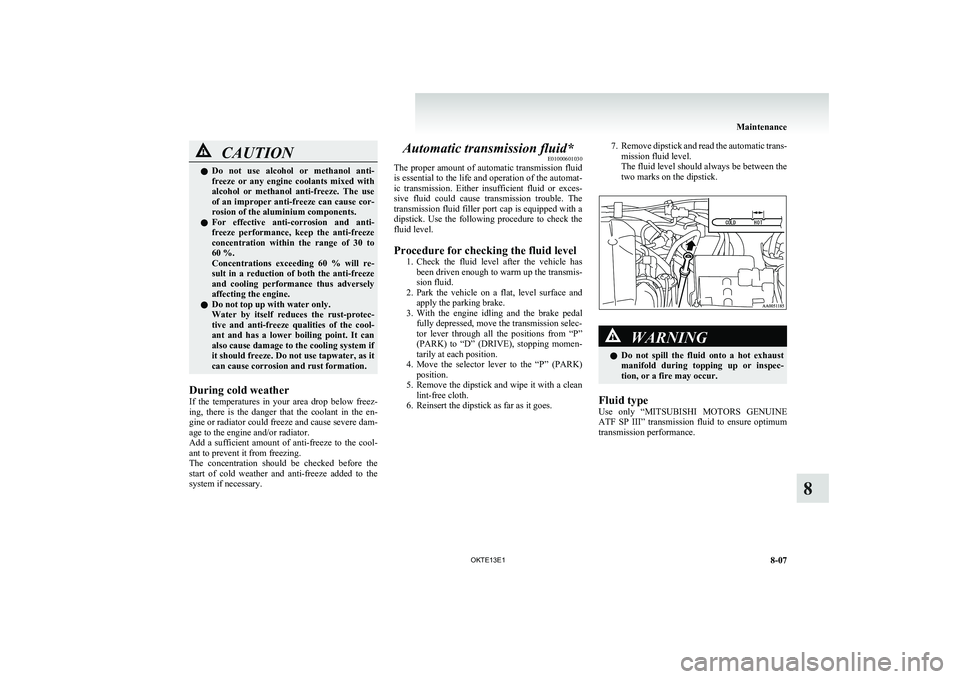
Automatic transmission fluid* E01000601030
The proper amount of automatic transmission fluid
is essential to the life and operation of the automat-
ic transmission. Either insufficient fluid or exces-
sive fluid could cause transmission trouble. The
transmission fluid filler port cap is equipped with a
dipstick. Use the following procedure to check the
fluid level.
Procedure for checking the fluid level 1.Check the fluid level after the vehicle has
been driven enough to warm up the transmis-
sion fluid.
2. Park the vehicle on a flat, level surface and
apply the parking brake.
3. With the engine idling and the brake pedal
fully depressed, move the transmission selec-
tor lever through all the positions from “P”
(PARK) to “D” (DRIVE), stopping momen-
tarily at each position.
4. Move the selector lever to the “P” (PARK)
position.
5. Remove the dipstick and wipe it with a clean
lint-free cloth.
6. Reinsert the dipstick as far as it goes.7. Remove dipstick and read the automatic trans-
mission fluid level.
The fluid level should always be between the
two marks on the dipstick.WARNINGl Do not spill the fluid onto a hot exhaust
manifold during topping up or inspec-
tion, or a fire may occur.
Fluid type
Use only “ MITSUBISHI MOTORS GENUINE
ATF SP III” transmission fluid to ensure optimum
transmission performance.
Maintenance
8-07
OKTE13E1
8
Page 314 of 362

Engine compartment fuse location tableE01008000583Engine compartment fuse locationFront
No.SymbolElectrical systemCa-
pacity1———2Electric window system40 A3Ignition switch40 A4Air conditioning compres-
sor10 A5Condenser fan motor20 ANo.SymbolElectrical systemCa-
pacity6Headlamp high-beam
(left)10 A7Headlamp high-beam
(right)10 A8Headlamp low beam (left)10 A9Headlamp low beam
(right)10 A10Engine control20 A11Alternator7.5 A12Stop lamps15 A13Horn10 A14Automatic transmission20 A15Hazard warning flasher10 A16Fuel pump15 A17Front fog lamps15 A18Audio amp20 A
l Some fuses may not be installed on your ve-
hicle, depending on the vehicle model or spec-
ifications.
l The table above shows the main equipment
corresponding to each fuse.
Identification of fuse E01008100308CapacityColour7.5 ABrown10 ARed15 ABlue20 AYellow30 AGreen (fuse type)/
Pink (fusible link type)40 AGreen (fusible link type)Fuse replacement E01007800656
1.Before replacing a fuse, always turn off the
electrical circuit concerned and place the ig-
nition switch in the “LOCK” position.
2. Pull the fuse lid (A) to remove it.
3. Remove the fuse puller (B) from the fuse lid
(A).
Maintenance
8-22 OKTE13E1
8 LHD
Page 327 of 362

Vehicle labeling............................................................................ 9-02
Vehicle dimensions.......................................................................9-03
Vehicle performance.....................................................................9-09
Vehicle weight .............................................................................. 9-10
Engine specifications .................................................................... 9-14
Transmission specifications .......................................................... 9-15
Electrical system ........................................................................... 9-16
Tyres and wheels .......................................................................... 9-17
Other specifications ...................................................................... 9-18
Fuel consumption ......................................................................... 9-19
Refill capacities ............................................................................ 9-20Specifications
OKTE13E1
9
Page 328 of 362

Vehicle labelingE01100101791
Vehicle identification number
The vehicle identification number is stamped as
shown in the illustration.
Vehicle information code plate
The vehicle information code plate is located as
shown in the illustration.
The plate shows model code and engine model,
transmission model and body colour code, etc.
Please use this number when ordering replacement
parts.
1- Model code
2- Engine model code
3- Transmission model code
4- Body colour code
5- Interior code
6- Option code
Vehicle identification number plate
(RHD vehicles only)
The vehicle identification number is stamped on
the plate riveted to the left front corner of the instru-
ment panel pad. It is visible from outside of the ve-
hicle through the windscreen.
Engine number
The engine number is stamped on the engine cylin-
der block as shown in the illustration.
Specifications
9-02 OKTE13E1
9
Page 341 of 362

Transmission specificationsE01100701553
Item
M/TA/T2WD4WD
2WD
4WDVehicles
with 15 inch tyresVehicles
with 16 inch tyresEasy select4WDSuper select 4WDEasy select4WDSuper select 4WDHigh powerengineStandard
power engine4A/T5A/TTransmission1 st
gear ratio4.3132.8423.7892nd
gear ratio2.3301.4952.0573rd
gear ratio1.4361.0001.4214th
gear ratio1.0000.7311.0005th
gear ratio0.788—0.731Reverse gear
ratio4.2202.7203.865TransferHigh gear ra-
tio—1.000—1.0001.000Low gear ra-
tio—1.900—1.9001.900Final gear ratio3.9093.9173.9173.9173.917, 4.100 *3.9173.9174.1003.917*
: Vehicles for Russia, Kazakhstan and Ukraine
Specifications
9-15
OKTE13E1
9
Page 347 of 362
![MITSUBISHI L200 2013 Owners Manual (in English) No.ItemQuantityLubricants1Engine coolant8.2 litres
[includes 0.65 litre in the reserve tank]MITSUBISHI MOTORS GENUINESUPER LONG LIFE COOLANT or equivalent2Automatic transmission fluid9.7 litresMITSUBI](/manual-img/19/34875/w960_34875-346.png "MITSUBISHI L200 2013 Owners Manual (in English) No.ItemQuantityLubricants1Engine coolant8.2 litres
[includes 0.65 litre in the reserve tank]MITSUBISHI MOTORS GENUINESUPER LONG LIFE COOLANT or equivalent2Automatic transmission fluid9.7 litresMITSUBI")
No.ItemQuantityLubricants1Engine coolant8.2 litres
[includes 0.65 litre in the reserve tank]MITSUBISHI MOTORS GENUINESUPER LONG LIFE COOLANT or equivalent2Automatic transmission fluid9.7 litresMITSUBISHI MOTORS GENUINEATF SP III3Brake fluidAs requiredBrake fluid DOT3 or DOT44Clutch fluidAs requiredBrake fluid DOT3 or DOT45Power steering fluidAs requiredMITSUBISHI MOTORS GENUINE ATF II
6Engine oil
Oil pan2WD with 15 inch tyres6.5 litres
Refer to page 8-04.
2WD with 16 inch tyres, 4WD5.5 litresOil filter0.8 litreOil cooler0.1 litre7Washer fluid4.8 litres,
4.5 litres *1—8Manual transmis-
sion oil2WD2.3 litresMITSUBISHI MOTORS GENUINE MTF API classification GL-3 SAE 75W-854WD3.4 litres
9Transfer oil2.5 litres
MITSUBISHI MOTORS GENUINEMTF API classification GL-3 SAE
75W-85 or MITSUBISHI MOTORS
GENUINE Multi Gear Oil API classi- fication GL-4 SAE 75W-85*1: Vehicles with “front (Type 1)” (Refer to “Outside” on page 8-24)
*2 : 4WD vehicles only
*3 : Double cab with capacity up air conditioning
Specifications
9-21
OKTE13E1
9