2013 MINI COOPER CONVERTIBLE height
[x] Cancel search: heightPage 60 of 292

and side airbags on the front passenger side
are deactivated.
Deactivating the front passenger airbags
If a child restraint fixing system is used in
the front passenger seat, the front passenger
airbags must be deactivated; otherwise, there
is an increased risk of injury to the child when
the airbags are triggered, even with a child re‐
straint fixing system. ◀
Seat position and height
Before installing a child restraint fixing system,
move the front passenger seat as far back as
possible and adjust its height to the highest po‐
sition to obtain the best possible position for
the belt and to offer optimal protection in the
event of an accident.
Do not change this seat position once it has
been set.
Child seat securityMINI Coupe, MINI Roadster
The safety belt for the passenger can be locked
to prevent it from being pulled out when it is
used to secure child restraint systems.
MINI Convertible
All rear safety belts and the safety belt for the
front passenger can be locked to prevent ex‐
tension in order to permit attachment of child
restraint fixing systems.
To lock the safety belt
1.Secure the child restraint fixing system with
the belt.2.Pull out the belt webbing completely.3.Allow the belt webbing to be pulled in and
pull it taut against the child restraint fixing
system.
The safety belt is locked.
To unlock the safety belt
1.Open the belt buckle.2.Remove the child restraint fixing system.Seite 60ControlsTransporting children safely60
Online Edition for Part no. 01 40 2 919 017 - II/13
Page 125 of 292

Closing the tailgateDrive with the tailgate closed
Only drive with the tailgate closed; other‐
wise, passengers and other road users may be
endangered or the vehicle may be damaged if
an accident occurs or during braking or swerv‐
ing. In addition, exhaust fumes may enter the
passenger compartment. ◀
If, despite this, the vehicle must be driven with
the tailgate open:▷Drive moderately.▷Coupe: close all windows.▷Switch off recirculated air mode and greatly
increase the blower speed.
Hot exhaust system
Hot exhaust system
High temperatures are generated in the
exhaust system.
Do not remove the heat shields installed and
never apply undercoating to them. Make sure
that flammable materials, e. g. hay, leaves,
grass, etc. do not come in contact with the hot
exhaust system during driving, while in idle po‐
sition mode, or when parked. Such contact
could lead to a fire, and with it the risk of seri‐
ous personal injury as well as property damage.
Do not touch hot exhaust pipes; otherwise,
there is the danger of getting burned. ◀
Mobile communication devices in the
vehicle
Mobile communication devices in the ve‐
hicle
It is not recommended to use mobile phones,
such as mobile phones without a direct con‐
nection to an external aerial in the vehicle's
passenger compartment. Otherwise, the vehi‐
cle electronics and mobile communication de‐
vices can interfere with each other. In addition,
there is no assurance that the radiation gener‐
ated during transmission will be discharged
from the vehicle interior. ◀
Hydroplaning On wet or slushy roads, a wedge of water can
form between the tires and road surface.
This phenomenon is referred to as hydroplan‐
ing. It is characterized by a partial or complete
loss of contact between the tires and the road
surface, ultimately undermining your ability to
steer and brake the vehicle.
Hydroplaning
When driving on wet or slushy roads, re‐
duce your speed to prevent hydroplaning. ◀
The risk of hydroplaning increases as the tire
tread depth decreases. Minimum tread depth,
refer to page 230.
Driving through water Drive though calm water only if it is not deeper
than 12 inches/30 cm and at this height, no
faster than walking speed, up to
6 mph/10 km/h.
Adhere to water depth and speed limita‐
tions
Do not exceed this water depth and walking
speed; otherwise, the vehicle's engine, the
electrical systems and the transmission may be
damaged. ◀
Using the handbrake on inclines Using the handbrake
On inclines, do not hold the vehicle sta‐
tionary with a slipping clutch for extended pe‐
riod; use the handbrake instead. Otherwise, the
clutch will be subject to increased wear. ◀
Support from the hill drive-off assistant, refer to
page 103.Seite 125Things to remember when drivingDriving tips125
Online Edition for Part no. 01 40 2 919 017 - II/13
Page 237 of 292

To avoid damage, make sure that the
wiper arms are resting against the wind‐
shield before you open the engine compart‐
ment. Do not open the engine hood before the
engine has cooled down; otherwise, injuries
may result. ◀
Unlocking and opening the hood1.Pull the lever.2.Lift the hood all the way.3.Press the release handle and open the
hood.
Danger of injury when the hood is open
There is a danger of injury from protrud‐
ing parts when the hood is open. ◀
Closing the hood
Close the hood from a height of ap‐
prox. 16 in/40 cm with momentum. It must be
clearly heard to engage.
Hood open when driving
If you see any signs that the hood is not
completely closed while driving, pull over im‐
mediately and close it securely. ◀
Danger of pinching
Make sure that the closing path of the
hood is clear; otherwise, injuries may result. ◀
Seite 237Engine compartmentMobility237
Online Edition for Part no. 01 40 2 919 017 - II/13
Page 251 of 292

reduced track stability on braking, extended
braking distance, and altered self-steering
characteristics in the limit range. In conjunction
with winter tires, these characteristics are more
pronounced. ◀
Only mount one compact wheel
Only one compact wheel may be
mounted. Restore the wheels and tires to their
original size as quickly as possible. Failure to do
so is a safety risk. ◀
Check the tire inflation pressure at the next op‐
portunity and correct it if necessary. Replace
the defective tire as soon as possible and have
the new wheel balanced.
Preparing wheel change
Observe the safety precautions regarding flat
tires, refer to page 232.
Additional safety precautions in the event
of a wheel change
Change the wheel only on a level, firm surface
which is not slippery.
The vehicle or the jack could slip to the side if
you attempt to raise the vehicle on a soft or
slippery surface, snow, ice, tiles, etc. Do not use
a wooden block or similar object as a support
base for the jack, as this would prevent it from
extending to its full support height and reduce
its load-carrying capacity.
To avoid serious or fatal injury: never lie under
the vehicle, and never start the engine while it
is supported by the jack. ◀1.Place the folding wheel chock behind the
front wheel of the other vehicle side; if the
vehicle is on an incline, place it in front of
this wheel. If the vehicle is parked on a
steep incline, additionally secure the vehi‐
cle against rolling.2.Expose the lug bolts if necessary.3.Loosen the lug bolts a half turn.Jacking up vehicle
The vehicle jack is designed for changing
wheels only.
The vehicle jack is designed for changing
wheels only. Do not attempt to raise another
vehicle model with it or to raise any load of any
kind. To do so could cause accidents and per‐
sonal injury. ◀
1.Position the vehicle jack at the jacking point
closest to the wheel.
The entire surface of the jack base must
rest on the ground vertically beneath the
jacking point.2.Guide the jack head into the rectangular re‐
cess of the jacking point when cranking up.3.Jack the vehicle up until the wheel you are
changing is raised from the ground.
Mounting the compact wheel
1.Unscrew the lug bolts and remove the
wheel.2.Remove accumulations of mud or dirt from
the mounting surfaces of the wheel and
hub. Also clean the lug bolts.Seite 251Replacing componentsMobility251
Online Edition for Part no. 01 40 2 919 017 - II/13
Page 267 of 292

Dimensions
MINI Coupe
CooperCooper SJohn Cooper Works1Vehicle height without roof an‐
tenna54.3/1,37854.5/1,38454.5/1,3852Track width, front57.4/1,45957.2/1,45357.2/1,4533Vehicle width with exterior mir‐
rors74.5/1,89274.5/1,89274.5/1,8924Track width, rear57.8/1,46757.5/1,46157.5/1,461Seite 267Technical dataReference267
Online Edition for Part no. 01 40 2 919 017 - II/13
Page 269 of 292

CooperCooper SJohn Cooper Works1Vehicle height without roof an‐
tenna54.5/1,38454.7/1,39054.8/1,3912Track width, front57.4/1,45957.2/1,45357.2/1,4533Vehicle width with exterior mir‐
rors74.5/1,89274.5/1,89274.5/1,8924Track width, rear57.8/1,46757.5/1,46157.5/1,4615Vehicle width without exterior
mirrors66.3/1,68366.3/1,68366.3/1,6836Wheelbase97.1/2,46797.1/2,46797.1/2,4677Vehicle length146.8/3,728147/3,734148/3,758All dimensions in in/mm. Smallest turning radius dia.: 35 ft 10 in/10.7 m.Seite 269Technical dataReference269
Online Edition for Part no. 01 40 2 919 017 - II/13
Page 270 of 292

MINI Convertible
CooperCooper SJohn Cooper Works1Vehicle height without roof an‐
tenna55.7/1,41455.7/1,41455.7/1,4142Track width, front57.4/1,45957.2/1,45357.2/1,4533Vehicle width with exterior mir‐
rors75.3/1,91375.3/1,91375.3/1,9134Track width, rear57.8/1,46757.5/1,46157.5/1,4615Vehicle width without exterior
mirrors66.3/1,68366.3/1,68366.3/1,6836Wheelbase97.1/2,46797.1/2,46797.1/2,467Seite 270ReferenceTechnical data270
Online Edition for Part no. 01 40 2 919 017 - II/13
Page 284 of 292
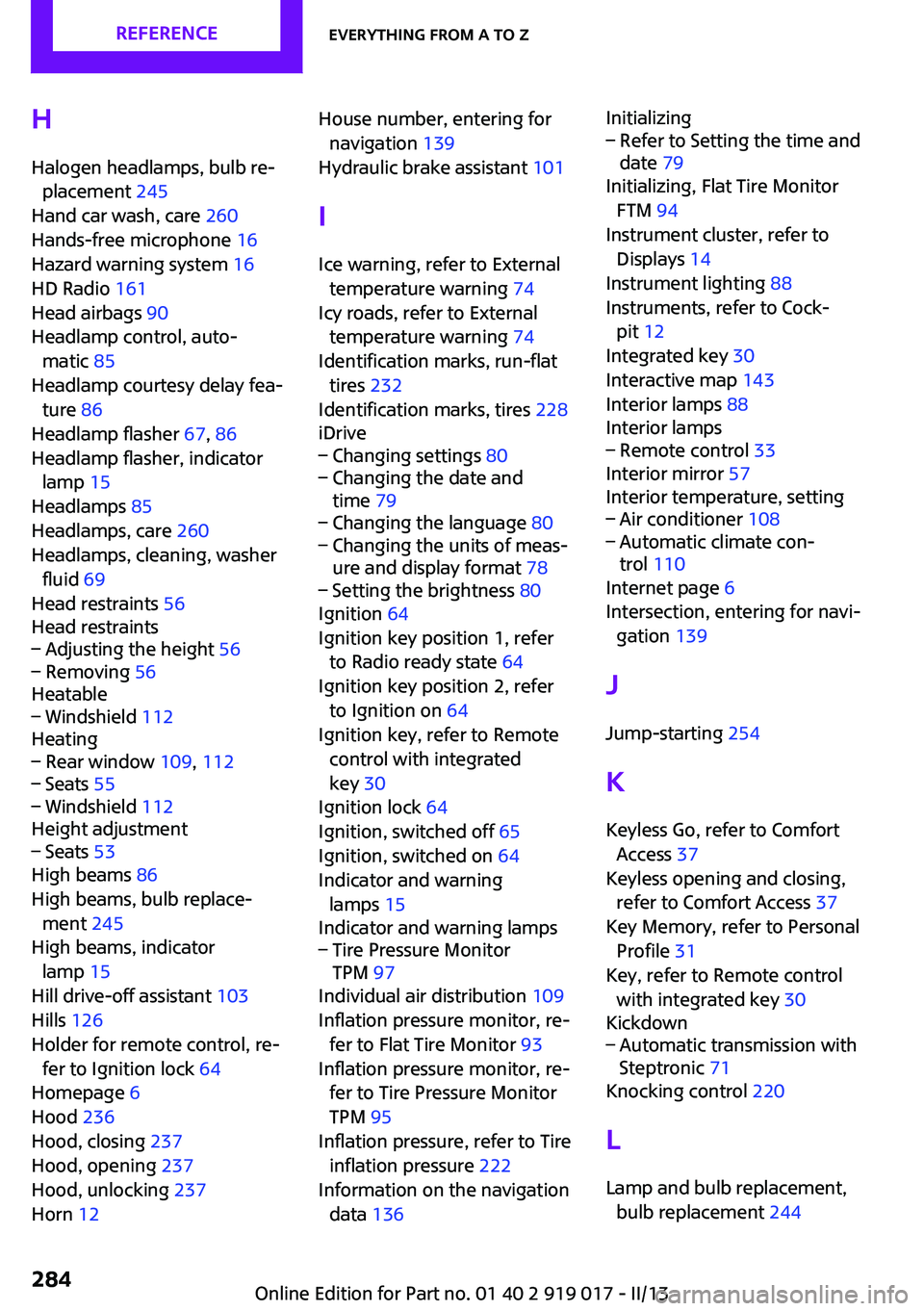
HHalogen headlamps, bulb re‐ placement 245
Hand car wash, care 260
Hands-free microphone 16
Hazard warning system 16
HD Radio 161
Head airbags 90
Headlamp control, auto‐ matic 85
Headlamp courtesy delay fea‐ ture 86
Headlamp flasher 67, 86
Headlamp flasher, indicator lamp 15
Headlamps 85
Headlamps, care 260
Headlamps, cleaning, washer fluid 69
Head restraints 56
Head restraints– Adjusting the height 56– Removing 56
Heatable
– Windshield 112
Heating
– Rear window 109, 112– Seats 55– Windshield 112
Height adjustment
– Seats 53
High beams 86
High beams, bulb replace‐ ment 245
High beams, indicator lamp 15
Hill drive-off assistant 103
Hills 126
Holder for remote control, re‐ fer to Ignition lock 64
Homepage 6
Hood 236
Hood, closing 237
Hood, opening 237
Hood, unlocking 237
Horn 12
House number, entering for
navigation 139
Hydraulic brake assistant 101
I
Ice warning, refer to External temperature warning 74
Icy roads, refer to External temperature warning 74
Identification marks, run-flat tires 232
Identification marks, tires 228
iDrive– Changing settings 80– Changing the date and
time 79– Changing the language 80– Changing the units of meas‐
ure and display format 78– Setting the brightness 80
Ignition 64
Ignition key position 1, refer to Radio ready state 64
Ignition key position 2, refer to Ignition on 64
Ignition key, refer to Remote control with integrated
key 30
Ignition lock 64
Ignition, switched off 65
Ignition, switched on 64
Indicator and warning lamps 15
Indicator and warning lamps
– Tire Pressure Monitor
TPM 97
Individual air distribution 109
Inflation pressure monitor, re‐ fer to Flat Tire Monitor 93
Inflation pressure monitor, re‐ fer to Tire Pressure Monitor
TPM 95
Inflation pressure, refer to Tire inflation pressure 222
Information on the navigation data 136
Initializing– Refer to Setting the time and
date 79
Initializing, Flat Tire Monitor
FTM 94
Instrument cluster, refer to Displays 14
Instrument lighting 88
Instruments, refer to Cock‐ pit 12
Integrated key 30
Interactive map 143
Interior lamps 88
Interior lamps
– Remote control 33
Interior mirror 57
Interior temperature, setting
– Air conditioner 108– Automatic climate con‐
trol 110
Internet page 6
Intersection, entering for navi‐ gation 139
J
Jump-starting 254
K Keyless Go, refer to Comfort Access 37
Keyless opening and closing, refer to Comfort Access 37
Key Memory, refer to Personal Profile 31
Key, refer to Remote control with integrated key 30
Kickdown
– Automatic transmission with
Steptronic 71
Knocking control 220
L Lamp and bulb replacement, bulb replacement 244
Seite 284ReferenceEverything from A to Z284
Online Edition for Part no. 01 40 2 919 017 - II/13