2013 MERCEDES-BENZ M-Class Airmatic
[x] Cancel search: AirmaticPage 191 of 458

X
Clean the headlamps and rear lights and
check for damage.
X Clean the fron tand rea rlicense plates.
X Clean the wheels/tires with a water jet and
remove any foreign objects.
X Clean the wheels, wheel housings and the
vehicle underside with a water jet; check
for any foreign objects and damage.
X Check whether twigs or other parts of
plants have become trapped. These
increase the risk of fire and can damage
fuel pipes, brake hoses or the rubber
bellows of the axle joints and propeller
shafts.
X After the trip, examine without fail the
entire undercarriage, wheels, tires, brakes,
bodywork structure, steering, chassis and
exhaust system for damage.
X After driving for extended periods across
sand, mud, gravel, water or in similarly dirty
conditions, have the brake discs, wheels,
brake pads/linings and axle joints checked
and cleaned.
X If you detect strong vibrations after off-road
travel, check for foreign objects in the
wheels and drive train and remove the mif
necessary .Foreign objects can disturb the
balance and cause vibrations.
Driving over rough terrain places greater
demands on your vehicle than driving on
normal roads. After driving off-road, check
the vehicle. This allows you to detect damage
promptly and reduce the risk of an accident
to yourself and other road users.
Driving on sand Observe the following rules when driving on
sand:
R vehicles with the AIRMATIC package:
select a raised vehicle level.
R avoid high engine speeds.
R select a shift range appropriate to the
terrain. R
drive quickly to overcom ethe rolling
resistance. Otherwise the vehicle's wheels
could become stuck in loose ground.
R drive in the tracks of other vehicles if
possible. Make sure that:
-the tire ruts are not too deep.
- the sand is sufficiently firm.
- the ground clearance of the vehicle is
sufficient.
Tire ruts and gravel roads !
Check that the ruts are not too deep and
that your vehicle has sufficient clearance.
Otherwise, your vehicle could be damaged
or bottom out and get stuck.
Observe the following rules when driving
along ruts in off-road terrain or on roads with
loose gravel:
R vehicles with the AIRMATIC package:
select a raised vehicle level.
R avoid high engine speeds.
R select shift range 1.
R drive slowly.
R where ruts are too deep, drive with the
wheels of one side on the center grassy
area, if possible.
Crossing obstacles !
Obstacles could damage the floor of the
vehicle or components of the chassis. Ask
passengers for guidance when driving over
large obstacles. The passenger should
always keep a safe distance from the
vehicle when doing so in order to avoid
injury as a result of unexpected vehicle
movements. After driving off-road or over
obstacles, check the vehicle for possible
damage, especially to the underbody and
the components of the chassis. Driving tips
189Driving and parking Z
Page 192 of 458

Observe the following rules when driving over
tree stumps, large stones and other
obstacles:
R
Raise the vehicle level.
R Avoid high engine speeds.
R Select shift range 1.
R Drive very slowly.
R Drive straight over the center of obstacles. Traveling uphill
Approach/departure angle G
WARNING
If you drive on a steep incline at an angle or
turn when driving on an incline, the vehicle
could slip sideways, tip and rollover. There is
a risk of an accident.
Always drive on a steep incline in the line of
fall (straight up or down) and do not turn the
vehicle. All vehicles (except vehicles with AMG
bodystyling)
0002 0003
Steel-sprung
vehicles
26° 25°
Vehicles with the
AIRMATIC
package
Highway level 23° 23°
Raised level 30° 28°
Vehicles with the
ON&OFFROAD
package
Highway level 23° 23°
Off-road level 1 26° 25°
Off-road level 2 30° 28°
Off-road level 3 31° 29°
AMG vehicles
Highway level (in
sports mode with
the AMG adaptive
suspension system
activated) 19° 21°
Raised level 23° 24°
Vehicles with AMG bodystyling
0002 0003
Steel-sprung
vehicles
25° 25°
Vehicles with the
AIRMATIC
package
Highway level 22° 22°
Raised level 28° 27°190
Driving tipsDriving and parking
Page 211 of 458
AIRMATIC package
General notes AIRMATIC regulates the level of your vehicle.
As well as level control ( Ypage 210), your
vehicle can be equipped with AD S(Adaptive
Damping System) (Y page 209) and ACTIVE
CURVE SYSTEM (Y page 209).
Observe the notes on driving with a trailer
(Y page 253).
ADS (Adaptive Damping System) General notes
ADS adapts the damping characteristics to
the current operating and driving situation.
This depends on:
R your driving style
R the road surface conditions
R the ADS setting
R the vehicle level setting
Your selection remains stored eve nifyou
remove the SmartKey from the ignition lock.
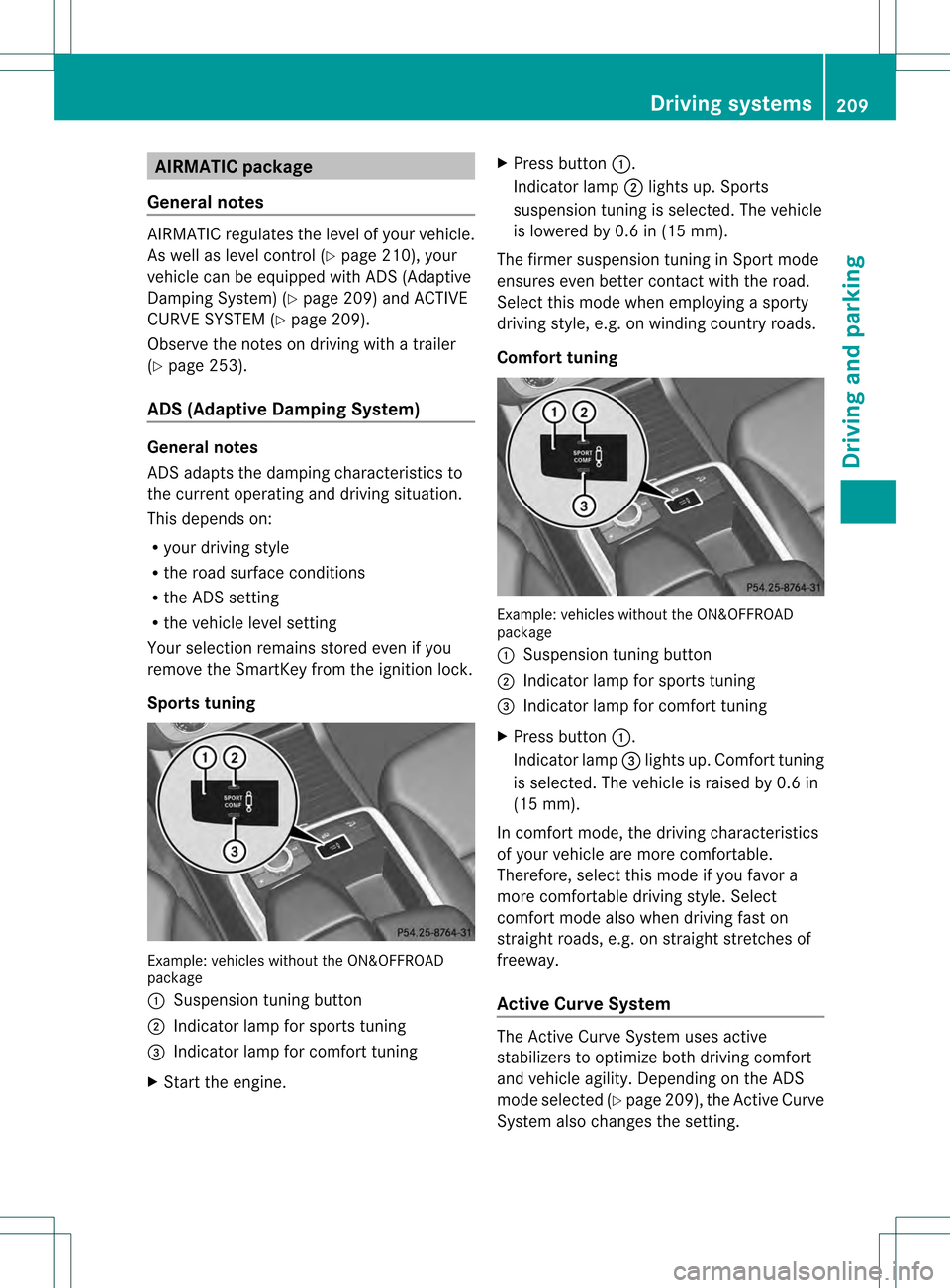
Sports tuning Example: vehicles without the ON&OFFROAD
package
0002 Suspension tuning button
0003 Indicator lamp for sports tuning
001F Indicator lamp for comfort tuning
X Start the engine. X
Press button 0002.
Indicator lamp 0003lights up. Sports
suspension tuning is selected. The vehicle
is lowered by 0.6 in (15 mm).
The firmer suspension tuning in Sport mode
ensures even better contact with the road.
Select this mode when employing a sporty
driving style, e.g. on winding country roads.
Comfort tuning Example: vehicles without the ON&OFFROAD
package
0002
Suspension tuning button
0003 Indicator lamp for sports tuning
001F Indicator lamp for comfort tuning
X Press button 0002.
Indicator lamp 001Flights up. Comfort tuning
is selected. The vehicle is raised by 0.6 in
(15 mm).
In comfort mode, the driving characteristics
of your vehicle are more comfortable.
Therefore, select this mode if you favor a
more comfortable driving style. Select
comfor tmode also when driving fast on
straight roads, e.g. on straight stretches of
freeway.
Active Curve System The Active Curve System uses active
stabilizers to optimize both driving comfort
and vehicle agility. Depending on the ADS
mode selected (Y
page 209), the Active Curve
System also changes the setting. Driving systems
209Driving and parking Z
Page 259 of 458

Coupling up a trailer
! Do no tconnectt he trailer's brake system
(if featured) to the hydraulic brake system
of the towing vehicle, as the latter is
equipped with an anti-lock brake system.
Doing so will result in a loss of function of
the brake systems of both the vehicle and
the trailer.
X Make sure that the automatic transmission
is set to position P.
X Apply the vehicle's electric parking brake.
X Start the engine.
X Vehicles with the AIRMATIC package:
select highway level.
X Vehicles with ADS: set ADS toAUTOor
COMF.
X Switch off the engine.
X Close all doors and the tailgate.
X Couple up the trailer.
X Establish all electrical connections.
X Check that the trailer lighting system is
working.
i Vehicles with the AIRMATIC package:
with a trailer attached, the vehicle will
always remain at highway level. When
coupling up a trailer, please observe the
following:
R Unless highway level has been set
manually, the vehicle is automatically
lowered to highway level. This is the case
if a speed of 5mph(8km/h) is reached.
R High-speed level is not available.
These restrictions apply to all accessories
powered through a connectio nto the trailer
power socket of your vehicle, e.g. a bicycle
carrier.
Observe the maximum permissible trailer
dimensions (width and length).
Most U.S. states and all Canadia nprovinces
require by law:
R Safety chains between the towing vehicle
and the trailer. The chains should be cross-
wound under the trailer drawbar. They must be fastened to the vehicle's trailer
coupling, not to the bumper or the axle.
Leave enough play in the chains to make
tight cornering possible.
R As eparate brake system for certain types
of trailer.
R As afety switch for braked trailers. Check
the specific legal requirements applicable
to your state.
If the trailer detaches from the towing
vehicle, the safety switch applies the
trailer's brakes. Towing
atrailer
There are numerous legal requirements
concerning the towing of a trailer, e.g .speed
restrictions. Make sure that your vehicle/
trailer combination complies with the local
requirements not only in your area of
residence but also at any location to which
you are traveling. The police and local
authorities can provide reliable information.
Please observe the following when towing a
trailer:
R To acquaint yourself with driving with a
trailer and with the resulting changes to
handling, you should practice cornering,
stopping and backing up in a traffic-free
location.
R Before driving, check:
-Trailer tow hitch
- Safety switch for braked trailers
- Safety chains
- Electrical connections
- Lights
- the wheels
R Adjust the exterior mirrors to provide an
unobstructed view of the rear section of the
trailer.
R If the trailer features electronically
controlled brakes, pull away the vehicle/
trailer combination carefully, manually Towing
atrailer
257Driving an d parking Z
Page 304 of 458

Display messages Possible causes/consequences and
0001 Solutions
0002
Check
Additive See
Operator's Manual The DEF tank is almost empty.
X
Have the DE Ftank filled as soon as possible at aqualified
specialist workshop (Y page 177).0002
Remaining Starts:
16 The DE
Flevel has fallen to a minimum. You can start the engine a
further 16 times.
X Have the DEFt ank filled immediately at a qualified specialist
workshop (Y page 177).
i You can start the engine a further 16 times. If DE Fis not added,
it will then not be possible to restart the engine. Fill the DEF tank
with about 1 gal (3.8 l) of DEF (Y page 177).Driving systems
Display messages Possible causes/consequences and
0001 Solutions
0003
Attention Assist:
Take a Break! Based on certain criteria, ATTENTION ASSIST has detected fatigue
or
alack of concentration on th epart of th edriver. A warning tone
also sounds.
X If necessary, take a break.
During long journeys, take regular breaks in good time so you get
enough rest. 0003
Attention Assist
Inoperative ATTENTION ASSIST is inoperative.
X
Visi taqualified specialist workshop. 0002
Drive More Slowly You cannot change the vehicle level. Possible causes are:
R
you are driving too fast for the selected vehicle level.
R you are towing a trailer.
R the trailer-coupling socket is being used, e.g. for a bicycle rack.
X Drive more slowly and then select the desired vehicle level
again.
R
Vehicles with the ON&OFFROA Dpackage (Y page 204)
R Vehicles with the AIRMATIC package (Y page 210)
X Observe the notes on towing a trailer (Y page 253).302
Display messagesOn-board computer and displays
Page 305 of 458

Display messages Possible causes/consequences and
0001 Solutions
0002
Compressor Is
Cooling You have selected a higher vehicle level. The compressor first
needs to cool down because of frequen
tlevel changes.
X Drive in a manner appropriate for the current vehicle level.
X Make sure that there is sufficien tground clearance.
X Allow the compresso rto cool down.
When the compressor has cooled down, the display message
disappears. The vehicle then continues rising to the selected
level. 0002
Malfunction AIRMATIC is malfunctioning.
X
Drive in a manner appropriate for the current vehicle level, but
no faster than 50 mph (80 km/h).
X Make sure that there is sufficient ground clearance.
X Have the vehicle checked at a qualified specialist workshop. 0002
Max. Speed 12 mph You are exceeding the speed permissible for the selected off-road
level.
In addition, the vehicle level display appears between the vehicle
icon and the display message, and a warning tone sounds.
G WARNING
The vehicle could tip and rollover.
There is a risk of an accident.
X Adjust your driving style to the altered handling characteristics.
X Only make slight steering movements and avoid fast steering
movements.
X Do not drive faster than 12 mph (20 km/h) until off-road level 2
has been reached. ACTIVE CURVE
SYSTEM
Malfunctioning The Active Curve Syste
mis faulty. The vehicle's handling
characteristics may be affected.
X Do not drive faster than 50 mph (80 km/h).
X Have the vehicle checked at a qualified specialist workshop. Display messages
303On-board computer and displays Z
Page 383 of 458

Vehicles with
a"Minispare" emergency
spare wheel Example
:vehicles with AIRMATIC and trailer tow
hitch
0002 Folding wheel chock
0003 Lug wrench
001F Alignment bolt
001E Ball coupling of the trailer tow hitch
001C Towing eye
001D Jack
0011 Ratchet wrench
X Lift the cargo compartment floor up
(Y page 342).
X Remove the "Minispare" emergency spare
wheel (Y page 437). Flat tire
Preparing the vehicle
Your vehicle may be equipped with:
R MOExtended tires (tires with run-flat
properties) (Y page 382)
Vehicle preparation is not necessary on
vehicles with MOExtended tires.
R a TIREFIT kit (Y page 380)
R an emergency spare wheel (only for certain
countries) (Y page 436)
Information on changing/mounting a wheel
(Y page 421). X
Stop the vehicle on solid, non-slippery and
level ground, as far away as possible from
traffic.
X Switch on the hazard warning lamps.
X Secure the vehicle against rolling away
(Y page 179).
X If possible, bring the fron twheels into the
straight-ahead position.
X Vehicles with the AIRMATIC package:
make sure that highway level is selected
(Y page 209).
X Switch off the engine.
X Vehicles without KEYLESS-GO: remove
the SmartKey from the ignition lock.
X Vehicles with KEYLESS-GO: open the
driver's door.
The on-board electronics now have status
0.T his is the same as the key having been
removed.
X Vehicles with KEYLESS-GO: remove the
Start/Stop button from the ignition lock
(Y page 158).
X All occupants must get out of the vehicle.
Make sure that they are not endangered as
they do so.
X Make sure that no one is near the danger
area while a wheel is being changed.
Anyone who is not directly assisting in the
wheel change should, for example, stand
behind the barrier.
X Get out of the vehicle. Pay attention to
traffic conditions when doing so.
X Close the driver's door.
X Unload heavy luggage.
i Only operate the tire inflation compressor
using a 12 V socket, even if the ignition is
turned off (Y page 347).
An emergency cut-out ensures that the on-
board voltage does not drop too low. If the
on-board voltage is too low, the power to
the sockets is automatically cut. This
ensures that there is sufficient power to
start the engine. Flat tire
381Breakdown assistance
Page 424 of 458

Direction of rotation
Tires with a specified direction of rotation
have additional benefits, e.g. if there is a risk
of hydroplaning .You will only gain these
benefits if the correct direction of rotation is
observed.
An arrow on the sidewall of the tire indicates
its correct direction of rotation. Storing wheels
Store wheels that are not being used in a cool,
dry and preferably dark place. Protec tthe
tires from oil, grease, gasoline and diesel. Cleaning the wheels
G
WARNING
The water jet from a circular jet nozzle (dirt
blasters) can cause invisible exterior damage
to the tires or chassis components.
Components damaged in this way may fail
unexpectedly. There is a risk of an accident.
Do not use power washers with circular jet
nozzles to clean the vehicle. Have damaged
tires or chassis components replaced
immediately. Mounting
awheel
Preparing the vehicle X
Vehicle with emergency spare wheel:
whe nmounting the emergency spare
wheel in the event of a flat tire, follow the
additional notes on vehicle preparation
under "Flat tire" (Y page 381).
X Park the vehicle on firm, non-slippery and
level ground.
X Unload heavy luggage.
X Apply the electric parking brake manually.
X Bring the front wheels into the straight-
ahead position.
X Shift the transmission to position P.X
Vehicles with the AIRMATIC package:
make sure that highway level is selected
(Y page 209).
X Switch off the engine.
X Vehicles without KEYLESS-GO: remove
the SmartKey from the ignition lock.
X Vehicles with KEYLESS-GO: open the
driver's door.
The on-board electronics have status 0,
which is the same as the SmartKey having
been removed.
X Vehicles with KEYLESS-GO: remove the
Start/Stop button from the ignition lock
(Y page 158).
X If included in the vehicle equipment, take
the tire-change tool kit out of the vehicle.
X Secure the vehicle to prevent it from rolling
away.
i Apart from certain country-specific
variations, vehicles are not equipped with
a tire-change tool kit. For information on
which tools are required to perform a wheel
change on your vehicle, consult an
authorized Mercedes-Benz Center.
Necessary wheel-changing tools can
include, for example:
R Jack
R Wheel chock
R Lug wrench
Securing the vehicle to prevent it from
rolling away 422
Changing
awheelWheels and tires