2013 MERCEDES-BENZ GLK-CLASS SUV mirror
[x] Cancel search: mirrorPage 38 of 380
Overhead control panel
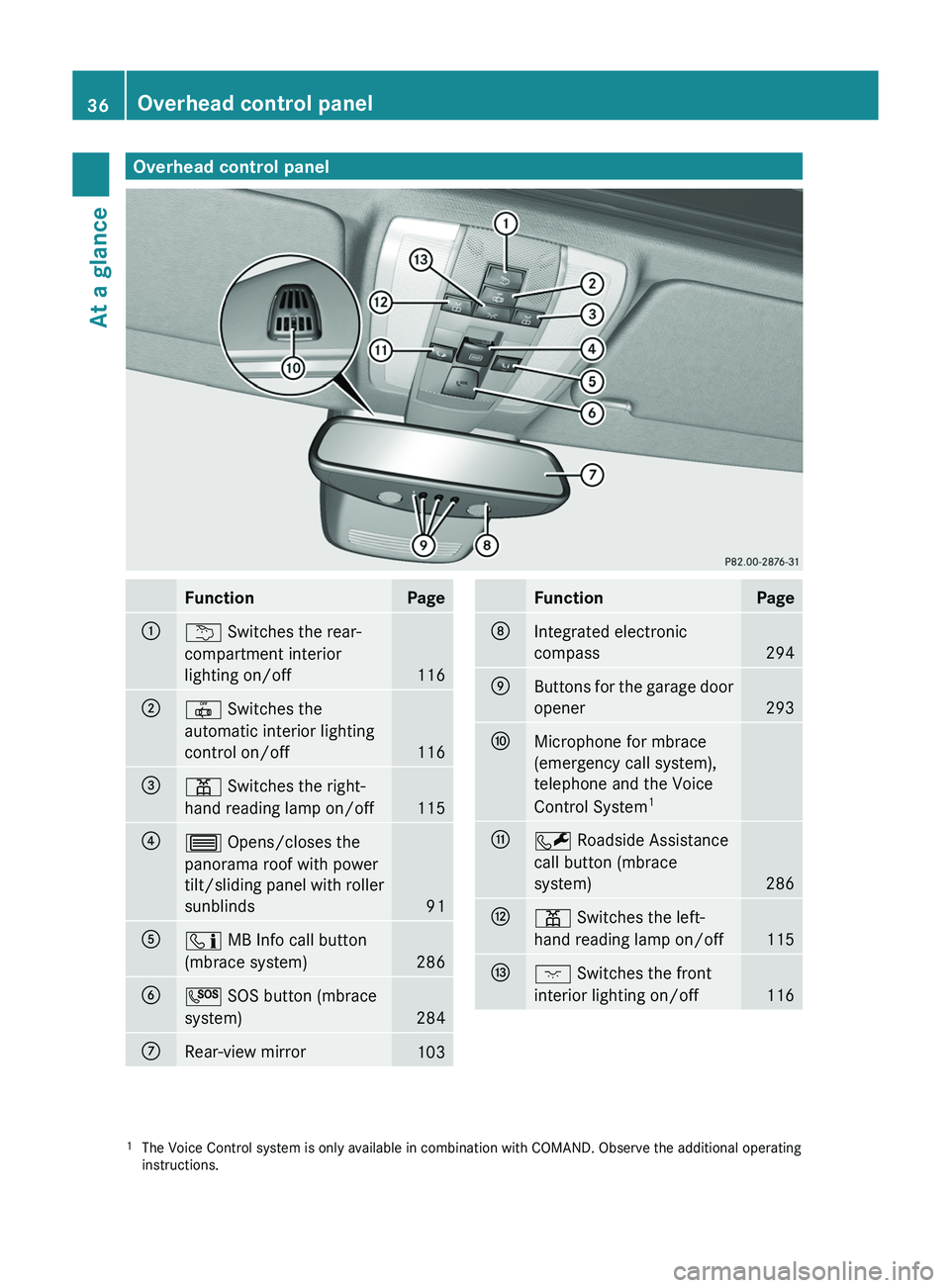
Function Page
0043
0042 Switches the rear-
compartment interior
lighting on/off
116
0044
0033 Switches the
automatic interior lighting
control on/off
116
0087
003D Switches the right-
hand reading lamp on/off
115
0085
0057 Opens/closes the
panorama roof with power
tilt/sliding panel with roller
sunblinds
91
0083
00D9 MB Info call button
(mbrace system)
286
0084
0053 SOS button (mbrace
system)
284
006B
Rear-view mirror
103 Function Page
006C
Integrated electronic
compass
294
006D
Buttons for the garage door
opener
293
006E
Microphone for mbrace
(emergency call system),
telephone and the Voice
Control System
1 006F
0052 Roadside Assistance
call button (mbrace
system)
286
0070
003D Switches the left-
hand reading lamp on/off
115
0071
004A Switches the front
interior lighting on/off
116
1
The Voice Control system is only available in combination with COMAND. Observe the additional operating
instructions.36
Overhead control panelAt a glance
Page 39 of 380

Door control panel
Function Page
0043
Opens the door 79
0044
00360037 Unlocks/locks
the vehicle
80
0087
Adjusts the seats
electrically
98
0085
008D003700380040
Stores settings for the
seat,
exterior mirrors and
steering wheel 106
0083
0070 Selects the left
exterior mirror
103
0084
00F5 Folds the exterior
mirrors in/out
104
006B
0071 Selects the right
exterior mirror
103 Function Page
006C
0062 Adjusts the exterior
mirrors
103
006D
0062 Opens/closes the
front side windows
87
006E
0062 Opens/closes the
rear side windows
87
006F
0089 Activates/
deactivates the override
feature for the side
windows in the rear
compartment
63
0070
008C Opens/closes the
tailgate
84Door control panel
37At a glance
Page 97 of 380
Useful information ..............................
96
Correct driver's seat position ............ 96
Seats .................................................... 97
Steering wheel .................................. 102
Mirrors ............................................... 103
Memory function .............................. 106 95Seats, steering wheel and mirrors
Page 98 of 380
Useful information
i This Operator's Manual describes all
models and all standard and optional
equipment of your vehicle available at the
time of publication of the Operator's
Manual. Country-specific differences are
possible. Please note that your
vehicle may
not be equipped with all features
described. This also applies to safety-
related systems and functions.
i Read the information on qualified
specialist workshops: ( Y page 27).Correct driver's seat position
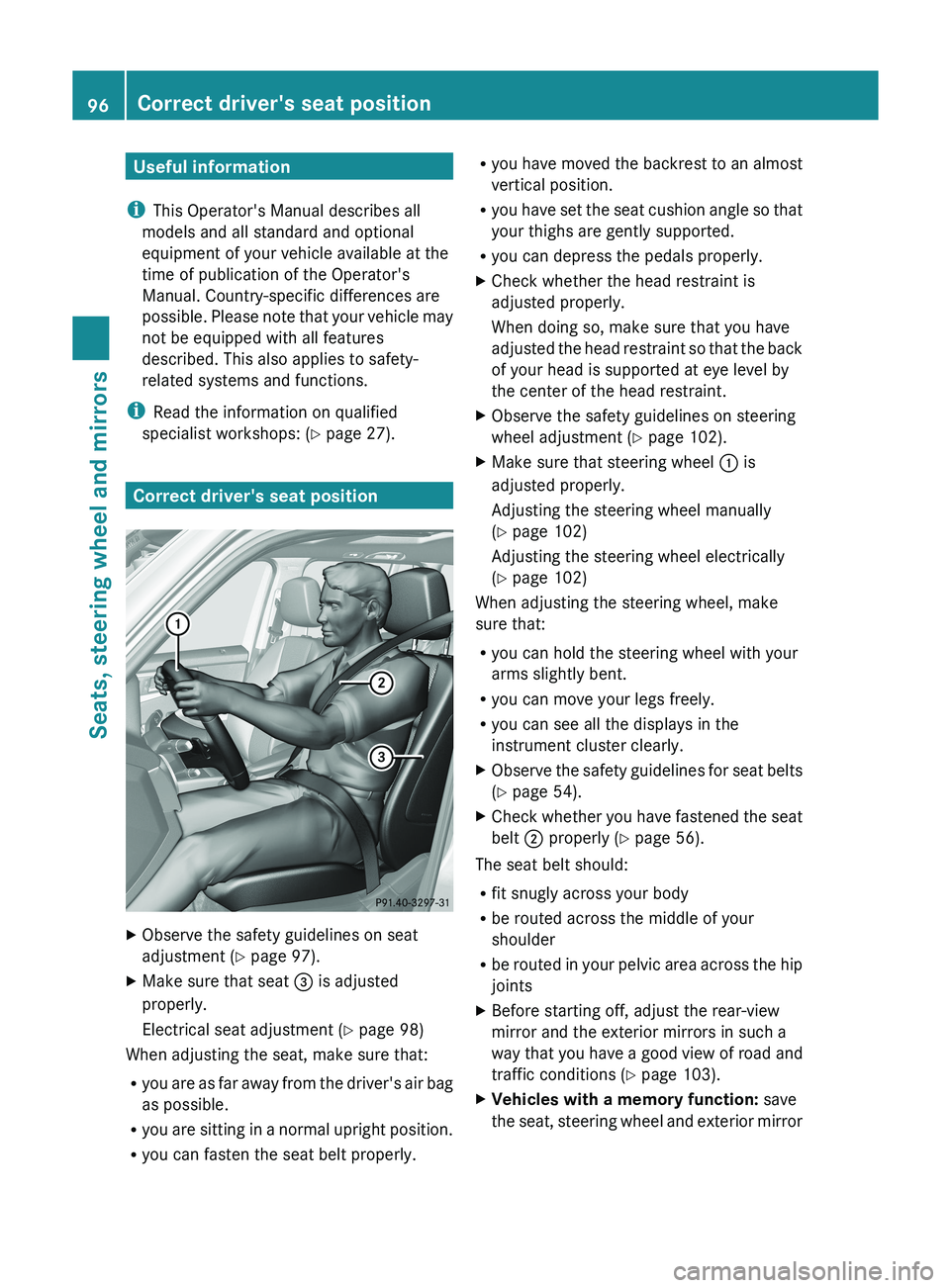
X
Observe the safety guidelines on seat
adjustment ( Y page 97).
X Make sure that seat 0087 is adjusted
properly.
Electrical seat adjustment ( Y page 98)
When adjusting the seat, make sure that:
R you are as far away
from the driver's air bag
as possible.
R you are sitting in a normal upright position.
R you can fasten the seat belt properly. R
you have moved the backrest
to an almost
vertical position.
R you have set the seat cushion angle so that
your thighs are gently supported.
R you can depress the pedals properly.
X Check whether the head restraint is
adjusted properly.
When doing so, make sure that you have
adjusted the head restraint so
that the back
of your head is supported at eye level by
the center of the head restraint.
X Observe the safety guidelines on steering
wheel adjustment ( Y page 102).
X Make sure that steering wheel 0043 is
adjusted properly.
Adjusting the steering wheel manually
(Y page 102)
Adjusting the steering wheel electrically
(Y page 102)
When adjusting the steering wheel, make
sure that:
R you can hold the steering wheel with your
arms slightly bent.
R you can move your legs freely.
R you can see all the displays in the
instrument cluster clearly.
X Observe the safety guidelines for seat belts
(Y page 54).
X Check whether you have fastened the seat
belt 0044 properly ( Y page 56).
The seat belt should:
R fit snugly across your body
R be routed across the middle of your
shoulder
R be routed in your
pelvic
area across the hip
joints
X Before starting off, adjust the rear-view
mirror and the exterior mirrors in such a
way that you have a
good view of road and
traffic conditions (Y page 103).
X Vehicles with a memory function: save
the seat, steering wheel and
exterior mirror96
Correct driver's seat position
Seats, steering wheel and mirrors
Page 99 of 380
settings with the memory function
(Y page 106).
Seats
Important safety notes
G
WARNING
The seats can still be adjusted when there is
no key in the ignition lock. For this reason,
children should never be left unsupervised in
the vehicle. They could otherwise become
trapped when adjusting the seat. G
WARNING
Make sure that the back of your head is
supported at eye level by the central area of
the head restraint. If your head is not
supported correctly by the head
restraint, you
could suffer a severe neck injury in the event
of an accident. Never drive if the head
restraints are not engaged and set correctly. G
WARNING
In order to avoid possible loss of vehicle
control, all seat, head restraint, steering
wheel and rear view mirror adjustments, as
well as fastening of seat belts, must be done
before setting the vehicle in motion. G
WARNING
Do not adjust the driver's seat while driving.
Adjusting the seat while driving could cause
the driver to lose control of the vehicle.
Never travel in a moving
vehicle with the seat
backrest in an excessively reclined position as
this can be dangerous. You could slide under
the seat belt in a collision. If you slide under
it, the seat belt would apply force at the
abdomen or neck. This could cause serious or
fatal injuries. The seat backrest and seat belts
provide the best restraint when the wearer is
in a position that is as upright as possible and
seat belts are properly positioned on the
body. G
WARNING
Your seat belt must be adjusted so that you
can correctly fasten your seat belt.
Observe the following points:
R adjust the seat backrest until
your arms are
slightly angled when holding the steering
wheel.
R adjust the seat to a comfortable seating
position that still allows you to reach the
accelerator/brake pedal safely. The
position should be as far back as possible
with the driver still able to operate the
controls properly.
R adjust the head restraint so that it is as
close to the head as possible and the center
of the head restraint supports the back of
the head at eye level.
R never place hands under the seat or near
any moving parts while a seat is being
adjusted.
Failure to do so could result in an accident
and/or serious personal injury. G
WARNING
According to accident statistics, children are
safer when properly restrained on the rear
seats than on the front-passenger
seat. Thus,
we strongly recommend that children be
placed in the rear seat whenever possible.
Regardless of seating position, children 12
years old and under must be seated and
properly secured in an appropriately sized
child restraint system or booster seat
recommended for the size and weight of the
child. For additional information, see the
"Children in the vehicle" section.
A child's risk of serious or fatal injuries is
significantly increased if the child restraints
are not properly secured in the vehicle and/
or the child is not properly secured in the child
restraint. G
WARNING
For your protection, drive only with properly
positioned head restraints. Seats
97
Seats, steering wheel and mirrors
Z
Page 100 of 380
Adjust the head restraint so that it is as close
to the head as possible and the center of the
head restraint supports the back of the head
at eye level. This will reduce the potential for
injury to the head
and
neck in the event of an
accident or similar situation.
Do not drive the vehicle without the seat head
restraints. Head restraints are intended to
help reduce injuries during an accident.
! To avoid damage to the seats and the seat
heating, observe the following information:
R keep liquids from spilling on the seats. If
liquid is spilled on the seats, dry them as
soon as possible.
R if the seat covers are damp or wet, do not
switch on the seat heating. The seat
heating should also not be used to dry
the seats.
R clean the seat covers as recommended;
see the "Interior care" section.
R do not transport heavy loads on the
seats. Do not place sharp objects on the
seat cushions, e.g. knives, nails or tools.
The seats should only be occupied by
passengers, if possible.
R when the seat heating is in operation, do
not cover the seats with insulating
materials, e.g. blankets, coats, bags,
seat covers, child seats or booster seats.
! Make sure that there are no objects in the
footwell or behind the seats when resetting
the seats. There is a risk that the seats
and/or the objects could be damaged.
i The rear-compartment head restraints
can be removed ( Y page 100).
For more information, contact a qualified
specialist workshop.
i Further related subjects:
R Cargo compartment enlargement
(folding the rear bench seat forwards)
(Y page 272) Adjusting the seats
i Vehicles without Memory function: the
seats can be adjusted within
three minutes
of a front door being opened.
The time period starts over again if, within
these three minutes, you:
R open or close a front door
R insert the SmartKey into the ignition lock
or remove it from the ignition lock
R switch the ignition on or off
If the SmartKey is in position 2 in the
ignition lock, the seats can be adjusted at
any time.
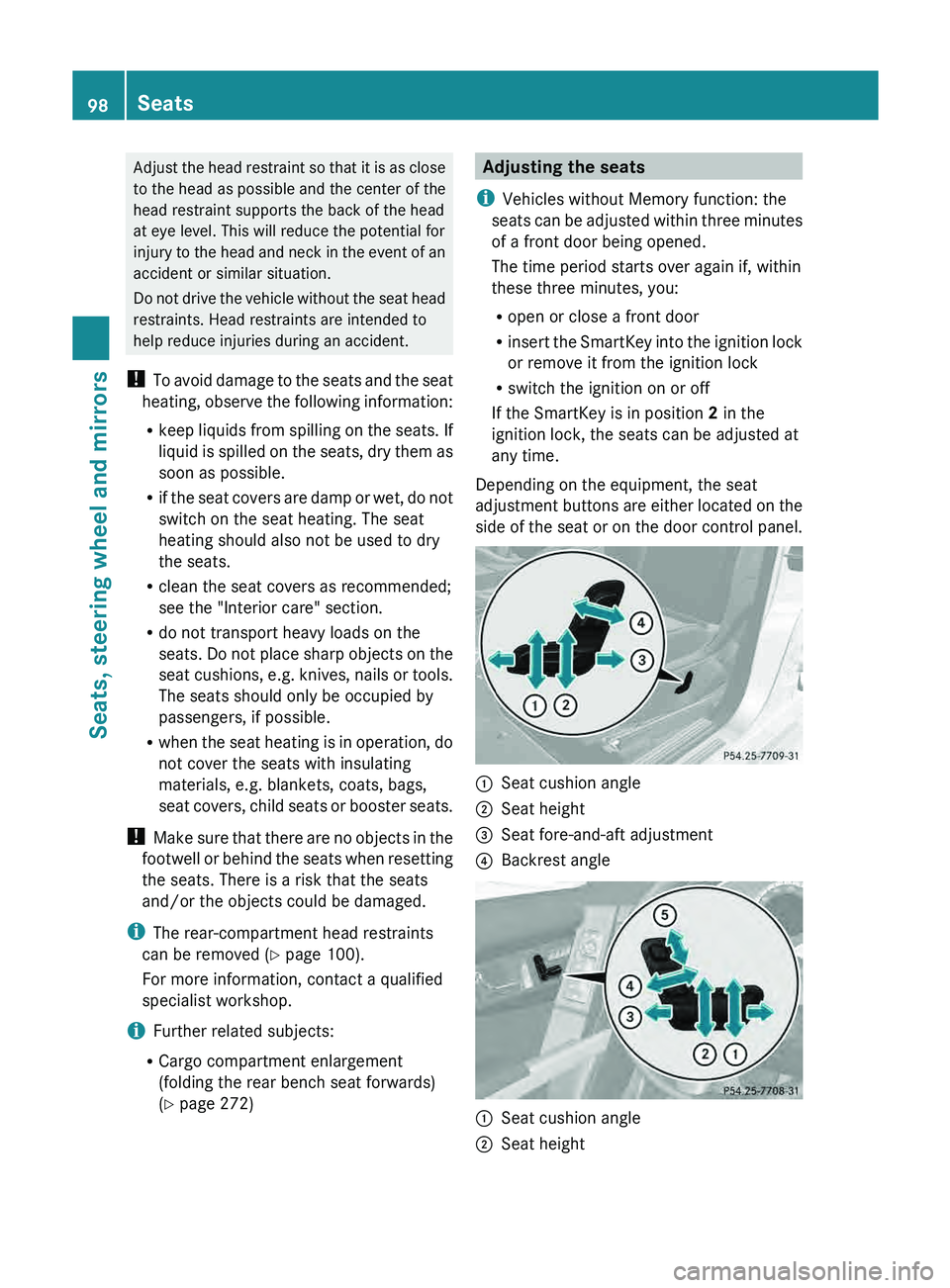
Depending on the equipment, the seat
adjustment buttons are either located on the
side of the seat or on the door control panel. 0043
Seat cushion angle
0044 Seat height
0087 Seat fore-and-aft adjustment
0085 Backrest angle 0043
Seat cushion angle
0044 Seat height98
Seats
Seats, steering wheel and mirrors
Page 101 of 380
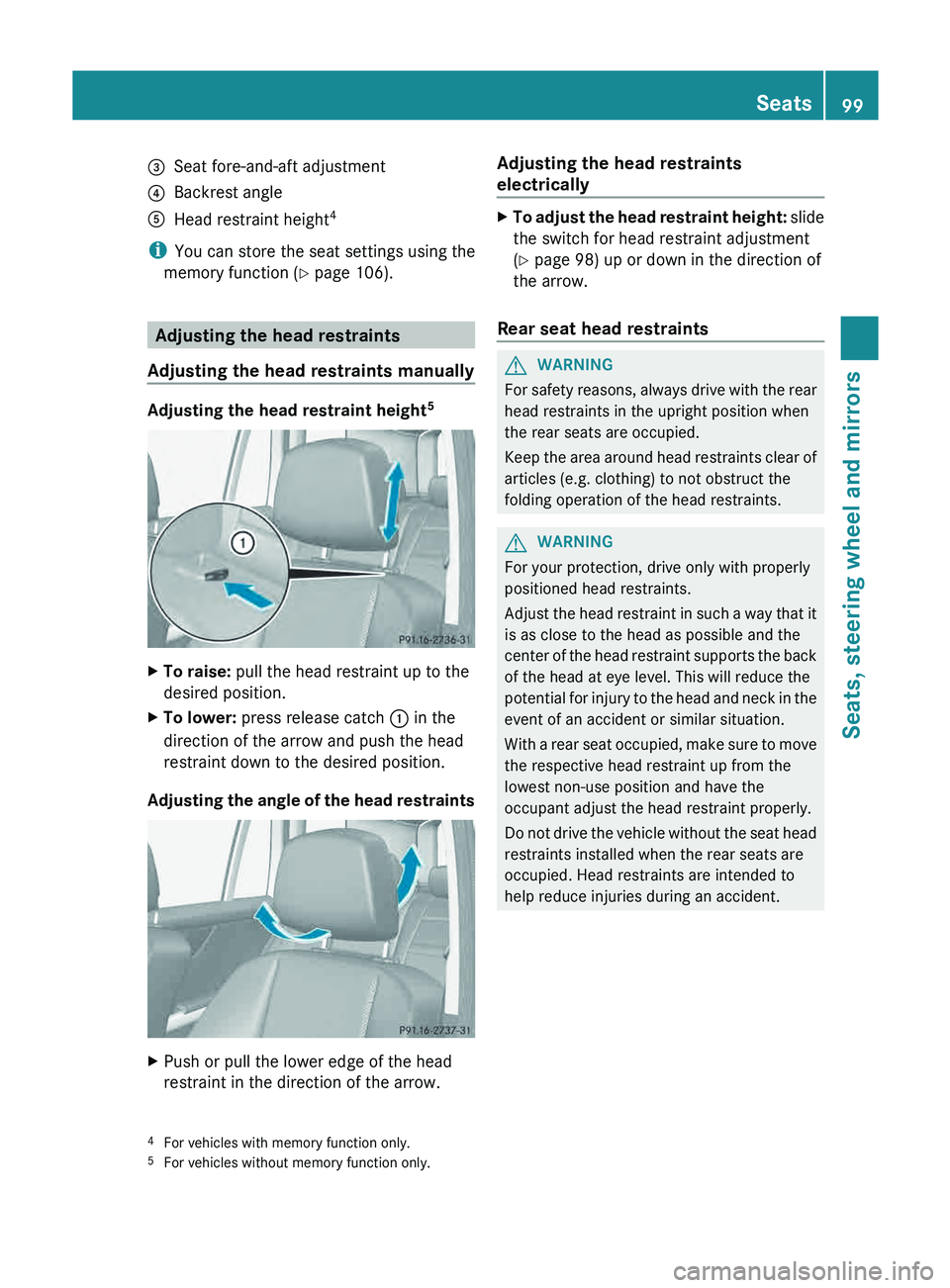
0087
Seat fore-and-aft adjustment
0085 Backrest angle
0083 Head restraint height 4
i You can store the seat settings using the
memory function ( Y page 106).Adjusting the head restraints
Adjusting the head restraints manually Adjusting the head restraint height
5X
To raise: pull the head restraint up to the
desired position.
X To lower: press release catch 0043 in the
direction of the arrow and push the head
restraint down to the desired position.
Adjusting the angle of the head restraints X
Push or pull the lower edge of the head
restraint in the direction of the arrow. Adjusting the head restraints
electrically X
To adjust the head restraint height: slide
the switch for head restraint adjustment
(Y page 98) up or down in the direction of
the arrow.
Rear seat head restraints G
WARNING
For safety reasons, always drive with the rear
head restraints in the upright position when
the rear seats are occupied.
Keep the area around head
restraints clear of
articles (e.g. clothing) to not obstruct the
folding operation of the head restraints. G
WARNING
For your protection, drive only with properly
positioned head restraints.
Adjust the head restraint in
such a way that it
is as close to the head as possible and the
center of the head restraint supports the back
of the head at eye level. This will reduce the
potential for injury to the head and neck in the
event of an accident or similar situation.
With a rear seat occupied, make sure to move
the respective head restraint up from the
lowest non-use position and have the
occupant adjust the head restraint properly.
Do not drive the vehicle without the seat head
restraints installed when the rear seats are
occupied. Head restraints are intended to
help reduce injuries during an accident.
4 For vehicles with memory function only.
5 For vehicles without memory function only. Seats
99
Seats, steering wheel and mirrors Z
Page 102 of 380
Adjusting the rear seat head restraint
height
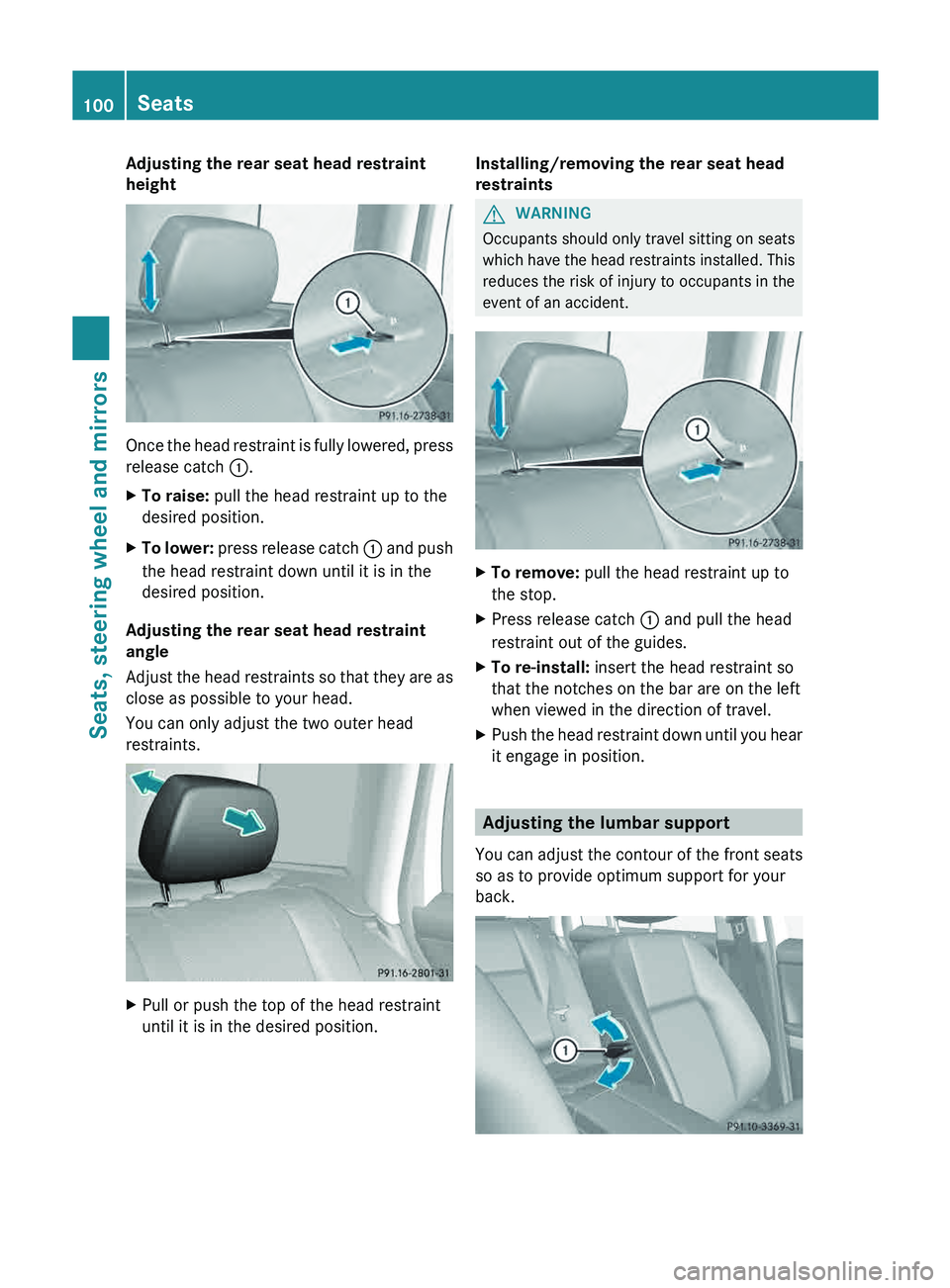
Once the head restraint is fully lowered, press
release catch 0043.
X
To raise: pull the head restraint up to the
desired position.
X To lower: press release catch 0043 and push
the head restraint down until it is in the
desired position.
Adjusting the rear seat head restraint
angle
Adjust the
head restraints
so
that they are as
close as possible to your head.
You can only adjust the two outer head
restraints. X
Pull or push the top of the head restraint
until it is in the desired position. Installing/removing the rear seat head
restraints G
WARNING
Occupants should only travel sitting on seats
which have the head restraints
installed. This
reduces the risk of injury to occupants in the
event of an accident. X
To remove: pull the head restraint up to
the stop.
X Press release catch 0043 and pull the head
restraint out of the guides.
X To re-install: insert the head restraint so
that the notches on the bar are on the left
when viewed in the direction of travel.
X Push the head restraint down until you hear
it engage in position. Adjusting the lumbar support
You can
adjust the
contour
of the front seats
so as to provide optimum support for your
back. 100
Seats
Seats, steering wheel and mirrors