2013 MERCEDES-BENZ GLK-Class tow
[x] Cancel search: towPage 19 of 378

SPORT handling mode
Activating/deactivating (AMG
vehicles) .......................................... 68
SRS
see SRS (Supplemental Restraint
System)
SRS (Supplemental Restraint
System)
Display message ............................ 235
Introduction ..................................... 41
Warning lamp ................................. 263
Warning lamp (function) ................... 41
Standing lamps
Changing bulbs .............................. 118
Display message ............................ 241
Switching on/off ........................... 112
Start/stop function
see ECO start/stop function
Starting (engine) ................................ 142
Steering (display message) ..............255
Steering wheel Adjusting (electrically). ..................102
Adjusting (manually). .....................102
Button overview ............................... 33
Buttons (on-board computer) ......... 217
Cleaning ......................................... 308
Important safety notes ..................102
Paddle shifters ............................... 152
Storing settings (memory function) 106
Steering wheel paddle shifters ........152
Stowage areas ................................... 271
Stowage compartments Armrest (under) ............................. 271
Cuph olders ................................... 278
Glove box ...................................... .271
Important safety information .........271
Rea r............................................... 272
Stowage net ................................... 272
Stowage net ....................................... 272
Summer opening see Convenience opening feature
Summer tires ..................................... 330
Sun visor ............................................ 278
Surround lighting (on-board
computer) .......................................... 227
SUV (Sport Utility Vehicle) .......................25Switching air-recirculation mode
on/off
................................................. 136
Switching off the alarm (ATA) ............71 T
Tachometer ........................................ 216
Tailgate Display message ............................ 254
Emergency unlocking .......................85
Important safety notes ....................82
Limiting the opening angle ...............85
Opening/closing (automatically
from inside) ...................................... 84
Opening/closing (automatically
from outside) ................................... 83
Opening/closing (from outside) .......82
Opening dimensions ......................373
Tail lamps
Display message ............................ 240
Tank content
Fuel gauge ....................................... 31
Technical data
Capacities ...................................... 365
Emergency spare wheel .................362
Information .................................... 364
Tires/wheels ................................. 357
Trailer loads ................................... 374
Vehicle data ................................... 373
TELEAID
Call priority .................................... 287
Downloading destinations
(COMAND) ..................................... 287
Downloading route s....................... 290
Emergency call .............................. 284
Geo fencing ................................... 290
Important safety notes ..................283
Locating astolen vehicl e............... 289
MB info call button ........................286
Remote vehicle locking ..................288
Roadside Assistance button ..........286
Search &Send ............................... 288
Self-test ......................................... 284
Speed alert .................................... 290
System .......................................... 284
Triggering the vehicle alarm ........... 291 Index
17
Page 21 of 378

Tire bead (definition
)...................... 351
Tire pressure (definition) ................351
Tire pressures (recommended )...... 349
Tire size (data) ............................... 357
Tire size designation, load-bearing
capacity, speed rating .................... 346
Tire tread ....................................... 329
Tire tread (definition) .....................351
Total load limit (definition) .............352
Traction ......................................... 344
Traction (definition) .......................351
Trea dwear ..................................... 344
TWR (permissible trailer drawbar
noseweight) (definition) .................351
Uniform Tire Quality Grading
Standard s...................................... 344
Uniform Tire Quality Grading
Standard s(definition) .................... 349
Unladen weight (definition) ............350
Wea rindicato r(definition) .............352
Whee lrim (definition ).................... 349
see Flat tire
Top Tether ............................................ 62
Towing Important safety guidelines ...........320
Installing the towing eye ................321
Removing the towing eye. ..............321
With the rear axle raised ................322
Towing atrailer
Activ eParking Assist ..................... 188
Cleaning the trailer tow hitch ......... 308
Coupling up atrailer ...................... 210
Decoupling atrailer ....................... 212
Driving tips .................................... 208
Important safety notes ..................208
Installing the ball coupling .............210
Lights displa ymessage .................. 239
Mounting dimensions ....................374
Power supply ................................. 213
Removing the ball coupling ............213
Shift range ..................................... 151
Storing the ball coupling ................213
Trailer loads ................................... 374
Towing away
With both axles on the ground .......322
Tow-starting
Emergency engine starting ............323
Important safety notes ..................320Trailer coupling
see Towing atrailer
Trailer loads and drawbar
noseweights ...................................... 212
Trailer towing Active Blind Spot Assist .................205
Active Lane Keeping Assist .... 202, 208
Blind Spot Assist ............................ 200
PARKTRONI C................................. 183
Permissible trailer loads and
drawba rnoseweights ..................... 212
Transfer case ..................................... 154
Transmission see Automatic transmission
Transmission position display .........149
Transmission position display
(DIRECT SELECTl ever)...................... 149
Transporting the vehicle ..................322
Traveling uphill Brow of hill ..................................... 169
Driving downhill ............................. 169
Maximum gradient-climbing
capability ....................................... 169
Trim pieces (cleaning instructions) .309
Trip computer (on-board computer) 219
Trip odometer Calling up ....................................... 219
Resetting (on-board computer) ......220
see Trip odometer
Turn signals
Changing bulbs (front) ...................119
Display message ............................ 240
Switching on/off ........................... 112
see Turn signals
TWR (Tongue Weight Rating)
(definition) ......................................... 351
Type identification plate see Vehicle identification plate U
Unlocking Emergency unlocking .......................81
From inside the vehicle (central
unlocking button) ............................. 80 Index
19
Page 22 of 378

V
Vanity mirror (in the sun visor) ........ 279
Vehicle Data acquisition ............................... 28
Display message ............................ 254
Emergency locking ........................... 81
Emergency unlocking .......................81
Equipment ....................................... 23
Individua lsettings .......................... 226
Limited Warranty ............................. 28
Loading .......................................... 339
Locking (in an emergency) ...............81
Locking (SmartKey) .......................... 74
Lowering ........................................ 356
Maintenance .................................... 24
Parking for a long period ................ 161
Pulling away ................................... 143
Raising ........................................... 354
Reporting problems .........................27
Securing from rolling away ............353
Towing away .................................. 320
Transporting .................................. 322
Unlocking (in an emergency) ...........81
Unlocking (SmartKey) ......................74
Vehicle data ................................... 373
Vehicle data ....................................... 373
Vehicle dimensions ...........................373
Vehicle emergency locking ................81
Vehicle identification number see VIN
Vehicle identification plate ..............364
Vehicle tool kit .................................. 312
Video (DVD) ........................................ 223
VIN ...................................................... 364W
Warning and indicator lamps ABS ................................................ 259
Brakes ........................................... 259
Check Engine ................................. 264
Coolant .......................................... 265
Distance warning ........................... 267
DISTRONI CPLUS ........................... 267
ESP ®
.............................................. 261
ESP ®
OFF ....................................... 262
Fuel tank ........................................ 264 Overview
.......................................... 32
PASSENGER AIR BAG OFF
indicator lamp .................................. 47
Reserve fuel ................................... 264
Seat bel t........................................ 257
SRS ................................................ 263
Tire pressure monitor ....................268
Warranty ............................................ 364
Washer fluid Display message ............................ 255
Wheel bol ttightening torque ...........356
Wheel chock ...................................... 353
Wheels Changing awheel .......................... 352
Checking ........................................ 329
Cleaning ......................................... 305
Cleaning (warning) .........................353
Emergency spare wheel .................359
Important safety notes ..................328
Interchanging/changing ................352
Mounting anew wheel ................... 355
Mounting awheel .......................... 353
Removing awheel .......................... 355
Storing ........................................... 352
Tightening torque ........................... 356
Whee lsize/tir esize ....................... 357
Window curtain air bag
Display message ............................ 236
Operation ........................................ .46
Windows
see Side windows
Windshield
Defrosting ...................................... 134
see Windshield
Windshiel dwasher fluid
see Windshield washer system
Windshiel dwasher system ..............303
Notes ............................................. 372
Windshiel dwipers
Problem (malfunction) ...................124
Rea rwindow wiper ........................ 121
Replacing the wiper blades ............121
Switching on/off ........................... 120
Winte rdriving
Important safety note s.................. 330
Slippery road surfaces ...................166
Snow chains .................................. 33120
Index
Page 29 of 378

Make sure that all objects in the vehicle are
stowed correctly, and that they cannot enter
the driver's footwell. Install the floormats
securely and as specified in order to ensure
sufficient clearance for the pedals. Do not use
loose floormats.
! If the engine is switched off and
equipment on the diagnostics connection
is used, the starter battery may discharge.
Connecting equipment to the diagnostics
connection can lead to emissions monitoring
information being reset, for example. This
may lead to the vehicle failing to meet the
requirements of the next emissions test
during the main inspection. Qualified specialist workshop
An authorized Mercedes-Ben zCenter is a
qualified specialist workshop. It has the
necessary specialist knowledge, tools and
qualifications to correctly carry out the work
required on your vehicle. This is especially the
case for work relevant to safety.
Observe the notes in the Maintenance
Booklet.
Always have the following work carried out at
an authorized Mercedes-BenzC enter:
R work relevant to safety
R service and maintenance work
R repair work
R alterations, installation work and
modifications
R work on electronic components Problems with your vehicle
If you should experience aproble mwith your
vehicle, particularly one that you believe may
affec tits safe operation, we urge you to
contact an authorized Mercedes-Benz Center
immediately to have the problem diagnosed
and rectified. If the problem is not resolved to
your satisfaction, please discuss the problem agai
nwith a Mercedes-Ben zCenter or
contact us at one of the following addresses.
In the USA
Customer Assistance Center
Mercedes-Benz USA, LLC
One Mercedes Drive
Montvale, NJ 07645-0350
In Canada
Customer Relations Department
Mercedes-BenzC anada, Inc.
98 Vanderhoof Avenue
Toronto, Ontario M4G 4C9 Reporting safety defects
USA only:
The following text is published as required of
manufacturers under Title 49, Code of U.S.
Federal Regulations, Part 57 5pursuan tto the
"National Traffic and Motor Vehicle Safety Act
of 1966".
If you believe that your vehicle has a defect
which could cause a crash or could cause
injury or death, you should immediately
inform the National Highway Traffic Safety
Administration (NHTSA )in addition to
notifying Mercedes-Benz USA, LLC.
If NHTSA receives similar complaints, it may
open an investigation, and if it finds tha ta
safety defect exists in a group of vehicles, it
may order a recall and remedy campaign.
However, NHTSA cannot become involved in
individual problems between you, your
dealer, or Mercedes-Benz USA, LLC.
To contact NHTSA, you may call the Vehicle
Safety Hotline toll-free at
1-888-327-4236(TTY: 1-800-424-9153); go
to http://www.safercar.gov; or write to:
Administrator, NHTSA, 400 Seventh Street,
SW., Washington, DC 20590.
You can also obtain other information about
motor vehicle safety from
http://www.safercar.gov Introduction
27 Z
Page 37 of 378
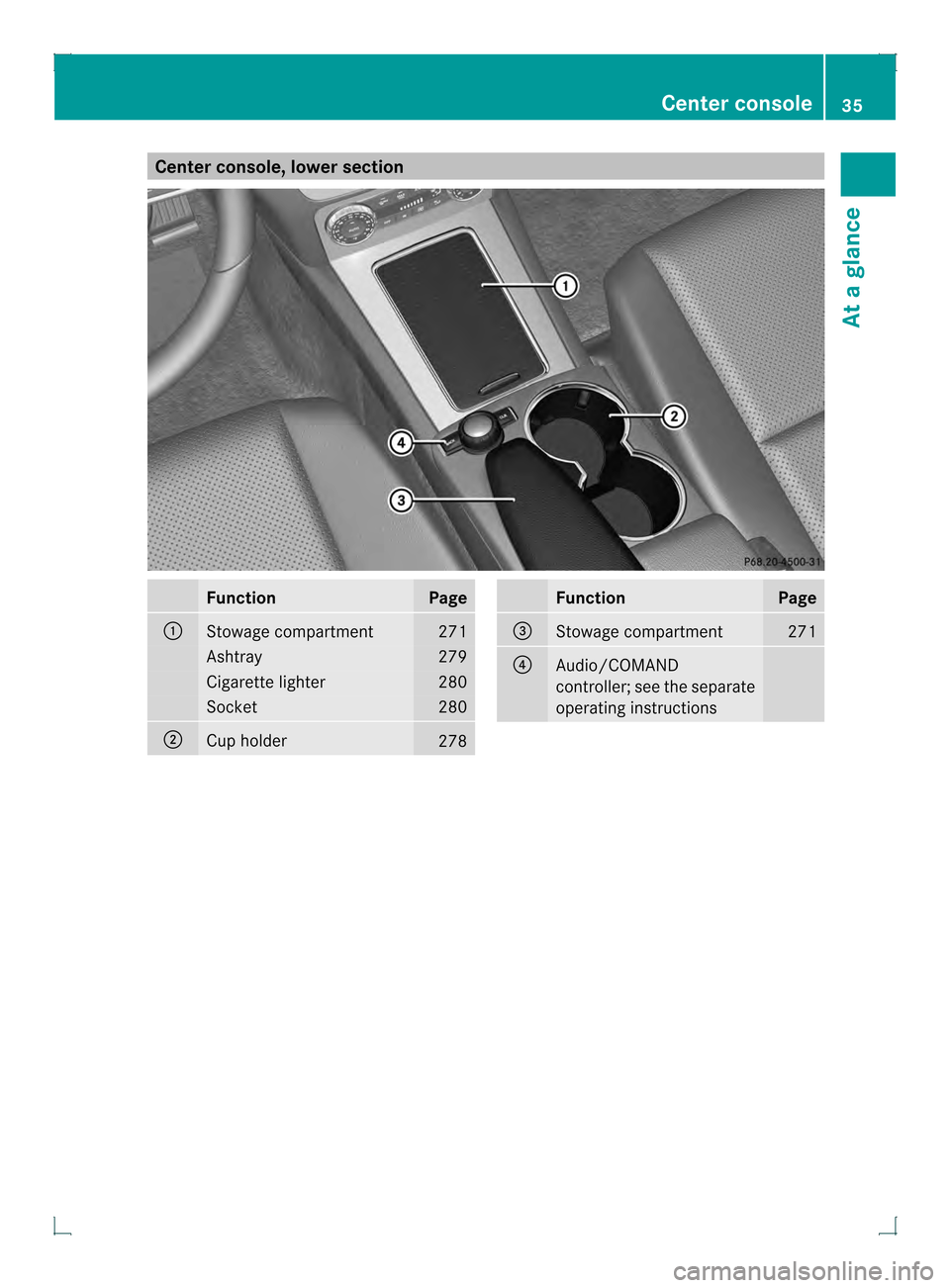
Center console, lower section
Function Page
0002
Stowage compartment 271
Ashtray 279
Cigarette lighter 280
Socket 280
0003
Cup holder
278 Function Page
0021
Stowage compartment 271
0020
Audio/COMAND
controller; see the separate
operating instructions Center console
35At a glance
Page 59 of 378

Adjust the height so tha
tthe upper part of the
seat belt is routed across the center of your
shoulder.
X To raise: slide the belt sash guide upwards.
The belt sash guide engages in various
positions.
X To lower: press and hold belt sash guide
release 0002.
X Slide the belt sash guide downwards.
X Release belt sash guide release 0002and
make sure that the belt sash guide has
engaged.
Using the rear center seat belt If the left-hand rear seat backrest is folded
down and back up again, the rear center seat
belt may lock. The seat belt can then not be
pulled out.
X To release the rear center seat belt: pull
the seat belt out approximately 1in
(25 mm) at the belt outlet on the backrest
and then release it again.
The seat belt is retracted and released.
Releasing seat belts X
Press release button 0020(Ypage 56) and
guide belt tongue 0003back towards belt
sash guide 0002.
! Make sure that the seat belt is fully rolled
up. Otherwise, the seat belt or belt tongue
will be trapped in the door or in the seat
mechanism. This could damage the door,
the door trim panel and the seat belt. Damaged seat belts can no longer fulfill
their protective function and must be
replaced. Visit a qualified specialist
workshop.
Belt warning for the driver and front
passenger Regardless of whether the driver's and front-
passenger seat belts have already been
fastened, the
0021seat belt warning lamp
lights up for six seconds each time the engine
is started. It then goes out if the driver and
the fron tpassenger have already fastened
their seat belts.
If the driver's seat belt is no tfastened when
the engine is started, an additional warning
tone will sound. This warning tone stops after
a maximum of six seconds or once the
driver's seat belt is fastened.
If after six seconds the driver or front
passenger have no tfastened their seat belts
and the doors are closed, the 0021seat belt
warning lamp lights up:
R until the driver's or fron tpassenger's seat
belt is fastened
R if a vehicle speed of 15 mph (25 km/h) is
exceeded, a warning tone also sounds with
increasing intensity for a maximum of
60 seconds or until the driver or front-
passenger seat belt has been fastened.
If the driver/front passenger unfasten their
seat belt while the vehicle is in motion, the
0021 seat belt warning lamp lights up and a
warning tone sounds again.
The warning tone ceases eve nifthe driver or
front-passenger seat belt has still not been
fastened after 60 seconds. The 0021seat belt
warning lamp stops flashing but remains
illuminated.
After the vehicle comes to a standstill, the
warning tone is reactivated and the 0021seat
belt warning lamp flashes again if the vehicle
speed again exceeds 15 mph (25 km/h). Occupant safety
57Safety Z
Page 60 of 378
The
0021 seat belt warning lamp only goes
out if:
R both the driver and the frontp assenger
have fastened their seat belts.
or
R the vehicle is stationary and a door is open.
i For more information on the 0021seat
belt warning lamp, see "Warning and
indicator lamps in the instrument cluster,
seat belts" ( Ypage 257).
Emergency Tensioning Devices, seat
belt force limiters The seat belts for the fron
tseats and rear
outer seats are equipped with ETDs and seat
belt force limiters.
The ETDs tighten the seat belts in an accident,
pulling them close against the body.
The ETDs do not correct incorrect seat
positions or incorrectly fastened seat belts.
The ETDs do not pull vehicle occupants back
towards the backrest.
When triggered, the seat belt force limiters
help to reduce the peak force exerted by the
seat belt on the vehicle occupant.
The seat belt force limiters for the fron tseats
are synchronized with the fron tair bags.
These take on a part of the deceleration force.
They take on a part of the deceleration force,
resulting in the force exerted on the occupant
being distributed over a greater area.
The ETDs can only be activated when:
R the ignition is switched on
R the restraint systems are operational; see
"SRS warning lamp" (Y page 41).
R the belt tongue is engaged in the buckle on
each of the lap-shoulder belts in the front
R the front-passenger seat is occupied and
the belt tongue is engaged in the buckle on
the front-passenger side
The ETDs on the outside seats in the rear
compartmen tare triggered independently of
the lock status of the seat belts. The Emergency Tensioning Devices are
triggered depending on the type and severity
of an accident, if:
R
in certain situations where the vehicle rolls
over and the system determines that it can
provide additional protection
R in the event of a head-on or rear-end
collision, the vehicle decelerates or
accelerates rapidly in a longitudinal
direction during the initia lstages of the
impact
R in the event of a side impact, the vehicle
decelerates or accelerates rapidly in a
lateral directio nonthe side opposite the
impact
If the ETDs are deployed, you will hear a bang,
and a small amount of powder may also be
released. Only in rare cases will the bang
affect your hearing. The powder that is
released generally does not constitute a
health hazard. The 0020SRS warning lamp
lights up. G
WARNING
Pyrotechnic ETDs that were activated must be
replaced.
For your safety, when disposing of the
pyrotechnic ETDs always follow our safety
instructions. These are available at any
authorized Mercedes-Ben zCenter.
! If the front-passenger seat is not
occupied, do not engage the seat belt
tongue in the buckle on the front-
passenger seat. Otherwise, the Emergency
Tensioning Device could be triggered in the
event of an accident. Children in the vehicle
Child restraint systems
Important safety notes We recommend that all infants and children
be properly secured in an infan
torchild 58
Children in the vehicleSafety
Page 68 of 378

R
there are strong rada rreflections, for
example in parking garages
R a narrow vehicle traveling in front, e.g. a
motorbike
R a vehicle traveling in fron tonadifferent line
relative to the center of your vehicle G
WARNING
BAS PLUS does not react:
R to people or animals
R to oncoming vehicles
R to crossing traffic
R when cornering
As aresult, BAS PLUS may not intervene in all
critical situations. There is a risk of an
accident.
Always pay careful attention to the traffic
situation and be ready to brake.
Following damage to the fron tend of the
vehicle, have the configuratio nand operation
of the rada rsensors checked at a qualified
specialist workshop. This also applies to
collisions at low speeds where there is no
visible damage to the fron tofthe vehicle. ESP
®
(Electronic Stability Program)
General notes i
Observe the "Important safety notes"
section (Y page 64).
ESP ®
monitors driving stability and traction,
i.e. power transmission between the tires and
the road surface.
If ESP ®
detects that the vehicle is deviating
from the direction desired by the driver, one
or more wheels are braked to stabilize the
vehicle. The engine output is also modified to
keep the vehicle on the desired course within
physical limits. ESP ®
assists the driver when
pulling away on wet or slippery roads. ESP ®
can also stabilize the vehicle during braking. ETS/4ETS (Electronic Traction System) i
Observe the "Important safety notes"
section (Y page 64).
ETS/4ETS traction control is part of ESP ®
.
Traction control brakes the drive wheels
individually if they spin. This enables you to
pull away and accelerate on slippery surfaces,
for example if the road surface is slippery on
one side. In addition, more drive torque is
transferred to the wheel or wheels with
traction.
Traction control remains active, even if you
deactivate ESP ®
.
Important safety notes i
Observe the "Important safety notes"
section (Y page 64). G
WARNING
If ESP ®
is malfunctioning, ESP ®
is unable to
stabilize the vehicle. Additionally, further
driving safety systems are deactivated. This
increases the risk of skidding and an accident.
Drive on carefully. Have ESP ®
checked at a
qualified specialist workshop.
! When testing the electric parking brake
on a braking dynamometer, switch off the
ignition. Application of the brakes by
ESP ®
may otherwise destroy the brake
system.
Vehicles without 4MATIC: observe the notes
on ESP ®
(Y page 322) when towing the
vehicle with a raised rear axle.
! Vehicles with 4MATIC: function or
performance tests may only be carried out
on a 2-axle dynamometer. Before you
operate the vehicle on such a
dynamometer, please consult a qualified
workshop. You could otherwise damage
the drive train or the brake system.
ESP ®
is deactivated if the 0017warning lamp
in the instrumentc luster lights up
continuously when the engine is running. 66
Driving safety systemsSafety