2013 MERCEDES-BENZ GL winter tires
[x] Cancel search: winter tiresPage 405 of 454
Only winter tires bearing the
0002snowflake
symbol in addition to the M+S marking
provide the best possible grip in wintry road
conditions.
Only these tires will allow driving safety
systems such as ABS and ESP ®
to function
optimally in winter. These tires have been
developed specifically for driving in snow.
Use M+S tires of the same make and tread on
all wheels to maintain safe handling
characteristics.
Always observe the maximum permissible
speed specified for the M+S tires you have
mounted.
Once the winter tires are mounted:
X Check the tire pressures (Y page 407).
X Restart the tire pressure monitor
(Y page 408).
X Vehicles for Canada: restart the tire
pressure loss warning system
(Y page 408).
For more information on driving with the
emergency spare wheel, see (Y page 434).Snow chains
G
WARNING
If snow chains are installed to the front
wheels, they may drag against the vehicle
body or chassis components. This could
cause damage to the vehicle or the tires.
There is a risk of an accident.
To avoid hazardous situations:
R never install snow chains to the front
wheels
R always install snow chains in pairs to the
rear wheels.
! You must drive at raised vehicle level
(height 1) if snow chains have been
installed. The vehicle may otherwise be
damaged.
! Vehicles with Adaptive Damping
System (ADS): do not use the sports mode if you have installed snow chains. The
vehicle may otherwise be damaged.
! On some tire sizes there is not enough
space for snow chains. To avoid damage to
the vehicle or tires, observe the "Wheel and
tire combinations" section under "Tires and
wheels".
For safety reasons, Mercedes-Benz
recommends that you only use snow chains
that have been specially approved for your
vehicle by Mercedes-Benz, or are of a
corresponding standard of quality.
If you intend to mount snow chains, please
bear the following points in mind:
R Only use snow chains when driving on
roads completely covered by snow.
Remove the snow chains as soon as
possible when you come to aroad that is
not snow-covered.
R Do not exceed the maximum permissible
speed of 30 mph (50 km/h).
R Local regulations may restrict the use of
snow chains. Observe the appropriate
regulations if you wish to mount snow
chains.
R Snow chains may not be mounted on all
wheel/tire combinations. Permissible
wheel-tire combinations (Y page 428).
i You may wish to deactivate ESP ®
when
pulling away with snow chains installed
(Y page 72). This way you can allow the
wheels to spin in a controlled manner,
achieving an increased driving force
(cutting action).
For more information on driving with an
emergency spare wheel, see (Y page 434). Winter operation
403Wheels and tires Z
Page 418 of 454
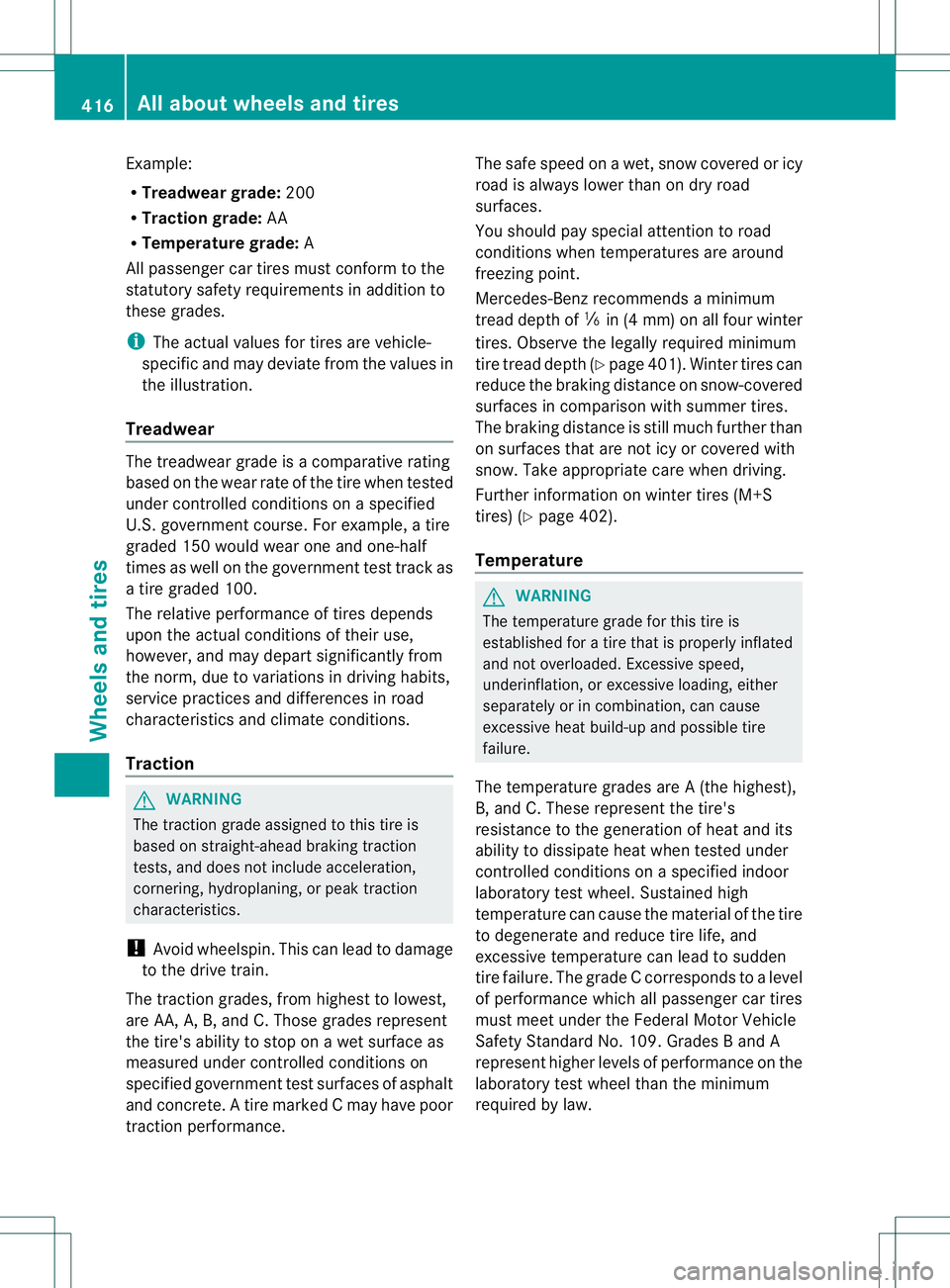
Example:
R Treadwear grade: 200
R Traction grade: AA
R Temperature grade: A
All passenger car tires must conform to the
statutory safety requirements in additio nto
these grades.
i The actual values for tires are vehicle-
specifi cand may deviate from the values in
the illustration.
Treadwear The treadwea
rgrade is a comparative rating
based on the wearr ate of the tire when tested
unde rcontrolled conditions on a specified
U.S. government course. For example, a tire
graded 150 would wear one and one-half
times as well on the government test track as
a tire graded 100.
The relative performance of tires depends
upon the actual conditions of their use,
however, and may depart significantly from
the norm, due to variations in driving habits,
service practices and differences in road
characteristics and climate conditions.
Traction G
WARNING
The traction grade assigned to this tire is
based on straight-ahead braking traction
tests, and does not include acceleration,
cornering, hydroplaning, or peak traction
characteristics.
! Avoid wheelspin. This can lead to damage
to the drive train.
The traction grades, from highest to lowest,
are AA, A, B, and C. Those grades represent
the tire's ability to stop on a wet surface as
measured under controlled conditions on
specified government test surfaces of asphalt
and concrete. Atire marked C may have poor
traction performance. The safe speed on a wet, snow covered or icy
road is always lower than on dry road
surfaces.
You should pay special attention to road
conditions when temperatures are around
freezing point.
Mercedes-Benz recommends a minimum
tread depth of
0009in(4 mm) on all four winter
tires. Observe the legally required minimum
tire tread depth (Y page 401). Winter tires can
reduce the braking distance on snow-covered
surfaces in comparison with summer tires.
The braking distance is still much further than
on surfaces that are not icy or covered with
snow. Take appropriate care when driving.
Further information on winter tires (M+S
tires) (Y page 402).
Temperature G
WARNING
The temperature grade for this tire is
established for a tire that is properly inflated
and not overloaded. Excessive speed,
underinflation, or excessive loading, either
separately or in combination, can cause
excessive heat build-up and possible tire
failure.
The temperature grades are A(the highest),
B, and C. These represent the tire's
resistance to the generatio nofheat and its
ability to dissipate heat when tested under
controlled conditions on a specified indoor
laboratory test wheel. Sustained high
temperature can cause the material of the tire
to degenerate and reduce tire life, and
excessive temperature can lead to sudden
tire failure. The grade Ccorresponds to a level
of performance which all passenger car tires
must meet under the Federal Motor Vehicle
Safety Standard No. 109. Grades B and A
represent higher levels of performance on the
laboratory test wheel than the minimum
required by law. 416
All about wheels and tiresWheels and tires
Page 421 of 454
All-weather tires and winter tires
Index Speed rating
Q M+S
2 up to 100 mph (160 km/h)
T M+S
2 up to 118 mph (190 km/h)
H M+S
2 up to 130 mph (210 km/h)
V M+S
2 up to 149 mph (240 km/h)
i
Not all tires with the M+S marking provide
the driving characteristics of winter tires.
In addition to the M+S marking, winte rtires
also have the 0002snowflake symbol on
the tire wall. Tires with this marking fulfill
the requirements of the Rubber
Manufacturers Association (RMA) and the
Rubber Association of Canada (RAC)
regarding the tire traction on snow. They
have been especially developed for driving
on snow.
An electronic speed limiter prevents your
vehicle fro mexceeding the following speeds:
R all vehicles (excep tAMG vehicles):
130 mph (210 km/h)
R AMG vehicles: 155 mph (250 km/h)
R AMG vehicles with increased top speed:
174 mph (280 km/h)
The speed rating of tires mounted at the
factory may be higher than the maximum
speed that the electronic speed limiter
permits.
Make sure that your tires have the required
speed rating, e.g. when buying new tires. The
required speed rating for your vehicle can be
found in the "Tires" section (Y page 428).
Further information about reading tire data
can be obtained from any qualified specialist
workshop. Load index
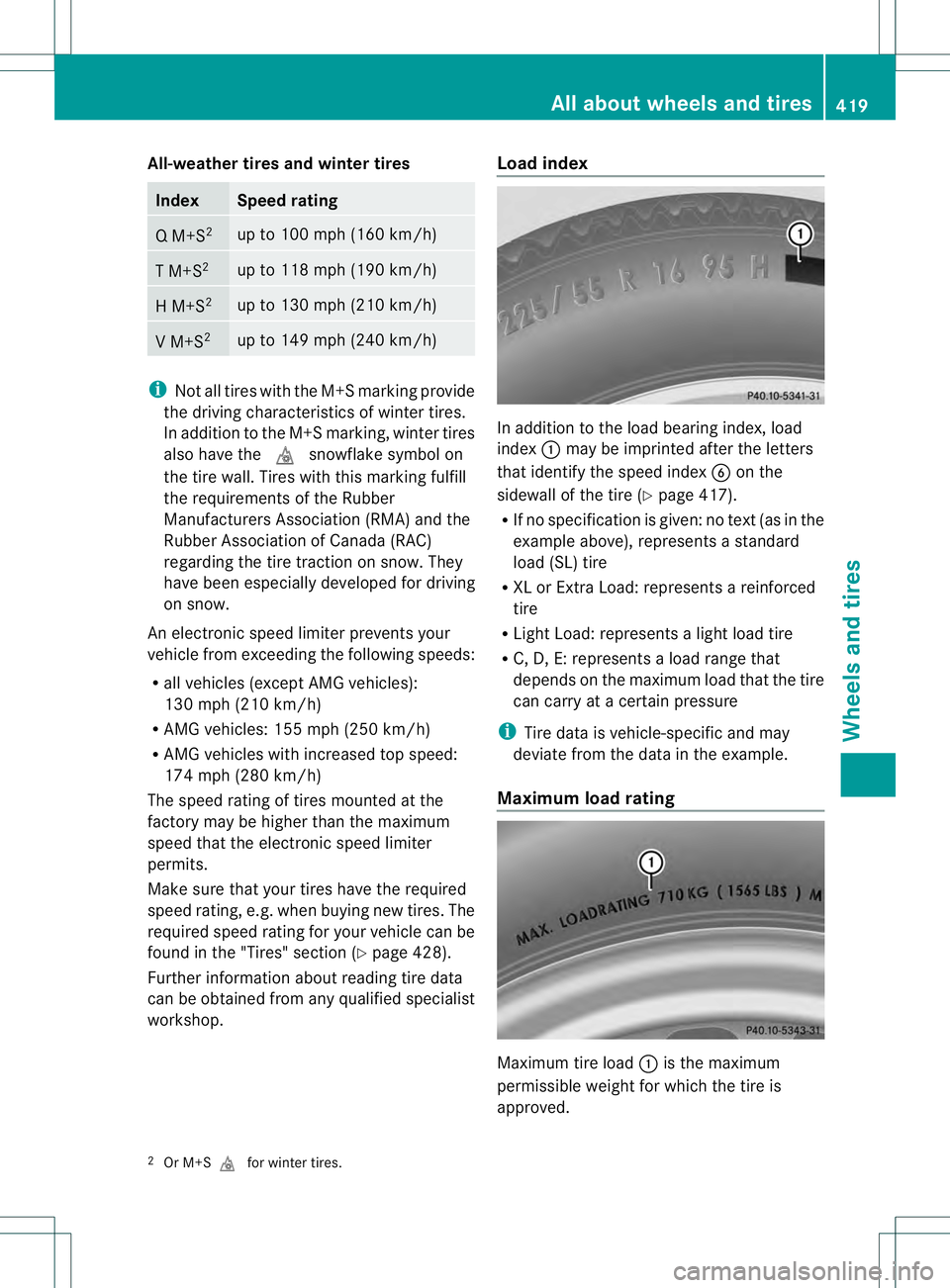
In addition to the load bearing index, load
index
0002may be imprinted after the letters
that identify the speed index 001Fon the
sidewall of the tire (Y page 417).
R If no specification is given: no text (as in the
example above), represents astandard
load (SL) tire
R XL or Extra Load: represents a reinforced
tire
R Ligh tLoad: represents a light load tire
R C, D, E: represents a load range that
depends on the maximum load that the tire
can carry at a certain pressure
i Tire data is vehicle-specific and may
deviate from the data in the example.
Maximum load rating Maximum tire load
0002is the maximum
permissible weight for which the tire is
approved.
2 Or M+S0002 for winter tires. All about wheels and tires
419Wheels and tires Z
Page 431 of 454
These tires have been specially adapted for
use with the control systems, such as ABS
or ESP ®
, and are marked as follows:
R MO =Mercedes-Benz Original
R MOE =Mercedes-Benz Original Extended
(tires featuring run-flat characteristics)
R MO1 =Mercedes-BenzO riginal (only
certain AMG tires)
Mercedes-Benz Original Extended tires
may only be used on wheels that have been
specifically approved by Mercedes-Benz.
Only use tires, wheels or accessories
tested and approved by Mercedes-Benz.
Certain characteristics, e.g. handling,
vehicle noise emissions or fuel
consumption, may otherwise be adversely
affected. In addition, when driving with a
load, tire dimension variations could cause
the tires to come into contact with the
bodywork and axle components. This could
result in damage to the tires or the vehicle.
Mercedes-Benz accepts no liability for
damage resulting from the use of tires,
wheels or accessories other than those
tested and approved.
Information on tires, wheels and approved
combinations can be obtained from any
qualified specialist workshop.
! Retreaded tires are neither tested nor
recommended by Mercedes-Benz, since
previous damage cannot always be
detected on retreaded tires. As a result,
Mercedes-Benz cannot guarantee vehicle
safety if retreaded tires are mounted. Do
not mount used tires if you have no
information about their previous usage.
Overview of abbreviations usedint he
following tire tables:
R BA: both axles
R FA: front axle
R RA: rear axle The recommended pressures for various
operating conditions can be found:
R
on the Tire and Loading Information placard
with the recommended tire pressures on
the B-pillar on the driver's side
R in the tire pressure table on the inside of
the fuel filler flap
Observe the notes on recommended tire
pressures under various operating conditions
(Y page 404).
Check tire pressures regularly, and only when
the tires are cold. Comply with the
maintenance recommendations of the tire
manufacturer in the vehicle document wallet.
Notes on the vehicle equipment –always
equip the vehicle with:
R tires of the same size on a given axle (left/
right)
R the same type of tires at a given time
(summer tires, winter tires, MOExtended
tires)
Vehicles with MOExtended tires are not
equipped with a TIREFIT kit at the factory. It
is therefore recommended that you
additionally equip your vehicle with a TIREFIT
kit if you moun ttires that do not feature run-
flat properties, e.g. winter tires. ATIREFIT kit
may be obtained from a qualified specialist
workshop.
i Not all wheel and tire combinations are
available at the factory for all countries.
i On the following pages, you can find
information on approved wheelr ims and
tire sizes for equipping your vehicle with
winter tires. Winter tires are not available
at the factory as standard equipmen tor
optional extras.
If you would like to equip your vehicle with
approved winter tires, you may also, in
certain circumstances, require rims of the
appropriate size. The sizes of the approved
winter tires may deviate from that of the
standard tires. This is dependent on the
model and the equipment installed at the
factory. Wheel and tire combinations
429Wheels and tires Z
Page 433 of 454
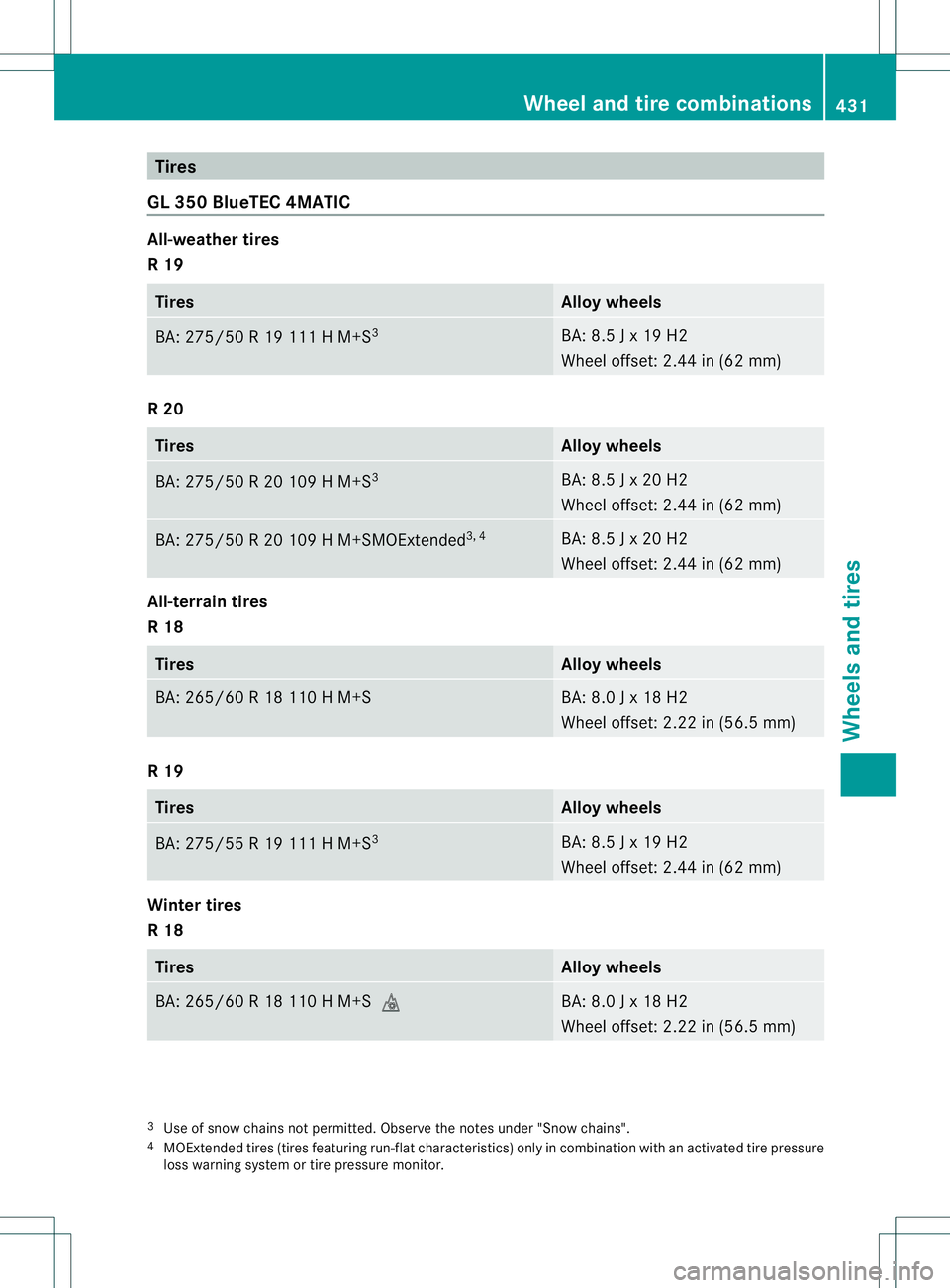
Tires
GL 350 BlueTEC 4MATIC All-weather tires
R 19
Tires Allo
ywheels BA: 275/50 R 19 111 H M+S
3 BA: 8.5 J x 19 H2
Wheel offset: 2.44 in (62 mm)
R 20
Tires Alloy wheels
BA: 275/50 R 20 109 H M+S
3 BA: 8.5 J x 20 H2
Wheel offset: 2.44 in (62 mm)
BA: 275/50 R 20 109 H M+SMOExtended
3, 4 BA: 8.5 J x 20 H2
Wheel offset: 2.44 in (62 mm)
All-terrain tires
R 18
Tires Alloy wheels
BA: 265/60 R 18 110 H M+S BA: 8.0 J x 18 H2
Wheel offset: 2.22 in (56.5 mm)
R 19
Tires Alloy wheels
BA: 275/55 R 19 111 H M+S
3 BA: 8.5 J x 19 H2
Wheel offset: 2.44 in (62 mm)
Winter tires
R 18
Tires Alloy wheels
BA: 265/60 R 18 110 H M+S
0002 BA: 8.0 J x 18 H2
Wheel offset: 2.22 in (56.5 mm)
3
Use of snow chains not permitted. Observe the notes under "Snow chains".
4 MOExtended tires (tires featuring run-fla tcharacteristics) only in combination with an activated tire pressure
loss warning system or tire pressure monitor. Wheel and tire combinations
431Wheels and tires Z
Page 434 of 454
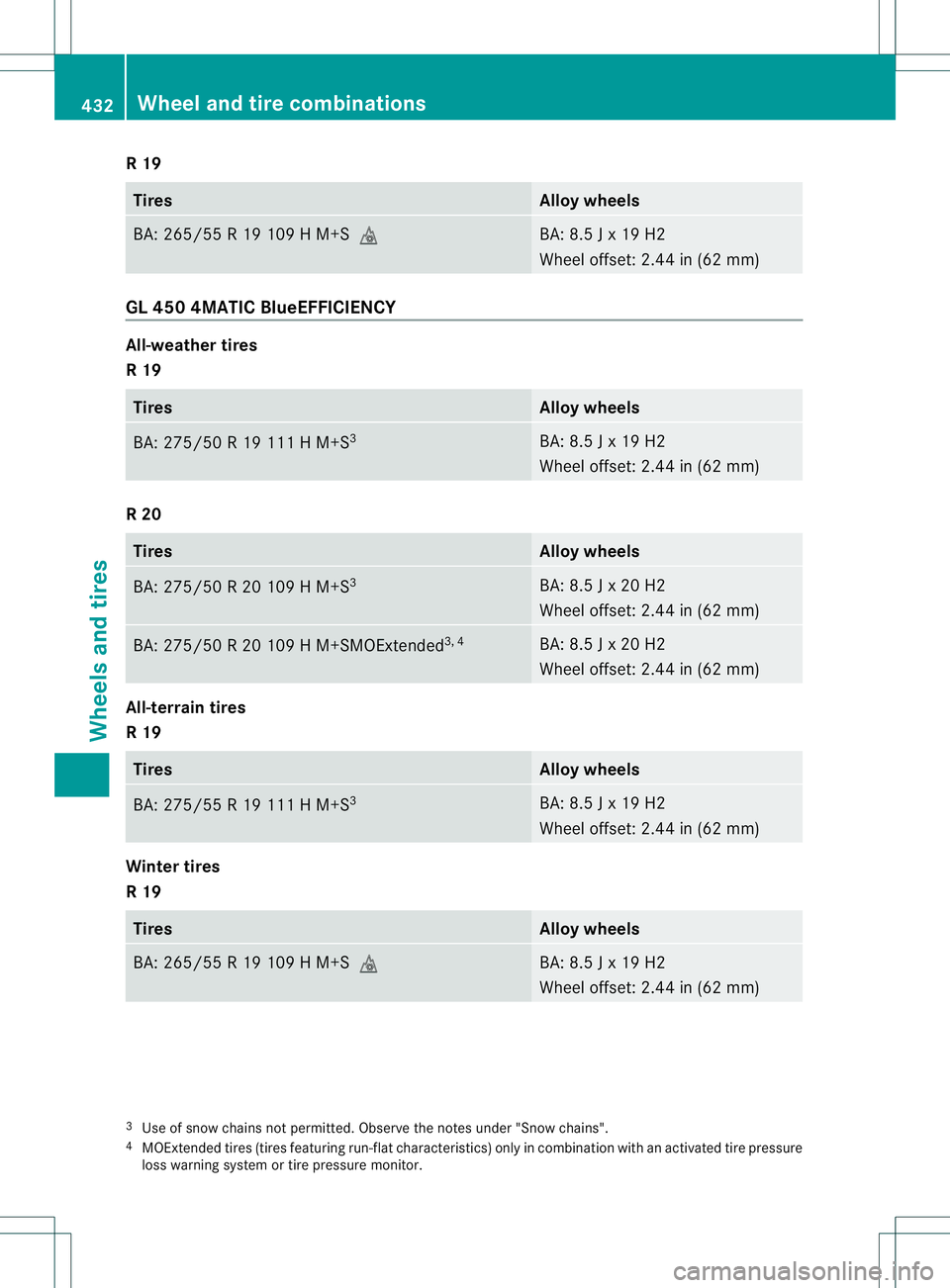
R 19
Tires Allo
ywheels BA: 265/55 R 19 109 H M+S
0002 BA: 8.5 J x 19 H2
Wheel offset: 2.44 in (62 mm)
GL 450 4MATIC BlueEFFICIENCY
All-weather tires
R 19
Tires Alloy wheels
BA: 275/50 R 19 111 H M+S
3 BA: 8.5 J x 19 H2
Wheel offset: 2.44 in (62 mm)
R 20
Tires Alloy wheels
BA: 275/50 R 20 109 H M+S
3 BA: 8.5 J x 20 H2
Wheel offset: 2.44 in (62 mm)
BA: 275/50 R 20 109 H M+SMOExtended
3, 4 BA: 8.5 J x 20 H2
Wheel offset: 2.44 in (62 mm)
All-terrain tires
R 19
Tires Alloy wheels
BA: 275/55 R 19 111 H M+S
3 BA: 8.5 J x 19 H2
Wheel offset: 2.44 in (62 mm)
Winter tires
R 19 Tires Alloy wheels
BA: 265/55 R 19 109 H M+S
0002 BA: 8.5 J x 19 H2
Wheel offset: 2.44 in (62 mm)
3
Use of snow chains not permitted. Observe the notes under "Snow chains".
4 MOExtended tires (tires featuring run-fla tcharacteristics) only in combination with an activated tire pressure
loss warning system or tire pressure monitor. 432
Wheel and tire combinationsWheels and tires
Page 435 of 454
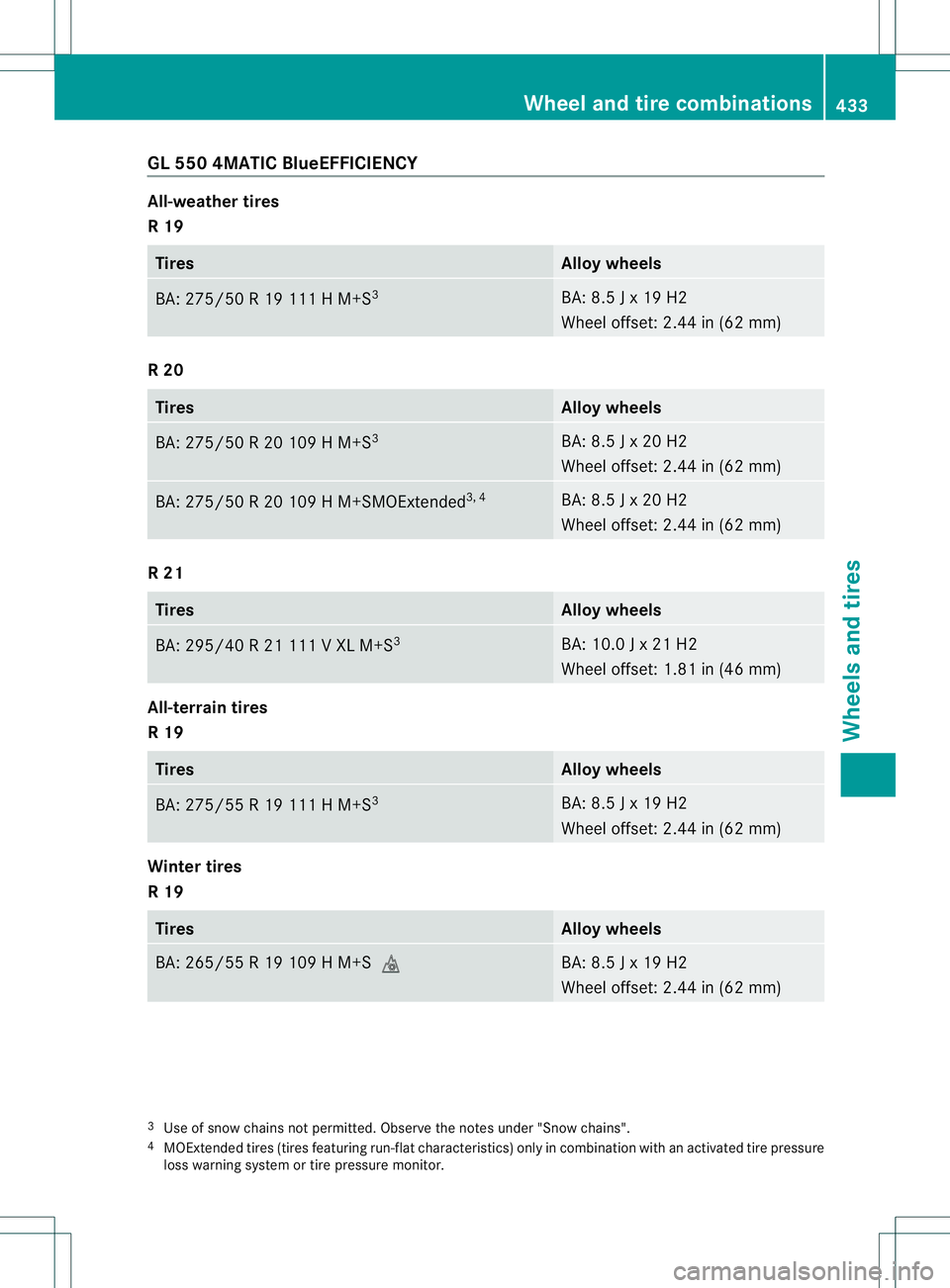
GL 550 4MATIC BlueEFFICIENCY
All-weather tires
R 19
Tires Alloy wheels
BA: 275/50 R 19 111 H M+S
3 BA: 8.5 J x 19 H2
Wheel offset: 2.44 in (62 mm)
R 20
Tires Alloy wheels
BA: 275/50 R 20 109 H M+S
3 BA: 8.5 J x 20 H2
Wheel offset: 2.44 in (62 mm)
BA: 275/50 R 20 109 H M+SMOExtended
3, 4 BA: 8.5 J x 20 H2
Wheel offset: 2.44 in (62 mm)
R 21
Tires Alloy wheels
BA: 295/40 R 21 111 V XL M+S
3 BA: 10.0 J x 21 H2
Wheel offset: 1.81 in (46 mm)
All-terrain tires
R 19
Tires Alloy wheels
BA: 275/55 R 19 111 H M+S
3 BA: 8.5 J x 19 H2
Wheel offset: 2.44 in (62 mm)
Winter tires
R 19
Tires Alloy wheels
BA: 265/55 R 19 109 H M+S
0002 BA: 8.5 J x 19 H2
Wheel offset: 2.44 in (62 mm)
3
Use of snow chains not permitted. Observe the notes under "Snow chains".
4 MOExtended tires (tires featuring run-flat characteristics) only in combinatio nwith an activated tire pressure
loss warning syste mortire pressure monitor. Wheel and tire combinations
433Wheels and tires Z
Page 436 of 454
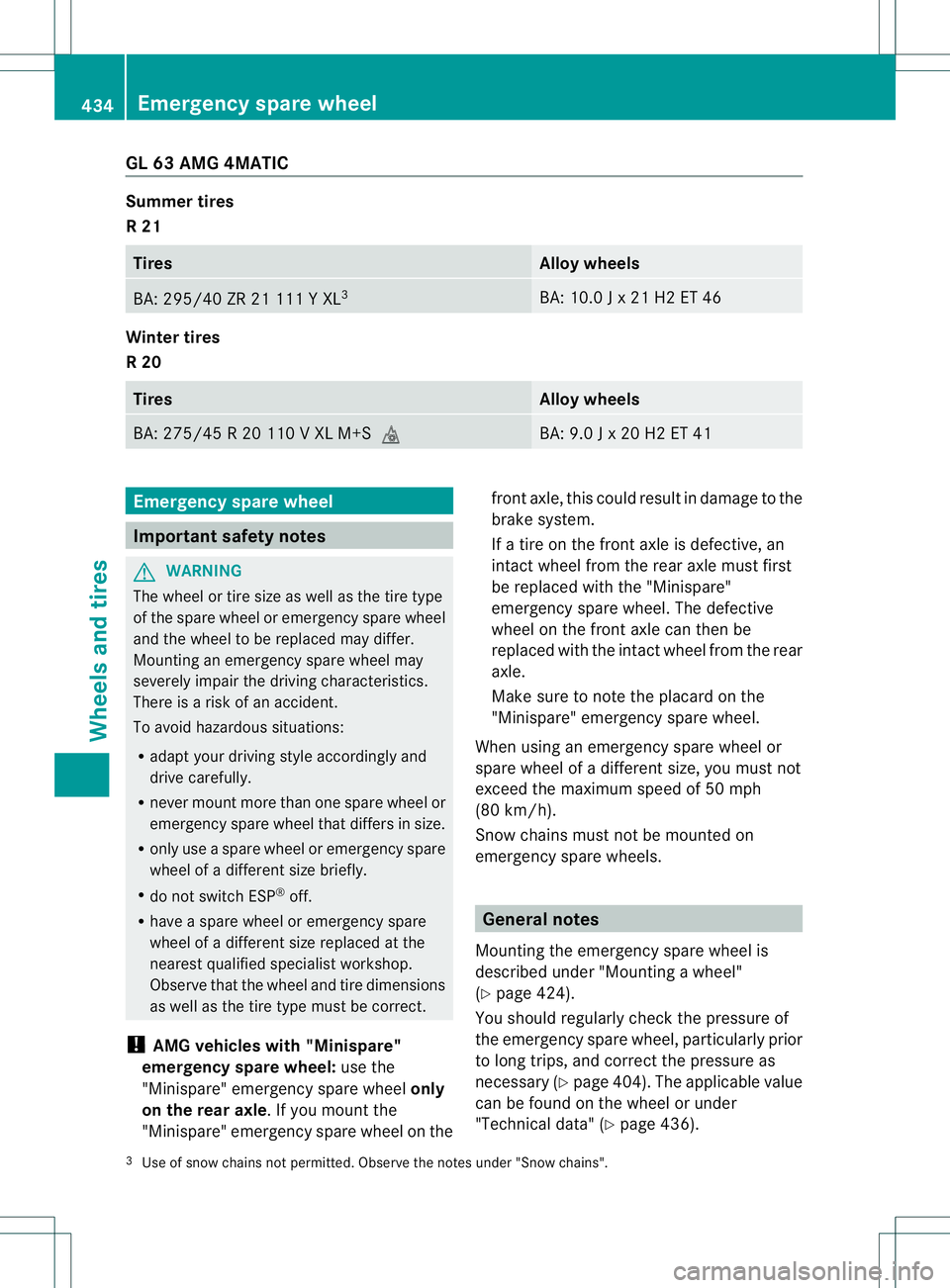
GL 63 AMG 4MATIC
Summer tires
R 21
Tires Alloy wheels
BA: 295/40 ZR 21 111 Y XL
3 BA: 10.0 J x 21 H2 ET 46
Winter tires
R 20
Tires Alloy wheels
BA: 275/45 R 20 110 V XL M+S
0002 BA: 9.0 J x 20 H2 ET 41
Emergency spare wheel
Important safety notes
G
WARNING
The wheel or tire size as well as the tire type
of the spare wheel or emergency spare wheel
and the wheel to be replaced may differ.
Mounting an emergency spare wheel may
severely impair the driving characteristics.
There is a risk of an accident.
To avoid hazardous situations:
R adapt yourd riving style accordingly and
drive carefully.
R never mount more than one spare wheel or
emergency spare wheel that differs in size.
R only use a spare wheel or emergency spare
wheel of a different size briefly.
R do not switch ESP ®
off.
R have a spare wheel or emergency spare
wheel of a different size replaced at the
nearest qualified specialist workshop.
Observe that the wheel and tire dimensions
as well as the tire type must be correct.
! AMG vehicles with "Minispare"
emergency spare wheel: use the
"Minispare" emergency spare wheel only
on the rear axle . If you mount the
"Minispare" emergency spare wheel on the front axle, this could resul
tindamage to the
brake system.
If a tire on the front axle is defective, an
intact wheel from the rear axle must first
be replaced with the "Minispare"
emergency spare wheel .The defective
wheel on the front axle can then be
replaced with the intact wheel from the rear
axle.
Make sure to note the placard on the
"Minispare" emergency spare wheel.
When using an emergency spare wheel or
spare wheel of a different size, you must not
exceed the maximum speed of 50 mph
(80 km/h).
Snow chains must not be mounted on
emergency spare wheels. General notes
Mounting the emergency spare wheel is
described under "Mounting a wheel"
(Y page 424).
You should regularly check the pressure of
the emergency spare wheel, particularly prior
to long trips, and correct the pressure as
necessary (Y page 404). The applicable value
can be found on the wheel or under
"Technical data" (Y page 436).
3 Use of snow chains not permitted. Observe the notes under "Snow chains". 434
Emergency spare wheelWheels and tires