Page 348 of 494

CHANGING A ROAD WHEEL
WARNING:The use of tire sealants may damage your tire
pressure monitoring system (TPMS) and should not be used.
However, if you must use a sealant, the TPMS sensor and valve stem on
the wheel must be replaced by an authorized Ford dealer.
WARNING:Refer toTire pressure monitoring system (TPMS)
in this chapter for important information. If the tire pressure
monitor sensor becomes damaged, it will no longer function.
Note:The tire pressure monitoring system (TPMS) indicator light will
illuminate when the spare tire is in use. To restore the full functionality
of the monitoring system, all road wheels equipped with tire pressure
monitoring sensors must be mounted on the vehicle.
If you get a flat tire while driving, do not apply the brake heavily.
Instead, gradually decrease your speed. Hold the steering wheel firmly
and slowly move to a safe place on the side of the road.
Have a flat serviced by an authorized dealer in order to prevent damage
to the TPMS sensors, refer toTire pressure monitoring system (TPMS)
earlier in the chapter. Replace the spare tire with a road tire as soon as
possible. During repairing or replacing of the flat tire, have the
authorized dealer inspect the TPMS sensor for damage.
Dissimilar Spare Tire/Wheel Information
WARNING:Failure to follow these guidelines could result in an
increased risk of loss of vehicle control, injury or death.
If you have a dissimilar spare tire/wheel, then it is intended for
temporary use only. This means that if you need to use it, you should
replace it as soon as possible with a road tire/wheel that is the same size
and type as the road tires and wheels that were originally provided by
Ford. If the dissimilar spare tire or wheel is damaged, it should be
replaced rather than repaired.
A dissimilar spare tire/wheel is defined as a spare tire and/or wheel that
is different in brand, size or appearance from the road tires and wheels
and can be one of three types:
1.T-type mini-spare:This spare tire begins with the letter “T” for tire
size and may have “Temporary Use Only” molded in the sidewall
348Wheels and Tires
2013 MKT(mkt)
Owners Guide gf, 1st Printing
USA(fus)
Page 349 of 494

2.Full-size dissimilar spare with label on wheel:This spare tire has
a label on the wheel that states: “THIS TIRE AND WHEEL FOR
TEMPORARY USE ONLY”
When driving with one of the dissimilar spare tires listed above,do not:
•Exceed 50 mph (80 km/h)
•Load the vehicle beyond maximum vehicle load rating listed on the
Safety Compliance Label
•Tow a trailer
•Use snow chains on the end of the vehicle with the dissimilar spare
tire
•Use more than one dissimilar spare tire at a time
•Use commercial car washing equipment
•Try to repair the dissimilar spare tire
Use of one of the dissimilar spare tires listed above at any one wheel
location can lead to impairment of the following:
•Handling, stability and braking performance
•Comfort and noise
•Ground clearance and parking at curbs
•Winter weather driving capability
•Wet weather driving capability
3.Full-size dissimilar spare without label on wheel
When driving with the full-size dissimilar spare tire/wheel,do not:
•Exceed 70 mph (113 km/h)
•Use more than one dissimilar spare tire/wheel at a time
•Use commercial car washing equipment
•Use snow chains on the end of the vehicle with the dissimilar spare
tire/wheel
The usage of a full-size dissimilar spare tire/wheel can lead to impairment
of the following:
•Handling, stability and braking performance
•Comfort and noise
•Ground clearance and parking at curbs
•Winter weather driving capability
Wheels and Tires349
2013 MKT(mkt)
Owners Guide gf, 1st Printing
USA(fus)
Page 350 of 494

•Wet weather driving capability
•All-Wheel driving capability (if applicable)
•Load leveling adjustment (if applicable)
When driving with the full-size dissimilar spare tire/wheel additional
caution should be given to:
•Towing a trailer
•Driving vehicles equipped with a camper body
•Driving vehicles with a load on the cargo rack
Drive cautiously when using a full-size dissimilar spare tire/wheel and
seek service as soon as possible.
Tire Change Procedure
WARNING:When one of the front wheels is off the ground, the
transmission alone will not prevent the vehicle from moving or
slipping off the jack, even if the vehicle is in P (Park).
WARNING:To help prevent the vehicle from moving when you
change a tire, be sure to place the transmission in P (Park), set
the parking brake and block (in both directions) the wheel that is
diagonally opposite (other side and end of the vehicle) to the tire being
changed.
WARNING:To prevent sudden vehicle movement, turn off the
air suspension switch (if equipped), prior to jacking, hoisting or
towing the vehicle.
WARNING:If the vehicle slips off the jack, you or someone else
could be seriously injured.
WARNING:Do not attempt to change a tire on the side of the
vehicle close to moving traffic. Pull far enough off the road to
avoid the danger of being hit when operating the jack or changing the
wheel.
350Wheels and Tires
2013 MKT(mkt)
Owners Guide gf, 1st Printing
USA(fus)
Page 351 of 494

WARNING:To lessen the risk of personal injury, do not put any
part of your body under the vehicle while changing a tire. Do not
start the engine when your vehicle is on the jack. The jack is only
meant for changing the tire.
Note:Passengers should not remain in the vehicle when the vehicle is
being jacked.
Park on a level surface, set the parking brake and activate hazard
flashers.
Place gearshift lever in P (Park) and turn engine off.
Non-limousine:If the 3rd row seat is stowed in the floor, you will need
to unstow it to access the spare tire and jack.
1. Remove the carpeted floor panel
located in the rear of the vehicle, then
remove the wing nut that secures the
spare tire by turning it counterclockwise.
2. Lift and remove the spare tire from
the trunk.
3. Remove the second wing nut that
secures the jack retention bracket by
turning it counterclockwise, remove the
jack kit from the vehicle.
4. Remove the jack, L-shaped bolt, and
the wrench from the felt bag. Fold down
the wrench socket to use to loosen the
lug nuts and to operate the jack.
Wheels and Tires351
2013 MKT(mkt)
Owners Guide gf, 1st Printing
USA(fus)
Page 352 of 494
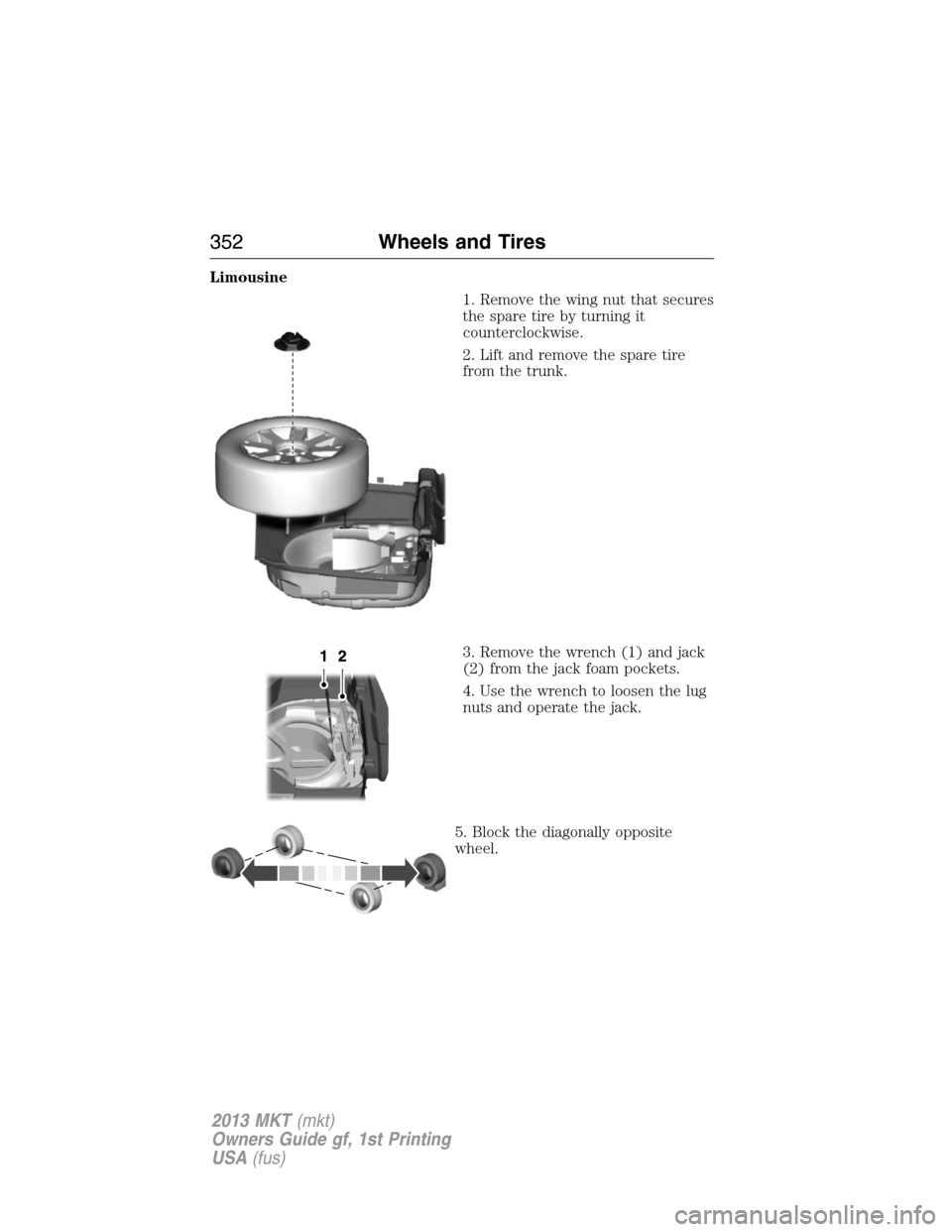
Limousine
1. Remove the wing nut that secures
the spare tire by turning it
counterclockwise.
2. Lift and remove the spare tire
from the trunk.
3. Remove the wrench (1) and jack
(2) from the jack foam pockets.
4. Use the wrench to loosen the lug
nuts and operate the jack.
5. Block the diagonally opposite
wheel.
352Wheels and Tires
2013 MKT(mkt)
Owners Guide gf, 1st Printing
USA(fus)
Page 353 of 494

6. Remove wheel cover (if equipped) with the lug wrench tip and loosen
each wheel lug nut one-half turn counterclockwise but do not remove
them until the wheel is raised off the ground.
7. The vehicle jacking points are shown here, and are depicted on the
yellow warning label on the jack.
Jack at the specific locations to avoid damage to the vehicle.
8. Put the jack in the jack notch next to the
tire you are changing. Turn the jack handle
clockwise until the wheel is completely off
the ground.
9. Remove the lug nuts with the lug wrench.
10. Replace the flat tire with the spare tire, making sure the valve stem is
facing outward. Reinstall the lug nuts until the wheel is snug against the
hub. Do not fully tighten the lug nuts until the wheel has been lowered.
11. Lower the wheel by turning the jack handle counterclockwise.
12. Remove the jack and fully tighten the
lug nuts in the order shown. Refer toWheel
lug nut torque specificationslater in this
chapter for the proper lug nut torque
specification.
13. Install the wheel cover (if equipped).
Wheels and Tires353
2013 MKT(mkt)
Owners Guide gf, 1st Printing
USA(fus)
Page 354 of 494
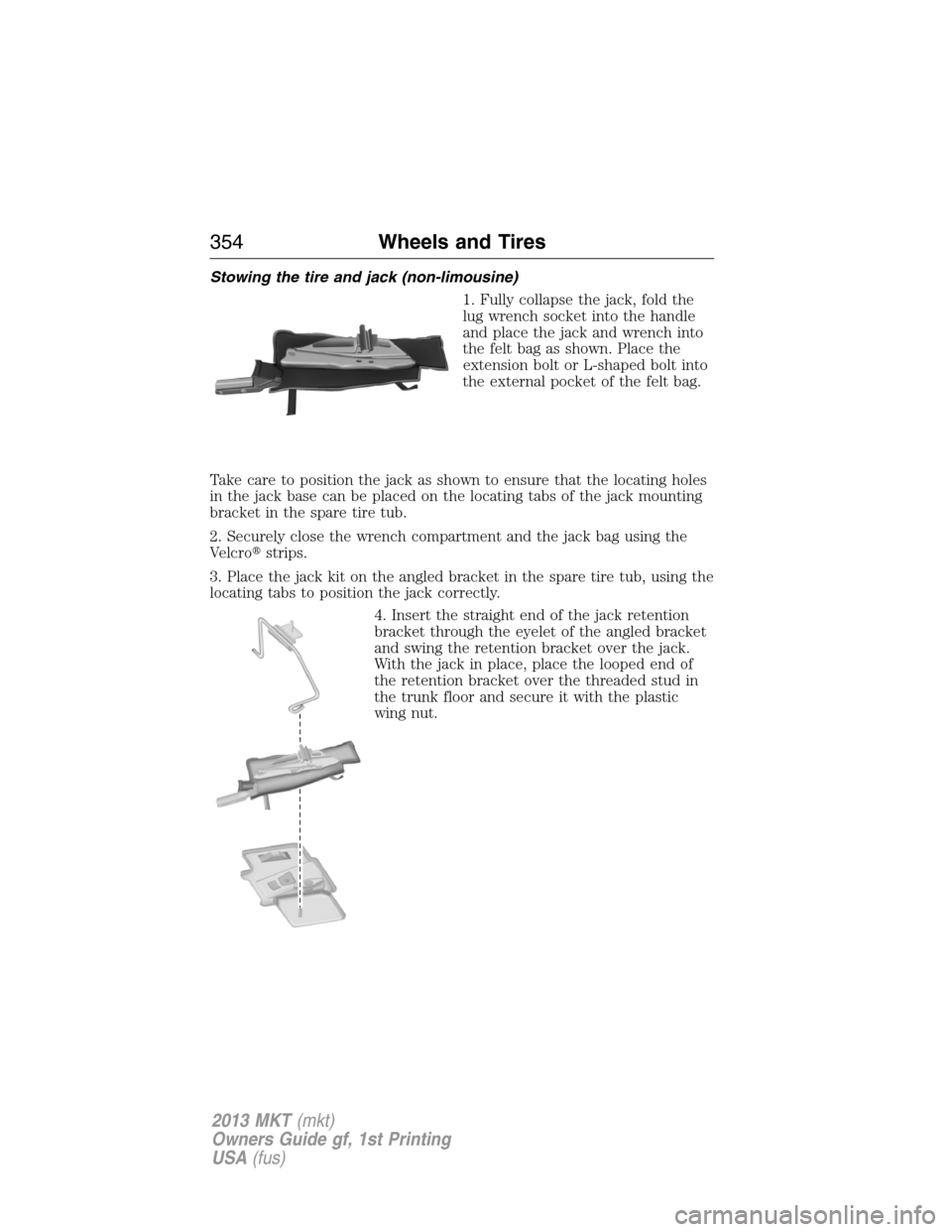
Stowing the tire and jack (non-limousine)
1. Fully collapse the jack, fold the
lug wrench socket into the handle
and place the jack and wrench into
the felt bag as shown. Place the
extension bolt or L-shaped bolt into
the external pocket of the felt bag.
Take care to position the jack as shown to ensure that the locating holes
in the jack base can be placed on the locating tabs of the jack mounting
bracket in the spare tire tub.
2. Securely close the wrench compartment and the jack bag using the
Velcro�strips.
3. Place the jack kit on the angled bracket in the spare tire tub, using the
locating tabs to position the jack correctly.
4. Insert the straight end of the jack retention
bracket through the eyelet of the angled bracket
and swing the retention bracket over the jack.
With the jack in place, place the looped end of
the retention bracket over the threaded stud in
the trunk floor and secure it with the plastic
wing nut.
354Wheels and Tires
2013 MKT(mkt)
Owners Guide gf, 1st Printing
USA(fus)
Page 355 of 494
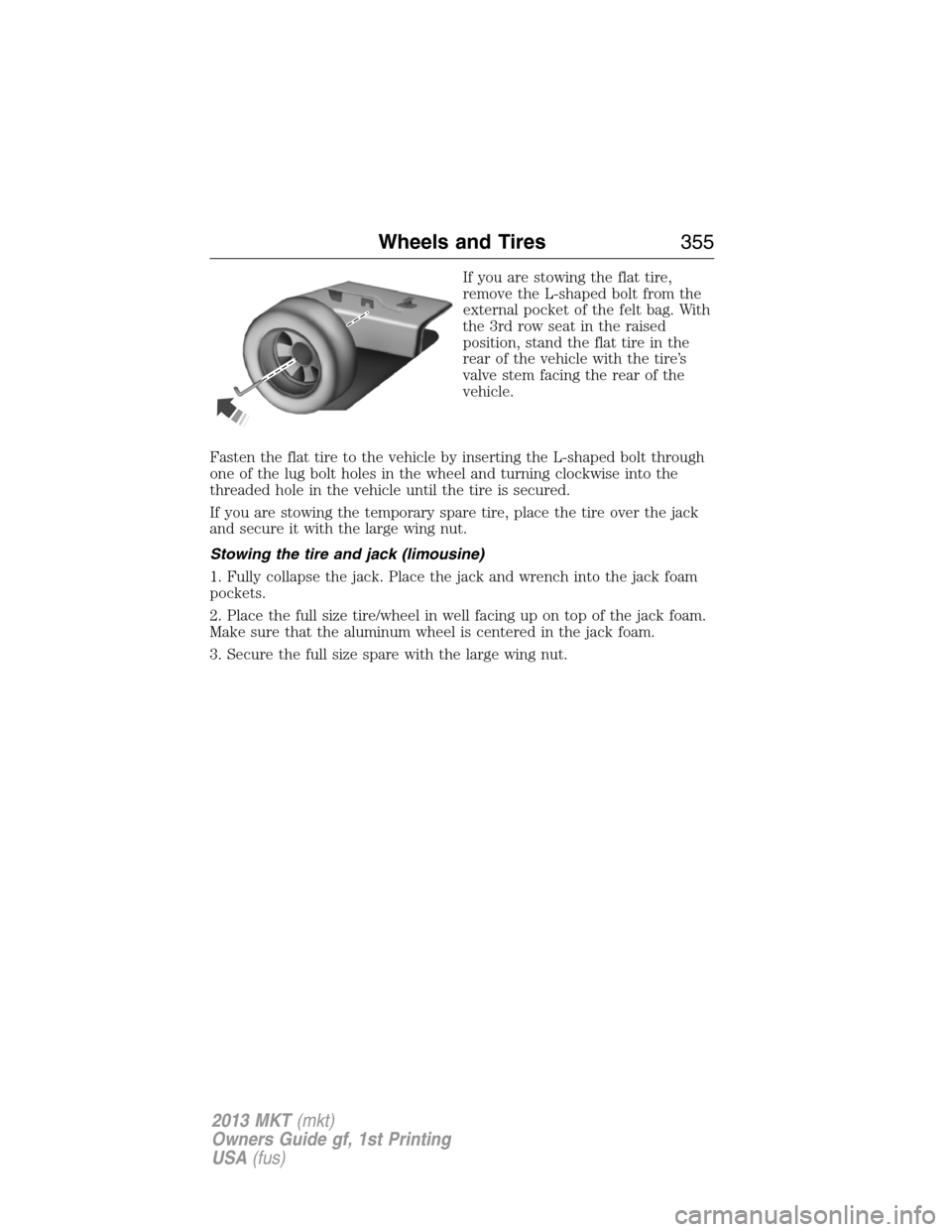
If you are stowing the flat tire,
remove the L-shaped bolt from the
external pocket of the felt bag. With
the 3rd row seat in the raised
position, stand the flat tire in the
rear of the vehicle with the tire’s
valve stem facing the rear of the
vehicle.
Fasten the flat tire to the vehicle by inserting the L-shaped bolt through
one of the lug bolt holes in the wheel and turning clockwise into the
threaded hole in the vehicle until the tire is secured.
If you are stowing the temporary spare tire, place the tire over the jack
and secure it with the large wing nut.
Stowing the tire and jack (limousine)
1. Fully collapse the jack. Place the jack and wrench into the jack foam
pockets.
2. Place the full size tire/wheel in well facing up on top of the jack foam.
Make sure that the aluminum wheel is centered in the jack foam.
3. Secure the full size spare with the large wing nut.
Wheels and Tires355
2013 MKT(mkt)
Owners Guide gf, 1st Printing
USA(fus)