Page 252 of 494

RECOMMENDED TOWING WEIGHTS
Note:2.0L FWD and 3.7L AWD applications (available on Limousine and
Livery only) are not rated for towing.
Powertrain Maximum GCWR - lb
(kg)Maximum Trailer
Weight - lb (kg)
3.7L FWD Class I 6900 (3131) 2000 (907)
3.7L AWD Class I 7070 (3208) 2000 (907)
EcoBoost™ Class I 7200 (3267) 2000 (907)
3.7L FWD Class III 9450 (4288) 4500 (2042)
1
3.7L AWD Class III 9620 (4365) 4500 (2042)2
EcoBoost™ Class III 9750 (4424) 4500 (2042)2
1
For towing trailers up to 3500 lb (1588 kg), use a weight-carrying
hitch and ball which uniformly spreads the trailer tongue loads through
the vehicle’s underbody structure. For towing trailers over 3500 lb
(1588 kg), up to 4500 lb (2042 kg), it is recommended to use a
weight-distributing hitch to increase front axle load while towing.
2For towing trailers up to 4500 lb (2042 kg), use a weight-carrying
hitch and ball which uniformly spreads the trailer tongue loads through
the vehicle’s underbody structure.
ESSENTIAL TOWING CHECKS
Follow these guidelines to ensure safe towing:
•Do not tow a trailer until your vehicle has been driven at least
1000 miles (1600 kilometers).
•Consult your local motor vehicle laws for towing a trailer.
•Refer to the instructions included with towing accessories for the
proper installation and adjustment specifications.
•Service your vehicle more frequently if you tow a trailer. Refer to your
scheduled maintenance information.
For load specification terms found on the label and instructions on
calculating your vehicle’s load, refer to theLoad Carryingchapter.
Remember to account for the trailer tongue weight as part of the vehicle
load when calculating the total vehicle weight.
252Towing
2013 MKT(mkt)
Owners Guide gf, 1st Printing
USA(fus)
Page 259 of 494

BREAKING-IN
Your vehicle does not need an extensive break-in. Try not to drive
continuously at the same speed for the first 1,000 miles (1,600 km) of
new vehicle operation. Vary your speed frequently in order to give the
moving parts a chance to break in.
Drive your new vehicle at least 1,000 miles (1,600 km) before towing a
trailer.
Do not add friction modifier compounds or special break-in oils since
these additives may prevent piston ring seating.
ECONOMICAL DRIVING
Fuel economy is affected by several things such as how you drive, the
conditions you drive under and how you maintain your vehicle.
There are some things to keep in mind that may improve your fuel
economy:
•Accelerate and slow down in a smooth, moderate fashion.
•Drive at steady speeds without stopping.
•Anticipate stops; slowing down may eliminate the need to stop.
•Combine errands and minimize stop-and-go driving.
•Close the windows for high-speed driving.
•Drive at reasonable speeds (traveling at 55 mph [88 km/h] uses 15%
less fuel than traveling at 65 mph [105 km/h]).
•Keep the tires properly inflated and use only the recommended size.
•Use the recommended engine oil.
•Perform all regularly scheduled maintenance.
There are also some things you may not want to do because they may
reduce your fuel economy:
•Sudden or hard accelerations.
•Rev the engine before turning it off.
•Idle for periods longer than one minute.
•Warm up your vehicle on cold mornings.
•Use the air conditioner or front defroster.
•Use the speed control in hilly terrain.
•Rest your foot on the brake pedal while driving.
Driving Hints259
2013 MKT(mkt)
Owners Guide gf, 1st Printing
USA(fus)
Page 268 of 494
GETTING THE SERVICES YOU NEED
Away from home
If you are away from home when your vehicle needs service, contact the
Ford Customer Relationship Center or use the online resources listed
below to find the nearest authorized dealer.
In the United States:
Mailing address
Ford Motor Company
Customer Relationship Center
P.O. Box 6248
Dearborn, MI 48121
Telephone
1-800-521-4140
(TDD for the hearing impaired: 1-800-232-5952)
Online
Additional information and resources are available online at
www.lincolnowner.com
•U.S. dealer locator by Dealer Name, City/State, or Zip Code
•Owner Guides
•Maintenance Schedules
•Recalls
•Ford Extended Service Plans
•Ford Genuine Accessories
•Service specials and promotions.
In Canada:
Mailing address
Lincoln Centre
Ford Motor Company of Canada, Limited
P.O. Box 2000
Oakville, Ontario L6J 5E4
Telephone
1-800-387-9333
Online
www.lincolncanada.com
268Customer Assistance
2013 MKT(mkt)
Owners Guide gf, 1st Printing
USA(fus)
Page 270 of 494

Online
Additional information and resources are available online at
www.fordowner.com
These are some of the items that can be found online:
•U.S. dealer locator by Dealer Name, City/State, or Zip Code
•Owner Manuals
•Maintenance Schedules
•Recalls
•Ford Extended Service Plans
•Ford Genuine Accessories
•Service specials and promotions.
In Canada:
Mailing address
Customer Relationship Centre
Ford Motor Company of Canada, Limited
P.O. Box 2000
Oakville, Ontario L6J 5E4
Telephone
1-800-565-3673 (FORD)
Online
www.ford.ca
Additional assistance
If you have questions or concerns, or are unsatisfied with the service you
are receiving, follow these steps:
1. Contact your Sales Representative or Service Advisor at your
selling/servicing authorized dealer.
2. If your inquiry or concern remains unresolved, contact the Sales
Manager, Service Manager or Customer Relations Manager.
3. If you require assistance or clarification on Ford Motor Company
policies, please contact the Ford Customer Relationship Center
In order to help you serve you better, please have the following
information available when contacting a Customer Relationship Center:
•Vehicle Identification Number (VIN)
•Your telephone number (home and business)
•The name of the authorized dealer and city where located
•The vehicle’s current odometer reading
270Customer Assistance
2013 MKT(mkt)
Owners Guide gf, 1st Printing
USA(fus)
Page 278 of 494

FUSE SPECIFICATION CHART
Power Distribution Box
WARNING:Always disconnect the battery before servicing high
current fuses.
WARNING:To reduce risk of electrical shock, always replace the
cover to the power distribution box before reconnecting the
battery or refilling fluid reservoirs.
The power distribution box is located in the engine compartment. It has
high-current fuses that protect your vehicle’s main electrical systems
from overloads.
If the battery has been disconnected and reconnected, refer to the
Changing the Vehicle Batteryin theMaintenancechapter.
The high-current fuses are coded as follows:
Fuse/Relay
NumberFuse Amp
RatingProtected Components
1 40A** Fan relay 2
2 40A** Fan relay 1
3 30A** Trailer brake control module
97
98
77969594
93 92 91 90 89
88
66
4478
56
39
26
18 1617
312 4 5 6 7 8 919 20 21 22 23 2427 28 29 30 3140 41 42 4355
57 58 59 60 61 62 63 64 6579 80 81 82 83 84 85 86 87
67
45
32
10 11 12 1333 34 3546 47 48 49 50 5168 69 70 71 72 74
73 76
75
53
37 36 54
38
25
151452
278Fuses
2013 MKT(mkt)
Owners Guide gf, 1st Printing
USA(fus)
Page 287 of 494

GENERAL INFORMATION
Have your vehicle serviced regularly to help maintain its roadworthiness
and resale value. There is a large network of Ford authorized dealers that
are there to help you with their professional servicing expertise. We
believe that their specially trained technicians are best qualified to
service your vehicle properly and expertly. They are supported by a wide
range of highly specialized tools developed specifically for servicing your
vehicle.
To help you service your vehicle, we providescheduled maintenance
informationwhich makes tracking routine service easy.
If your vehicle requires professional service, your authorized dealer can
provide the necessary parts and service. Check yourWarranty Guideto
find out which parts and services are covered.
Use only recommended fuels, lubricants, fluids and service parts
conforming to specifications. Motorcraft�parts are designed and built to
provide the best performance in your vehicle.
Precautions
•Do not work on a hot engine.
•Make sure that nothing gets caught in moving parts.
•Do not work on a vehicle with the engine running in an enclosed
space, unless you are sure you have enough ventilation.
•Keep all open flames and other burning material (such as cigarettes)
away from the battery and all fuel related parts.
Working with the engine off
1. Set the parking brake and shift to P (Park).
2. Turn off the engine and remove the key (if equipped).
3. Block the wheels.
Working with the engine on
WARNING:To reduce the risk of vehicle damage and/or personal
burn injuries, do not start your engine with the air cleaner
removed and do not remove it while the engine is running.
1. Set the parking brake and shift to P (Park).
2. Block the wheels.
Maintenance287
2013 MKT(mkt)
Owners Guide gf, 1st Printing
USA(fus)
Page 288 of 494
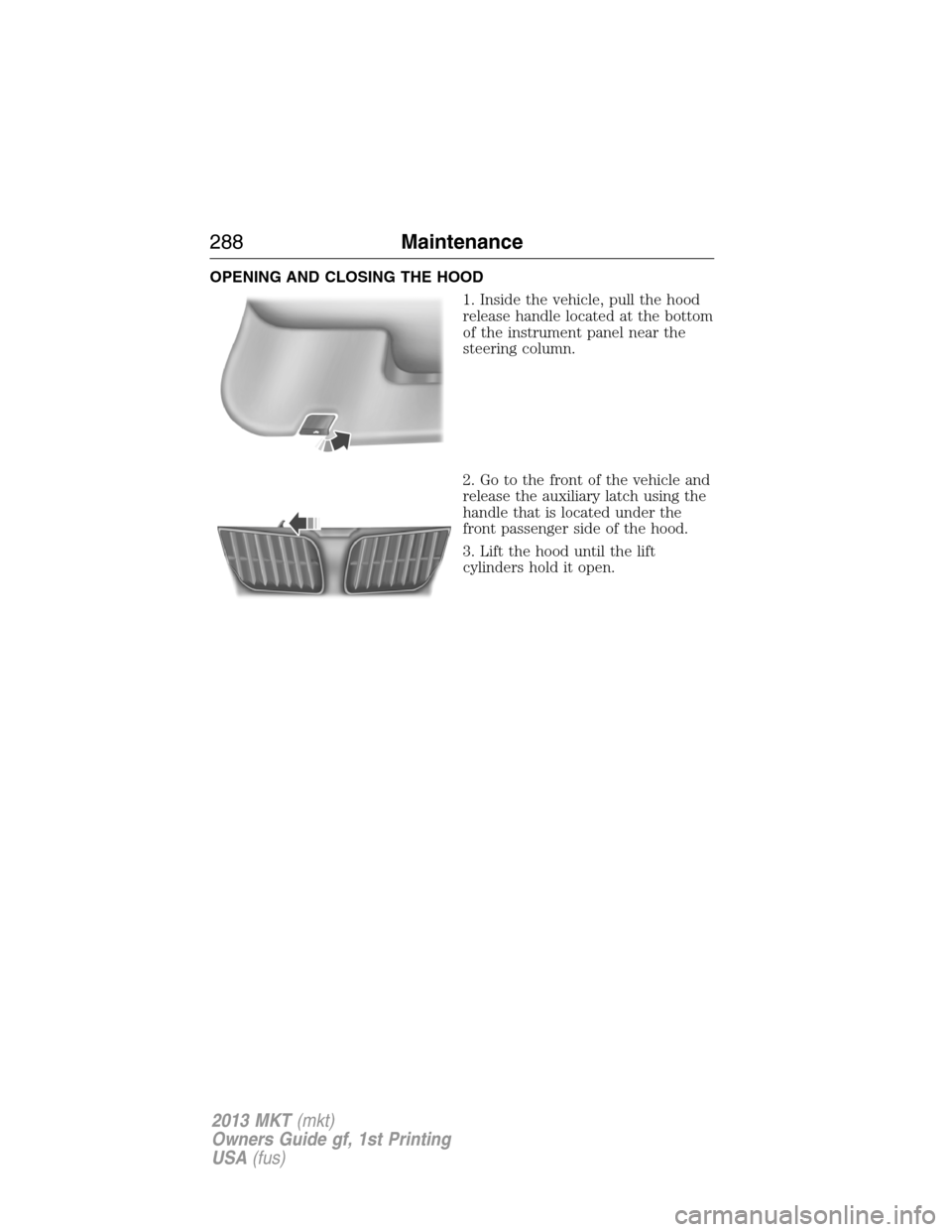
OPENING AND CLOSING THE HOOD
1. Inside the vehicle, pull the hood
release handle located at the bottom
of the instrument panel near the
steering column.
2. Go to the front of the vehicle and
release the auxiliary latch using the
handle that is located under the
front passenger side of the hood.
3. Lift the hood until the lift
cylinders hold it open.
288Maintenance
2013 MKT(mkt)
Owners Guide gf, 1st Printing
USA(fus)
Page 289 of 494
UNDER HOOD OVERVIEW
3.7L V6 engine
A. Engine coolant reservoir
B. Windshield washer fluid reservoir
C. Brake fluid reservoir
D. Battery
E. Power distribution box
F. Air filter assembly
G. Automatic transmission fluid dipstick
H. Engine oil dipstick
I. Engine oil filler cap
A
IHGF
BCDE
Maintenance289
2013 MKT(mkt)
Owners Guide gf, 1st Printing
USA(fus)