Page 189 of 494

AUTOMATIC TRANSMISSION
WARNING:Always set the parking brake fully and make sure the
gearshift is latched in P (Park). Turn the ignition to the off
position and remove the key whenever you leave your vehicle.
Your vehicle has been designed to improve fuel economy by reducing fuel
usage while coasting or decelerating. When you take your foot off the
accelerator pedal and the vehicle begins to slow down, the torque
converter clutch locks up and aggressively shuts off fuel flow to the
engine while decelerating. This fuel economy benefit may be perceived as
a light to medium braking sensation when removing your foot from the
accelerator pedal.
P (Park)
This position locks the transmission and prevents
the front wheels from turning.
To put your vehicle in gear:
•Press the brake pedal
•Move the gearshift lever into the desired gear
To put your vehicle in P (Park):
•Come to a complete stop
•Move the gearshift lever and securely latch it in P (Park)
R (Reverse)
With the gearshift lever in R (Reverse), the vehicle will move backward.
Always come to a complete stop before shifting into and out of R
(Reverse).
N (Neutral)
With the gearshift lever in N (Neutral), the vehicle can be started and is
free to roll. Hold the brake pedal down while in this position.
PRNDL
Transmission189
2013 MKT(mkt)
Owners Guide gf, 1st Printing
USA(fus)
Page 190 of 494
D (Drive) with Overdrive
The normal driving position for the best fuel economy. Transmission
operates in gears one through six.
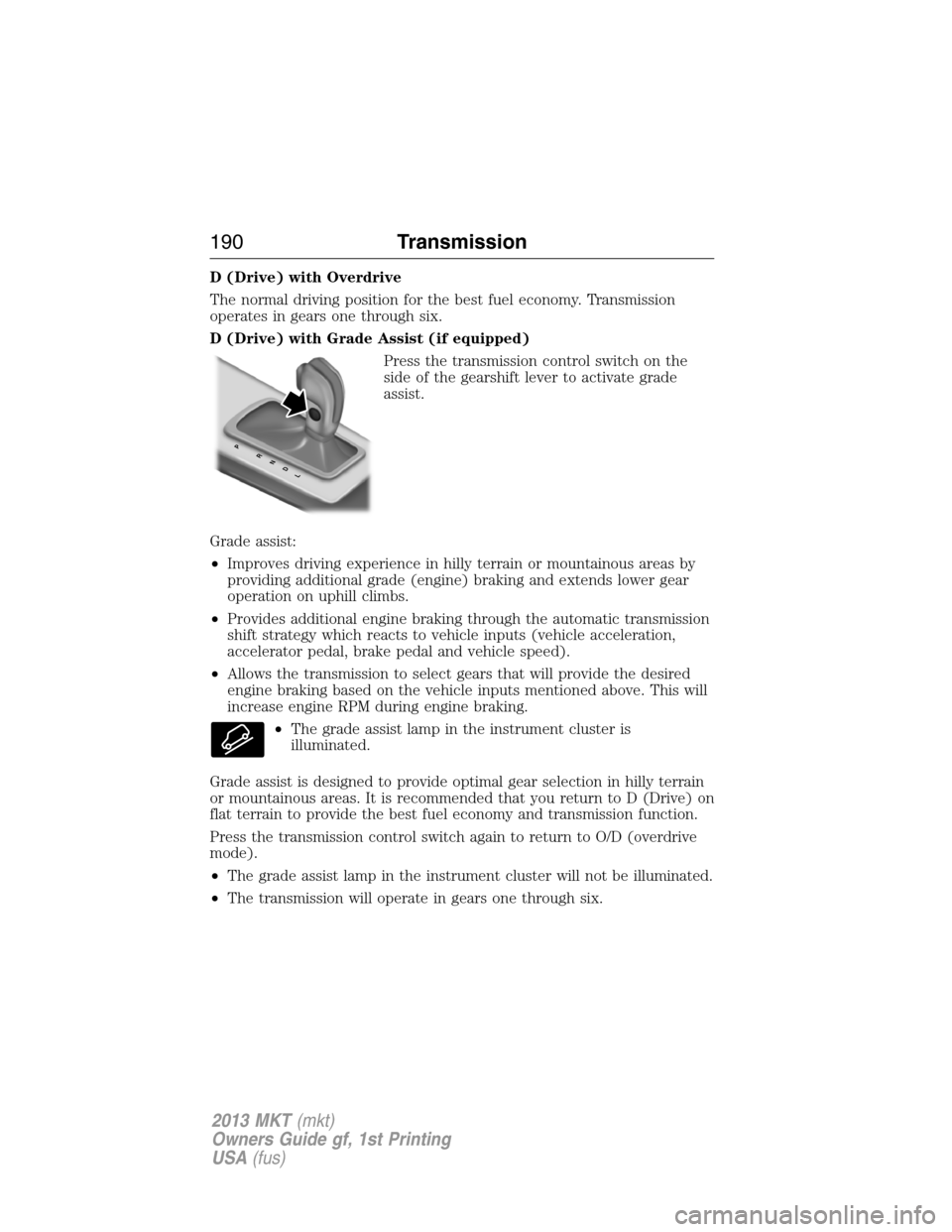
D (Drive) with Grade Assist (if equipped)
Press the transmission control switch on the
side of the gearshift lever to activate grade
assist.
Grade assist:
•Improves driving experience in hilly terrain or mountainous areas by
providing additional grade (engine) braking and extends lower gear
operation on uphill climbs.
•Provides additional engine braking through the automatic transmission
shift strategy which reacts to vehicle inputs (vehicle acceleration,
accelerator pedal, brake pedal and vehicle speed).
•Allows the transmission to select gears that will provide the desired
engine braking based on the vehicle inputs mentioned above. This will
increase engine RPM during engine braking.
•The grade assist lamp in the instrument cluster is
illuminated.
Grade assist is designed to provide optimal gear selection in hilly terrain
or mountainous areas. It is recommended that you return to D (Drive) on
flat terrain to provide the best fuel economy and transmission function.
Press the transmission control switch again to return to O/D (overdrive
mode).
•The grade assist lamp in the instrument cluster will not be illuminated.
•The transmission will operate in gears one through six.
PRNDL
190Transmission
2013 MKT(mkt)
Owners Guide gf, 1st Printing
USA(fus)
Page 191 of 494
L (Low)
•Provides maximum engine braking
•Will downshift to the lowest available gear for the current vehicle
speed; allows for first gear when vehicle reaches lower speeds
•Is not intended for use under extended or normal driving conditions
and results in lower fuel economy.
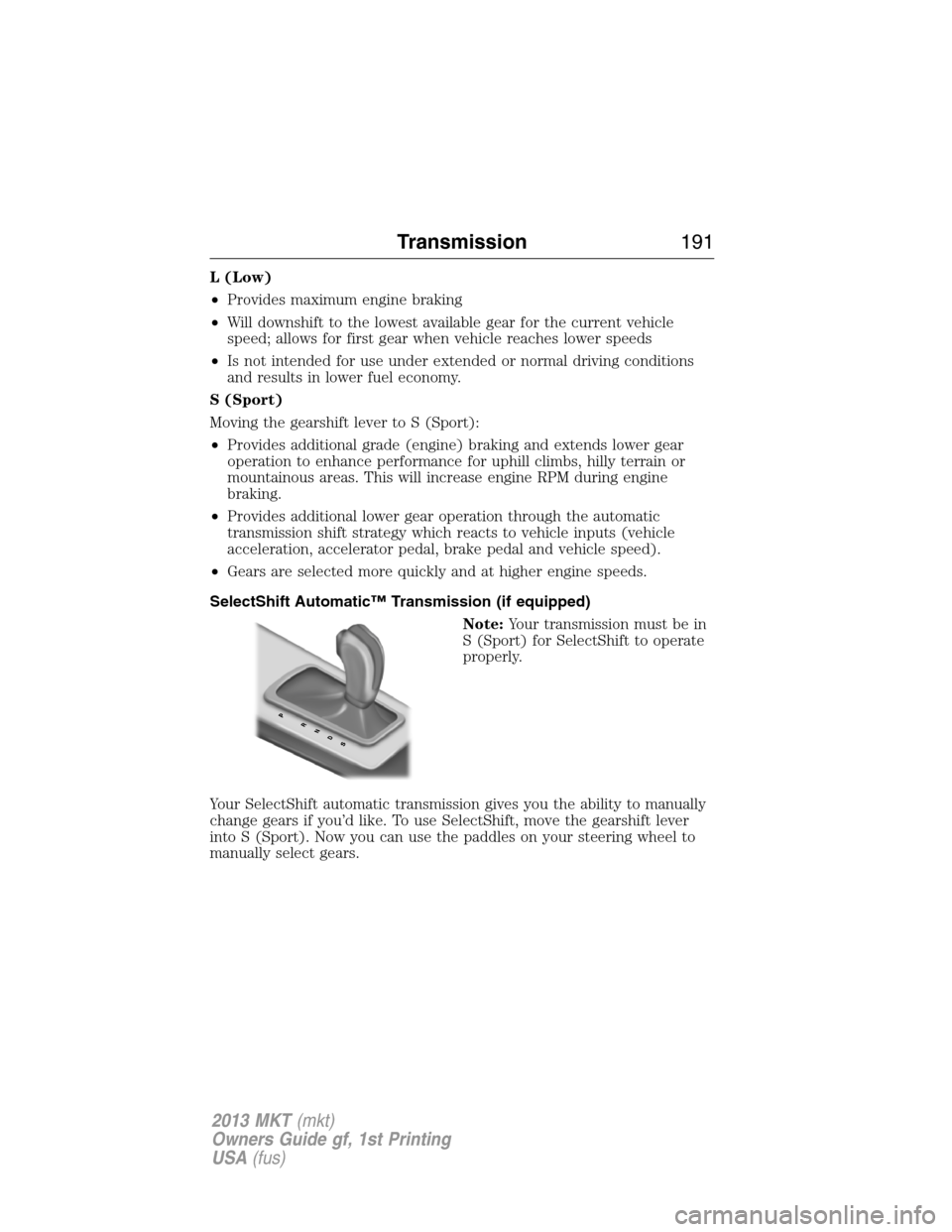
S (Sport)
Moving the gearshift lever to S (Sport):
•Provides additional grade (engine) braking and extends lower gear
operation to enhance performance for uphill climbs, hilly terrain or
mountainous areas. This will increase engine RPM during engine
braking.
•Provides additional lower gear operation through the automatic
transmission shift strategy which reacts to vehicle inputs (vehicle
acceleration, accelerator pedal, brake pedal and vehicle speed).
•Gears are selected more quickly and at higher engine speeds.
SelectShift Automatic™ Transmission (if equipped)
Note:Your transmission must be in
S (Sport) for SelectShift to operate
properly.
Your SelectShift automatic transmission gives you the ability to manually
change gears if you’d like. To use SelectShift, move the gearshift lever
into S (Sport). Now you can use the paddles on your steering wheel to
manually select gears.
Transmission191
2013 MKT(mkt)
Owners Guide gf, 1st Printing
USA(fus)
Page 192 of 494
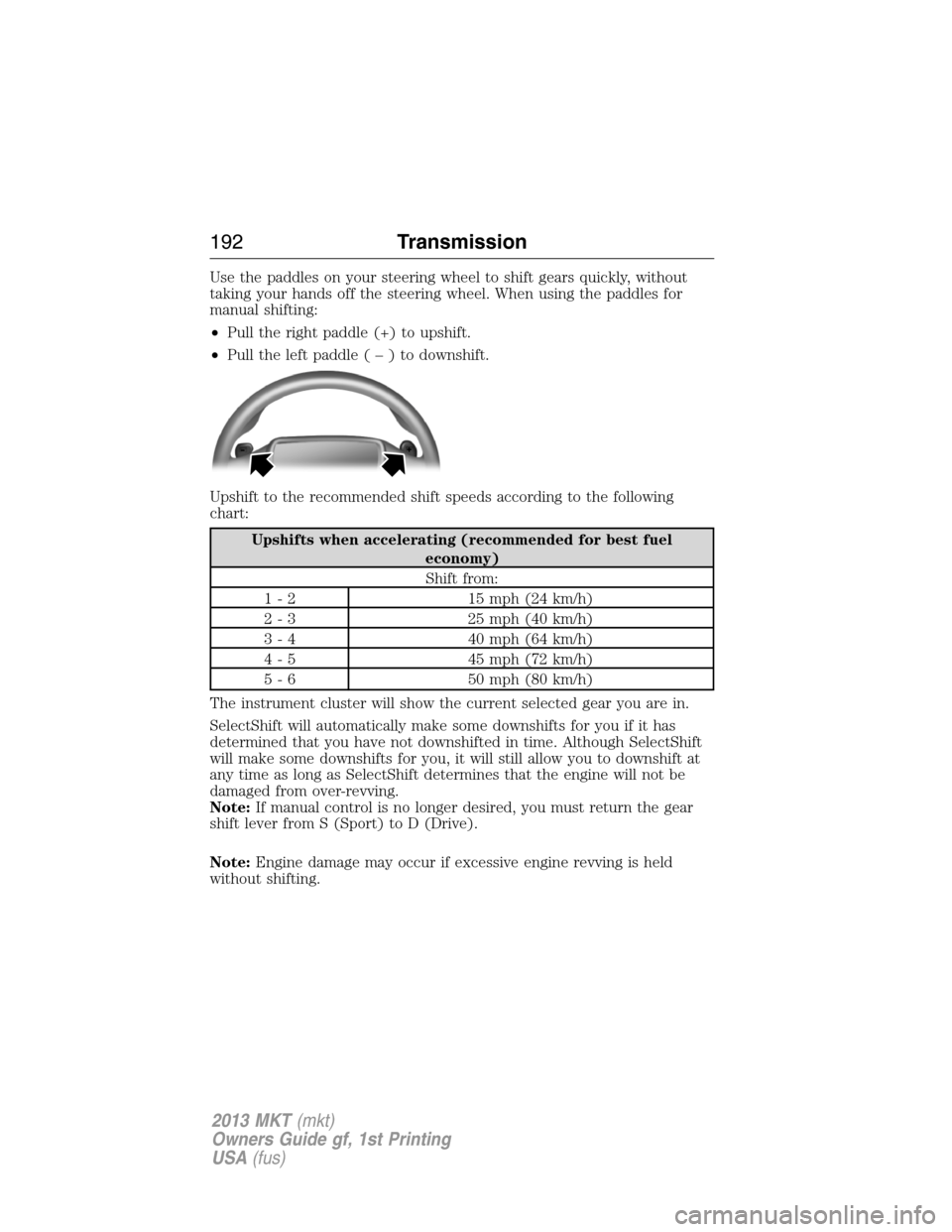
Use the paddles on your steering wheel to shift gears quickly, without
taking your hands off the steering wheel. When using the paddles for
manual shifting:
•Pull the right paddle (+) to upshift.
•Pull the left paddle(–)todownshift.
Upshift to the recommended shift speeds according to the following
chart:
Upshifts when accelerating (recommended for best fuel
economy)
Shift from:
1 - 2 15 mph (24 km/h)
2 - 3 25 mph (40 km/h)
3 - 4 40 mph (64 km/h)
4 - 5 45 mph (72 km/h)
5 - 6 50 mph (80 km/h)
The instrument cluster will show the current selected gear you are in.
SelectShift will automatically make some downshifts for you if it has
determined that you have not downshifted in time. Although SelectShift
will make some downshifts for you, it will still allow you to downshift at
any time as long as SelectShift determines that the engine will not be
damaged from over-revving.
Note:If manual control is no longer desired, you must return the gear
shift lever from S (Sport) to D (Drive).
Note:Engine damage may occur if excessive engine revving is held
without shifting.
192Transmission
2013 MKT(mkt)
Owners Guide gf, 1st Printing
USA(fus)
Page 193 of 494

Automatic transmission adaptive learning
This feature is designed to increase durability and provide consistent
shift feel over the life of the vehicle. A new vehicle or transmission may
have firm and/or soft shifts. This operation is considered normal and will
not affect function or durability of the transmission. Over time, the
adaptive learning process will fully update transmission operation.
Additionally, whenever the battery is disconnected or a new battery
installed, the strategy must be relearned.
Brake-shift interlock
WARNING:Do not drive your vehicle until you verify that the
brake lamps are working.
WARNING:Always set the parking brake fully and make sure the
gearshift lever is latched in P (Park). Switch the ignition to off
and remove the key whenever you leave your vehicle.
WARNING:If the parking brake is fully released, but the brake
warning lamp remains illuminated, the brakes may not be working
properly. See your authorized dealer.
This vehicle is equipped with a brake-shift interlock feature that prevents
the gearshift lever from being moved from P (Park) when the ignition is
in the on position unless the brake pedal is applied. If you cannot move
the gearshift lever out of P (Park) when the ignition is on and the brake
pedal applied, it is possible that a fuse has blown or the vehicle’s brake
lamps are not operating properly.
If the fuse is not blown and the brake lamps are working properly, you
will need to have your vehicle towed to an authorized dealer.
If Your Vehicle Gets Stuck in Mud or Snow
Note:Do not rock the vehicle if the engine is not at normal operating
temperature or damage to the transmission may occur.
Note:Do not rock the vehicle for more than a minute or damage to the
transmission and tires may occur, or the engine may overheat.
If your vehicle gets stuck in mud or snow, it may be rocked out by
shifting between forward and reverse gears, stopping between shifts in a
steady pattern. Press lightly on the accelerator in each gear.
Transmission193
2013 MKT(mkt)
Owners Guide gf, 1st Printing
USA(fus)
Page 204 of 494
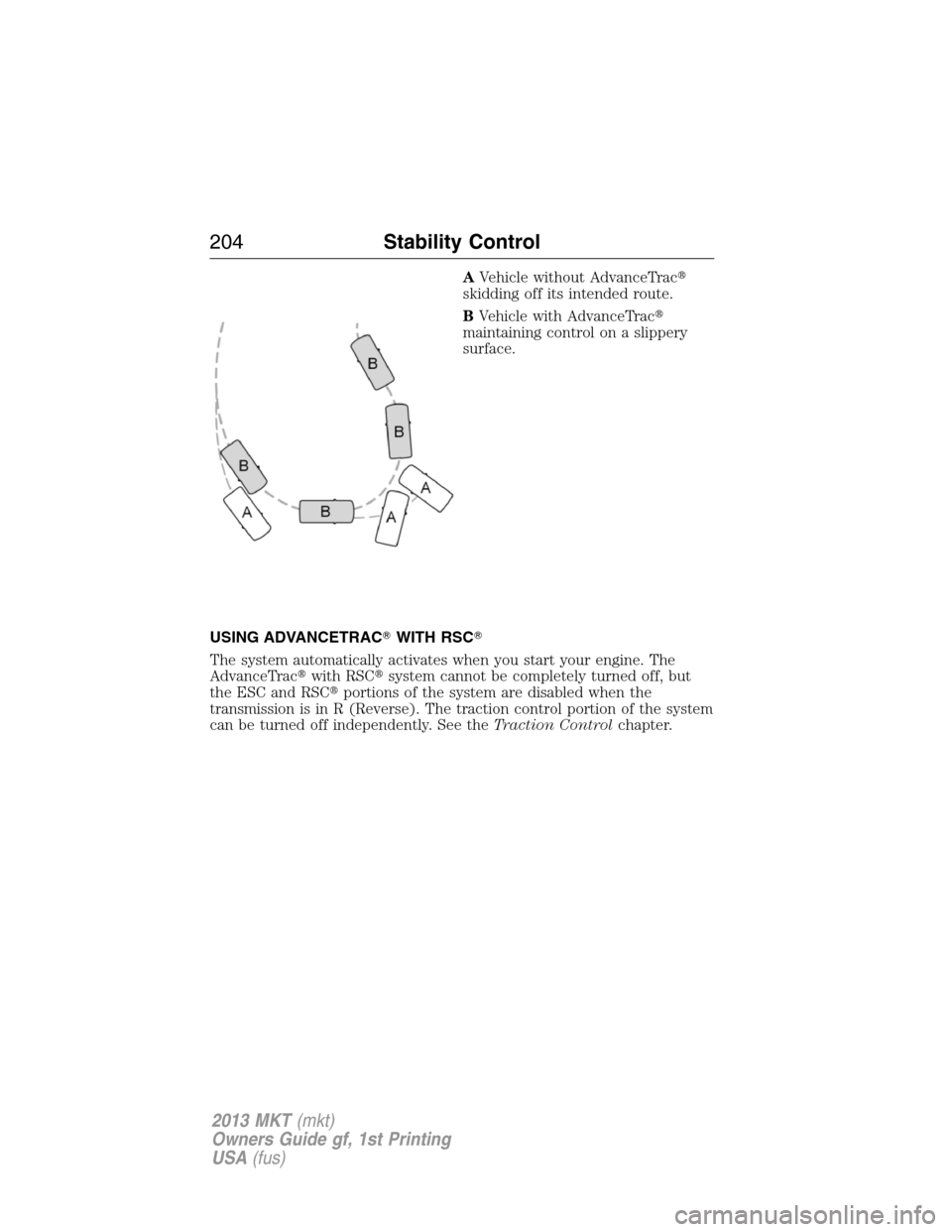
AVehicle without AdvanceTrac�
skidding off its intended route.
BVehicle with AdvanceTrac�
maintaining control on a slippery
surface.
USING ADVANCETRAC�WITH RSC�
The system automatically activates when you start your engine. The
AdvanceTrac�with RSC�system cannot be completely turned off, but
the ESC and RSC�portions of the system are disabled when the
transmission is in R (Reverse). The traction control portion of the system
can be turned off independently. See theTraction Controlchapter.
204Stability Control
2013 MKT(mkt)
Owners Guide gf, 1st Printing
USA(fus)
Page 209 of 494
Note:If a maneuver is interrupted before completion, the system turns
off. The steering wheel position will not indicate the actual position of
the steering and you have to full take control of the vehicle.
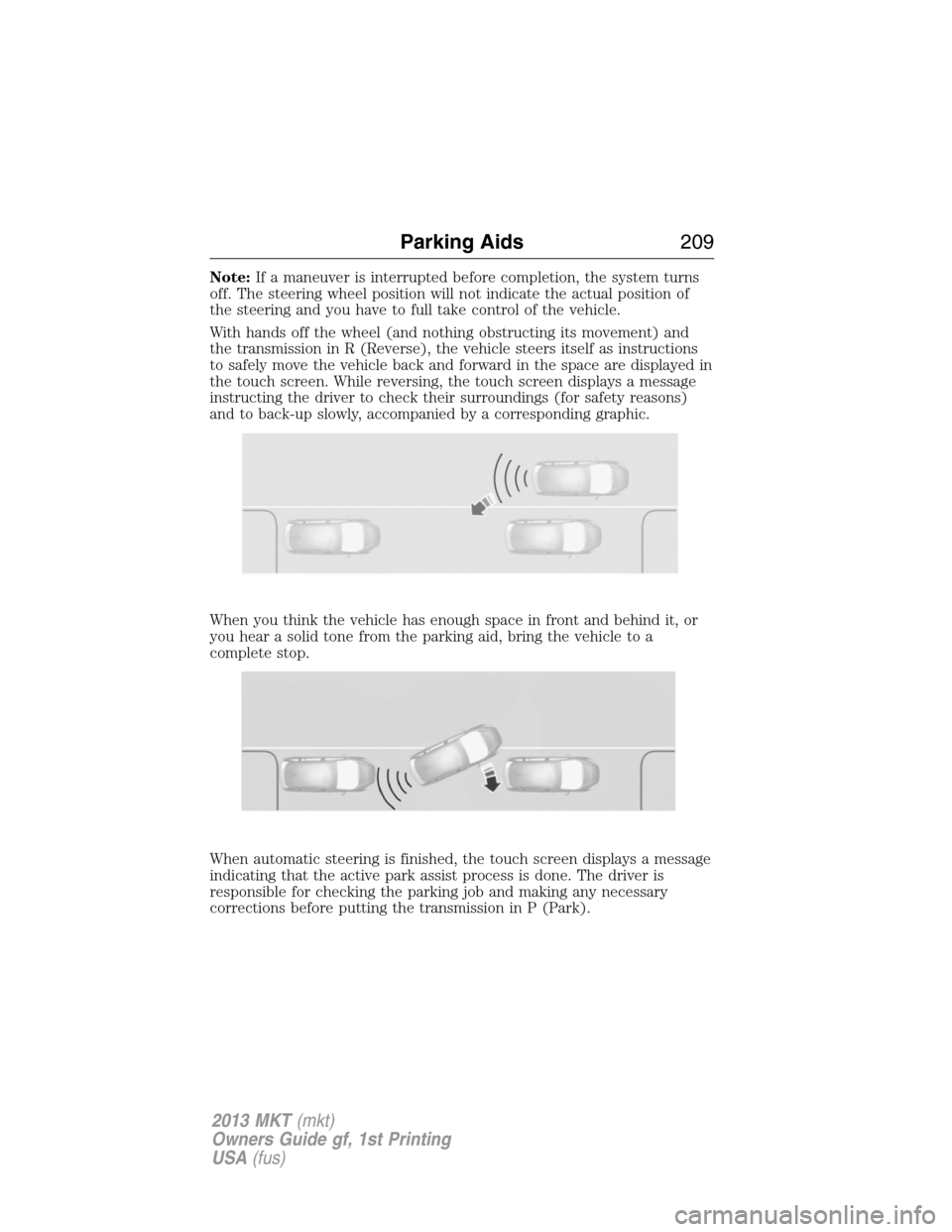
With hands off the wheel (and nothing obstructing its movement) and
the transmission in R (Reverse), the vehicle steers itself as instructions
to safely move the vehicle back and forward in the space are displayed in
the touch screen. While reversing, the touch screen displays a message
instructing the driver to check their surroundings (for safety reasons)
and to back-up slowly, accompanied by a corresponding graphic.
When you think the vehicle has enough space in front and behind it, or
you hear a solid tone from the parking aid, bring the vehicle to a
complete stop.
When automatic steering is finished, the touch screen displays a message
indicating that the active park assist process is done. The driver is
responsible for checking the parking job and making any necessary
corrections before putting the transmission in P (Park).
Parking Aids209
2013 MKT(mkt)
Owners Guide gf, 1st Printing
USA(fus)
Page 210 of 494

Deactivating the Park Assist Feature
The system can be deactivated manually by:
•pressing the active park assist button
•grabbing the steering wheel
•driving above approximately 20 mph (35 km/h) for 30 seconds during
an active park search
•driving above 6 mph (10 km/h) during automatic steering
•turning off the traction control system.
Certain vehicle conditions can also deactivate the system:
•Traction control has activated on a slippery or loose surface.
•Anti-lock brake system activation or failure.
•Any door (except the driver’s) opens.
•Something touches the steering wheel.
If a problem occurs with the system, a warning message is displayed,
followed by a chime. Occasional active park assist messages may occur in
normal operation. For recurring or frequent active park assist faults,
contact an authorized dealer to have your vehicle serviced.
Troubleshooting the System
The system does not look for a space
The traction control system may be off
Any door (except the driver’s) may not be completely closed
The system does not offer a particular space
Something may be contacting the front bumper or side sensors
There is not enough room on both sides of the vehicle in order to park
There is not enough space for the parking maneuver on the opposite
side of the parking space
The vehicle is farther than 5 ft (1.5 m) from the parking space
The vehicle is closer than 16 in. (40 cm) from neighboring parked
vehicles
The transmission is in R (Reverse); the vehicle must be moving forward
to detect a parking space
210Parking Aids
2013 MKT(mkt)
Owners Guide gf, 1st Printing
USA(fus)