2013 KIA VENGA engine overheat
[x] Cancel search: engine overheatPage 283 of 751

619
What to do in an emergency
Notes on the safe use of the Tire Mobility Kit
Park your car at the side of theroad so that you can work with the
Tire Mobility Kit away from moving
traffic. Place your warning triangle
in a prominent place to make pass-
ing vehicles aware of your location.
To be sure your vehicle won't move, even when you're on fairly
level ground, always set your park-
ing brake.
Only use the Tire Mobility Kit for sealing/inflation passenger car
tires. Do not use on motorcycles,
bicycles or any other type of tires.
Do not remove any foreign objects- such as nails or screws -that have
penetrated the tire.
Before using the Tire Mobility Kit, read the precautionary advice
printed on the sealant bottle!
Provided the car is outdoors, leave the engine running. Otherwise
operating the compressor may
eventually drain the car battery. Never leave the Tire Mobility Kit
unattended while it is being used.
Do not leave the compressor run- ning for more than 10 min. at a time
or it may overheat.
Do not use the Tire Mobility Kit if the ambient temperature is below -30°C(-22°F).
Do not use the sealing compound after its expiration date which can
be found on the label of the bottle.
Keep away from children. Technical Data
System voltage: DC 12 V
Working voltage: DC 10 - 15 V
Amperage rating: max. 15 A
Suitable for use at temperatures:
-30 ~ +70°C (-22 ~ +158°F)
Max. working pressure: 6 bar (87 psi)
Size
Compressor: 170 x 150 x 60 mm (6.7 x 5.9 x 2.4 in.)
Sealant bottle: 85 x 77 ø mm (3.3 x 3.0 ø in.)
Compressor weight: 0.8 kg (1.8 lbs)
Sealant volume: 200 ml (12.2 cu. in.)
❈ Sealing compound and spare
parts can be obtained and
replaced at an authorized vehicle
or tire dealer. Empty sealing com-
pound bottles may be disposed of
at home. Liquid residue from thesealing compound should be dis-
posed of by your vehicle or tiredealer or in accordance with local
waste disposal regulations.
YN ENG 6.QXP 4/16/2012 10:06 AM Page 19
Page 387 of 751
Index
4
I
Drinks holders, see cup holders . . . . . . . . . . . . . . . . . . 4-94
Driver's and passenger's front air bag. . . . . . . . . . . . . . 3-44
Driving at night. . . . . . . . . . . . . . . . . . . . . . . . . . . . . . . 5-45
Driving in flooded areas . . . . . . . . . . . . . . . . . . . . . . . . 5-46
Driving in the rain . . . . . . . . . . . . . . . . . . . . . . . . . . . . 5-46
Economical operation . . . . . . . . . . . . . . . . . . . . . . . . . . 5-41
Electric power steering . . . . . . . . . . . . . . . . . . . . . . . . . 4-33
Electronic stability program (ESP). . . . . . . . . . . . . . . . 5-29
Emergency starting . . . . . . . . . . . . . . . . . . . . . . . . . . . . . 6-4
Jump starting . . . . . . . . . . . . . . . . . . . . . . . . . . . . . . . . 6-4
Push starting . . . . . . . . . . . . . . . . . . . . . . . . . . . . . . . . . 6-5
Emergency while driving . . . . . . . . . . . . . . . . . . . . . . . . 6-2
Emission control system . . . . . . . . . . . . . . . . . . . . . . . . 7-78 Crankcase emission control system . . . . . . . . . . . . . . 7-78
Evaporative emission control System . . . . . . . . . . . . 7-78
Exhaust emission control system . . . . . . . . . . . . . . . . 7-79
Engine compartment . . . . . . . . . . . . . . . . . . . . . . . . . . . . 2-4
Engine coolant . . . . . . . . . . . . . . . . . . . . . . . . . . . . . . . 7-25
Engine number . . . . . . . . . . . . . . . . . . . . . . . . . . . . . . . . 8-8
Engine oil . . . . . . . . . . . . . . . . . . . . . . . . . . . . . . . . . . . 7-24
Engine overheats. . . . . . . . . . . . . . . . . . . . . . . . . . . . . . . 6-6
Engine start/stop button . . . . . . . . . . . . . . . . . . . . . . . . . 5-8
Engine will not start . . . . . . . . . . . . . . . . . . . . . . . . . . . . 6-3
Evaporative emission control system . . . . . . . . . . . . . . 7-78 Exhaust emission control system . . . . . . . . . . . . . . . . . 7-79
Explanation of scheduled maintenance items . . . . . . . 7-20
Exterior care . . . . . . . . . . . . . . . . . . . . . . . . . . . . . . . . . 7-72
Flat tire . . . . . . . . . . . . . . . . . . . . . . . . . . . . . . . . . . . . . . 6-7
Changing tires. . . . . . . . . . . . . . . . . . . . . . . . . . . . . . . . 6-8
Compact spare tire . . . . . . . . . . . . . . . . . . . . . . . . . . . 6-13
Components of the tire mobility kit . . . . . . . . . . . . . . 6-16
Jack and tools . . . . . . . . . . . . . . . . . . . . . . . . . . . . . . . . 6-7
Removing and storing the spare tire . . . . . . . . . . . . . . 6-8
Tiremobilitykit . . . . . . . . . . . . . . . . . . . . . . . . . . . . . . 6-15
Floor mat anchor(s) . . . . . . . . . . . . . . . . . . . . . . . . . . . 4-97Fluid Automatic transaxle fluid . . . . . . . . . . . . . . . . . . . . . . 7-29
Brakes fluid . . . . . . . . . . . . . . . . . . . . . . . . . . . . . . . . 7-28
Washer fluid . . . . . . . . . . . . . . . . . . . . . . . . . . . . . . . . 7-31
Fog light (front) . . . . . . . . . . . . . . . . . . . . . . . . . . . . . . 7-66
Fog light (rear) . . . . . . . . . . . . . . . . . . . . . . . . . . . . . . . 7-69Fog light bulbs replacement Fog light (front) . . . . . . . . . . . . . . . . . . . . . . . . . . . . . 7-66
Fog light (rear) . . . . . . . . . . . . . . . . . . . . . . . . . . . . . . 7-69
Folding the rear seat . . . . . . . . . . . . . . . . . . . . . . . . . . . 3-10
Front seat adjustment . . . . . . . . . . . . . . . . . . . . . . . . . . . 3-5
Fuel filler lid . . . . . . . . . . . . . . . . . . . . . . . . . . . . . . . . . 4-26
Fuel filter . . . . . . . . . . . . . . . . . . . . . . . . . . . . . . . . . . . 7-32
E
F
YN eng INDEX.QXP 2011.09.22. 16:35 Page 4
Page 390 of 751
I7
Index
Mirrors . . . . . . . . . . . . . . . . . . . . . . . . . . . . . . . . . . . . . 4-35
Day/night rearview mirror . . . . . . . . . . . . . . . . . . . . . 4-35
Folding the outside rearview mirror. . . . . . . . . . . . . . 4-38
Inside rearview mirror . . . . . . . . . . . . . . . . . . . . . . . . 4-35
Outside rearview mirror . . . . . . . . . . . . . . . . . . . . . . . 4-36
Odometer . . . . . . . . . . . . . . . . . . . . . . . . . . . . . . . . . . . 4-43
Oil (Engine) . . . . . . . . . . . . . . . . . . . . . . . . . . . . . . . . . 7-24
Outside rearview mirror . . . . . . . . . . . . . . . . . . . . . . . . 4-36
Overheats . . . . . . . . . . . . . . . . . . . . . . . . . . . . . . . . . . . . 6-6
Owner maintenance . . . . . . . . . . . . . . . . . . . . . . . . . . . . 7-5
Parking brake . . . . . . . . . . . . . . . . . . . . . . . . . . . . . . . . 5-25
Power brakes. . . . . . . . . . . . . . . . . . . . . . . . . . . . . . . . . 5-24
Power outlet . . . . . . . . . . . . . . . . . . . . . . . . . . . . . . . . . 4-96
Power window lock button . . . . . . . . . . . . . . . . . . . . . . 4-22
Pre-tensioner seat belt. . . . . . . . . . . . . . . . . . . . . . . . . . 3-21
Push starting . . . . . . . . . . . . . . . . . . . . . . . . . . . . . . . . . . 6-5
Rear combination light bulb replacement . . . . . . . . . . 7-68
Rear parking assist system . . . . . . . . . . . . . . . . . . . . . . 4-57
Rear seat . . . . . . . . . . . . . . . . . . . . . . . . . . . . . . . . . . . . . 3-9 Rear view camera . . . . . . . . . . . . . . . . . . . . . . . . . . . . . 4-60
Recommended cold tire inflation pressures . . . . . . . . . 7-42
Recommended lubricants and capacities . . . . . . . . . . . . 8-4
Recommended SAE viscosity number . . . . . . . . . . . . . 8-6
Remote keyless entry . . . . . . . . . . . . . . . . . . . . . . . . . . . 4-5Replacement light bulb Fog light (front) . . . . . . . . . . . . . . . . . . . . . . . . . . . . . 7-66
Fog light (rear) . . . . . . . . . . . . . . . . . . . . . . . . . . . . . . 7-69
Headlight bulb replacement . . . . . . . . . . . . . . . . . . . . 7-63
Interior light bulb replacement . . . . . . . . . . . . . . . . . . 7-71
Rear combination light bulb replacement . . . . . . . . . 7-68
Road warning . . . . . . . . . . . . . . . . . . . . . . . . . . . . . . . . . 6-2
Rocking the vehicle . . . . . . . . . . . . . . . . . . . . . . . . . . . 5-44
Scheduled maintenance service . . . . . . . . . . . . . . . . . . . 7-7
Maintenance under severe usage conditions . . . . . 7-12,18
Normal maintenance schedule. . . . . . . . . . . . . . . . . 7-8,14
Seat belt warning (front). . . . . . . . . . . . . . . . . . . . . . . . 3-16
Seat belt warning (rear) . . . . . . . . . . . . . . . . . . . . . . . . 3-18
Seat belts . . . . . . . . . . . . . . . . . . . . . . . . . . . . . . . . . . . . 3-14 Height adjustment. . . . . . . . . . . . . . . . . . . . . . . . . . . . 3-16
Lap/shoulder belt . . . . . . . . . . . . . . . . . . . . . . . . . . . . 3-16
Pre-tensioner seat belt . . . . . . . . . . . . . . . . . . . . . . . . 3-21
Seat belt warning (front) . . . . . . . . . . . . . . . . . . . . . . 3-15
Seat warmer(front) . . . . . . . . . . . . . . . . . . . . . . . . . . . . . 3-8
O
SP
R
YN eng INDEX.QXP 2011.09.22. 16:35 Page 7
Page 515 of 751
451
Features of your vehicle
Automatic transaxle shiftposition indicator (if equipped)
The indicator displays which automatic
transaxle shift lever is selected.
Manual transaxle shiftindicator (if equipped)
This indicator informs you which gear is
desired whilst driving to save fuel.
For example
: Indicates that shifting up to the 3rdgear is desired (currently the shift
lever is in the 2nd or 1st gear).
: Indicates that shifting down to the 3rd gear is desired (currently the
shift lever is in the 4th or 5th gear).
When the system is not working proper-
ly, the indicator (Up & Down Arrow and
gear) is not displayed.
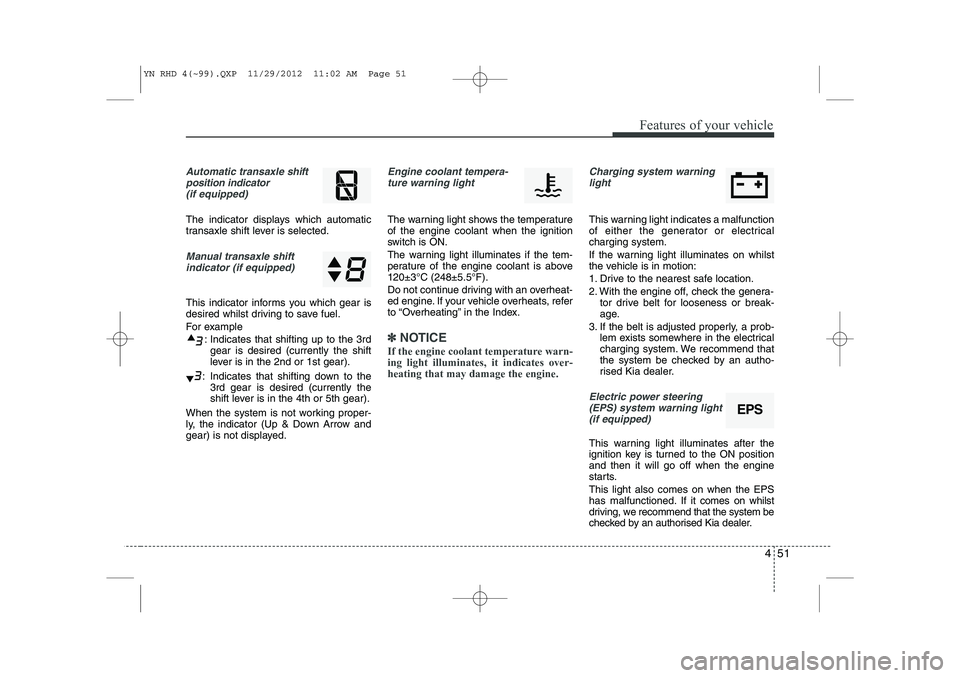
Engine coolant tempera- ture warning light
The warning light shows the temperature of the engine coolant when the ignition
switch is ON.
The warning light illuminates if the tem-
perature of the engine coolant is above120±3°C (248±5.5°F).
Do not continue driving with an overheat-
ed engine. If your vehicle overheats, refer
to “Overheating” in the Index.
✽✽ NOTICE
If the engine coolant temperature warn- ing light illuminates, it indicates over-heating that may damage the engine.
Charging system warning light
This warning light indicates a malfunction
of either the generator or electricalcharging system.
If the warning light illuminates on whilst
the vehicle is in motion:
1. Drive to the nearest safe location.
2. With the engine off, check the genera- tor drive belt for looseness or break-
age.
3. If the belt is adjusted properly, a prob- lem exists somewhere in the electrical
charging system. We recommend that
the system be checked by an autho-
rised Kia dealer.
Electric power steering
(EPS) system warning light(if equipped)
This warning light illuminates after the
ignition key is turned to the ON positionand then it will go off when the engine
starts. This light also comes on when the EPS
has malfunctioned. If it comes on whilst
driving, we recommend that the system be
checked by an authorised Kia dealer.
EPS
YN RHD 4(~99).QXP 11/29/2012 11:02 AM Page 51
Page 567 of 751
Driving your vehicle
4
5
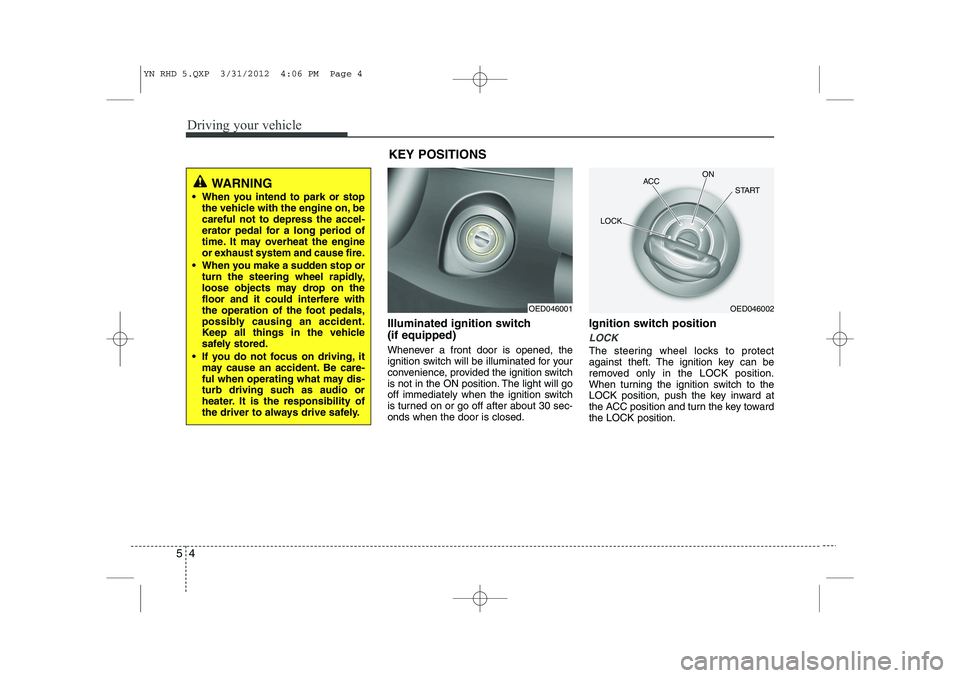
Illuminated ignition switch (if equipped)
Whenever a front door is opened, the
ignition switch will be illuminated for your
convenience, provided the ignition switch
is not in the ON position. The light will go
off immediately when the ignition switch
is turned on or go off after about 30 sec-onds when the door is closed. Ignition switch position
LOCK
The steering wheel locks to protect
against theft. The ignition key can be
removed only in the LOCK position.
When turning the ignition switch to the
LOCK position, push the key inward at
the ACC position and turn the key towardthe LOCK position.
KEY POSITIONS
OED046001OED046002
ACC
ON
START
LOCK
WARNING
When you intend to park or stop the vehicle with the engine on, be careful not to depress the accel-
erator pedal for a long period of
time. It may overheat the engine
or exhaust system and cause fire.
When you make a sudden stop or turn the steering wheel rapidly,
loose objects may drop on the
floor and it could interfere with
the operation of the foot pedals,
possibly causing an accident.
Keep all things in the vehicle
safely stored.
If you do not focus on driving, it may cause an accident. Be care-
ful when operating what may dis-
turb driving such as audio or
heater. It is the responsibility of
the driver to always drive safely.
YN RHD 5.QXP 3/31/2012 4:06 PM Page 4
Page 581 of 751

Driving your vehicle
18
5
Good driving practices
Never take the vehicle out of gear and
coast down a hill. This is extremely
hazardous. Always leave the vehicle in
gear.
Don't "ride" the brakes. This can cause them to overheat and malfunction.
Instead, when you are driving down a
long hill, shift to a lower gear. When
you do this, engine braking will help
slow down the vehicle.
Slow down before shifting to a lower gear. This will help avoid over-revving
the engine, which can cause damage.
Slow down when you encounter cross winds. This gives you much better con-
trol of your vehicle.
Be sure the vehicle is completely stopped before you attempt to shift into
reverse. The transaxle can be dam-
aged if you do not. To shift into reverse,
depress the clutch, move the shift lever
to neutral, then shift to the reverseposition. Exercise extreme caution when driving
on a slippery surface. Be especially
careful when braking, accelerating or
shifting gears. On a slippery surface,
an abrupt change in vehicle speed can
cause the drive wheels to lose traction
and the vehicle to go out of control.
WARNING
Always buckle-up! In a collision, an unbelted occupant is signifi-
cantly more likely to be seriously
injured or killed than a properlybelted occupant.
Avoid high speeds when corner- ing or turning.
Do not make quick steering wheel movements, such as sharp
lane changes or fast, sharp turns.
The risk of rollover is greatly increased if you lose control of
your vehicle at highway speeds.
Loss of control often occurs if two or more wheels drop off the
roadway and the driver over-
steers to reenter the roadway.
In the event your vehicle leaves the roadway, do not steer sharply.
Instead, slow down before pulling
back into the travel lanes.
Never exceed posted speed lim- its.
YN RHD 5.QXP 3/31/2012 4:06 PM Page 18
Page 585 of 751
Driving your vehicle
22
5
Shift lock system (if equipped)
For your safety, the automatic transaxle
has a shift lock system which prevents
shifting the transaxle from P (Park) or N
(Neutral) into R (Reverse) unless the
brake pedal is depressed.
To shift the transaxle from P (Park) or N
(Neutral) into R (Reverse):
1. Depress and hold the brake pedal.
2. Move the shift lever.
If the brake pedal is repeatedly depressed and released with the shift
lever in the P (Park) position, a chattering
noise near the shift lever may be heard.
This is a normal condition. Good driving practices
Never move the shift lever from P
(Park) or N (Neutral) to any other posi-
tion with the accelerator pedaldepressed.
Never move the gear selector lever into P (Park) when the vehicle is in motion.
Be sure the car is completely stopped before you attempt to shift into R
(Reverse) or D (Drive).
Never take the vehicle out of gear and coast down a hill. This may be
extremely hazardous. Always leave the
car in gear when moving.
Do not "ride" the brakes. This can cause them to overheat and malfunc-
tion. Instead, when you are driving
down a long hill, slow down and shift to
a lower gear. When you do this, engine
braking will help slow down the vehicle. Slow down before shifting to a lower
gear. Otherwise, the lower gear maynot be engaged.
Always use the parking brake. Do not depend on placing the transaxle in P
(Park) to keep the vehicle from moving.
Exercise extreme caution when driving on a slippery surface. Be especially
careful when braking, accelerating or
shifting gears. On a slippery surface,
an abrupt change in vehicle speed can
cause the drive wheels to lose traction
and the vehicle to go out of control.
Optimum vehicle performance and economy is obtained by smoothly
depressing and releasing the accelera-tor pedal.
WARNING
Always fully depress the brake
pedal before and whilst shifting out
of the P (Park) position into anoth-
er position to avoid inadvertent
motion of the vehicle which could
injure persons in or around the car.
YN RHD 5.QXP 3/31/2012 4:07 PM Page 22
Page 587 of 751
Driving your vehicle
24
5
Power brakes
Your vehicle has power-assisted brakes
that adjust automatically through normal
usage.
In the event that the power-assisted
brakes lose power because of a stalled
engine or some other reason, you can
still stop your vehicle by applying greater
force to the brake pedal than you nor-
mally would. The stopping distance, how-
ever, will be longer.
When the engine is not running, the
reserve brake power is partially depleted
each time the brake pedal is applied. Do
not pump the brake pedal when the
power assist has been interrupted.
Pump the brake pedal only when neces-
sary to maintain steering control on slip-
pery surfaces.In the event of brake failure
If service brakes fail to operate whilst the
vehicle is in motion, you can make an
emergency stop with the parking brake.
The stopping distance, however, will be
much greater than normal.
BRAKE SYSTEM
WARNING
- Parking brake
Applying the parking brake whilst
the vehicle is moving at normal
speeds can cause a sudden loss of
control of the vehicle. If you mustuse the parking brake to stop the
vehicle, use great caution in apply-
ing the brake.
WARNING - Brakes
Do not drive with your foot rest- ing on the brake pedal. This will create abnormal high brake tem-
peratures, excessive brake lining
and pad wear, and increasedstopping distances.
(Continued)
(Continued)
When descending a long or steephill, shift to a lower gear and
avoid continuous application of
the brakes. Continuous brakeapplication will cause the brakes
to overheat and could result in a
temporary loss of braking per-
formance.
Wet brakes may impair the vehi- cle’s ability to safely slow down;
the vehicle may also pull to oneside when the brakes are applied.
Applying the brakes lightly will
indicate whether they have been
affected in this way. Always test
your brakes in this fashion after
driving through deep water. To
dry the brakes, apply them lightly
whilst maintaining a safe forward
speed until brake performancereturns to normal.
Always, confirm the position of the brake and accelerator pedal
before driving. If you don't checkthe position of the accelerator
and brake pedal before driving,
you may depress the accelerator
instead of the brake pedal. It maycause a serious accident.
YN RHD 5.QXP 3/31/2012 4:07 PM Page 24