2013 KIA VENGA ignition
[x] Cancel search: ignitionPage 62 of 751
349
Safety features of your vehicle
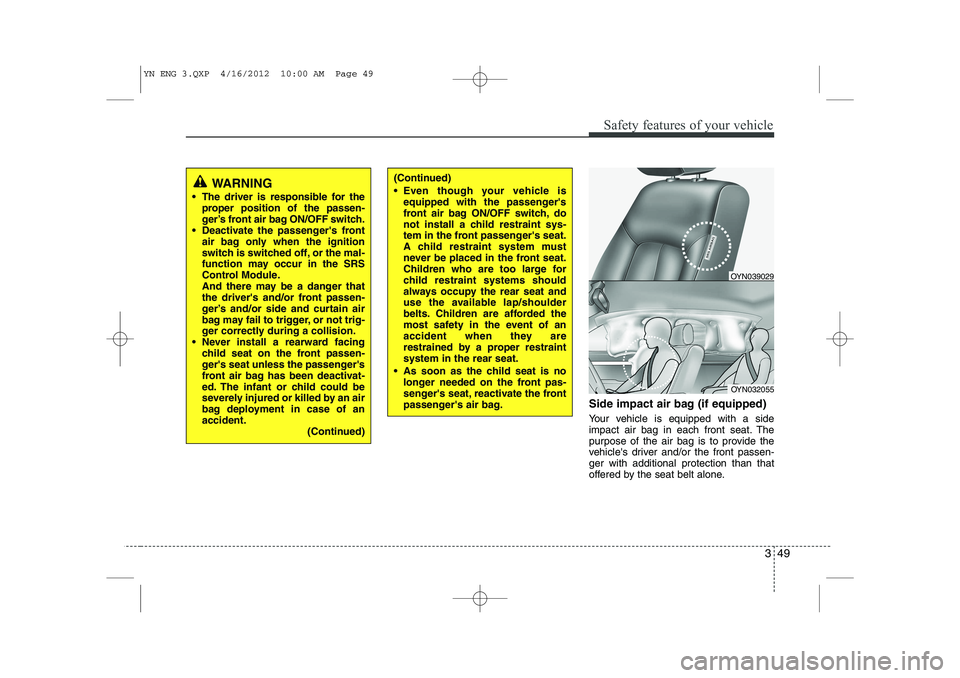
Side impact air bag (if equipped)
Your vehicle is equipped with a side
impact air bag in each front seat. The
purpose of the air bag is to provide the
vehicle's driver and/or the front passen-ger with additional protection than that
offered by the seat belt alone.
(Continued)
Even though your vehicle isequipped with the passenger's
front air bag ON/OFF switch, do
not install a child restraint sys-
tem in the front passenger's seat.
A child restraint system must
never be placed in the front seat.
Children who are too large for
child restraint systems should
always occupy the rear seat and
use the available lap/shoulder
belts. Children are afforded the
most safety in the event of an
accident when they are
restrained by a proper restraintsystem in the rear seat.
As soon as the child seat is no longer needed on the front pas-
senger's seat, reactivate the front
passenger's air bag.WARNING
The driver is responsible for the proper position of the passen-
ger’s front air bag ON/OFF switch.
Deactivate the passenger's front air bag only when the ignition
switch is switched off, or the mal-
function may occur in the SRS
Control Module.
And there may be a danger that
the driver's and/or front passen-
ger’s and/or side and curtain air
bag may fail to trigger, or not trig-
ger correctly during a collision.
Never install a rearward facing child seat on the front passen-
ger's seat unless the passenger's
front air bag has been deactivat-
ed. The infant or child could be
severely injured or killed by an air
bag deployment in case of anaccident.
(Continued)
OYN032055
OYN039029
YN ENG 3.QXP 4/16/2012 10:00 AM Page 49
Page 63 of 751

Safety features of your vehicle
50
3
The side impact air bags are designed to
deploy only during certain side-impact
collisions, depending on the crash sever-
ity, angle, speed and point of impact. Theside impact air bags are not designed to
deploy in all side impact situations.(Continued)
Do not use any accessory seat
covers.
Use of seat covers could reduce or prevent the effectiveness of the system.
Do not install any accessories on the side or near the side impact air
bag.
Do not place any objects over the air bag or between the air bag and
yourself.
Do not place any objects (an umbrella, bag, etc.) between the
front door and the front seat. Such
objects may become dangerous
projectiles and cause injury if the
supplemental side impact air baginflates.
To prevent unexpected deploy- ment of the side impact air bag that
may result in personal injury, avoidimpact to the side impact sensor
when the ignition switch is on.
If seat or seat cover is damaged, we recommend that the system
be serviced by an authorized Kia
dealer.WARNING
Do not allow the passengers to lean their heads or bodies onto
doors, put their arms on the doors,
stretch their arms out of the win-
dow, or place objects between the
doors and passengers when theyare seated on seats equipped with
side and/or curtain air bags.
The side impact air bag is supple- mental to the driver's and the pas-
senger's seat belt systems and is
not a substitute for them. Therefore
your seat belts must be worn at all
times while the vehicle is in
motion. The air bags deploy only in
certain side impact conditions
severe enough to cause significant
injury to the vehicle occupants.
For best protection from the side impact air bag system and to avoid
being injured by the deploying side
impact air bag, both front seatoccupants should sit in an upright
position with the seat belt properly
fastened. The driver's hands shouldbe placed on the steering wheel at
the 9:00 and 3:00 positions. The
passenger's arms and handsshould be placed on their laps.
(Continued)
YN ENG 3.QXP 4/16/2012 10:00 AM Page 50
Page 75 of 751

43
Features of your vehicle
Immobilizer system (if equipped)
Your vehicle may be equipped with an
electronic engine immobilizer system to
reduce the risk of unauthorized vehicle
use.
Your immobilizer system is comprised of
a small transponder in the ignition key
and electronic devices inside the vehicle.
With the immobilizer system, whenever
you insert your ignition key into the igni-
tion switch and turn it to ON, it checks
and determines and verifies if the ignition
key is valid or not.
If the key is determined to be valid, the
engine will start.
If the key is determined to be invalid, the
engine will not start.To deactivate the immobilizer sys-tem:
Insert the ignition key into the key cylin-
der and turn it to the ON position.
To activate the immobilizer system:
Turn the ignition key to the OFF position.
The immobilizer system activates auto-
matically. Without a valid ignition key for
your vehicle, the engine will not start.
WARNING
In order to prevent theft of your
vehicle, do not leave spare keys
anywhere in your vehicle. Your
immobilizer password is a cus-
tomer unique password and should
be kept confidential. Do not leave
this number anywhere in your vehi-
cle.
WARNING - Ignition key
Leaving children unattended in a
vehicle with the ignition key is dan-
gerous even if the key is not in the
ignition switch. Children copy
adults and they could place the key
in the ignition switch. The ignition
key would enable children to oper-
ate power windows or other con-
trols, or even make the vehicle
move, which could result in serious
bodily injury or even death. Never
leave the keys in your vehicle with
unsupervised children.
WARNING
We recommend that you use parts
for replacement from an authorized
Kia dealer. If an aftermarket key is
used, the ignition switch may not
return to ON after START. If this
happens, the starter will continue
to operate causing damage to the
starter motor and possible fire due
to excessive current in the wiring.
YN ENG 4(~99).QXP 4/16/2012 10:15 AM Page 3
Page 76 of 751

Features of your vehicle
4
4
✽✽
NOTICE
When starting the engine, do not use the
key with other immobilizer keys around.Otherwise the engine may not start or
may stop soon after it starts. Keep each
key separately in order to avoid a start-ing malfunction.
✽
✽ NOTICE
If you need additional keys or lose your
keys, we recommend that you consult
with an authorized Kia dealer.
CAUTION
The transponder in your ignition key is an important part of the
immobilizer system. It is designedto give years of trouble-free service, however you should avoid expo-sure to moisture, static electricity
and rough handling. Immobilizersystem malfunction could occur.
CAUTION
Do not change, alter or adjust the
immobilizer system because itcould cause the immobilizer sys-tem to malfunction. We recommend that the system be serviced by an
authorized Kia dealer.
Malfunctions caused by improperalterations, adjustments or modifi-cations to the immobilizer system
are not covered by your vehicle manufacturer warranty.
CAUTION
Do not put metal accessories near
the ignition switch. Metal acces- sories may interrupt the transpon-der signal and may prevent theengine from being started.
YN ENG 4(~99).QXP 4/16/2012 10:15 AM Page 4
Page 83 of 751
411
Features of your vehicle
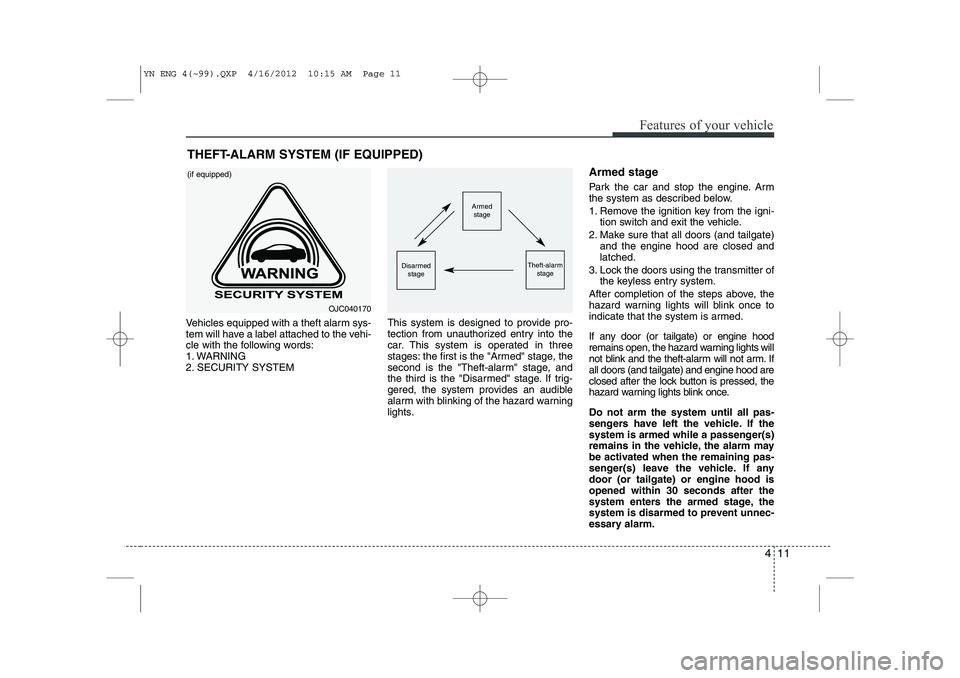
Vehicles equipped with a theft alarm sys-
tem will have a label attached to the vehi-
cle with the following words:
1. WARNING
2. SECURITY SYSTEMThis system is designed to provide pro-
tection from unauthorized entry into the
car. This system is operated in three
stages: the first is the "Armed" stage, the
second is the "Theft-alarm" stage, and
the third is the "Disarmed" stage. If trig-
gered, the system provides an audible
alarm with blinking of the hazard warning
lights.Armed stage
Park the car and stop the engine. Arm
the system as described below.
1. Remove the ignition key from the igni-
tion switch and exit the vehicle.
2. Make sure that all doors (and tailgate) and the engine hood are closed and latched.
3. Lock the doors using the transmitter of the keyless entry system.
After completion of the steps above, the
hazard warning lights will blink once to
indicate that the system is armed.
If any door (or tailgate) or engine hood
remains open, the hazard warning lights will
not blink and the theft-alarm will not arm. Ifall doors (and tailgate) and engine hood are
closed after the lock button is pressed, the
hazard warning lights blink once. Do not arm the system until all pas-
sengers have left the vehicle. If the
system is armed while a passenger(s)
remains in the vehicle, the alarm may
be activated when the remaining pas-
senger(s) leave the vehicle. If anydoor (or tailgate) or engine hood isopened within 30 seconds after the
system enters the armed stage, the
system is disarmed to prevent unnec-
essary alarm.
THEFT-ALARM SYSTEM (IF EQUIPPED)
Armed
stage
Theft-alarm stageDisarmedstage
OJC040170
(if equipped)
YN ENG 4(~99).QXP 4/16/2012 10:15 AM Page 11
Page 84 of 751
Features of your vehicle
12
4
Theft-alarm stage
The alarm will be activated if any of the
following occurs while the system is
armed.
A front or rear door is opened without
using the transmitter (or smart key).
The tailgate is opened without using the transmitter (or smart key).
The engine hood is opened.The siren will sound and the hazard
warning lights will blink continuously for
27 seconds, unless the system is dis-
armed. To turn off the system, unlock the
doors with the transmitter (or smart key). Disarmed stage
The system will be disarmed when:
Transmitter
- The door unlock button is pressed.
- The engine is started. (within 3 sec-
onds)
- The ignition switch is in the “ON” posi- tion for 30 seconds or more.
Smart key
- The door unlock button is pressed.
- The button of the front outside door ispressed while carrying the smart key.
- The engine is started. (within 3 sec- onds)
After the doors are unlocked, the hazard
warning lights will blink twice to indicate
that the system is disarmed.
After pressing the unlock button, if any door (or tailgate) is not opened within 30
seconds, the system will be rearmed.
✽✽ NOTICE - Immobilizer system
Page 87 of 751
415
Features of your vehicle
Impact sensing door unlock sys- tem (if equipped)
All doors will automatically unlock when
an impact causes the air bags to deploy.
Speed sensing door lock system (if equipped)
When the speed of the vehicle keeps
above15 km/h for 1 second, it will auto-
matically lock all doors. For deactivation
of this feature, we recommend that you
contact an authorized Kia dealer.
WARNING- Unlocked
vehicles
Leaving your vehicle unlocked can
invite theft or possible harm to you
or others from someone hiding in
your vehicle while you are gone.
Always remove the ignition key,
engage the parking brake, close all
windows and lock all doors when
leaving your vehicle unattended.
WARNING - Unattended
children
An enclosed vehicle can become
extremely hot, causing death or
severe injury to unattended chil-dren or animals who cannot escape
the vehicle. Furthermore, children
might operate features of the vehi-
cle that could injure them, or they
could encounter other harm, possi-
bly from someone gaining entry to
the vehicle. Never leave children or
animals unattended in your vehicle.
WARNING - Doors
The doors should always be fully closed and locked while the vehi-
cle is in motion to prevent acci-
dental opening of the door.
Locked doors will also discour-
age potential intruders when the
vehicle stops or slows.
Be careful when opening doors and watch for vehicles, motorcy-
cles, bicycles or pedestrians
approaching the vehicle in the
path of the door. Opening a door
when something is approaching
can cause damage or injury.
YN ENG 4(~99).QXP 4/16/2012 10:15 AM Page 15
Page 92 of 751
Features of your vehicle
20
4
Power windows
The ignition switch must be in the ON
position for power windows to operate.
Each door has a power window switch
that controls the door's window. The driv-
er has a power window lock switch which
can block the operation of passenger
windows. The power windows can be
operated for approximately 30 seconds
after the ignition key is removed or turned
to the ACC or LOCK position. However, if
the front doors are opened, the power
windows cannot be operated within the
30 seconds period after the ignition key
removal.
The driver’s door has a master power
window switch that controls all the win-
dows in the vehicle.✽✽
NOTICE
While driving with the rear windows
down or with the sunroof (if equipped) in
an open (or partially open position), yourvehicle may demonstrate a wind buffet-
ing or pulsation noise. This noise is a
normal occurrence and can be reduced
or eliminated by taking the followingactions. If the noise occurs with one or
both of the rear windows down, partially
lower both front windows approximatelyone inch. If you experience the noise with
the sunroof open, slightly reduce the size
of the sunroof opening
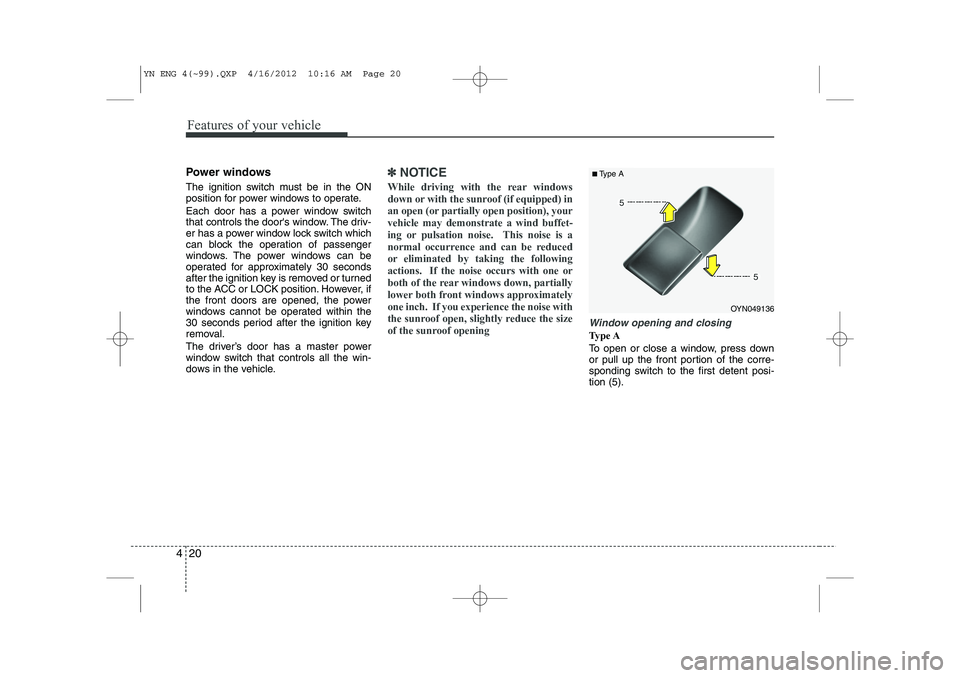
Window opening and closing
Type A
To open or close a window, press down
or pull up the front portion of the corre-
sponding switch to the first detent posi-tion (5).
OYN049136
■ Type A
YN ENG 4(~99).QXP 4/16/2012 10:16 AM Page 20