2013 KIA VENGA air condition
[x] Cancel search: air conditionPage 685 of 751
733
Maintenance
AIR CLEANER
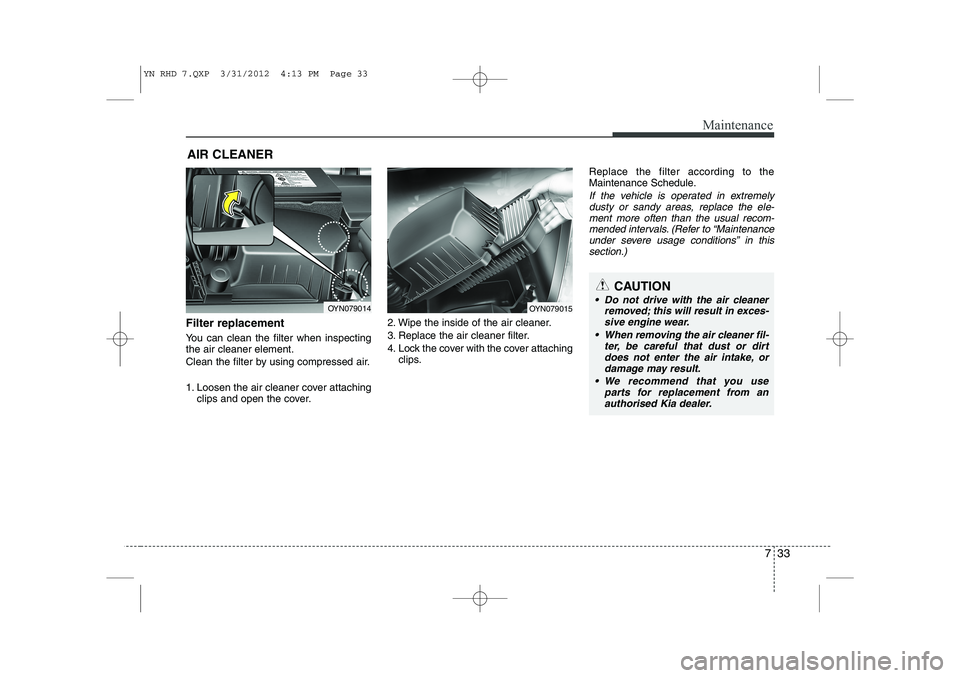
Filter replacement
You can clean the filter when inspecting the air cleaner element.
Clean the filter by using compressed air.
1. Loosen the air cleaner cover attaching clips and open the cover. 2. Wipe the inside of the air cleaner.
3. Replace the air cleaner filter.
4. Lock the cover with the cover attaching
clips. Replace the filter according to the
Maintenance Schedule.
If the vehicle is operated in extremely
dusty or sandy areas, replace the ele- ment more often than the usual recom-
mended intervals. (Refer to “Maintenance under severe usage conditions” in thissection.)
OYN079014OYN079015
CAUTION
Do not drive with the air cleaner
removed; this will result in exces-sive engine wear.
When removing the air cleaner fil- ter, be careful that dust or dirtdoes not enter the air intake, or
damage may result.
We recommend that you use parts for replacement from anauthorised Kia dealer.
YN RHD 7.QXP 3/31/2012 4:13 PM Page 33
Page 696 of 751
Maintenance
44
7
Remove the valve cap from the tyre
valve stem. Press the tyre gage firm-
ly onto the valve to get a pressure
measurement. If the cold tyre infla-tion pressure matches the recom-mended pressure on the tyre and
loading information label, no further
adjustment is necessary. If the pres-
sure is low, add air until you reachthe recommended amount.
If you overfill the tyre, release air by pushing on the metal stem in the
centre of the tyre valve. Recheck the
tyre pressure with the tyre gage. Be
sure to put the valve caps back on
the valve stems. They help prevent
leaks by keeping out dirt and mois-
ture. Tyre rotation
To equalize tread wear, it is recom- mended that the tyres be rotated
every 12,000 km (7,500 miles) or
sooner if irregular wear develops.
During rotation, check the tyres for
correct balance.
When rotating tyres, check for
uneven wear and damage. Abnormal
wear is usually caused by incorrect
tyre pressure, improper wheel align-
ment, out-of-balance wheels, severe
braking or severe cornering. Look for
bumps or bulges in the tread or side
of tyre. Replace the tyre if you find
either of these conditions. Replace
the tyre if fabric or cord is visible.
After rotation, be sure to bring thefront and rear tyre pressures to spec-
ification and check lug nut tightness.
Refer to “Tyre and wheels” in section 8.
WARNING
Inspect your tyres frequently for proper inflation as well as
wear and damage. Always use
a tyre pressure gauge.
Tyres with too much or too lit- tle pressure wear unevenly
causing poor handling, loss of
vehicle control, and suddentyre failure leading to acci-
dents, injuries, and even death.The recommended cold tyre
pressure for your vehicle can
be found in this manual and onthe tyre label located on the
driver's side centre pillar.
Worn tyres can cause acci- dents. Replace tyres that are
worn, show uneven wear, or
are damaged.
Remember to check the pres- sure of your spare tyre. Kia
recommends that you check
the spare every time you
check the pressure of the
other tyres on your vehicle.
YN RHD 7.QXP 3/31/2012 4:14 PM Page 44
Page 702 of 751
Maintenance
50
7
5. Maximum permissible inflation
pressure
This number is the greatest amount of air pressure that should be put in
the tyre. Do not exceed the maximum
permissible inflation pressure. Refer
to the Tyre and Loading Information
label for recommended inflation
pressure.
6. Maximum load rating
This number indicates the maximum
load in kilograms and pounds that
can be carried by the tyre. When
replacing the tyres on the vehicle,
always use a tyre that has the same
load rating as the factory installed
tyre.
7. Uniform tyre quality grading
Quality grades can be found where
applicable on the tyre sidewall
between tread shoulder and maxi-
mum section width.
For example:
TREAD wear 200
TRACTION AA
TEMPERATURE A
Tread wear
The tread wear grade is a compara-
tive rating based on the wear rate ofthe tyre when tested under controlled
conditions on a specified govern-
ment test course. For example, a tyre
graded 150 would wear one-and-a-
half times (1½) as well on the gov-
ernment course as a tyre graded100.
The relative performance of tyres depends upon the actual conditions
of their use, however, and may
depart significantly from the norm
due to variations in driving habits,
service practices and differences in
road characteristics and climate. These grades are molded on the
side-walls of passenger vehicle
tyres. The tyres available as standard
or optional equipment on your vehi-
cle may vary with respect to grade.
Traction - AA, A, B & C
The traction grades, from highest to
lowest, are AA, A, B and C. Those
grades represent the tyre’s ability to
stop on wet pavement measuredunder controlled conditions on spec-
ified government test surfaces of
asphalt and concrete. A tyre marked
C may have poor traction perform-
ance.
WARNING
The traction grade assigned to this tyre is based on straight-ahead braking traction tests,
and does not include accelera-
tion, cornering, hydroplaning,
or peak traction characteristics.
YN RHD 7.QXP 3/31/2012 4:14 PM Page 50
Page 709 of 751

757
Maintenance
Inner fuse panel
DescriptionFuse ratingSystemProtected Component
25APOWER WINDOWLeft Power Window
25APOWER WINDOWRight Power Window
10AOUTSIDE MIRROR HEATEDOutside Mirror Defroster
10ABLOWERAir Conditioning System, ECU
20ADOOR LOCKDoor Lock/Unlock
20ASUNROOFSunroof
15ASAFETY POWER WINDOWSafety Power Window (Driver)
10AFOLDING MIRROROutside Mirror Folding Switch, Centre Facia Switch
10ATAIL LAMPLeft Tail Light
10ATAIL LAMPRight Tail Light
10ASTARTStart Motor Relay
15AHAZARD WARNING SIGNALCentre Facia Switch
25APOWER DISTRIBUTIONMODULESmk Unit
10APOWER DISTRIBUTIONMODULESmk Unit, SSB
MDPS210AMOTOR DRIVER POWERSTEERINGMDPS
BRAKE SW10ASTOP SWITCHSTOP SWITCH
YN RHD 7.QXP 3/31/2012 4:15 PM Page 57
Page 710 of 751

Maintenance
58
7
DescriptionFuse ratingSystemProtected Component
15ATRANSMISSION
CONTROL UNITSpeed In Sensor, Speed Out Sensor, Speed Sensor, Inhibitor Switch
15AIGNITION COILIgnition Coil, Condensor
10AIGNITIONHLLD Switch, HLLD Actuator, BCM, Air Conditioning System, Sunroof
25AWINDSCREEN WIPING
SYSTEM (CONTINUOUS)Front Wiper Motor Relay, Multi Function Switch Wiper
10AFRONT FOG LAMPFront Fog Lamp, BCM
10AREAR FOG LAMPRear Fog Lamp, BCM
10AROOM LAMPRoom Lamp Switch, MUT
15ASTOP LAMPStop Switch, BCM
10ACLUSTERCluster, BCM, Digtal Clock
10AIGNITIONAudio,TPMS, Centre Facia Switch
10AANTI-LOCK BRAKE SYSTEMYaw Rate Sensor, ABS(ESP),ESP Switch
10AB/UP LPBack Up Switch
10AELECTRONIC (ENGINE) CONTROL UNITECU, AFS
10ARAIN SENSOR
(PTC HEATER )Rain Sensor Relay (PTC, Fuel Filter Heater)
10APOWER DISTRIBUTION MODULESmart key Unit, SSB
YN RHD 7.QXP 3/31/2012 4:15 PM Page 58
Page 713 of 751

761
Maintenance
DescriptionFuse ratingSystemProtected Component
20AHEADLAMP HIGH BEAMSHeadlamp High Beam
10AHORNHorn, Burglar Alarm Horn, Battery Sensor
20AHEADLAMP DIPPED BEAMSHeadlamp Low Beam
F/PUMP20AFUEL PUMPFuel Pump Relay (Petrol)
10AELECTRONIC (ENGINE)
CONTROL UNIT/AIR HTRECU
15AINJECTORINJECTOR (PETROL)
E-EGR, WGT, CPS (DIESEL)
10ASENSORAIR CONDITIONING RELAY, STOP SW, COOLING FAN RELAY (HIGH),
COOLING FAN RELAY (LOW)
10AB/UP LPRR COMBI LP, ECM MIRROR
10AAIR CONDITIONERAir Conditioning Relay
10AHEADLAMP DIPPED BEAMSCluster(Low Indicator), Head Lamp Low LH
20AELECTRONIC(ENGINE) CONTROL UNITECU
10AHEADLAMP DIPPED BEAMSHead Lamp Low RH
10AELECTRONIC(ENGINE) CONTROL UNITECU, TCU, GLOW Relay
10ARAIN SENSORRAIN SENSOR
YN RHD 7.QXP 3/31/2012 4:15 PM Page 61
Page 727 of 751
775
Maintenance
Corrosion protection
Protecting your vehicle from corrosion
By using the most advanced design and
construction practices to combat corro-
sion, we produce vehicles of the highest
quality. However, this is only part of the
job. To achieve the long-term corrosion
resistance your vehicle can deliver, the
owner's cooperation and assistance isalso required.
Common causes of corrosion The most common causes of corrosion
on your vehicle are:
Road salt, dirt and moisture that isallowed to accumulate underneath the
vehicle.
Removal of paint or protective coatings by stones, gravel, abrasion or minor
scrapes and dents which leave unpro-
tected metal exposed to corrosion. High-corrosion areas
If you live in an area where your vehicle
is regularly exposed to corrosive materi-
als, corrosion protection is particularly
important. Some of the common causes
of accelerated corrosion are road salts,
dust control chemicals, ocean air and
industrial pollution.
Moisture breeds corrosion Moisture creates the conditions in which
corrosion is most likely to occur. For
example, corrosion is accelerated by
high humidity, particularly when tempera-
tures are just above freezing. In such
conditions, the corrosive material is kept
in contact with the vehicle’s surface by
moisture that slowly evaporates.
Mud is particularly corrosive because it
dries slowly and holds moisture in con-
tact with the vehicle. Although the mud
appears to be dry, it can still retain mois-ture and promote corrosion.
High temperatures can also accelerate
corrosion of parts that are not properly
ventilated so the moisture can be dis-
persed. For all these reasons, it is par-
ticularly important to keep your vehicle
clean and free of mud or accumulations
of other materials. This applies not only
to the visible surfaces but particularly to
the underside of the vehicle.
YN RHD 7.QXP 3/31/2012 4:16 PM Page 75
Page 732 of 751
Maintenance
80
7
Do not operate the engine in confined
or closed areas (such as garages) any
more than what is necessary to move
the vehicle in or out of the area.
When the vehicle is stopped in an open area for more than a short time
with the engine running, adjust the
ventilation system (as needed) to draw
outside air into the vehicle.
Never sit in a parked or stopped vehi- cle for any extended time with the
engine running.
When the engine stalls or fails to start, excessive attempts to restart the
engine may cause damage to theemission control system.Operating precautions for catalytic
converters (if equipped)Your vehicle is equipped with a catalytic
converter emission control device.
Therefore, the following precautions
must be observed:
Use only UNLEADED FUEL for petrol engine.
Do not operate the vehicle when there are signs of engine malfunction, such
as misfire or a noticeable loss of per-
formance.
Do not misuse or abuse the engine. Examples of misuse are coasting withthe ignition off and descending steep
grades in gear with the ignition off.
Do not operate the engine at high idle speed for extended periods (5 minutesor more).
Do not modify or tamper with any part of the engine or emission control sys-
tem. We recommend that the system
be inspected by an authorised Kia
dealer.
Avoid driving with a extremely low fuel level. Running out of fuel could cause
the engine to misfire, damaging the
catalytic converter.
Failure to observe these precautionscould result in damage to the catalytic
converter and to your vehicle.
Additionally, such actions could void your
warranties.
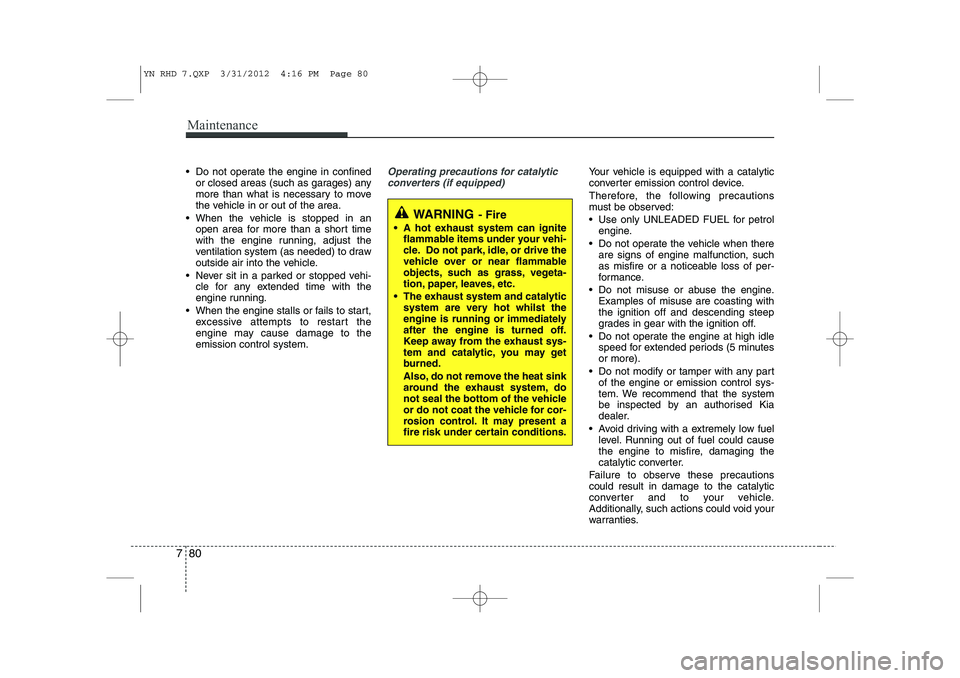
WARNING - Fire
A hot exhaust system can ignite flammable items under your vehi-
cle. Do not park, idle, or drive the
vehicle over or near flammable
objects, such as grass, vegeta-
tion, paper, leaves, etc.
The exhaust system and catalytic system are very hot whilst the
engine is running or immediately
after the engine is turned off.
Keep away from the exhaust sys-
tem and catalytic, you may get
burned.
Also, do not remove the heat sink
around the exhaust system, do
not seal the bottom of the vehicle
or do not coat the vehicle for cor-
rosion control. It may present a
fire risk under certain conditions.
YN RHD 7.QXP 3/31/2012 4:16 PM Page 80