2013 KIA Sportage Position ligh
[x] Cancel search: Position lighPage 9 of 387

Index
6I
Jack and tools ··················\
··················\
··················\
·············6-7
Jump starting ··················\
··················\
··················\
··············6-4
Key positions ··················\
··················\
··················\
·············5-4
Keys ··················\
··················\
··················\
··················\
·········4-2
LabelAir bag warning label ··················\
··················\
···········3-68
Tire sidewall labeling ··················\
··················\
···········7-36
Tire specification and pressure label ··················\
········8-7
Vehicle certification label ··················\
··················\
·······8-6
Latch system, see lower anchor system ··················\
·······3-39
Lighting ················\
··················\
··················\
··················\
····4-67 Battery saver function ··················\
··················\
··········4-67
Daytime running light ··················\
··················\
···········4-71
Headlight escort function ··················\
··················\
······4-67
Headlight welcome function ··················\
··················\
·4-67
Lubricants and capacities ··················\
··················\
·············8-4
Luggage net holder ··················\
··················\
··················\
4-104
Luggage rack, see roof rack ··················\
··················\
·····4-107
Lumbar support ··················\
··················\
··················\
··········3-7 Main fuse ··················\
··················\
··················\
················7-46
Maintenance
Explanation of scheduled maintenance items ···········7-10Maintenance services ··················\
··················\
············· 7-3
Maintenance schedule ··················\
··················\
·············7-6
Owner maintenance ··················\
··················\
················7-4
Tire maintenance ··················\
··················\
··················\
7-35
Maintenance services ··················\
··················\
··················\
·7-3
Manual climate control system ··················\
··················\
··4-80 Air conditioning ··················\
··················\
··················\
·4-84
Climate control air filter ··················\
··················\
·······4-87
Heating and air conditioning ··················\
··················\
4-80
Manual heating and air conditioning ··················\
···········4-90
Manual transaxle ··················\
··················\
··················\
······5-12
Memory fuse ··················\
··················\
··················\
············7-45
Mirrors ················\
··················\
··················\
··················\
·····4-37 Day/night rearview mirror ··················\
··················\
···4-37
Electric chromic mirror (ECM) ··················\
·············4-37
Inside rearview mirror ··················\
··················\
··········4-37
Outside rearview mirror ··················\
··················\
·······4-43
Moonroof, see panoramic sunroof ··················\
···············4-31
Neck restraints, see headrest ··················\
················3-8, 3-15
L
M
N
K
J
Page 26 of 387
Safety features of your vehicle
43
(Continued)
When resetting the seatback tothe upright position, make sure it
is securely latched by pushing it
forward and backwards.
To avoid the possibility of burns, do not remove the carpet in the
cargo area. Emission control
devices beneath this floor gener-
ate high temperatures.WARNING- Rear seatbacks
The rear seatback must besecurely latched. If not, passen-
gers and objects could be thrown
forward resulting in serious
injury or death in the event of a
sudden stop or collision.
Luggage and other cargo should be laid flat in the cargo area. If
objects are large, heavy, or must
be piled, they must be secured.
Under no circumstances should
cargo be piled higher than the
seatbacks. Failure to follow these
warnings could result in serious
injury or death in the event of a
sudden stop, collision or rollover.
No passenger should ride in the cargo area or sit or lie on folded
seatbacks while the vehicle is
moving. All passengers must be
properly seated in seats and
restrained properly while riding.
(Continued)
WARNING
After adjusting the seat, always
check that it is securely locked into
place by attempting to move the
seat forward or backward without
using the lock release lever.
Sudden or unexpected movement
of the driver's seat could cause you
to lose control of the vehicle result-
ing in an accident.
WARNING
Do not adjust the seat while wear-ing seat belts. Moving the seat
cushion forward may cause
strong pressure on the abdomen.
Use extreme caution so that hands or other objects are not
caught in the seat mechanisms
while the seat is moving.
Do not put a cigarette lighter on the floor or seat. When you oper-
ate the seat, gas may gush out of
the lighter and cause fire.
Page 27 of 387
35
Safety features of your vehicle
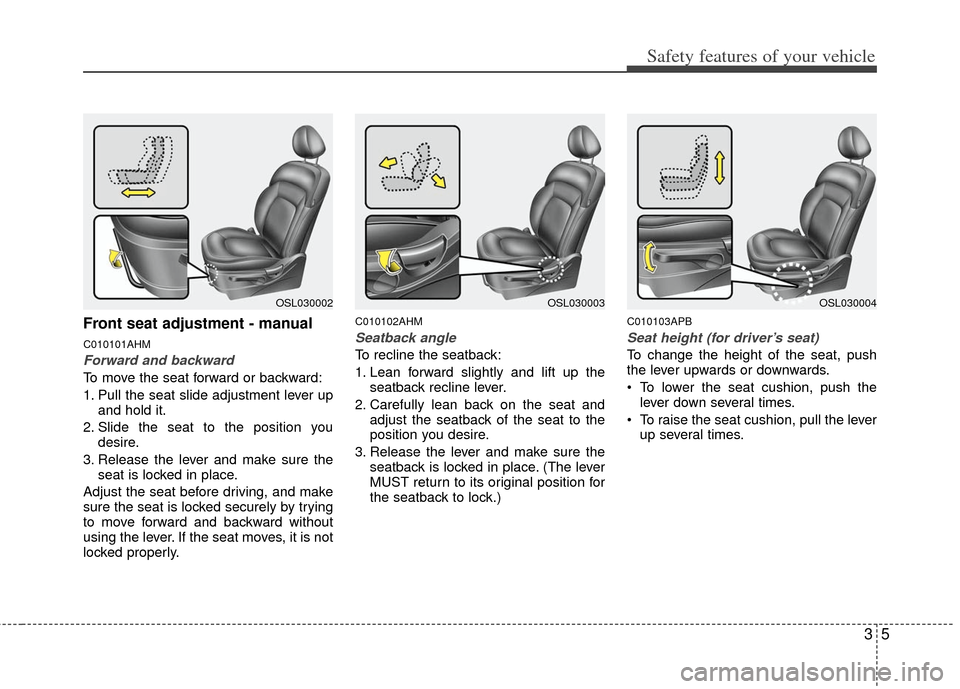
Front seat adjustment - manual
C010101AHM
Forward and backward
To move the seat forward or backward:
1. Pull the seat slide adjustment lever upand hold it.
2. Slide the seat to the position you desire.
3. Release the lever and make sure the seat is locked in place.
Adjust the seat before driving, and make
sure the seat is locked securely by trying
to move forward and backward without
using the lever. If the seat moves, it is not
locked properly.
C010102AHM
Seatback angle
To recline the seatback:
1. Lean forward slightly and lift up the seatback recline lever.
2. Carefully lean back on the seat and adjust the seatback of the seat to the
position you desire.
3. Release the lever and make sure the seatback is locked in place. (The lever
MUST return to its original position for
the seatback to lock.)
C010103APB
Seat height (for driver’s seat)
To change the height of the seat, push
the lever upwards or downwards.
To lower the seat cushion, push thelever down several times.
To raise the seat cushion, pull the lever up several times.
OSL030002OSL030004OSL030003
Page 41 of 387
319
Safety features of your vehicle
C020101AAM-EU
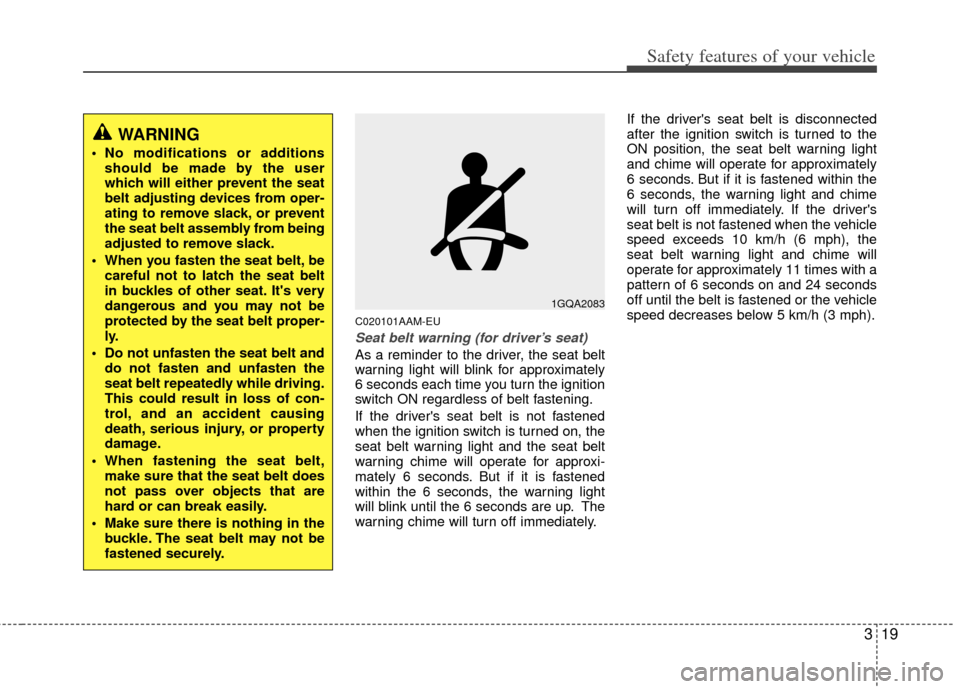
Seat belt warning (for driver’s seat)
As a reminder to the driver, the seat belt
warning light will blink for approximately
6 seconds each time you turn the ignition
switch ON regardless of belt fastening.
If the driver's seat belt is not fastened
when the ignition switch is turned on, the
seat belt warning light and the seat belt
warning chime will operate for approxi-
mately 6 seconds. But if it is fastened
within the 6 seconds, the warning light
will blink until the 6 seconds are up. The
warning chime will turn off immediately.If the driver's seat belt is disconnected
after the ignition switch is turned to the
ON position, the seat belt warning light
and chime will operate for approximately
6 seconds. But if it is fastened within the
6 seconds, the warning light and chime
will turn off immediately. If the driver's
seat belt is not fastened when the vehicle
speed exceeds 10 km/h (6 mph), the
seat belt warning light and chime will
operate for approximately 11 times with a
pattern of 6 seconds on and 24 seconds
off until the belt is fastened or the vehicle
speed decreases below 5 km/h (3 mph).
1GQA2083
WARNING
No modifications or additions
should be made by the user
which will either prevent the seat
belt adjusting devices from oper-
ating to remove slack, or prevent
the seat belt assembly from being
adjusted to remove slack.
When you fasten the seat belt, be careful not to latch the seat belt
in buckles of other seat. It's very
dangerous and you may not be
protected by the seat belt proper-
ly.
Do not unfasten the seat belt and do not fasten and unfasten the
seat belt repeatedly while driving.
This could result in loss of con-
trol, and an accident causing
death, serious injury, or property
damage.
When fastening the seat belt, make sure that the seat belt does
not pass over objects that are
hard or can break easily.
Make sure there is nothing in the buckle. The seat belt may not be
fastened securely.
Page 42 of 387
Safety features of your vehicle
20
3
Seat belt warning
(for front passenger’s seat)
As a reminder to the front passenger, the
front passenger's seat belt warning light
will blink for approximately 6 seconds
each time you turn the ignition switch ON
regardless of belt fastening. If the pas-
senger's seat belt is unfastened when
the vehicle speed exceeds 10 km/h (6
mph), the passenger's seat belt warning
light will blink for at least 6 seconds until
the belt is fastened.
C020102AAM-EU
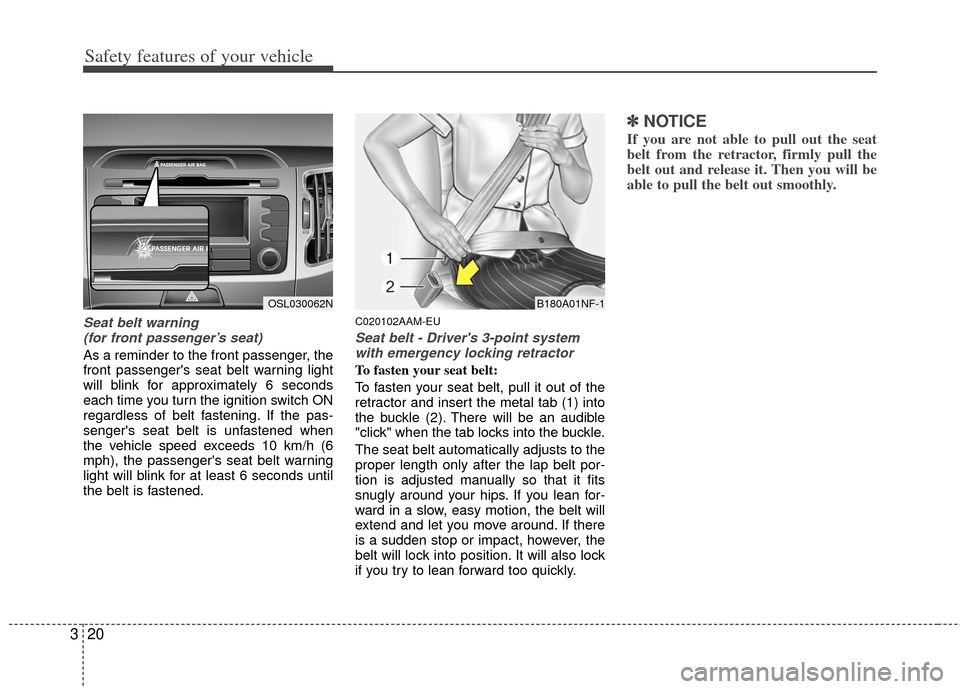
Seat belt - Driver's 3-point systemwith emergency locking retractor
To fasten your seat belt:
To fasten your seat belt, pull it out of the
retractor and insert the metal tab (1) into
the buckle (2). There will be an audible
"click" when the tab locks into the buckle.
The seat belt automatically adjusts to the
proper length only after the lap belt por-
tion is adjusted manually so that it fits
snugly around your hips. If you lean for-
ward in a slow, easy motion, the belt will
extend and let you move around. If there
is a sudden stop or impact, however, the
belt will lock into position. It will also lock
if you try to lean forward too quickly.
✽ ✽ NOTICE
If you are not able to pull out the seat
belt from the retractor, firmly pull the
belt out and release it. Then you will be
able to pull the belt out smoothly.
B180A01NF-1OSL030062N
Page 49 of 387
327
Safety features of your vehicle
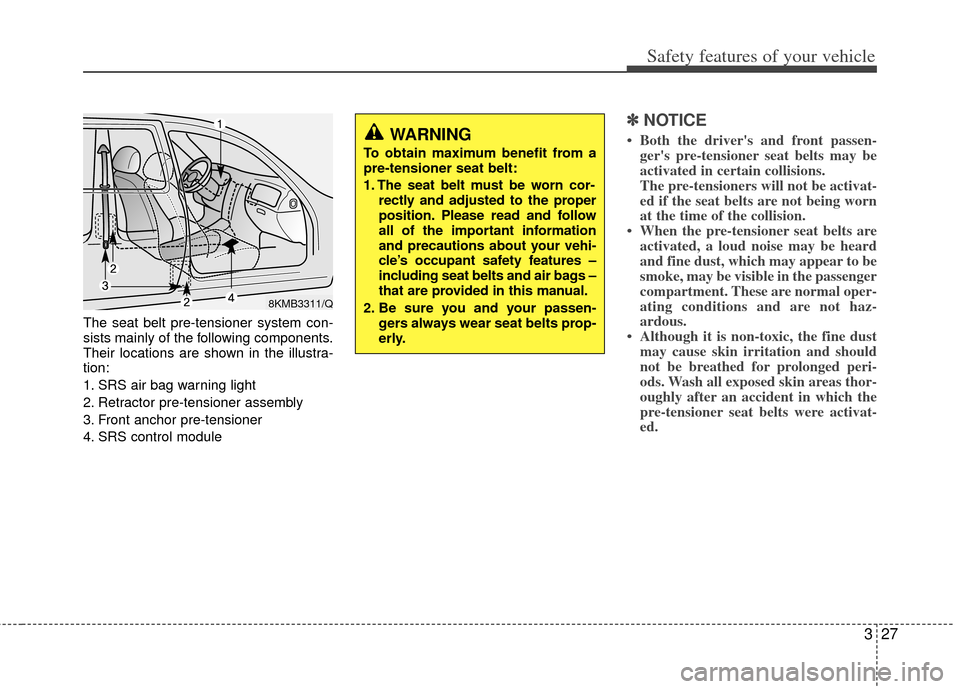
The seat belt pre-tensioner system con-
sists mainly of the following components.
Their locations are shown in the illustra-
tion:
1. SRS air bag warning light
2. Retractor pre-tensioner assembly
3. Front anchor pre-tensioner
4. SRS control module
✽ ✽NOTICE
• Both the driver's and front passen-
ger's pre-tensioner seat belts may be
activated in certain collisions.
The pre-tensioners will not be activat-
ed if the seat belts are not being worn
at the time of the collision.
• When the pre-tensioner seat belts are activated, a loud noise may be heard
and fine dust, which may appear to be
smoke, may be visible in the passenger
compartment. These are normal oper-
ating conditions and are not haz-
ardous.
• Although it is non-toxic, the fine dust may cause skin irritation and should
not be breathed for prolonged peri-
ods. Wash all exposed skin areas thor-
oughly after an accident in which the
pre-tensioner seat belts were activat-
ed.WARNING
To obtain maximum benefit from a
pre-tensioner seat belt:
1. The seat belt must be worn cor-
rectly and adjusted to the proper
position. Please read and follow
all of the important information
and precautions about your vehi-
cle’s occupant safety features –
including seat belts and air bags –
that are provided in this manual.
2. Be sure you and your passen- gers always wear seat belts prop-
erly.
8KMB3311/Q
Page 50 of 387
Safety features of your vehicle
28
3
✽
✽
NOTICE
Because the sensor that activates the
SRS air bag is connected with the pre-
tensioner seat belt, the SRS air bag
warning light ( ) on the instrument
panel will illuminate for approximately
6 seconds after the ignition switch has
been turned to the ON position, and
then it should turn off.
CAUTION
If the pre-tensioner seat belt is not
working properly, this warning lightwill illuminate even if there is nomalfunction of the SRS air bag. Ifthe SRS air bag warning light doesnot illuminate when the ignition switch is turned ON, or if it remainsilluminated after illuminating forapproximately 6 seconds, or if itilluminates while the vehicle isbeing driven, please have anauthorized Kia dealer inspect thepre-tensioner seat belt and SRS airbag system as soon as possible.
WARNING
Pre-tensioners are designed to operate only one time. After acti-
vation, pre-tensioner seat belts
must be replaced. All seat belts,
of any type, should always be
replaced after they have been
worn during a collision.
The pre-tensioner seat belt assembly mechanisms become
hot during activation. Do not
touch the pre-tensioner seat belt
assemblies for several minutes
after they have been activated.
Do not attempt to inspect or replace the pre-tensioner seat
belts yourself. This must be done
by an authorized Kia dealer.
Do not strike the pre-tensioner seat belt assemblies.
Do not attempt to service or repair the pre-tensioner seat belt
system in any manner.
Do not put anything near the buckle. Placing objects near the
buckle can adversely affect the
buckle pretensioner and may
increase the risk of personal
injury in the event of a collision.
(Continued)
(Continued)
Improper handling of the pre-ten-sioner seat belt assemblies, and
failure to heed the warnings not
to strike, modify, inspect, replace,
service or repair the pre-tension-
er seat belt assemblies may lead
to improper operation or inadver-
tent activation and serious injury.
Always wear the seat belts when driving or riding in a motor vehi-
cle.
If the vehicle or pre-tensioner seat belt must be discarded, con-
tact an authorized Kia dealer.
Page 52 of 387
Safety features of your vehicle
30
3
C020301AHM
Larger children
Children who are too large for child
restraint systems should always occupy
the rear seat and use the available
lap/shoulder belts. The lap portion should
be fastened and snugged on the hips
and as low as possible. Check if the belt
fits periodically. A child's squirming could
put the belt out of position. Children are
given the most safety in the event of an
accident when they are restrained by a
proper restraint system in the rear seat. If
a larger child (over age 12) must be seat-
ed in the front seat, the child should be
securely restrained by the available
lap/shoulder belt and the seat should be
placed in the rearmost position. Children
age 12 and under should be restrained
securely in the rear seat. NEVER place a
child age 12 and under in the front seat.
NEVER place a rear facing child seat in
the front seat of a vehicle. If the shoulder belt portion slightly touch-
es the child’s neck or face, try placing the
child closer to the center of the vehicle. If
the shoulder belt still touches their face
or neck they need to be returned to a
child restraint system.
C020302AKM
Restraint of pregnant women
Pregnant women should wear lap/shoul-
der belt assemblies whenever possible
according to specific recommendations
by their doctors. The lap portion of the
belt should be worn AS SECURELY AND
LOW AS POSSIBLE.
WARNING- Shoulder belts
on small children
Never allow a shoulder belt to be
in contact with a child’s neck or
face while the vehicle is in
motion.
If seat belts are not properly worn and adjusted on children, there is
a risk of death or serious injury.WARNING - Pregnantwomen
Pregnant women must never place
the lap portion of the safety belt
over the area of the abdomen
where the fetus is located or above
the abdomen where the belt could
crush the fetus during an impact.