Page 19 of 393
Introduction
61
INDICATOR SYMBOLS ON THE INSTRUMENT CLUSTER
Seat Belt Warning Light
High Beam Indicator
Turn Signal Indicator
ABS Warning Light*
Parking Brake & Brake Fluid
Warning Light
Malfunction Indicator
Low Fuel Level Warning Light Tailgate Open Warning Light
❈ For more detailed explanations, refer to “Instrument cluster” in section 4.
Charging System Warning
Light
Door Ajar Warning Light
Front Fog Light Indicator*
Engine Oil Pressure Warning
Light
Air Bag Warning Light
Low Tire Pressure Telltale*
Cruise Indicator*
Cruise SET Indicator*
ESC Indicator
ESC OFF Indicator
Tail light indicator*
Electronic power steering
(EPS) system warning light
Auto stop for ISG system
indicator*
Active ECO indicator*
ECO
Key out indicator*
KEY
OUT
* if equipped
Fuel cap open warning indi-
cator
Low windshield washer fluid
level warning light Immobilizer indicator
Page 20 of 393
2
Interior overview / 2-2
Instrument panel overview / 2-3
Engine compartment / 2-4
Your vehicle at a glance
Page 22 of 393

23
Your vehicle at a glance
INSTRUMENT PANEL OVERVIEW
1. Instrument Cluster ............................4-40
2. Light Control / Turn Signals ..............4-65
3. Audio Controls* ..............................4-110
4. Advanced Lighting Speaker* ..........4-111
5. Driver's Front Air Bag .......................3-44
6. Auto Cruise Controls*.......................5-37
7. Wiper/Washer ...................................4-69
8. Vent Controls ....................................4-79
9. Engine start/stop button*....................5-8
10. Active ECO button* ........................5-41
11. Hazard Warning Flasher Switch ........................................4-64, 6-2
12. Passenger air bag OFF indicator ...3-38
13. Climate Control System ........4-76, 4-85
14. Shift Lever .............................5-17, 5-20
15. Brake Pedal
16. Accelerator Pedal
17. Parking Brake .................................5-26
18. Glove Box .......................................4-98
19. Passenger's Front Air Bag .............3-44
* if equipped
OAM012002
❈ The actual instrument panel in the vehicle may differ from the illustration.
Page 23 of 393
Your vehicle at a glance
42
ENGINE COMPARTMENT
OAM012003/OAM072100L
1. Windshield Washer Fluid Reservoir ....7-32
2. Engine Oil Filler Cap ........................7-26
3. Engine Oil Dipstick ...........................7-26
4. Engine Coolant Reservoir ................7-28
5. Radiator Cap ....................................7-29
6. Brake/Clutch Fluid Reservoir ...........7-31
7. Positive Battery Terminal ..................7-38
8. Negative Battery Terminal ................7-38
9. Fuse Box ..........................................7-54
10. Air Cleaner .....................................7-34
* if equipped
❈The actual engine compartment in the vehicle may differ from the illustration..
■2.0 Gasoline
■1.6 Gasoline
Page 31 of 393

Safety features of your vehicle
83
Seat warmer (if equipped)
The seat warmer is provided to warm
the front seats during cold weather.
While the engine is running, push
either of the switches to warm the
driver's seat or the front passenger's
seat.
During mild weather or under condi-
tions where the operation of the seat
warmer is not needed, keep the
switches in the OFF position. Each time you push the button, the
temperature setting of the seat is
changed as follows :
The seat warmer defaults to the OFF position whenever the ignition
switch is turned on.
With the seat warmer switch in the
ON position, the heating system in
the seat turns off or on automatically
depending on the seat temperature.
OFF → HIGH ( ) → LOW ( )
→
OAM032010
CAUTION - Seat damage
When cleaning the seats, do not use an organic solventsuch as paint thinner, ben-zene, alcohol and gasoline.Doing so may damage the sur-face of the heater or seats.
To prevent overheating the seat warmer, do not place any-thing on the seats that insu-lates against heat, such asblankets, cushions or seatcovers on the seats while theseat warmer is in operation.
Do not place heavy or sharp objects on seats equippedwith seat warmers. Damage tothe seat warming componentscould occur.
Page 66 of 393
343
Safety features of your vehicle
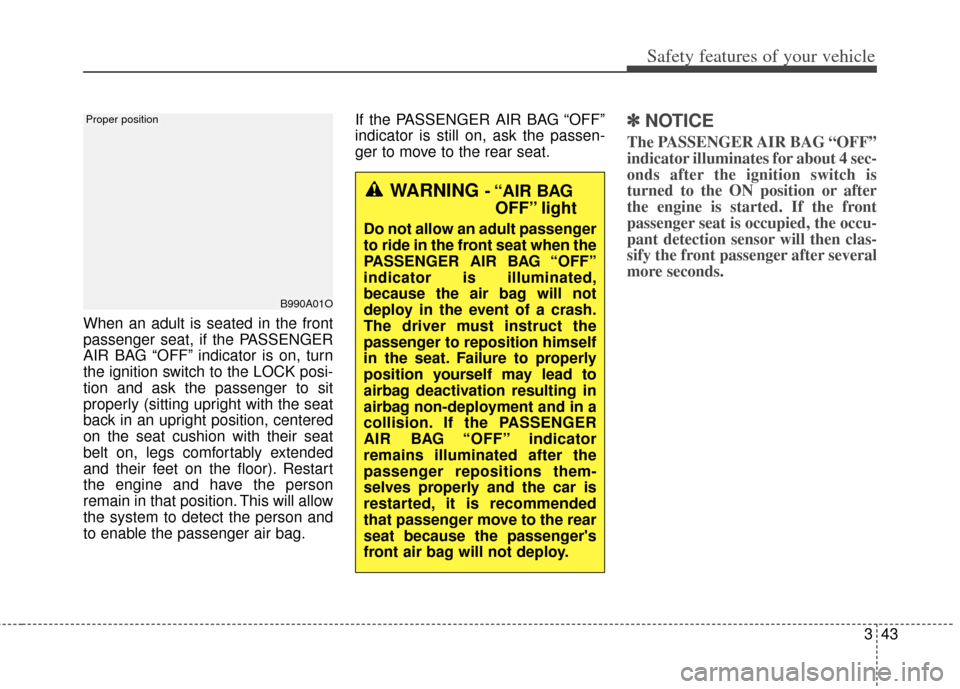
When an adult is seated in the front
passenger seat, if the PASSENGER
AIR BAG “OFF” indicator is on, turn
the ignition switch to the LOCK posi-
tion and ask the passenger to sit
properly (sitting upright with the seat
back in an upright position, centered
on the seat cushion with their seat
belt on, legs comfortably extended
and their feet on the floor). Restart
the engine and have the person
remain in that position. This will allow
the system to detect the person and
to enable the passenger air bag.If the PASSENGER AIR BAG “OFF”
indicator is still on, ask the passen-
ger to move to the rear seat.
✽ ✽
NOTICE
The PASSENGER AIR BAG “OFF”
indicator illuminates for about 4 sec-
onds after the ignition switch is
turned to the ON position or after
the engine is started. If the front
passenger seat is occupied, the occu-
pant detection sensor will then clas-
sify the front passenger after several
more seconds.
B990A01O
Proper position
WARNING - “AIR BAG
OFF” light
Do not allow an adult passenger
to ride in the front seat when the
PASSENGER AIR BAG “OFF”
indicator is illuminated,
because the air bag will not
deploy in the event of a crash.
The driver must instruct the
passenger to reposition himself
in the seat. Failure to properly
position yourself may lead to
airbag deactivation resulting in
airbag non-deployment and in a
collision. If the PASSENGER
AIR BAG “OFF” indicator
remains illuminated after the
passenger repositions them-
selves properly and the car is
restarted, it is recommended
that passenger move to the rear
seat because the passenger's
front air bag will not deploy.
Page 81 of 393
Features of your vehicle
24
Record your key number
The key code number is stamped on
the bar code tag attached to the key
set. Should you lose your keys, this
number will enable an authorized Kia
dealer to duplicate the keys easily.
Remove the bar code tag and store it
in a safe place. Also, record the code
number and keep it in a safe place
(not in the vehicle).
Key operations
• Used to start the engine.
Used to lock and unlock the doors.
Ty p e B
To unfold the key, press the release
button then the key will unfold auto-
matically.
To fold the key, fold the key manually
while pressing the release button.
KEYS
OUN046100L
OUN026060
OAM041096L
■
Type A
■ Type B
CAUTION - Folding key
Do not fold the key without
pressing the release button.This may damage the key.
Page 82 of 393

43
Features of your vehicle
Immobilizer system
Your vehicle may be equipped with
an electronic engine immobilizer sys-
tem to reduce the risk of unautho-
rized vehicle use.
Your immobilizer system is com-
prised of a small transponder in the
ignition key and electronic devices
inside the vehicle.
With the immobilizer system, when-
ever you insert your ignition key into
the ignition switch and turn it to ON,
it checks and determines and verifies
that the ignition key is valid.
If the key is determined to be valid,
the engine will start.
If the key is determined to be invalid,
the engine will not start.
To deactivate the immobilizersystem:
Insert the ignition key into the key
cylinder and turn it to the ON posi-
tion.
To activate the immobilizer sys-tem:
Turn the ignition key to the OFF posi-
tion. The immobilizer system acti-
vates automatically. Without a valid
ignition key for your vehicle, the
engine will not start.
Your Immobilizer password is a cus-
tomer unique password and should
be kept confidential. Do not leave this
number anywhere in your vehicle.
✽ ✽ NOTICE
Keep each key separately in order to
avoid a starting malfunction.
WARNING - Aftermarket
keys
Use only Kia original parts for
the ignition key in your vehicle.
If an aftermarket key is used,
the ignition switch may not
return to ON after START. If this
happens, the starter will contin-
ue to operate causing possible
fire due to excessive current in
the wiring.


