2013 KIA CEED spare wheel
[x] Cancel search: spare wheelPage 1091 of 1168
Maintenance
54
7
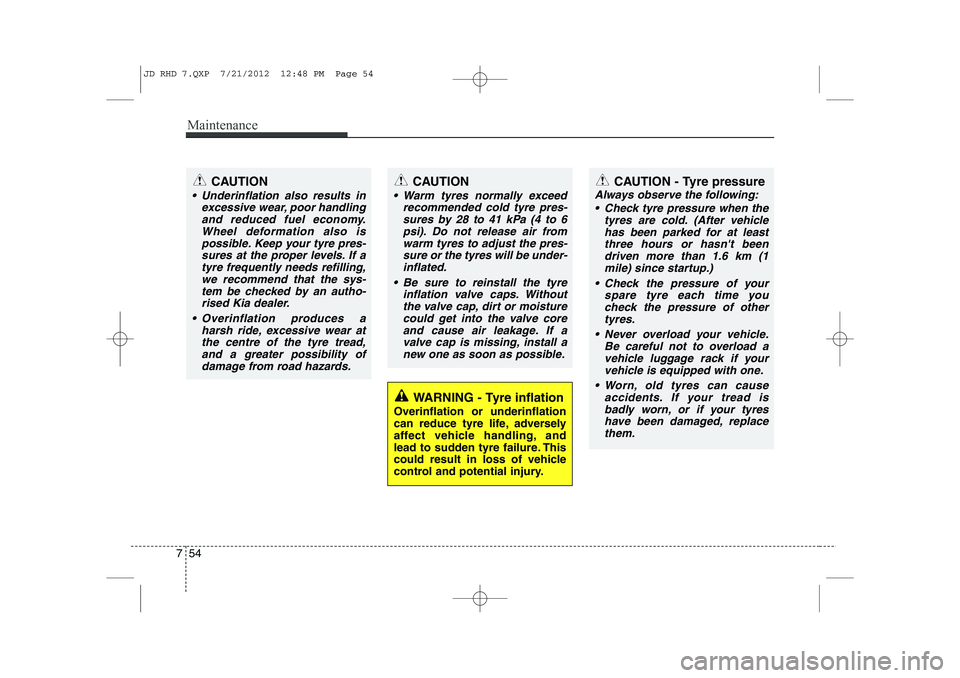
WARNING - Tyre inflation
Overinflation or underinflation
can reduce tyre life, adversely
affect vehicle handling, and
lead to sudden tyre failure. This
could result in loss of vehicle
control and potential injury.
CAUTION - Tyre pressure
Always observe the following:
Check tyre pressure when the tyres are cold. (After vehiclehas been parked for at leastthree hours or hasn't been driven more than 1.6 km (1mile) since startup.)
Check the pressure of your spare tyre each time youcheck the pressure of other tyres.
Never overload your vehicle. Be careful not to overload avehicle luggage rack if yourvehicle is equipped with one.
Worn, old tyres can cause accidents. If your tread isbadly worn, or if your tyreshave been damaged, replacethem.
CAUTION
Underinflation also results in excessive wear, poor handlingand reduced fuel economy.Wheel deformation also ispossible. Keep your tyre pres- sures at the proper levels. If atyre frequently needs refilling,we recommend that the sys- tem be checked by an autho-rised Kia dealer.
Overinflation produces a harsh ride, excessive wear atthe centre of the tyre tread, and a greater possibility ofdamage from road hazards.
CAUTION
Warm tyres normally exceed recommended cold tyre pres-sures by 28 to 41 kPa (4 to 6 psi). Do not release air fromwarm tyres to adjust the pres-sure or the tyres will be under- inflated.
Be sure to reinstall the tyre inflation valve caps. Withoutthe valve cap, dirt or moisturecould get into the valve core and cause air leakage. If avalve cap is missing, install anew one as soon as possible.
JD RHD 7.QXP 7/21/2012 12:48 PM Page 54
Page 1093 of 1168
Maintenance
56
7
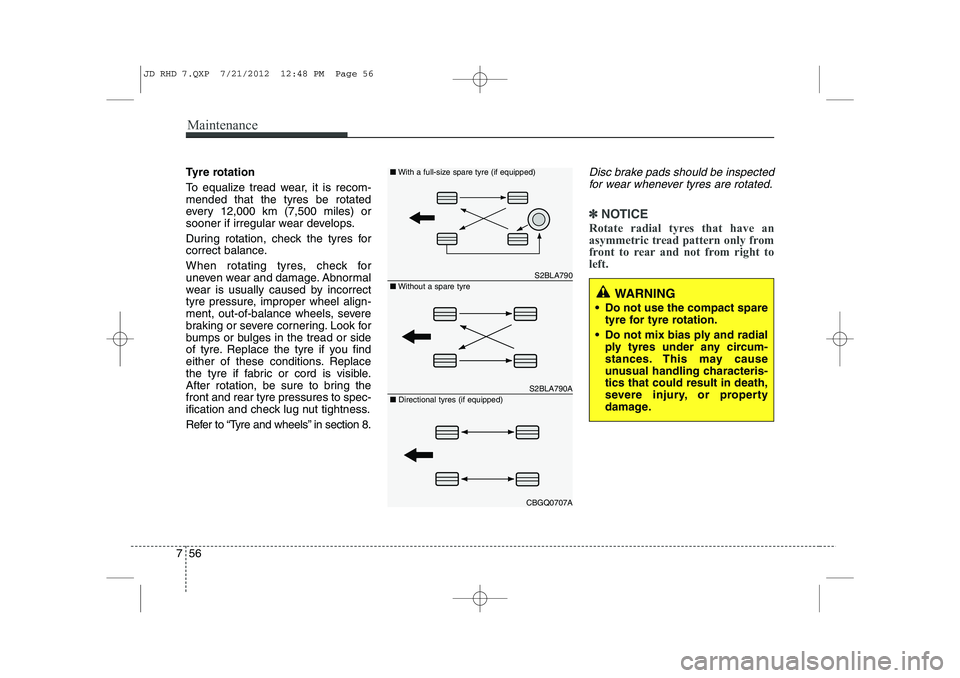
Tyre rotation
To equalize tread wear, it is recom- mended that the tyres be rotated
every 12,000 km (7,500 miles) or
sooner if irregular wear develops.
During rotation, check the tyres for
correct balance.
When rotating tyres, check for
uneven wear and damage. Abnormal
wear is usually caused by incorrect
tyre pressure, improper wheel align-
ment, out-of-balance wheels, severe
braking or severe cornering. Look for
bumps or bulges in the tread or side
of tyre. Replace the tyre if you find
either of these conditions. Replace
the tyre if fabric or cord is visible.
After rotation, be sure to bring thefront and rear tyre pressures to spec-
ification and check lug nut tightness.
Refer to “Tyre and wheels” in section 8.Disc brake pads should be inspected
for wear whenever tyres are rotated.
✽✽ NOTICE
Rotate radial tyres that have an
asymmetric tread pattern only from
front to rear and not from right toleft.
WARNING
Do not use the compact spare tyre for tyre rotation.
Do not mix bias ply and radial ply tyres under any circum-
stances. This may cause
unusual handling characteris-tics that could result in death,
severe injury, or property
damage.
S2BLA790
S2BLA790A
CBGQ0707A
■Without a spare tyre
■
With a full-size spare tyre (if equipped)
■ Directional tyres (if equipped)
JD RHD 7.QXP 7/21/2012 12:48 PM Page 56
Page 1095 of 1168
Maintenance
58
7
Compact spare tyre replacement
(if equipped)
A compact spare tyre has a shorter
tread life than a regular size tyre.
Replace it when you can see the
tread wear indicator bars on the tyre.The replacement compact spare tyre
should be the same size and design
tyre as the one provided with your
new vehicle and should be mountedon the same compact spare tyre
wheel. The compact spare tyre is notdesigned to be mounted on a regular
size wheel, and the compact spare
tyre wheel is not designed for mount-
ing a regular size tyre. Wheel replacement
When replacing the metal wheels for
any reason, make sure the new
wheels are equivalent to the original
factory units in diameter, rim widthand offset.
(Continued)
The use of any other tyre size
or type may seriously affect
ride, handling, ground clear-
ance, stopping distance, body
to tyre clearance, snow tyre
clearance, and speedometer
reliability.
It is best to replace all four tyres at the same time. If that
is not possible, or necessary,
then replace the two front or
two rear tyres as a pair.Replacing just one tyre can
seriously affect your vehicle’shandling.
The ABS works by comparing the speed of the wheels. Tyre
size can affect wheel speed.
When replacing tyres, all 4
tyres must use the same size
originally supplied with the
vehicle. Using tyres of a dif-
ferent size can cause the ABS
(Anti-lock Brake System) and
ESC (Electronic Stability
Control) to work irregularly.
WARNING
A wheel that is not the correct
size may adversely affect wheel
and bearing life, braking and
stopping abilities, handling
characteristics, ground clear-
ance, body-to-tyre clearance,
snow chain clearance,speedometer and odometer cal-
ibration, headlight aim and
bumper height.
JD RHD 7.QXP 7/21/2012 12:48 PM Page 58
Page 1097 of 1168
Maintenance
60
7
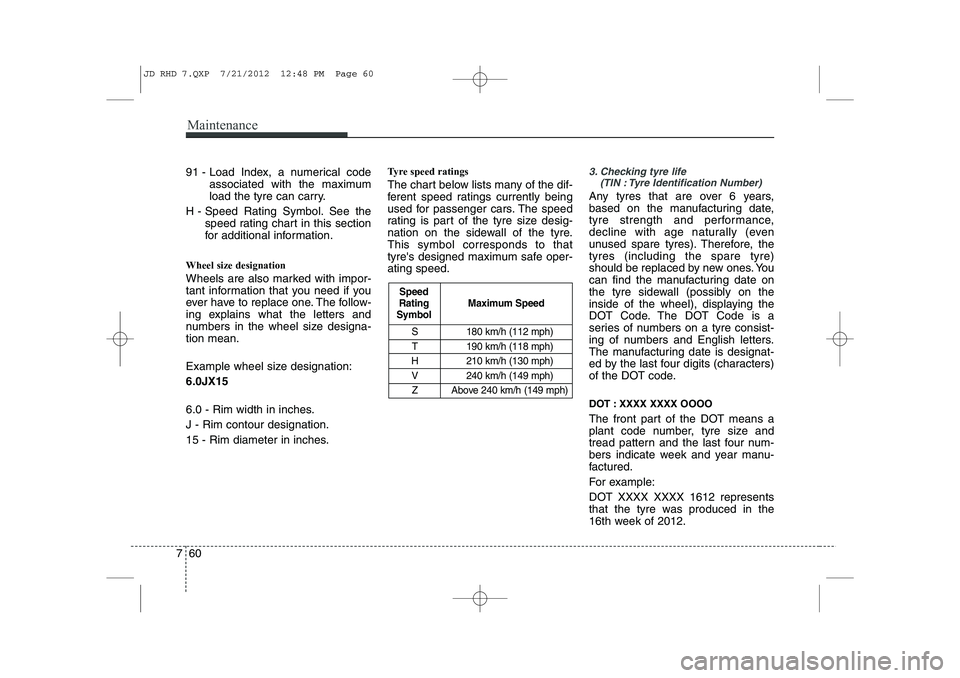
S 180 km/h (112 mph)
T 190 km/h (118 mph)
H 210 km/h (130 mph)
V 240 km/h (149 mph) Z Above 240 km/h (149 mph)
Maximum Speed
Speed
Rating
Symbol
91 - Load Index, a numerical code
associated with the maximum
load the tyre can carry.
H - Speed Rating Symbol. See the speed rating chart in this section
for additional information.
Wheel size designation
Wheels are also marked with impor-
tant information that you need if you
ever have to replace one. The follow-
ing explains what the letters and
numbers in the wheel size designa-tion mean.
Example wheel size designation: 6.0JX15
6.0 - Rim width in inches. J - Rim contour designation.
15 - Rim diameter in inches. Tyre speed ratings
The chart below lists many of the dif-
ferent speed ratings currently being
used for passenger cars. The speed
rating is part of the tyre size desig-
nation on the sidewall of the tyre.This symbol corresponds to that
tyre's designed maximum safe oper-ating speed.3. Checking tyre life
(TIN : Tyre Identification Number)
Any tyres that are over 6 years,
based on the manufacturing date,
tyre strength and performance,
decline with age naturally (even
unused spare tyres). Therefore, thetyres (including the spare tyre)
should be replaced by new ones. You
can find the manufacturing date on
the tyre sidewall (possibly on the
inside of the wheel), displaying the
DOT Code. The DOT Code is a
series of numbers on a tyre consist-
ing of numbers and English letters.
The manufacturing date is designat-
ed by the last four digits (characters)
of the DOT code.
DOT : XXXX XXXX OOOO
The front part of the DOT means a
plant code number, tyre size and
tread pattern and the last four num-
bers indicate week and year manu-
factured.
For example:
DOT XXXX XXXX 1612 represents
that the tyre was produced in the
16th week of 2012.
JD RHD 7.QXP 7/21/2012 12:48 PM Page 60
Page 1124 of 1168
787
Maintenance
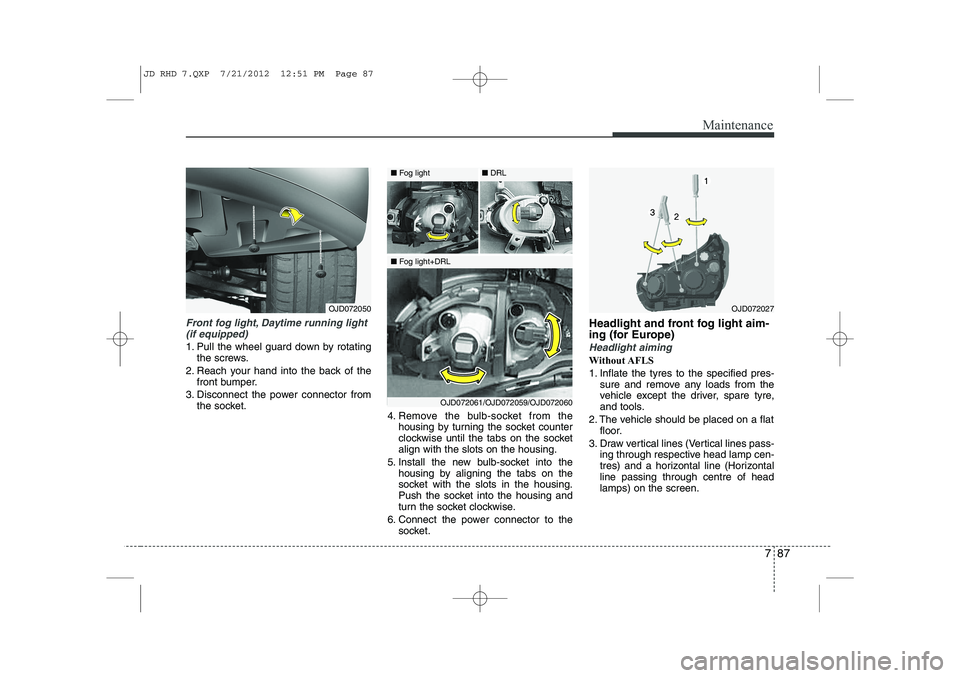
Front fog light, Daytime running light(if equipped)
1. Pull the wheel guard down by rotating the screws.
2. Reach your hand into the back of the front bumper.
3. Disconnect the power connector from the socket. 4. Remove the bulb-socket from the
housing by turning the socket counter
clockwise until the tabs on the socketalign with the slots on the housing.
5. Install the new bulb-socket into the housing by aligning the tabs on the
socket with the slots in the housing.
Push the socket into the housing and
turn the socket clockwise.
6. Connect the power connector to the socket. Headlight and front fog light aim-
ing (for Europe)Headlight aiming
Without AFLS
1. Inflate the tyres to the specified pres-
sure and remove any loads from the
vehicle except the driver, spare tyre,
and tools.
2. The vehicle should be placed on a flat floor.
3. Draw vertical lines (Vertical lines pass- ing through respective head lamp cen-
tres) and a horizontal line (Horizontalline passing through centre of headlamps) on the screen.
OJD072027OJD072050
■Fog light
■Fog light+DRL ■
DRL
OJD072061/OJD072059/OJD072060
JD RHD 7.QXP 7/21/2012 12:51 PM Page 87
Page 1125 of 1168
Maintenance
88
7
4. With the head lamp and battery in nor-
mal condition, aim the head lamps so
the brightest portion falls on the hori-
zontal and vertical lines.
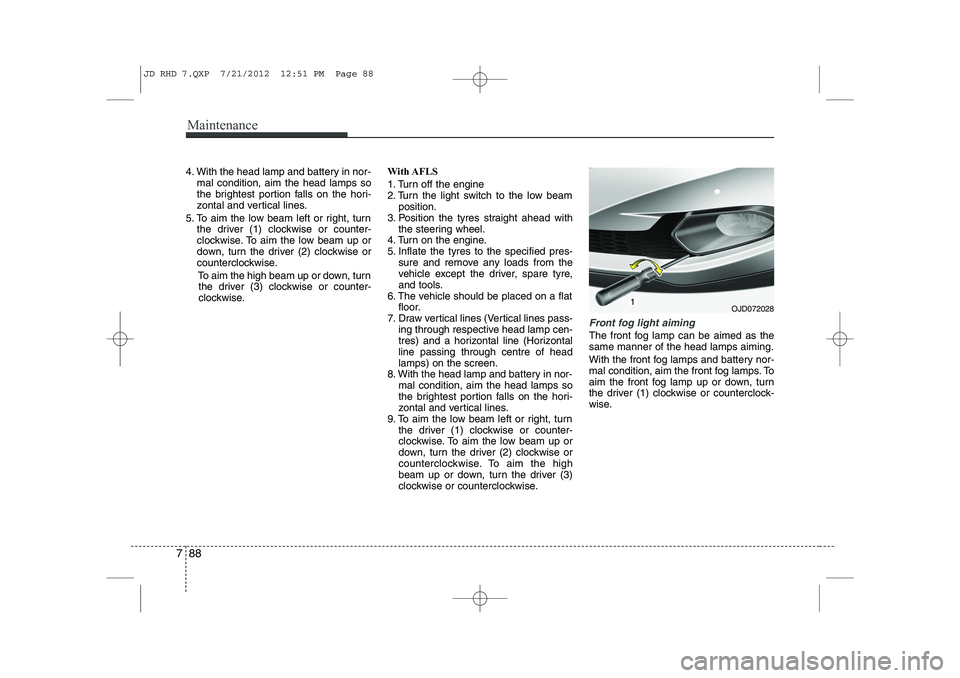
5. To aim the low beam left or right, turn the driver (1) clockwise or counter-
clockwise. To aim the low beam up or
down, turn the driver (2) clockwise or
counterclockwise.
To aim the high beam up or down, turnthe driver (3) clockwise or counter-
clockwise. With AFLS
1. Turn off the engine
2. Turn the light switch to the low beam
position.
3. Position the tyres straight ahead with the steering wheel.
4. Turn on the engine.
5. Inflate the tyres to the specified pres- sure and remove any loads from the
vehicle except the driver, spare tyre,
and tools.
6. The vehicle should be placed on a flat floor.
7. Draw vertical lines (Vertical lines pass- ing through respective head lamp cen-
tres) and a horizontal line (Horizontalline passing through centre of headlamps) on the screen.
8. With the head lamp and battery in nor- mal condition, aim the head lamps so
the brightest portion falls on the hori-
zontal and vertical lines.
9. To aim the low beam left or right, turn the driver (1) clockwise or counter-
clockwise. To aim the low beam up or
down, turn the driver (2) clockwise or
counterclockwise. To aim the high
beam up or down, turn the driver (3)
clockwise or counterclockwise.
Front fog light aiming
The front fog lamp can be aimed as the same manner of the head lamps aiming.
With the front fog lamps and battery nor-
mal condition, aim the front fog lamps. To
aim the front fog lamp up or down, turn
the driver (1) clockwise or counterclock-
wise.
OJD072028
JD RHD 7.QXP 7/21/2012 12:51 PM Page 88
Page 1149 of 1168
85
Specifications & Consumer information
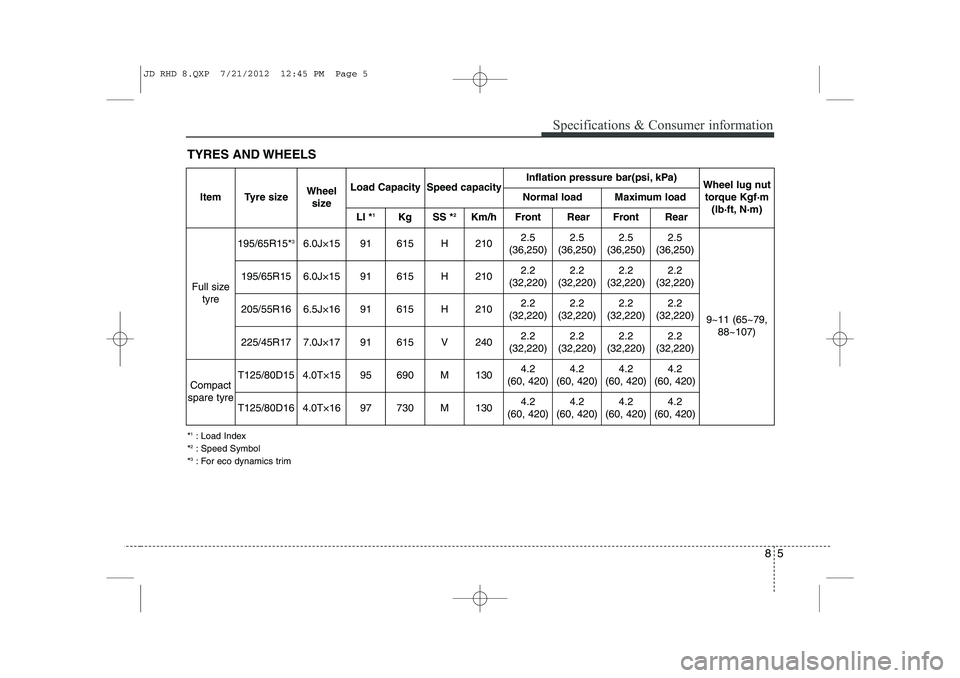
TYRES AND WHEELS *1
: Load Index
* 2
: Speed Symbol
* 3
: For eco dynamics trim
ItemTyre sizeWheel
sizeLoad CapacitySpeed capacityInflation pressure bar(psi, kPa)Wheel lug nuttorque Kgf·m (lb·ft, N·m)
Normal loadMaximum load
LI * 1KgSS * 2Km/hFrontRear FrontRear
Full size
tyre
195/65R15* 36.0J×15 91615H2102.5
(36,250)2.5
(36,250)2.5
(36,250)2.5
(36,250)
9~11 (65~79, 88~107)
195/65R156.0J×15 91615H2102.2
(32,220)2.2
(32,220)2.2
(32,220)2.2
(32,220)
205/55R166.5J×1691615H2102.2
(32,220)2.2
(32,220)2.2
(32,220)2.2
(32,220)
225/45R177.0J×1791615V2402.2
(32,220)2.2
(32,220)2.2
(32,220)2.2
(32,220)
Compact
spare tyreT125/80D154.0T×1595690M1304.2
(60, 420)4.2
(60, 420)4.2
(60, 420)4.2
(60, 420)
T125/80D164.0T×1697730M1304.2
(60, 420)4.2
(60, 420)4.2
(60, 420)4.2
(60, 420)
JD RHD 8.QXP 7/21/2012 12:45 PM Page 5
Page 1160 of 1168
I5
Index
Crankcase emission control system . . . . . . . . . . . 7-104
Evaporative emission control System . . . . . . . . . . 7-104
Exhaust emission control system . . . . . . . . . . . . . 7-105
Engine . . . . . . . . . . . . . . . . . . . . . . . . . . . . . . . . . . . . . . 8-2
Engine compartment . . . . . . . . . . . . . . . . . . . . . . . . . . 2-6
Engine compartment panel fuse . . . . . . . . . . . . . . . . 7-35
Engine coolant . . . . . . . . . . . . . . . . . . . . . . . . . . . . . . . 7-37
Engine number . . . . . . . . . . . . . . . . . . . . . . . . . . . . . . 8-10
Engine oil . . . . . . . . . . . . . . . . . . . . . . . . . . . . . . . . . . . 7-35
Engine overheats . . . . . . . . . . . . . . . . . . . . . . . . . . . . . . 6-8
Engine start/stop button. . . . . . . . . . . . . . . . . . . . . . . . 5-9
Engine temperature gauge (Normal vision) . . . . . . . 4-54
Engine temperature gauge (Super vision) . . . . . . . . 4-67
Engine will not start . . . . . . . . . . . . . . . . . . . . . . . . . . . 6-4
Evaporative emission control System . . . . . . . . . . . 7-104
Exhaust emission control system . . . . . . . . . . . . . . . 7-105
Explanation of scheduled maintenance items . . . . . 7-32
Exterior care . . . . . . . . . . . . . . . . . . . . . . . . . . . . . . . . 7-98
Exterior features Mounting bracket for roof carrier . . . . . . . . . . . . 4-165
Roof rack . . . . . . . . . . . . . . . . . . . . . . . . . . . . . . . . . 4-167
Exterior overview(front) . . . . . . . . . . . . . . . . . . . . . . . 2-2
Exterior overview(rear) . . . . . . . . . . . . . . . . . . . . . . . . 2-3 Flat tyre (with spare tyre) . . . . . . . . . . . . . . . . . . . . . . 6-9
Changing tyres . . . . . . . . . . . . . . . . . . . . . . . . . . . . . 6-10
Compact spare tyre . . . . . . . . . . . . . . . . . . . . . . . . . 6-15
Jack and tools . . . . . . . . . . . . . . . . . . . . . . . . . . . . . . . 6-9
Removing and storing the spare tyre . . . . . . . . . . . 6-10
Flat tyre (with tyre mobility kit) . . . . . . . . . . . . . . . . 6-17
Flex steering wheel . . . . . . . . . . . . . . . . . . . . . . . . . . . 4-40
Floor mat anchor(s) . . . . . . . . . . . . . . . . . . . . . . . . . 4-159Fluid Brakes/clutch fluid . . . . . . . . . . . . . . . . . . . . . . . . . . 7-40
Fluid Washer fluid . . . . . . . . . . . . . . . . . . . . . . . . . . . . . . . 7-41
Fog light (front) . . . . . . . . . . . . . . . . . . . . . . . . . . . . . 4-115
Fog light (rear) . . . . . . . . . . . . . . . . . . . . . . . . . . . . . 4-115
Folding the rear seat . . . . . . . . . . . . . . . . . . . . . . . . . . 3-15
Front seat adjustment. . . . . . . . . . . . . . . . . . . . . . . . . . 3-4
Fuel filler lid . . . . . . . . . . . . . . . . . . . . . . . . . . . . . . . . 4-30
Fuel filter . . . . . . . . . . . . . . . . . . . . . . . . . . . . . . . . . . . 7-42
Fuel gauge (Normal vision) . . . . . . . . . . . . . . . . . . . . 4-48
Fuel gauge (Super vision) . . . . . . . . . . . . . . . . . . . . . . 4-61
Fuel requirements . . . . . . . . . . . . . . . . . . . . . . . . . . . . . 1-2
Fuse switch . . . . . . . . . . . . . . . . . . . . . . . . . . . . . . . . . 7-65
Fuses . . . . . . . . . . . . . . . . . . . . . . . . . . . . . . . . . . . . . . . 7-63 Engine compartment panel fuse . . . . . . . . . . . . . . . 7-65
Fuse switch . . . . . . . . . . . . . . . . . . . . . . . . . . . . . . . . 7-65F
JD RHD Index.QXP 7/21/2012 1:10 PM Page 5