2013 KIA CEED warning
[x] Cancel search: warningPage 539 of 1168

Maintenance
86
7
Turn signal light
Follow the steps 1 to 7 from the previous
page.
8. Remove the socket from the assembly
by turning the socket counterclockwise
until the tabs on the socket align with
the slots on the assembly.
9. Remove the bulb from the socket by pressing it in and rotating it counter-
clockwise until the tabs on the bulb
align with the slots in the socket. Pull
the bulb out of the socket.
10. Insert a new bulb by inserting it into the socket and rotating it until it locks
into place. 11. Install the socket in the assembly by
aligning the tabs on the socket with
the slots in the assembly. Push the
socket into the assembly and turn the
socket clockwise.
OHD076046
WARNING - Halogen bulbs
Halogen bulbs contain pressurized
gas that will produce flying pieces
of glass if broken.
Always handle them carefully, and avoid scratches and abrasions. If
the bulbs are lit, avoid contact with
liquids. Never touch the glass with
bare hands. Residual oil may cause
the bulb to overheat and burst
when lit. A bulb should be operated
only when installed in a headlight.
If a bulb is damaged or cracked, replace it immediately and carefullydispose of it.
Wear eye protection when chang- ing a bulb. Allow the bulb to cool
down before handling it.
OJD072044
JD eng 7.QXP 7/17/2012 10:59 AM Page 86
Page 550 of 1168
797
Maintenance
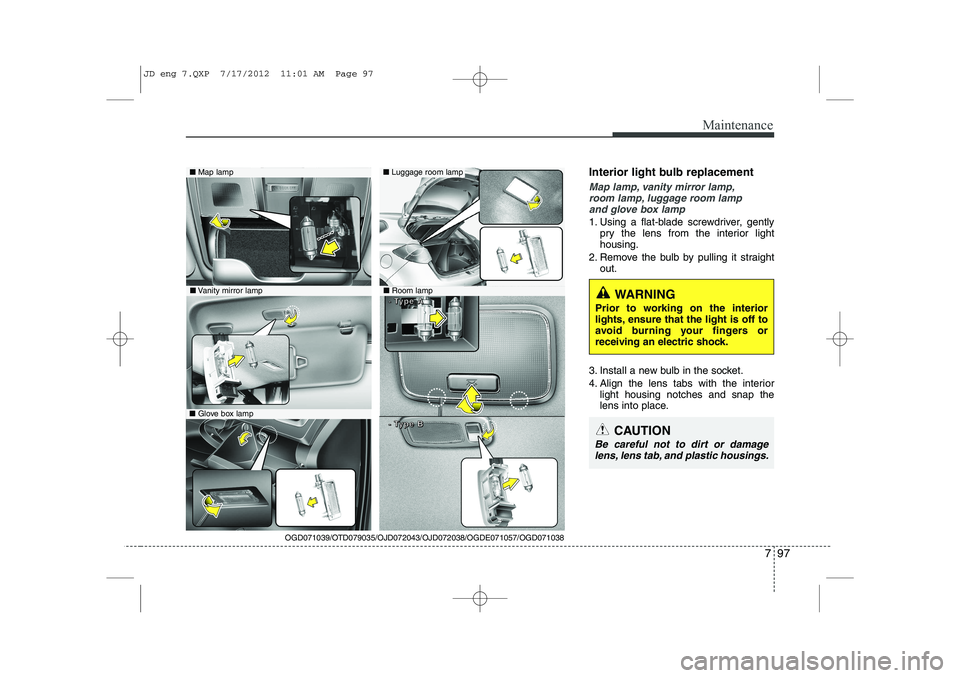
Interior light bulb replacement
Map lamp, vanity mirror lamp,room lamp, luggage room lamp and glove box lamp
1. Using a flat-blade screwdriver, gently pry the lens from the interior light housing.
2. Remove the bulb by pulling it straight out.
3. Install a new bulb in the socket.
4. Align the lens tabs with the interior light housing notches and snap the
lens into place.
■Map lamp
■Glove box lamp
■Vanity mirror lamp
■ Luggage room lamp
■Room lamp
OGD071039/OTD079035/OJD072043/OJD072038/OGDE071057/OGD071038 ---- TTTTyyyyppppeeee AAAA
---- TTTTyyyyppppeeee BBBB
WARNING
Prior to working on the interior
lights, ensure that the light is off to
avoid burning your fingers or
receiving an electric shock.
CAUTION
Be careful not to dirt or damage lens, lens tab, and plastic housings.
JD eng 7.QXP 7/17/2012 11:01 AM Page 97
Page 551 of 1168
Maintenance
98
7
APPEARANCE CARE
Exterior care
Exterior general caution
It is very important to follow the label
directions when using any chemical
cleaner or polish. Read all warning andcaution statements that appear on thelabel.
Finish maintenance
Washing
To help protect your vehicle’s finish from
rust and deterioration, wash it thoroughlyand frequently at least once a month with
lukewarm or cold water.
If you use your vehicle for off-road driv-
ing, you should wash it after each off-
road trip. Pay special attention to the
removal of any accumulation of salt, dirt,
mud, and other foreign materials. Ensure
drain holes in the lower edges of the
doors and rocker panels are kept clean.
Insects, tar, tree sap, bird droppings,
industrial pollution and similar deposits
can damage your vehicle’s finish if not
removed immediately.
Even prompt washing with plain water
may not completely remove all these
deposits.
A mild soap, safe for use on painted sur-
faces, may be used.
After washing, rinse the vehicle thor-
oughly with lukewarm or cold water. Do
not allow soap to dry on the finish.
WARNING - Wet brakes
After washing the vehicle, test the
brakes while driving slowly to see if
they have been affected by water. If
braking performance is impaired,
dry the brakes by applying them
lightly while maintaining a slow for-
ward speed.
CAUTION
Do not use strong soap, chemical detergents or hot water, and do
not wash the vehicle in directsunlight or when the body of thevehicle is warm.
Be careful when washing the side windows of your vehicle.Especially, with high-pressure water, water may leak through thewindows and wet the interior.
To prevent damage to the plastic parts and lamps, do not cleanwith chemical solvents or strong detergents.
JD eng 7.QXP 7/17/2012 11:01 AM Page 98
Page 553 of 1168

Maintenance
100
7
Bright-metal maintenance
To remove road tar and insects, use a
tar remover, not a scraper or other
sharp object.
To protect the surfaces of bright-metal parts from corrosion, apply a coating of
wax or chrome preservative and rub to
a high luster.
During winter weather or in coastal areas, cover the bright metal parts with
a heavier coating of wax or preserva-
tive. If necessary, coat the parts with
non-corrosive petroleum jelly or other
protective compound.
Underbody maintenance
Corrosive materials used for ice and
snow removal and dust control may col-
lect on the underbody. If these materials
are not removed, accelerated rusting can
occur on underbody parts such as the
fuel lines, frame, floor pan and exhaust
system, even though they have been
treated with rust protection.
Thoroughly flush the vehicle underbody
and wheel openings with lukewarm or
cold water once a month, after off-road
driving and at the end of each winter. Payspecial attention to these areas because
it is difficult to see all the mud and dirt. It
will do more harm than good to wet down
the road grime without removing it. The
lower edges of doors, rocker panels, and
frame members have drain holes that
should not be allowed to clog with dirt;
trapped water in these areas can cause
rusting.WARNING
After washing the vehicle, test the
brakes while driving slowly to see if
they have been affected by water. If
braking performance is impaired,
dry the brakes by applying them
lightly while maintaining a slow for-
ward speed.
JD eng 7.QXP 7/17/2012 11:01 AM Page 100
Page 558 of 1168

7 105
Maintenance
3. Exhaust emission control system
The Exhaust Emission Control System is
a highly effective system which controls
exhaust emissions while maintaining
good vehicle performance.
Vehicle modifications
This vehicle should not be modified.
Modification of your vehicle could affect
its performance, safety or durability and
may even violate governmental safety
and emissions regulations.
In addition, damage or performance
problems resulting from any modification
may not be covered under warranty.
If you use unauthorized electronic devices, it may cause the vehicle to
operate abnormally, wire damage, bat-
tery discharge or fire. For your safety,
do not use unauthorized electric
devices.
Engine exhaust gas precautions
(carbon monoxide)
Carbon monoxide can be present with other exhaust fumes. Therefore, if you
smell exhaust fumes of any kind inside
your vehicle, have it inspected and
repaired immediately. If you ever sus-
pect exhaust fumes are coming into
your vehicle, drive it only with all the
windows fully open. Have your vehicle
checked and repaired immediately. Do not operate the engine in confined
or closed areas (such as garages) any
more than what is necessary to move
the vehicle in or out of the area.
When the vehicle is stopped in an open area for more than a short time
with the engine running, adjust the
ventilation system (as needed) to draw
outside air into the vehicle.
Never sit in a parked or stopped vehi- cle for any extended time with the
engine running.
When the engine stalls or fails to start, excessive attempts to restart the
engine may cause damage to theemission control system.
WARNING - Exhaust
Engine exhaust gases contain car-
bon monoxide (CO). Though color-
less and odorless, it is dangerousand could be lethal if inhaled.
Follow the instructions following to
avoid CO poisoning.
JD eng 7.QXP 7/17/2012 11:01 AM Page 105
Page 559 of 1168

Maintenance
106
7
Operating precautions for catalytic
converters (if equipped)Your vehicle is equipped with a catalytic
converter emission control device.
Therefore, the following precautions
must be observed:
Make sure to refuel your vehicle according to the "Fuel requirements" suggested in section 1.
Do not operate the vehicle when there are signs of engine malfunction, such
as misfire or a noticeable loss of per-
formance.
Do not misuse or abuse the engine. Examples of misuse are coasting withthe ignition off and descending steep
grades in gear with the ignition off.
Do not operate the engine at high idle speed for extended periods (5 minutesor more).
Do not modify or tamper with any part of the engine or emission control sys-
tem. We recommend that the system be
inspected by an authorized Kia dealer.
Avoid driving with a extremely low fuel level. Running out of fuel cause the
engine to misfire, damaging the cat-
alytic converter.
Failure to observe these precautionscould result in damage to the catalytic
converter and to your vehicle.
Additionally, such actions could void your
warranties.Diesel Particulate Filter (if equipped)
The Diesel Particulate Filter (DPF) sys-
tem removes the soot emitted from the
vehicle.
Unlike a disposable air filter, the DPF
system automatically burns (oxidizes)
and removes the accumulated soot
according to the driving condition. In
other words, the active burning by engine
control system and high exhaust gas
temperature caused by normal/high driv-
ing condition burns and removes the
accumulated soot.
However, if the vehicle continues to be
driven at low speed for long time, the
accumulated soot may not be automati-
cally removed because of low exhaust
gas temperature. In this particular case,the amount of soot is out of detection
limit, the soot oxidation process by
engine control system may not happen
and the malfunction indicator light may
blink. When the malfunction indicator light
blinks, it may stop blinking by driving the
vehicle at more than 60km/h (37 mph) orat more than second gear with 1500 ~
2000 engine rpm for a certain time (for
about 25 minutes).
WARNING - Fire
A hot exhaust system can ignite flammable items under your vehi-
cle. Do not park, idle, or drive the
vehicle over or near flammable
objects, such as dry grass, paper,
leaves, etc.
The exhaust system and catalytic system are very hot while the
engine is running or immediately
after the engine is turned off.
Keep away from the exhaust sys-
tem and catalytic, you may get
burned.
Also, do not remove the heat sink
around the exhaust system, do
not seal the bottom of the vehicle
or do not coat the vehicle for cor-
rosion control. It may present a
fire risk under certain conditions.
JD eng 7.QXP 7/17/2012 11:01 AM Page 106
Page 573 of 1168

Index
2
I
Active ECO system . . . . . . . . . . . . . . . . . . . . . . . . . . . 5-32
AFLS (Adaptive Front Lighting System) . . . . . . . . 4-117
Air bag warning label . . . . . . . . . . . . . . . . . . . . . . . . . 3-63
Air bag warning light . . . . . . . . . . . . . . . . . . . . . . . . . 3-43
Air bags . . . . . . . . . . . . . . . . . . . . . . . . . . . . . . . . . . . . 3-40
Air bag warning label . . . . . . . . . . . . . . . . . . . . . . . 3-54
Air bag warning light . . . . . . . . . . . . . . . . . . . . . . . . 3-43
Curtain air bag . . . . . . . . . . . . . . . . . . . . . . . . . . . . . 3-54
Driver's and passenger's front air bag . . . . . . . . . . 3-48
Passenger’s front air bag ON indicator . . . . . . . . . 3-44
Passenger’s front air bag ON/OFF switch . . . . . . . 3-50
Side impact air bag. . . . . . . . . . . . . . . . . . . . . . . . . . 3-53
SRS components and functions . . . . . . . . . . . . . . . . 3-45
Air cleaner . . . . . . . . . . . . . . . . . . . . . . . . . . . . . . . . . . 7-43
Air conditioner compressor label . . . . . . . . . . . . . . . 8-11
Air conditioning system . . . . . . . . . . . . . . . . . . . . . . . . 8-3
Alarm system. . . . . . . . . . . . . . . . . . . . . . . . . . . . . . . . 4-14
Aming . . . . . . . . . . . . . . . . . . . . . . . . . . . . . . . . . . . . . . 7-87
Anti-lock brake system (ABS) . . . . . . . . . . . . . . . . . . 5-41
Appearance care Interior care . . . . . . . . . . . . . . . . . . . . . . . . . . . . . . 7-103
Armrest (Rear seat) . . . . . . . . . . . . . . . . . . . . . . . . . . 3-14
Ashtray. . . . . . . . . . . . . . . . . . . . . . . . . . . . . . . . . . . . 4-154
Audio remote control . . . . . . . . . . . . . . . . . . . . . . . . 4-164 Audio system . . . . . . . . . . . . . . . . . . . . . . . . . . . . . . . 4-169
Audio remote control . . . . . . . . . . . . . . . . . . . . . . . 4-170
Roof antenna . . . . . . . . . . . . . . . . . . . . . . . . . . . . . . 4-169
Auto defogging system . . . . . . . . . . . . . . . . . . . . . . . 4-149
Auto light/AFLS position . . . . . . . . . . . . . . . . . . . . . 4-112
Automatic climate control system . . . . . . . . . . . . . . 4-136 Air conditioning . . . . . . . . . . . . . . . . . . . . . . . . . . . 4-145
Automatic heating and air conditioning . . . . . . . 4-137
Climate control air filter . . . . . . . . . . . . . . . . . . . . 4-146
Manual heating and air conditioning . . . . . . . . . . 4-139
Automatic transaxle / DCT . . . . . . . . . . . . . . . . . . . . 5-23 DS mode. . . . . . . . . . . . . . . . . . . . . . . . . . . . . . . . . . . 5-27
Paddle shifter . . . . . . . . . . . . . . . . . . . . . . . . . . . . . . 5-28
Shift lock system . . . . . . . . . . . . . . . . . . . . . . . . . . . . 5-29
Sports mode. . . . . . . . . . . . . . . . . . . . . . . . . . . . . . . . 5-27
Automatic transaxle shift position indicator (Normal vision) . . . . . . . . . . . . . . . . . . . . . . . . . . . . . 4-49
Automatic transaxle shift position indicator (Super vision) . . . . . . . . . . . . . . . . . . . . . . . . . . . . . . 4-62
Aux, USB and iPod . . . . . . . . . . . . . . . . . . . . . . . . . . 4-158
Barrier net . . . . . . . . . . . . . . . . . . . . . . . . . . . . . . . . . 4-161
Battery . . . . . . . . . . . . . . . . . . . . . . . . . . . . . . . . . . . . . 7-50
Battery replacement (Remote keyless entry) . . . . . . . 4-9
Battery saver function . . . . . . . . . . . . . . . . . . . . . . . 4-110
A
B
JD eng Index.qxp 7/21/2012 11:45 AM Page 2
Page 577 of 1168

Index
6
I
Gauge (Normal vision)
Engine temperature gauge. . . . . . . . . . . . . . . . . . . . 4-54
Fuel gauge . . . . . . . . . . . . . . . . . . . . . . . . . . . . . . . . . 4-48
Gauge (Super vision) Engine temperature gauge. . . . . . . . . . . . . . . . . . . . 4-67
Fuel gauge . . . . . . . . . . . . . . . . . . . . . . . . . . . . . . . . . 4-61
Glove box . . . . . . . . . . . . . . . . . . . . . . . . . . . . . . . . . . 4-152
Glove box lamp . . . . . . . . . . . . . . . . . . . . . . . . . . . . . 4-124
Hazard warning flasher . . . . . . . . . . . . . . . . . . . . . . 4-109
Hazardous driving conditions . . . . . . . . . . . . . . . . . . 5-64
Headlamp delay function . . . . . . . . . . . . . . . . . . . . . 4-110
Headlight (Headlamp) welcome function . . . . . . . . 4-110
Headlight bulb replacement. . . . . . . . . . . . . . . . . . . . 7-82
Headlight leveling device . . . . . . . . . . . . . . . . . . . . . 4-116
Headlight position . . . . . . . . . . . . . . . . . . . . . . . . . . . 4-112
Headlight washer . . . . . . . . . . . . . . . . . . . . . . . . . . . 4-121
Headrest(front) . . . . . . . . . . . . . . . . . . . . . . . . . . . . . . 3-10
Headrest(rear) . . . . . . . . . . . . . . . . . . . . . . . . . . . . . . . 3-13
Heated steering wheel. . . . . . . . . . . . . . . . . . . . . . . . . 4-38
High - beam operation . . . . . . . . . . . . . . . . . . . . . . . 4-113
Hight adjustment (seat belt) . . . . . . . . . . . . . . . . . . . 3-21
Highway driving . . . . . . . . . . . . . . . . . . . . . . . . . . . . . 5-66 Hill-start assist control (HAC). . . . . . . . . . . . . . . . . . 5-48
Hood . . . . . . . . . . . . . . . . . . . . . . . . . . . . . . . . . . . . . . . 4-28
Horn . . . . . . . . . . . . . . . . . . . . . . . . . . . . . . . . . . . . . . . 4-39
How to use this manual . . . . . . . . . . . . . . . . . . . . . . . . 1-2
Icy road warning . . . . . . . . . . . . . . . . . . . . . . . . . . . . . 4-89
Indicator symbols on the instrument cluster . . . . . . . 1-6
Indicators and warnings . . . . . . . . . . . . . . . . . . . . . . 4-77
Inside rearview mirror . . . . . . . . . . . . . . . . . . . . . . . . 4-42Instrument cluster
LCD display information . . . . . . . . . . . . . . . . . . . . . 4-71
Warning and indicators . . . . . . . . . . . . . . . . . . . . . . 4-77
Instrument cluster (Normal vision). . . . . . . . . . . . . . 4-46
Automatic transaxle shift position indicator . . . . . 4-49
Double clutch transmission shift indicator . . . . . . 4-49
Fuel gauge . . . . . . . . . . . . . . . . . . . . . . . . . . . . . . . . . 4-48
Instrument panel illumination . . . . . . . . . . . . . . . . 4-47
Manual transaxle shift indicator. . . . . . . . . . . . . . . 4-48
Odometer . . . . . . . . . . . . . . . . . . . . . . . . . . . . . . . . . . 4-50
Speed limiter indicator. . . . . . . . . . . . . . . . . . . . . . . 4-50
Speedometer . . . . . . . . . . . . . . . . . . . . . . . . . . . . . . . 4-47
Tachometer . . . . . . . . . . . . . . . . . . . . . . . . . . . . . . . . 4-47
Trip computer . . . . . . . . . . . . . . . . . . . . . . . . . . . . . . 4-51
User Settings . . . . . . . . . . . . . . . . . . . . . . . . . . . . . . . 4-56
G
H
I
JD eng Index.qxp 7/21/2012 11:45 AM Page 6