2013 KIA CEED brake
[x] Cancel search: brakePage 580 of 1168

I9
Index
Normal maintenance schedule
(except Europe, for Russia) . . . . . . . . . . . . . . . . . . 7-21
Normal maintenance schedule (for Europe, except Russia) . . . . . . . . . . . . . . . . . . 7-10
Owner maintenance . . . . . . . . . . . . . . . . . . . . . . . . . . 7-7
Scheduled maintenance service . . . . . . . . . . . . . . . . . 7-9
Tire maintenance . . . . . . . . . . . . . . . . . . . . . . . . . . . 7-59
Maintenance schedule . . . . . . . . . . . . . . . . . . . . . . . . . 7-9 Maintenance under severe usage conditions (except Europe, for Russia) . . . . . . . . . . . . . . . . . . 7-30
Maintenance under severe usage conditions (for Europe, except Russia) . . . . . . . . . . . . . . . . . . 7-19
Normal maintenance schedule (except Europe, for Russia) . . . . . . . . . . . . . . . . . . 7-21
Normal maintenance schedule (for Europe, except Russia) . . . . . . . . . . . . . . . . . . 7-10
Maintenance services . . . . . . . . . . . . . . . . . . . . . . . . . . 7-5
Manual climate control system . . . . . . . . . . . . . . . . 4-127 Air conditioning . . . . . . . . . . . . . . . . . . . . . . . . . . . 4-133
Climate control air filter . . . . . . . . . . . . . . . . . . . . 4-134
Heating and air conditioning. . . . . . . . . . . . . . . . . 4-128
Manual transaxle . . . . . . . . . . . . . . . . . . . . . . . . . . . . 5-20
Manual transaxle shift indicator (Normal vision) . . 4-48
Manual transaxle shift indicator (Super vision) . . . 4-61
Map lamp. . . . . . . . . . . . . . . . . . . . . . . . . . . . . . . . . . 4-122
Mirrors . . . . . . . . . . . . . . . . . . . . . . . . . . . . . . . . . . . . . 4-42 Day/night rearview mirror . . . . . . . . . . . . . . . . . . . 4-42
Electric chromic mirror (ECM) . . . . . . . . . . . . . . . 4-42 Inside rearview mirror . . . . . . . . . . . . . . . . . . . . . . . 4-42
Outside rearview mirror . . . . . . . . . . . . . . . . . . . . . 4-43
Moonroof, see panorama sunroof . . . . . . . . . . . . . . . 4-33
Mounting bracket for roof carrier . . . . . . . . . . . . . 4-161
Multi fuse . . . . . . . . . . . . . . . . . . . . . . . . . . . . . . . . . . . 7-66
Odometer (Normal vision) . . . . . . . . . . . . . . . . . . . . . 4-50
Odometer (Super vision) . . . . . . . . . . . . . . . . . . . . . . 4-63
Oil (Engine) . . . . . . . . . . . . . . . . . . . . . . . . . . . . . . . . . 7-35
Outside ambient Temperature . . . . . . . . . . . . . . . . . . 4-88
Outside rearview mirror . . . . . . . . . . . . . . . . . . . . . . 4-43
Overheats . . . . . . . . . . . . . . . . . . . . . . . . . . . . . . . . . . . . 6-8
Owner maintenance . . . . . . . . . . . . . . . . . . . . . . . . . . . 7-7
Paddle shifter . . . . . . . . . . . . . . . . . . . . . . . . . . . . . . . 5-28
Panorama sunroof . . . . . . . . . . . . . . . . . . . . . . . . . . . 4-33
Parking assist system . . . . . . . . . . . . . . . . . . . . . . . . . 4-94
Parking brake-Hand type . . . . . . . . . . . . . . . . . . . . . 7-41
Passenger’s front air bag ON indicator . . . . . . . . . . 3-44
Passenger’s front air bag ON/OFF switch . . . . . . . . 3-50
Position light position . . . . . . . . . . . . . . . . . . . . . . . . 4-111
Power brakes . . . . . . . . . . . . . . . . . . . . . . . . . . . . . . . . 5-33
Power outlet . . . . . . . . . . . . . . . . . . . . . . . . . . . . . . . . 4-157
Power window lock button. . . . . . . . . . . . . . . . . . . . . 4-26
O
P
JD eng Index.qxp 7/21/2012 11:45 AM Page 9
Page 592 of 1168

15
Introduction
Biodiesel
Commercially supplied Diesel blends of no more than 7% biodiesel, commonly
known as "B7 Diesel" may be used in
your vehicle if Biodiesel meets EN 14214
or equivalent specifications. (EN stands
for "European Norm"). The use of biofu-
els exceeding 7% made from rapeseed
methyl ester (RME), fatty acid methyl
ester (FAME), vegetable oil methyl ester
(VME) etc. or mixing diesel exceeding7% with biodiesel will cause increased
wear or damage to the engine and fuel
system. Repair or replacement of worn ordamaged components due to the use of
non approved fuels will not be covered by
the manufactures warranty.No special break-in period is needed. By
following a few simple precautions for the
first 1,000 km (600 miles) you may add to
the performance, economy and life of
your vehicle.
Do not race the engine.
Whilst driving, keep your engine speed
(rpm, or revolutions per minute)
between 2,000 rpm and 4,000 rpm.
Do not maintain a single speed for long periods of time, either fast or slow.
Varying engine speed is needed to
properly break-in the engine.
Avoid hard stops, except in emergen-
cies, to allow the brakes to seat prop-
erly.
Don't let the engine idle longer than 3 minutes at one time.
Don't tow a trailer during the first 2,000 km (1,200 miles) of operation.CAUTION
Do not let any petrol or water enter
the tank. This would make it neces-
sary to drain it out and to bleed thelines to avoid jamming the injectionpump and damaging the engine.
CAUTION - Diesel Fuel
(if equipped with DPF)
It is recommended to use the regu- lated automotive diesel fuel for
diesel vehicle equipped with theDPF system.
If you use diesel fuel including highsulfur (more than 50 ppm sulfur) andunspecified additives, it can cause
the DPF system to be damaged andwhite smoke can be emitted.
CAUTION
Never use any fuel, whether diesel, B7 biodiesel or otherwise,that fails to meet the latest petro-leum industry specification.
Never use any fuel additives or treatments that are not recom-mended or approved by the vehi- cle manufacturer.
VEHICLE BREAK-IN PROCESS
JD RHD 1.QXP 3/21/2012 4:55 PM Page 5
Page 593 of 1168

Introduction
6
1
* : if equipped ❈ For more detailed explanations, refer
to section 4, “Instrument cluster”.
Charging system warning light
Glow indicator (Diesel only)
Fuel filter warning light (Diesel only)Engine coolant temperature
warning light
INDICATOR SYMBOLS ON THE INSTRUMENT CLUSTER
Seat belt warning light
High beam indicator
Light on indicator
Turn signal indicator
ABS warning light
Air bag warning light
Low fuel level warning light
Electronic stability control (ESC) indicator
Electronic stability control (ESC) OFF indicator
Immobiliser indicator
Low beam indicator*
Tailgate open warning light
Electronic power steering (EPS)
system warning light
Adaptive Front Lighting System (AFLS) malfunction indicator*
AFLS
Front fog light indicator*
Rear fog light indicator*
Parking brake & Brake fluid
warning light
Electric parking brake (EPB) malfunction indicator*
EPB
Active ECO
indicator*ECO
Auto stop for ISG system indicator*
Cruise control indicator*
Cruise SET indicator*
Engine oil pressure warning light
Malfunction indicator
Engine oil level warning light* (Diesel only)
Low tyre pressure telltale*/ TPMS malfunction indicator* Low windscreen washer fluid
level warning light*
JD RHD 1.QXP 3/21/2012 4:55 PM Page 6
Page 599 of 1168

Your vehicle at a glance
6
2
ENGINE COMPARTMENT
OJD072001R/OJD072002R
❈
The actual engine room in the vehicle may differ from the illustration. 1. Engine oil filler cap ............................7-35
2. Brake/clutch fluid reservoir ................7-40
3. Positive battery terminal ....................7-50
4. Negative battery terminal ..................7-50
5. Fuse box ............................................7-65
6. Air cleaner ........................................7-43
7. Radiator cap ......................................7-39
8. Engine coolant reservoir....................7-38
9. Engine oil dipstick..............................7-35
10. Windscreen washer fluid reservoir ..7-41
■■
Petrol engine - GDI
■■Petrol engine - MPI
JD RHD 2.QXP 7/21/2012 12:58 PM Page 6
Page 600 of 1168

27
Your vehicle at a glance
OJD072003R
❈
The actual engine room in the vehicle may differ from the illustration. 1. Engine oil filler cap ............................7-35
2. Brake/clutch fluid reservoir ................7-40
3. Positive battery terminal ....................7-50
4. Negative battery terminal ..................7-50
5. Fuse box ............................................7-65
6. Air cleaner ........................................7-43
7. Radiator cap ......................................7-39
8. Engine coolant reservoir....................7-38
9. Engine oil dipstick..............................7-35
10. Windscreen washer fluid reservoir ..7-41
11. Fuel filter ........................................7-42
■■
Diesel engine
JD RHD 2.QXP 7/21/2012 12:59 PM Page 7
Page 617 of 1168

317
Safety system of your vehicle
10. Return the seat cushion to the origi-nal position by pushing down the rear
side of the seat cushion first. Make
sure the seat cushion is locked in
place.
11. Return the rear seat belt to the prop- er position.
WARNING
When you return the rear seatback to its upright position after being
folded down:
Be careful not to damage the seat
belt webbing or buckle. Do not
allow the seat belt webbing or
buckle to get caught or pinched in
the rear seat. Ensure that the seat-
back is completely locked into its
upright position by pushing on the
top of the seatback. Otherwise, in
an accident or sudden stop, the
seat could fold down and allow
cargo to enter the passenger com-
partment, which could result in
serious injury or death.
CAUTION - Rear seat belts
When returning the rear seatbacks
to the upright position, remember
to return the rear shoulder belts totheir proper position.
WARNING - Cargo
Cargo should always be secured to
prevent it from being thrown about
the vehicle in a collision and caus-
ing injury to the vehicle occupants.Special care should be taken ofobjects placed in the rear seats,
since those may hit the front seat
occupants in a frontal collision.
WARNING - Cargo loading
Make sure the engine is off, the
automatic transaxle is in P (Park)
or the manual transaxle is in R
(Reverse) or 1st, and the parking
brake is securely applied whenever
loading or unloading cargo. Failure
to take these steps may allow the
vehicle to move if the shift lever is
inadvertently moved to anotherposition.OJD032023
JD RHD 3.QXP 7/21/2012 1:06 PM Page 17
Page 660 of 1168
Safety system of your vehicle
60
3
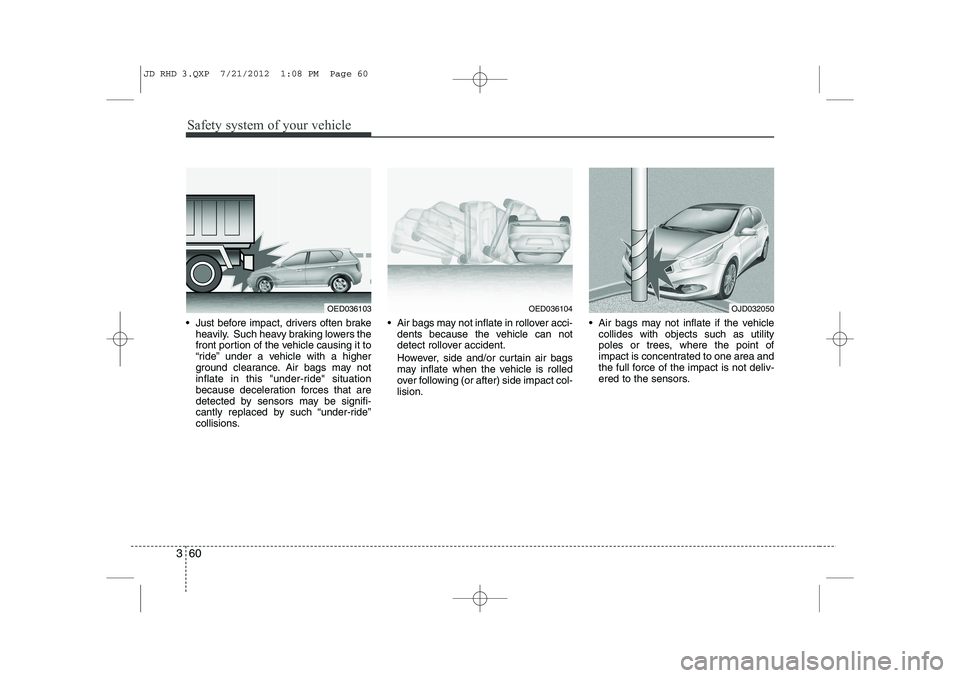
Just before impact, drivers often brake
heavily. Such heavy braking lowers the
front portion of the vehicle causing it to
“ride” under a vehicle with a higher
ground clearance. Air bags may not
inflate in this "under-ride" situation
because deceleration forces that are
detected by sensors may be signifi-
cantly replaced by such “under-ride”
collisions. Air bags may not inflate in rollover acci-
dents because the vehicle can not
detect rollover accident.
However, side and/or curtain air bags
may inflate when the vehicle is rolled
over following (or after) side impact col-lision. Air bags may not inflate if the vehicle
collides with objects such as utility
poles or trees, where the point of
impact is concentrated to one area and
the full force of the impact is not deliv-
ered to the sensors.
OED036103OED036104OJD032050
JD RHD 3.QXP 7/21/2012 1:08 PM Page 60
Page 682 of 1168

419
Features of your vehicle
✽✽NOTICE
Once the doors are locked with the
transmitter or smart key, the doors can-not be unlocked with the central doorlock/unlock switch. WARNING - Doors
The doors should always be fully closed and locked whilst the
vehicle is in motion to prevent
accidental opening of the door.
Locked doors will also discour-
age potential intruders when the
vehicle stops or slows down.
Be careful when opening doors and watch for vehicles, motorcy-
cles, bicycles or pedestrians
approaching the vehicle in the
path of the door. Opening a door
when something is approaching
can cause damage or injury.WARNING - Unlocked
vehicles
Leaving your vehicle unlocked can
invite theft or possible harm to you
or others from someone hiding in
your vehicle whilst you are gone.
Always remove the ignition key,
engage the parking brake, close all
windows and lock all doors when
leaving your vehicle unattended.
WARNING - Unattended
children
An enclosed vehicle can become
extremely hot, causing death or
severe injury to unattended chil-dren or animals who cannot escape
the vehicle. Furthermore, children
might operate features of the vehi-
cle that could injure them, or they
could encounter other harm, possi-
bly from someone gaining entry to
the vehicle. Never leave children or
animals unattended in your vehicle.
WARNING - Door lock mal-
function
If a power door lock ever fails to
function whilst you are in the vehi-
cle, try one or more of the follow-ing:
Operate the other door locks and handles.
Lower the driver’s window and use the key to unlock the door
from outside.
Move to the cargo area and open the tailgate.
JD RHD 4a(~168).QXP 7/21/2012 12:04 PM Page 19