Page 7 of 338

Index
4I
Tailgate··················\
··················\
··················\
··················\
···4-13
Theft-alarm system ··················\
··················\
··················\
····4-9
Tire specification and pressure label ··················\
·············8-6
Tires and wheels ··················\
··················\
··················\
7-31/8-3
Towing ··················\
··················\
··················\
··················\
···6-18
Trailer towing··················\
··················\
··················\
···········5-37
Vehicle break-in process ··················\
··················\
··············1-4
Vehicle certification label ··················\
··················\
············8-6
Vehicle identification number (VIN) ··················\
·············8-6
Vehicle load limit ··················\
··················\
··················\
·····5-44
Vehicle weight ··················\
··················\
··················\
·········5-49
Washer fluid ··················\
··················\
··················\
·············7-24
Windows ··················\
··················\
··················\
··················\
4-15
Windshield defrosting and defogging··················\
··········4-77
Winter driving ··················\
··················\
··················\
··········5-34
Wiper blades ··················\
··················\
··················\
············7-26
Wipers and washers ··················\
··················\
··················\
·4-54
V
W
T
Page 140 of 338

457
Features of your vehicle
The spray and wiper operation will con-
tinue until you release the lever.
If the washer does not work, check the
washer fluid level. If the fluid level is not
sufficient, you will need to add appropri-
ate non-abrasive windshield washer fluid
to the washer reservoir.
The reservoir filler neck is located in the
front of the engine compartment on the
passenger side.CAUTION
To prevent possible damage to thewasher pump, do not operate thewasher when the fluid reservoir isempty.
WARNING
Do not use the washer in freezing
temperatures without first warming
the windshield with the defrosters;
the washer solution could freeze on
contact with the windshield and
obscure your vision.
CAUTION
To prevent possible damage to the wipers or windshield, do notoperate the wipers when thewindshield is dry.
To prevent damage to the wiper blades, do not use gasoline,kerosene, paint thinner, or othersolvents on or near them.
To prevent damage to the wiper arms and other components, donot attempt to move the wipersmanually.
Page 233 of 338

Driving your vehicle
32
5
Adjust your mirrors to reduce the glare
from other driver's headlights.
Keep your headlights clean and prop- erly aimed. Dirty or improperly aimed
headlights will make it much more diffi-
cult to see at night. Headlight operation
when using windshield wipers is
mandatory in some states.
Avoid staring directly at the headlights of oncoming vehicles. You could be
temporarily blinded, and it will take
several seconds for your eyes to read-
just to the darkness.
E110500AUN
Driving in the rain
Rain and wet roads can make driving
dangerous, especially if you’re not pre-
pared for the slick pavement. Here are a
few things to consider when driving in the
rain:
A heavy rainfall will make it harder tosee and will increase the distance
needed to stop your vehicle, so slow
down.
Keep your windshield wiping equip- ment in good shape. Replace your
windshield wiper blades when they
show signs of streaking or missing
areas on the windshield. If your tires are not in good condition,
making a quick stop on wet pavement
can cause a skid and possibly lead to
an accident. Be sure your tires are in
good shape.
Turn on your headlights to make it eas- ier for others to see you.
Driving too fast through large puddles can affect your brakes. If you must go
through puddles, try to drive through
them slowly.
If you believe you may have gotten your brakes wet, apply them lightly
while driving until normal braking oper-
ation returns.E110600AUN
Driving in flooded areas
Avoid driving through flooded areas
unless you are sure the water is no high-
er than the bottom of the wheel hub.
Drive through any water slowly. Allow
adequate stopping distance because
brake performance may be affected.
After driving through water, dry the
brakes by gently applying them several
times while the vehicle is moving slowly.
1VQA3003
Page 271 of 338
7
Engine compartment / 7-2
Maintenance services / 7-4
Owner maintenance / 7-6
Maintenance schedule / 7-8
Explanation of scheduled maintenance items / 7-12
Engine oil / 7-16
Engine coolant / 7-17
Brakes fluid / 7-20
Power steering fluid / 7-21
Automatic transaxle fluid / 7-22
Washer fluid / 7-24
Parking brake / 7-24
Air cleaner / 7-25
Climate control air filter / 7-25
Wiper blades / 7-26
Battery / 7-28
Tires and wheels / 7-31
Fuses / 7-44
Appearance care / 7-53
Emission control system / 7-59
Maintenance
Page 277 of 338

77
Maintenance
G030103AUN
At least monthly:
Check coolant level in the enginecoolant reservoir.
Check the operation of all exterior lights, including the stoplights, turn sig-
nals and hazard warning flashers.
Check the inflation pressures of all tires including the spare.
G030104AUN
At least twice a year (i.e., every Spring and Fall):
Check radiator, heater and air condi- tioning hoses for leaks or damage.
Check windshield washer spray and wiper operation. Clean wiper blades
with clean cloth dampened with wash-
er fluid.
Check headlight alignment.
Check muffler, exhaust pipes, shields and clamps.
Check the lap/shoulder belts for wear and function.
Check for worn tires and loose wheel lug nuts.
G030105AUN-EU
At least once a year:
Clean body and door drain holes.
Lubricate door hinges and checks, andhood hinges.
Lubricate door and hood locks and latches.
Lubricate door rubber weatherstrips.
Check the air conditioning system.
Check the power steering fluid level.
Inspect and lubricate automatic transaxle linkage and controls.
Clean battery and terminals.
Check the brake fluid level.
Page 288 of 338

Maintenance
18
7
Check the condition and connections of
all cooling system hoses and heater
hoses. Replace any swollen or deterio-
rated hoses.
The coolant level should be filled
between F and L marks on the side of the
coolant reservoir when the engine is
cool.
If the coolant level is low, add enough
specified coolant to provide protection
against freezing and corrosion. Bring the
level to F, but do not overfill. If frequent
additions are required, see an authorized
Kia dealer for a cooling system inspec-
tion.
G070101AUN
Recommended engine coolant
Use only soft (de-mineralized) water in
the coolant mixture.
The engine in your vehicle has alu- minum engine parts and must be pro-
tected by an ethylene-glycol-based
coolant to prevent corrosion and freez-
ing.
DO NOT USE alcohol or methanol coolant or mix them with the specified
coolant.
Do not use a solution that contains more than 60% antifreeze or less than
35% antifreeze, which would reduce
the effectiveness of the solution.
For mixture percentage, refer to the fol-
lowing table.
OUN056007
WARNING
The electric motor (cool-
ing fan) is controlled by
engine coolant tempera-
ture, refrigerant pres-
sure and vehicle speed.
It may sometimes operate even
when the engine is not running.
Use extreme caution when working
near the blades of the cooling fan
so that you are not injured by a
rotating fan blades. As the engine
coolant temperature decreases, the
electric motor will automatically
shut off. This is a normal condition.
-15°C (5°F) 35 65
-25°C (-13°F) 40 60
-35°C (-31°F) 50 50
-45°C (-49°F) 60 40
Ambient
Temperature Mixture Percentage (volume)
Coolant
Solution Water
Page 296 of 338

Maintenance
26
7
WIPER BLADES
G180100AUN
Blade inspection
✽
✽
NOTICE
Commercial hot waxes applied by auto-
matic car washes have been known to
make the windshield difficult to clean.
Contamination of either the windshield or
the wiper blades with foreign matter can
reduce the effectiveness of the wind-
shield wipers. Common sources of con-
tamination are insects, tree sap, and hot
wax treatments used by some commer-
cial car washes. If the blades are not wip-
ing properly, clean both the window and
the blades with a good cleaner or mild
detergent, and rinse thoroughly with
clean water.G180200AUN
Blade replacement
When the wipers no longer clean ade-
quately, the blades may be worn or
cracked, and require replacement.
1JBA5122CAUTION
To prevent damage to the wiper
blades, do not use gasoline,kerosene, paint thinner, or othersolvents on or near them.
CAUTION
To prevent damage to the wiperarms or other components, do notattempt to move the wipers manual-ly.
CAUTION
The use of a non-specified wiper blade could result in wiper malfunc-tion and failure.
Page 297 of 338
727
Maintenance
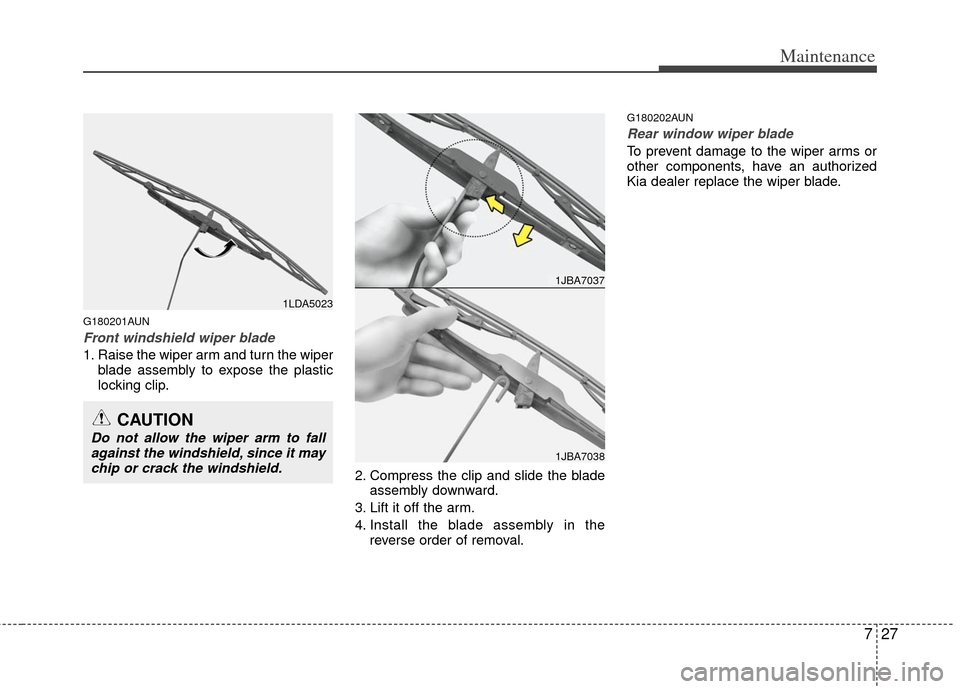
G180201AUN
Front windshield wiper blade
1. Raise the wiper arm and turn the wiperblade assembly to expose the plastic
locking clip.
2. Compress the clip and slide the bladeassembly downward.
3. Lift it off the arm.
4. Install the blade assembly in the reverse order of removal.
G180202AUN
Rear window wiper blade
To prevent damage to the wiper arms or
other components, have an authorized
Kia dealer replace the wiper blade.
1LDA5023
CAUTION
Do not allow the wiper arm to fallagainst the windshield, since it maychip or crack the windshield.
1JBA7037
1JBA7038