Page 71 of 655
WARNING!Ignoring the Air Bag Warning Light in your instru-
ment panel could mean you won’t have the air bags
to protect you in a collision. If the light does not come
on as a bulb check when the ignition is first turned
on, stays on after you start the vehicle, or if it comes
on as you drive, have an authorized dealer service the
air bag system immediately.
Driver And Passenger Advanced Front Air Bag
Inflator Units
The Driver and Passenger Advanced Front Air Bag
Inflator Units are located in the center of the steering
wheel and on the right side of the instrument panel. When the ORC detects a collision requiring the Ad-
vanced Front Air Bags, it signals the inflator units. A large
quantity of non-toxic gas is generated to inflate the
Advanced Front Air Bags. Different air bag inflation rates
are possible, based on several factors, including the
collision type and severity. The steering wheel hub trim
cover and the upper right side of the instrument panel
separate and fold out of the way as the air bags inflate to
their full size. The air bags fully inflate in about 50 to
70 milliseconds. This is about half of the time it takes to
blink your eyes. The air bags then quickly deflate while
helping to restrain the driver and front passenger.
The Advanced Front Air Bag gas is vented through the
vent holes in the sides of the air bag. In this way, the air
bags do not interfere with your control of the vehicle. 2 THINGS TO KNOW BEFORE STARTING YOUR VEHICLE 69
Page 72 of 655

Supplemental Seat-Mounted Side Air Bags (SAB)
Inflator Units — If Equipped
The Supplemental Seat-Mounted Side Air Bags Inflator
Units (if equipped) are designed to activate only in
certain side collisions.
The ORC determines if a side collision requires the side
air bags to inflate, based on several factors, including the
severity and type of collision.
Based on several factors, including the severity and type
of collision, the side air bag inflator on the crash side of
the vehicle is triggered releasing a quantity of non-toxic
gas. The inflating SAB exits through the seat seam into
the space between the occupant and the door. The SAB
fully inflate in about 10 milliseconds. The side air bag
moves at a very high speed and with such a high force
that it could injure you if you are not seated properly, or
if items are positioned in the area where the side air bag
inflates. This especially applies to children. Front And Side Impact Sensors
In front and side impacts, impact sensors can aid the ORC
in determining appropriate response to impact events.
Enhanced Accident Response System
In the event of an impact causing air bag deployment, if
the communication network remains intact, and the
power remains intact, depending on the nature of the
event the ORC will determine whether to have the
Enhanced Accident Response System perform the follow-
ing functions:
• Cut off fuel to the engine.
• Flash hazard lights as long as the battery has power or
until the ignition key is turned off.70 THINGS TO KNOW BEFORE STARTING YOUR VEHICLE
Page 73 of 655

• Turn on the interior lights, which remain on as long as
the battery has power or until the ignition key is
removed.
• Unlock the doors automatically.
In order to reset the Enhanced Accident Response System
functions after an event, the ignition switch must be
changed from IGN ON to IGN OFF.
If A Deployment Occurs
The Advanced Front Air Bags are designed to deflate
immediately after deployment.
NOTE: Front and/or side air bags will not deploy in all
collisions. This does not mean something is wrong with
the air bag system. If you do have a collision which deploys the air bags, any
or all of the following may occur:
• The nylon air bag material may sometimes cause
abrasions and/or skin reddening to the driver and
front passenger as the air bags deploy and unfold. The
abrasions are similar to friction rope burns or those
you might get sliding along a carpet or gymnasium
floor. They are not caused by contact with chemicals.
They are not permanent and normally heal quickly.
However, if you haven’t healed significantly within a
few days, or if you have any blistering, see your doctor
immediately.
2 THINGS TO KNOW BEFORE STARTING YOUR VEHICLE 71
Page 76 of 655

WARNING! (Continued)• It is dangerous to try to repair any part of the air bag
system yourself. Be sure to tell anyone who works on
your vehicle that it has an air bag system.
Air Bag Warning Light
You will want to have the air bags ready to
inflate for your protection in a collision. The
Air Bag Warning Light monitors the internal
circuits and interconnecting wiring associated
with air bag system electrical components. While the air
bag system is designed to be maintenance free. If any of
the following occurs, have an authorized dealer service
the air bag system immediately.
• The Air Bag Warning Light does not come on during
the four to eight seconds when the ignition switch is
first turned to the ON/RUN position. • The Air Bag Warning Light remains on after the four to
eight-second interval.
• The Air Bag Warning Light comes on intermittently or
remains on while driving.
NOTE: If the speedometer, tachometer, or any engine
related gauges are not working, the Occupant Restraint
Controller (ORC) may also be disabled. The air bags may
not be ready to inflate for your protection. Promptly
check the fuse block for blown fuses. Refer to the label
located on the inside of the fuse block cover for the
proper air bag fuses. See your authorized dealer if the
fuse is good.74 THINGS TO KNOW BEFORE STARTING YOUR VEHICLE
Page 103 of 655

to seep into the passenger compartment. In addition,
inspect the exhaust system each time the vehicle is raised
for lubrication or oil change. Replace as required.
Safety Checks You Should Make Inside The
Vehicle
Seat Belts
Inspect the belt system periodically, checking for cuts,
frays, and loose parts. Damaged parts must be replaced
immediately. Do not disassemble or modify the system.
Front seat belt assemblies must be replaced after a
collision. Rear seat belt assemblies must be replaced after
a collision if they have been damaged (i.e., bent retractor,
torn webbing, etc.). If there is any question regarding belt
or retractor condition, replace the belt. Air Bag Warning Light
The light should come on and remain on for
four to eight seconds as a bulb check when the
ignition switch is first turned ON. If the light is
not lit during starting, see your authorized
dealer. If the light stays on, flickers, or comes on while
driving, have the system checked by an authorized
dealer.
Defroster
Check operation by selecting the defrost mode and place
the blower control on high speed. You should be able to
feel the air directed against the windshield. See your
authorized dealer for service if your defroster is inoper-
able.
2THINGS TO KNOW BEFORE STARTING YOUR VEHICLE 101
Page 105 of 655
Periodic Safety Checks You Should Make Outside
The Vehicle
Tires
Examine tires for excessive tread wear and uneven wear
patterns. Check for stones, nails, glass, or other objects
lodged in the tread or sidewall. Inspect the tread for cuts
and cracks. Inspect sidewalls for cuts, cracks and bulges.
Check the wheel nuts for tightness. Check the tires
(including spare) for proper cold inflation pressure.
Lights
Have someone observe the operation of brake lights and
exterior lights while you work the controls. Check turn
signal and high beam indicator lights on the instrument
panel. Door Latches
Check for positive closing, latching, and locking.
Fluid Leaks
Check area under vehicle after overnight parking for fuel,
engine coolant, oil, or other fluid leaks. Also, if gasoline
fumes are detected or if fuel, power steering fluid, or
brake fluid leaks are suspected, the cause should be
located and corrected immediately.
2THINGS TO KNOW BEFORE STARTING YOUR VEHICLE 103
Page 109 of 655

▫ Replacing The Rear Seat
— Two-Door Models .................. .164
▫ 60/40 Split Folding Rear Seat — Four-Door
Models ........................... .164
� TO OPEN AND CLOSE THE HOOD ........ .166
� LIGHTS ............................ .167
▫ Multifunction Lever ................... .167
▫ Headlights And Parking Lights ........... .167
▫ Automatic Headlights — If Equipped ...... .168
▫ Turn Signals ........................ .169
▫ Lane Change Assist .................. .169
▫ Lights-On Reminder .................. .170
▫ High/Low Beam Switch ................ .170
▫ Flash-To-Pass ....................... .170 ▫ Front Fog Lights ..................... .170
▫ Instrument Panel Dimmer .............. .170
▫ Daytime Running Lights — If Equipped .... .171
▫ Interior Lights ...................... .171
� WINDSHIELD WIPERS AND WASHERS ..... .173
▫ Windshield Wiper Operation ............ .174
▫ Intermittent Wiper System .............. .174
▫ Windshield Washers ................... .175
▫ Mist Feature ........................ .176
� TILT STEERING COLUMN .............. .177
� ELECTRONIC SPEED CONTROL
— IF EQUIPPED ...................... .178
▫ To Activate ......................... .1793 UNDERSTANDING THE FEATURES OF YOUR VEHICLE 107
Page 113 of 655
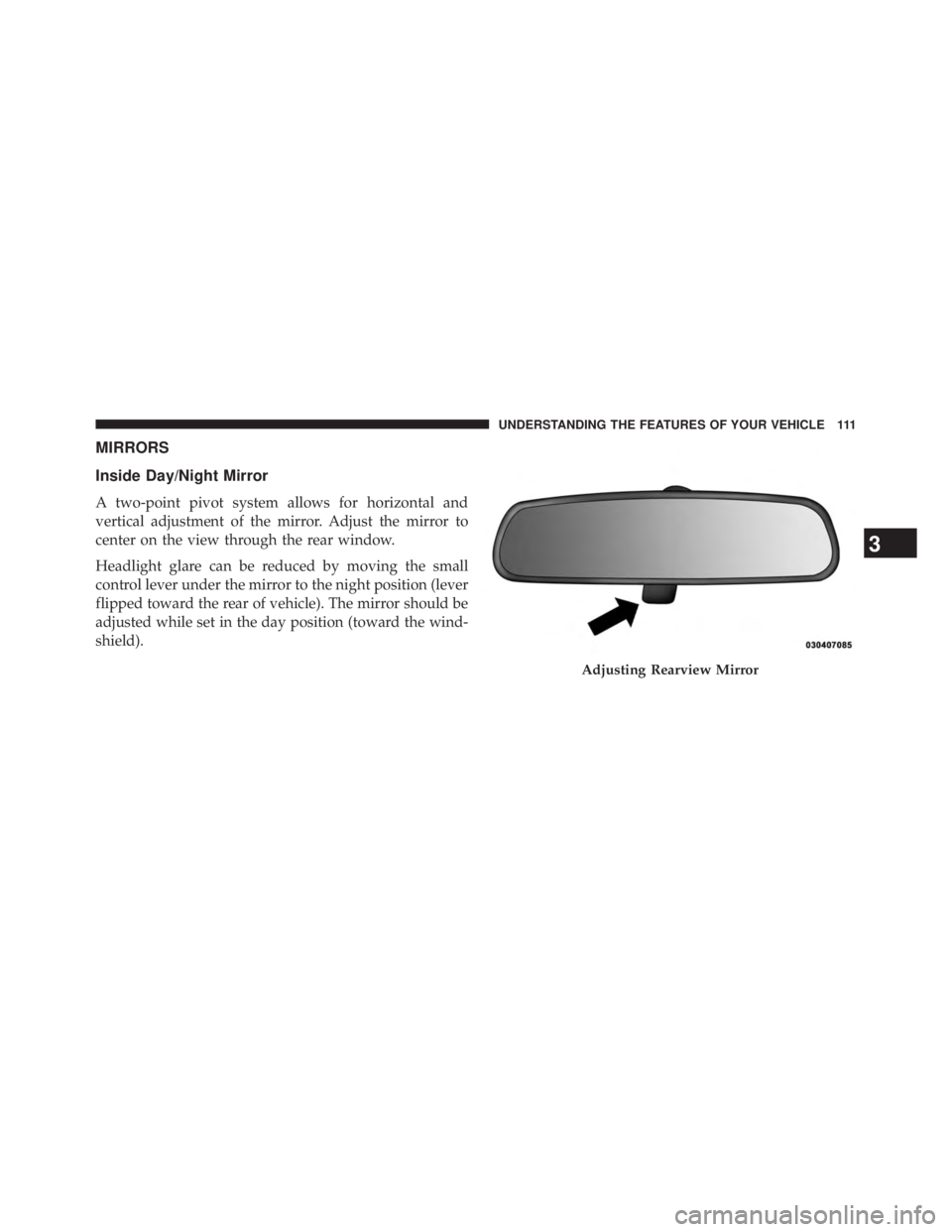
MIRRORS
Inside Day/Night Mirror
A two-point pivot system allows for horizontal and
vertical adjustment of the mirror. Adjust the mirror to
center on the view through the rear window.
Headlight glare can be reduced by moving the small
control lever under the mirror to the night position (lever
flipped toward the rear of vehicle). The mirror should be
adjusted while set in the day position (toward the wind-
shield). Adjusting Rearview Mirror
3 UNDERSTANDING THE FEATURES OF YOUR VEHICLE 111