Page 301 of 525

Recirculation ControlPressing the Recirculation Control button will
put the system in recirculation mode. This can
be used when outside conditions such as
smoke, odors, dust, or high humidity are pres-
ent. Activating recirculation will cause the LED in the
control button to illuminate.
NOTE:
• Continuous use of the Recirculation mode may make
the inside air stuffy and window fogging may occur.
Extended use of this mode is not recommended.
• The use of the Recirculation mode in cold or damp
weather will cause windows to fog on the inside,
because of moisture buildup inside the vehicle. Select
the outside air position for maximum defogging. •
The A/C will engage automatically to prevent fogging
when the recirculation button is pressed and the mode
control is set to panel or panel / floor.
• The A/C can be deselected manually without disturb-
ing the mode control selection.
• When the ignition switch is turned to the LOCK
position, the recirculation feature will be cancelled.
Air Conditioning Control
Press this button to engage the Air Con-
ditioning. A light will illuminate when
the Air Conditioning system is engaged.
Rotating the dial left into the blue area
of the scale indicates cooler tempera-
tures, while rotating right into the red
area indicates warmer temperatures.
4
UNDERSTANDING YOUR INSTRUMENT PANEL 299
Page 302 of 525
NOTE:The air conditioning compressor will not engage
until the engine has been running for about 10 seconds.
• MAX A/C
For maximum cooling use the A/C and recirculation
buttons at the same time.
• ECONOMY MODE
If economy mode is desired, press the A/C button to turn
OFF the indicator light and the A/C compressor. Then,
move the temperature control to the desired temperature.Automatic Temperature Control (ATC) — If
Equipped
The Automatic Temperature Control system automati-
cally maintains the climate in the cabin of the vehicle at
the comfort levels desired by the driver and passenger.
Automatic Temperature Control
300 UNDERSTANDING YOUR INSTRUMENT PANEL
Page 312 of 525
�FOUR-WHEEL DRIVE OPERATION —
IF EQUIPPED ........................ .329
� ON-ROAD DRIVING TIPS ................329
� OFF-ROAD DRIVING TIPS ...............330
▫ When To Use Low (L Off-Road) With The
4WD Lock Lever Engaged ...............331
▫ Driving In Snow, Mud And Sand ..........331
▫ Hill Climbing ....................... .333
▫ Driving Through Water .................335
▫ After Driving Off-Road .................337
� POWER STEERING .....................338
▫ Power Steering Fluid Check ..............339
� PARKING BRAKE ..................... .340
� BRAKE SYSTEM ...................... .343▫
Anti-Lock Brake System (ABS) ............344
� ELECTRONIC BRAKE CONTROL SYSTEM . . . .346
▫ Anti-Lock Brake System (ABS) ............346
▫ Traction Control System (TCS) ............346
▫ Brake Assist System (BAS) ...............347
▫ Electronic Roll Mitigation (ERM) ..........348
▫ Hill Descent Control (HDC) – If Equipped . . .349
▫ Hill Start Assist (HSA) –
Manual Transmission Only ..............350
▫ Electronic Stability Control (ESC) ..........352
▫ ESC Activation/Malfunction Indicator Light
And ESC OFF Indicator Light ............355
� TIRE SAFETY INFORMATION .............357
▫ Tire Markings ....................... .357
310 STARTING AND OPERATING
Page 318 of 525
ENGINE BLOCK HEATER — IF EQUIPPED
The engine block heater warms the engine, and permits
quicker starts in cold weather. Connect the cord to a
standard 110-115 Volt AC electrical outlet with a
grounded, three-wire extension cord.
The engine block heater must be plugged in at least one
hour to have an adequate warming effect on the engine.
WARNING!
Remember to disconnect the engine block heater
cord before driving. Damage to the 110-115 Volt
electrical cord could cause electrocution.
MANUAL TRANSMISSION — IF EQUIPPED
Five–Speed Manual Transmission
WARNING!
You or others could be injured if you leave the vehicle
unattended without having the parking brake fully
applied. The parking brake should always be applied
when the driver is not in the vehicle, especially on an
incline.
Fully press the clutch pedal before you shift gears. As you
release the clutch pedal, lightly press the accelerator
pedal.
316 STARTING AND OPERATING
Page 319 of 525
Use each gear in numerical order, do not skip a gear. Be
sure the transmission is in first gear, (not third), when
starting from a standing position. Damage to the clutch
can result from starting in third gear.For most city driving, you will find it easier to use only
the lower gears. For steady highway driving with light
accelerations, fifth gear is recommended.
Never drive with your foot resting on the clutch pedal,
and never try to hold the vehicle on a hill with the clutch
pedal partially engaged. This will cause abnormal wear
on the clutch.
Never shift into REVERSE until the vehicle has come to a
complete stop.
NOTE:
During cold weather, until the transmission lu-
bricant is warm, you may experience slightly higher shift
efforts. This is normal and not harmful to the transmis-
sion.
Shift Pattern
5
STARTING AND OPERATING 317
Page 328 of 525
WARNING!(Continued)
practices that limit your response to changing traffic
or road conditions. You might lose control of the
vehicle and have a collision.
CAUTION!
Towing the vehicle, coasting, or driving for any other
reason with the transmission in NEUTRAL can cause
severe transmission damage. Refer to “Recreational
Towing” in “Starting And Operating” and “Towing A
Disabled Vehicle” in “What To Do In Emergencies”
for further information. DRIVE
This range should be used for most city and highway
driving. It provides the best fuel economy. The DRIVE
position provides optimum driving characteristics under
all normal operating conditions.
When frequent transmission shifting occurs (such as
when operating the vehicle under heavy loading condi-
tions, in hilly terrain, traveling into strong head winds, or
while towing heavy trailers), use the AutoStick
�shift
control (if equipped) to select a lower gear ratio. Under
these conditions, using a lower gear ratio will improve
performance and extend transmission life by reducing
excessive shifting and heat buildup.
During sustained high speed driving or trailer towing up
long grades on hot days, the automatic transmission oil
may become too hot. If this happens, the transmission
overheat indicator light will come on, and the vehicle will
slow slightly until the transmission cools down enough
326 STARTING AND OPERATING
Page 331 of 525
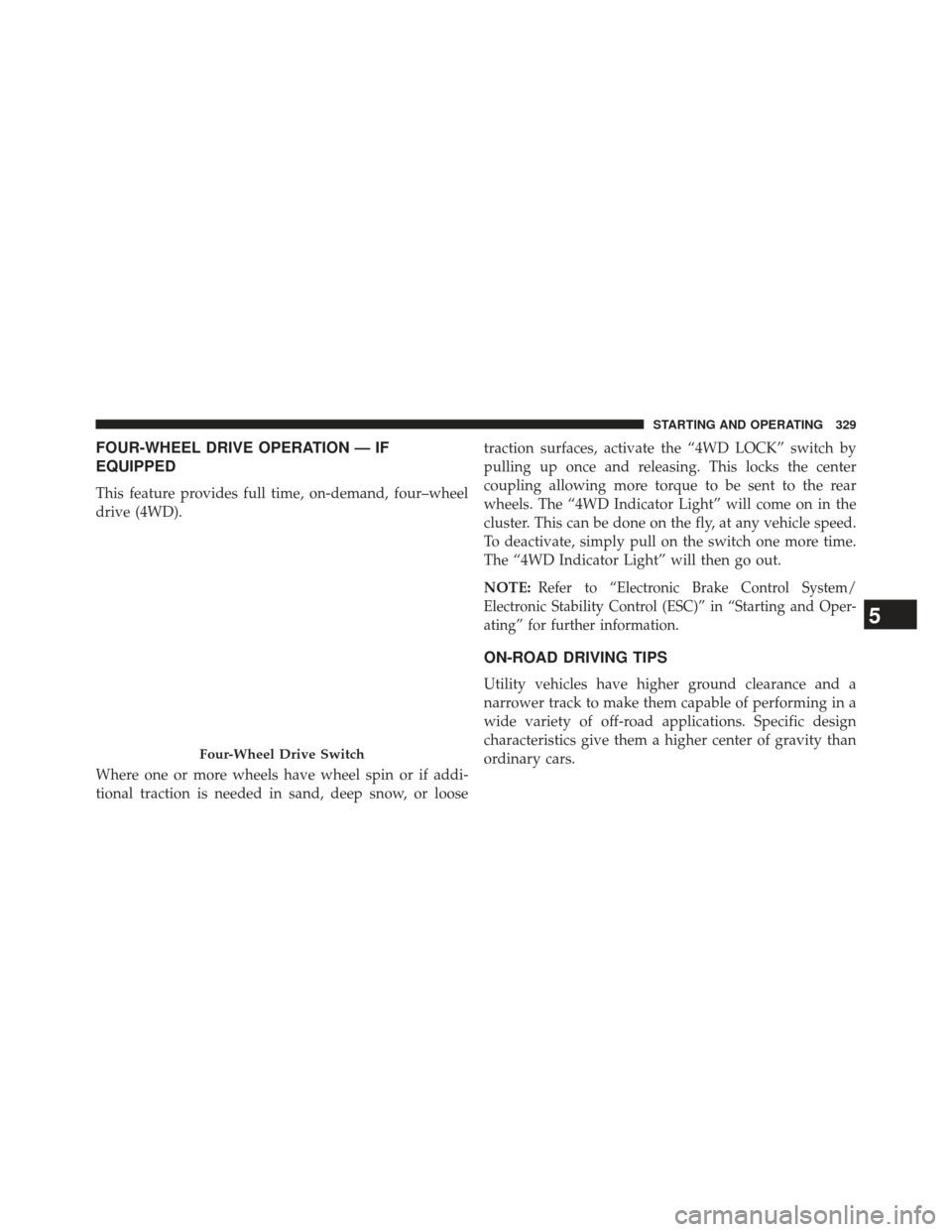
FOUR-WHEEL DRIVE OPERATION — IF
EQUIPPED
This feature provides full time, on-demand, four–wheel
drive (4WD).
Where one or more wheels have wheel spin or if addi-
tional traction is needed in sand, deep snow, or loosetraction surfaces, activate the “4WD LOCK” switch by
pulling up once and releasing. This locks the center
coupling allowing more torque to be sent to the rear
wheels. The “4WD Indicator Light” will come on in the
cluster. This can be done on the fly, at any vehicle speed.
To deactivate, simply pull on the switch one more time.
The “4WD Indicator Light” will then go out.
NOTE:
Refer to “Electronic Brake Control System/
Electronic Stability Control (ESC)” in “Starting and Oper-
ating” for further information.
ON-ROAD DRIVING TIPS
Utility vehicles have higher ground clearance and a
narrower track to make them capable of performing in a
wide variety of off-road applications. Specific design
characteristics give them a higher center of gravity than
ordinary cars.
Four-Wheel Drive Switch
5
STARTING AND OPERATING 329
Page 332 of 525
An advantage of the higher ground clearance is a better
view of the road, allowing you to anticipate problems.
They are not designed for cornering at the same speeds as
conventional two-wheel drive vehicles any more than
low-slung sports cars are designed to perform satisfacto-
rily in off-road conditions. If at all possible, avoid sharp
turns or abrupt maneuvers. As with other vehicles of this
type, failure to operate this vehicle correctly may result in
loss of control or vehicle rollover.
OFF-ROAD DRIVING TIPS
You will encounter many types of terrain driving off-
road. You should be familiar with the terrain and area
before proceeding. There are many types of surface
conditions: hard packed dirt, gravel, rocks, grass, sand,
mud, snow and ice. Every surface has a different effect on
your vehicle’s steering, handling and traction. Control-
ling your vehicle is one of the keys to successful off-road
driving, so always keep a firm grip on the steering wheel
and maintain a good driving posture. Avoid suddenaccelerations, turns or braking. In most cases there are no
road signs, posted speed limits or signal lights. Therefore
you will need to use your own good judgment on what is
safe and what is not. When on a trail, you should always
be looking ahead for surface obstacles and changes in
terrain. The key is to plan your future driving route while
remembering what you are currently driving over.
CAUTION!
Never park your vehicle over dry grass or other
combustible materials. The heat from your vehicle
exhaust system could cause a fire.
WARNING!
Always wear your seat belt and firmly tie down
cargo. Unsecured cargo can become projectiles in an
off-road situation.
330 STARTING AND OPERATING