2013 HYUNDAI VELOSTER stop start
[x] Cancel search: stop startPage 259 of 372
623
What to do in an emergency
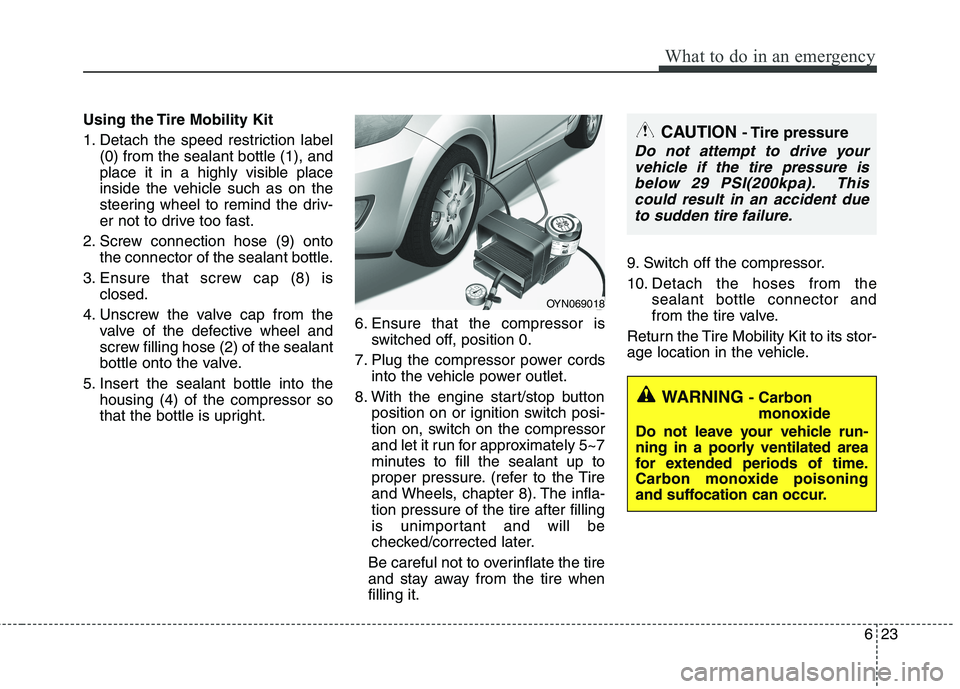
Using the Tire Mobility Kit
1. Detach the speed restriction label
(0) from the sealant bottle (1), and
place it in a highly visible place
inside the vehicle such as on the
steering wheel to remind the driv-
er not to drive too fast.
2. Screw connection hose (9) onto
the connector of the sealant bottle.
3. Ensure that screw cap (8) is
closed.
4. Unscrew the valve cap from the
valve of the defective wheel and
screw filling hose (2) of the sealant
bottle onto the valve.
5. Insert the sealant bottle into the
housing (4) of the compressor so
that the bottle is upright.6. Ensure that the compressor is
switched off, position 0.
7. Plug the compressor power cords
into the vehicle power outlet.
8. With the engine start/stop button
position on or ignition switch posi-
tion on, switch on the compressor
and let it run for approximately 5~7
minutes to fill the sealant up to
proper pressure. (refer to the Tire
and Wheels, chapter 8). The infla-
tion pressure of the tire after filling
is unimportant and will be
checked/corrected later.
Be careful not to overinflate the tire
and stay away from the tire when
filling it.9. Switch off the compressor.
10. Detach the hoses from the
sealant bottle connector and
from the tire valve.
Return the Tire Mobility Kit to its stor-
age location in the vehicle.CAUTION - Tire pressure
Do not attempt to drive your
vehicle if the tire pressure is
below 29 PSI(200kpa). This
could result in an accident due
to sudden tire failure.
WARNING - Carbon
monoxide
Do not leave your vehicle run-
ning in a poorly ventilated area
for extended periods of time.
Carbon monoxide poisoning
and suffocation can occur.
OYN069018
Page 295 of 372
Maintenance
30 7
Parking brake
Inspect the parking brake system includ-
ing the parking brake pedal and cables.
Brake discs, pads, calipers and
rotors
Check the pads for excessive wear, discs
for run out and wear, and calipers for fluid
leakage.
Exhaust pipe and muffler
Visually inspect the exhaust pipes, muf-
fler and hangers for cracks, deterioration,
or damage. Start the engine and listen
carefully for any exhaust gas leakage.
Tighten connections or replace parts as
necessary.
Suspension mounting bolts
Check the suspension connections for
looseness or damage. Retighten to the
specified torque.
Steering gear box, linkage &
boots/lower arm ball joint
With the vehicle stopped and engine off,
check for excessive free-play in the
steering wheel.
Check the linkage for bends or damage.
Check the dust boots and ball joints for
deterioration, cracks, or damage.
Replace any damaged parts.
Drive shafts and boots
Check the drive shafts, boots and clamps
for cracks, deterioration, or damage.
Replace any damaged parts and, if nec-
essary, repack the grease.
Air conditioning refrigerant
Check the air conditioning lines and con-
nections for leakage and damage.
Page 298 of 372
733
Maintenance
ENGINE COOLANT
The high-pressure cooling system has a
reservoir filled with year-round antifreeze
coolant. The reservoir is filled at the factory.
Check the antifreeze protection and
coolant level at least once a year, at the
beginning of the winter season, and
before traveling to a colder climate.
Checking the coolant level
WARNING
Removing radiator
cap
Never attempt to remove the radi-
ator cap while the engine is oper-
ating or hot. Doing so might lead
to cooling system and engine
damage and could result in seri-
ous personal injury from escap-
ing hot coolant or steam.
(Continued)
(Continued)
Turn the engine off and wait until it
cools down. Use extreme care
when removing the radiator cap.
Wrap a thick towel around it, and
turn it counterclockwise slowly to
the first stop. Step back while the
pressure is released from the cool-
ing system. When you are sure all
the pressure has been released,
press down on the cap, using a
thick towel, and continue turning
counterclockwise to remove it.
Even if the engine is not operat-
ing, do not remove the radiator
cap or the drain plug while the
engine and radiator are hot. Hot
coolant and steam may still blow
out under pressure, causing seri-
ous injury.WARNING
The electric motor (cool-
ing fan) is controlled by
engine coolant tempera-
ture, refrigerant pres-
sure and vehicle speed.
It may sometimes operate even
when the engine is not running. Use
extreme caution when working near
the blades of the cooling fan so that
you are not injured by a rotating fan
blades. As the engine coolant tem-
perature decreases, the electric
motor will automatically shut off.
This is a normal condition.
If your vehicle is equipped with
GDI, the electric motor (cooling fan)
may operate until you disconnect
the negative battery cable.
The electric cooling fan can start at
any time when the engine coolant
temperature is high. Disconnect the
negative battery cable when servic-
ing the vehicle.
Page 312 of 372
747
Maintenance
Battery recharging
Your vehicle has a maintenance-free,
calcium-based battery.
If the battery becomes discharged in a
short time (because, for example the
headlights or interior lights were left on
while vehicle was not in use) jump start
the vehicle from another battery and run
the engine at least 20 minutes at idle
before driving. Do not turn off the engine
for 30 minutes total of idle and/or driving
as the battery may not have sufficient
recharge to start.CALIFORNIA PROPOSI-
TION 65 WARNING
Battery posts, terminals, and relat-
ed accessories contain lead and
lead compounds, chemicals known
to the State of California to cause
cancer, birth defects and reproduc-
tive harm. Batteries also contain
other chemicals known to the State
of California to cause cancer. Wash
hands after handling.
CAUTION
When you don’t use the vehicle
for a long time in the low temper-
ature, remove the battery and
store it indoors.
Always charge the battery fully to
prevent the battery case from
being damaged in low tempera-
tures.
If you connect unauthorized elec-
tronic devices to the battery, the
battery may be discharged. Never
use unauthorized devices.
WARNING- Recharging
battery
When recharging the battery,
observe the following precautions:
The battery must be removed
from the vehicle and placed in an
area with good ventilation.
Do not allow cigarettes, sparks,
or flame near the battery.
Watch the battery during charg-
ing, and stop or reduce the charg-
ing rate if the battery cells begin
gassing (boiling) violently or if
the temperature of the electrolyte
of any cell exceeds 120°F (49°C).
Wear eye protection when check-
ing the battery during charging.
Disconnect the battery charger in
the following order.
1. Turn off the battery charger main
switch.
2. Unhook the negative clamp from
the negative battery terminal.
3. Unhook the positive clamp from
the positive battery terminal.
Page 333 of 372

Maintenance
68 7
Description Fuse rating Protected component
STOP LP 15A Stop Lamp Switch, Key Solenoid, Stop Signal Relay, Smart Key Control Module
ECU 1 10A Immobilizer Module, Smart Key Control Module, ECM, Stop Lamp Switch
AMP 25A AMP
INVERTER 2 25A A/C Inverter Module
INTERIOR LAMP 10A Luggage Room Lamp, Map Lamp, Room Lamp, Vanity Lamp LH/RH, Overhead Console Lamp
SMART KEY 2 10A Smart Key Control Module, Immobilizer Module, Start Stop Button Switch
VACUUM PUMP (T-GDI) 15AEngine Room Fuse & relay box (Vacuum Pump Relay)
TCU (GDI) 15A TCM
TAIL LP LH 10ARear Combination Lamp LH, License Lamp LH/RH, Shift Lever Indicator, Instrument Cluster,
Multifunction Switch, Passenger Power Window Switch, Power Window Main Switch, AUX & USB Jack,
Inside Miiror A/C Control Module, ESC Off Switch, A/V & Navigation Head Unit, Crash Pad Switch,
Driver/Passenger Seat Warmer Switch, Head Lamp LH
S/HEATER 20A Driver/Passenger Seat Warmer
P/WDW LH 25A Power Window Main Switch
START 10ABurglar Alarm Relay, Transaxle Range Switch, Smart Key Control Module, ECM, TCM,
Engine Room Fuse & Relay Box (Start Relay)
B/UP LP 1 15A Back-Up Lamp Switch, Transaxle Range Switch
TAIL LP RH 10A Head Lamp RH, Rear Combination Lamp RH
SAFETY POWER
WINDOW25A Driver Safety Power Window Module
P/WDW RH 25A Power Window Main Switch, Passenger Power Window Switch, Rear Power Window Switch RH
B/UP LP 2 10AA/V & Navigation Head Unit, Transaxle Range Switch, MTS Module, TCM,
Back-Up Lamp Switch, Rear Combination Lamp LH/RH, IPS Control Module
ECU 2 15A Condenser, Ignition Coil #1/#2/#3/#4
HTD MIRR 10A ECM, A/C Control Module, Dirver/Passenger Power Outside Mirror
P/SEAT DRV 25A Not Used
Page 352 of 372
787
Maintenance
Do not operate the engine in confined
or closed areas (such as garages) any
more than what is necessary to move
the vehicle in or out of the area.
When the vehicle is stopped in an
open area for more than a short time
with the engine running, adjust the
ventilation system (as needed) to draw
outside air into the vehicle.
Never sit in a parked or stopped vehi-
cle for any extended time with the
engine running.
When the engine stalls or fails to start,
excessive attempts to restart the
engine may cause damage to the
emission control system.Operating precautions for catalytic
converters (if equipped)Your vehicle is equipped with a catalytic
converter emission control device.
Therefore, the following precautions
must be observed:
Use only UNLEADED FUEL for gaso-
line engines.
Do not operate the vehicle when there
are signs of engine malfunction, such
as misfire or a noticeable loss of per-
formance.
Do not misuse or abuse the engine.
Examples of misuse are coasting with
the ignition off and descending steep
grades in gear with the ignition off.
Do not operate the engine at high idle
speed for extended periods (5 minutes
or more).
Do not modify or tamper with any part
of the engine or emission control sys-
tem. All inspections and adjustments
must be made by an authorized
HYUNDAI dealer.
Avoid driving with a extremely low fuel
level. Running out of fuel could cause
the engine to misfire, damaging the
catalytic converter.
Failure to observe these precautions
could result in damage to the catalytic
converter and to your vehicle. Additionally,
such actions could void your warranties.
WARNING- Fire
A hot exhaust system can ignite
flammable items under your vehi-
cle. Do not park, idle, or drive the
vehicle over or near flammable
objects, such as grass, vegeta-
tion, paper, leaves, etc.
The exhaust system and catalytic
system are very hot while the
engine is running or immediately
after the engine is turned off. Keep
away from the exhaust and catalyt-
ic systems, you may get burned.
Also, do not remove the heat sink
around the exhaust system, do
not seal the bottom of the vehicle
or do not coat the vehicle for cor-
rosion control. It may present a
fire risk under certain conditions.
When the engine is running or
turning off, do not touch catalytic
system and other exhaust sys-
tems because it is hot. If you
touch that, you may be burned.
Page 366 of 372
Index
2I
Air bags ........................................................................3-32
Air bag warning label ................................................3-58
Air bag warning light ................................................3-35
Curtain air bag ............................................................3-49
Driver's and passenger's front air bag ........................3-44
Side impact air bag ....................................................3-48
Air cleaner ....................................................................7-38
Alarm system ................................................................4-14
Anti-lock brake system (ABS) ......................................5-27
Appearance care ............................................................7-79
Exterior care ..............................................................7-79
Interior care ................................................................7-84
Ashtray ..........................................................................4-97
Automatic transaxle /
EcoShift dual clutch transmission ............................5-16
Base curb weight ..........................................................5-54
Battery ..........................................................................7-46
Battery saver function ..................................................4-67
Before driving ................................................................5-3
Bottle holders, see cup holders ....................................4-93
Brake system ................................................................5-24
Anti-lock brake system (ABS) ..................................5-27
Electronic stability program (ESP) ............................5-29Parking brake..............................................................5-25
Power brakes ..............................................................5-24
Brake clutch fluid ..........................................................7-36
Bulb replacement ..........................................................7-72
Bulb wattage....................................................................8-2
Button start/stop, see engine start/stop button ................5-8
Capacities (Lubricants) ..................................................8-5
Care
Exterior care ..............................................................7-79
Interior care ................................................................7-84
Tire care ......................................................................7-49
Cargo weight ................................................................5-54
Center console storage ..................................................4-90
Central door lock switch ..............................................4-20
Chains
Tire chains ..................................................................5-46
Changing tires ..............................................................6-13
Checking tire inflation pressure ....................................7-50
Child restraint system....................................................3-24
Child-protector rear door lock ......................................4-21
Cigarette lighter ............................................................4-96
Climate control air filter................................................4-87
Climate control system (Manual)..................................4-79
Air conditioning ........................................................4-80
Climate control air filter ............................................4-87
A
B
C
Page 367 of 372
I3
Index
Heating and air conditioning ......................................4-80
Clock (Digital) ..............................................................4-97
Clothes hanger ..............................................................4-98
Combined instrument, see instrument cluster ..............4-44
Compact spare tire replacement ....................................7-54
Coolant ..........................................................................7-33
Cooling fluid, see engine coolant ................................7-33
Crankcase emission control system ..............................7-85
Cruise control system ....................................................5-34
Cup holder ....................................................................4-93
Curtain air bag ..............................................................3-49
Dashboard illumination,
see instrument panel illumination ..............................4-45
Dashboard, see instrument cluster ................................4-44
Defogging (Windshield)................................................4-88
Defogging logic (Windshield) ......................................4-89
Defroster (Rear window) ..............................................4-78
Defrosting (Windshield)................................................4-88
Digital clock ..................................................................4-97
Dimensions ......................................................................8-2
Display illumination,
see instrument panel illumination ..............................4-45
Displays, see instrument cluster....................................4-44
Door locks ....................................................................4-18
Central door lock switch ............................................4-20Child-protector rear door lock....................................4-21
Drinks holders, see cup holders ....................................4-93
Driver's air bag ..............................................................3-44
Driving at night ............................................................5-42
Driving in flooded areas................................................5-43
Driving in the rain ........................................................5-43
Economical operation....................................................5-39
EcoShift dual clutch transmission ................................5-16
Electronic stability control (ESC) ................................5-29
Emergency starting..........................................................6-4
Jump starting ................................................................6-4
Push starting ................................................................6-5
Emergency towing ........................................................6-26
Emergency while driving ................................................6-2
Emission control system ..............................................7-85
Crankcase emission control system ..........................7-85
Evaporative emission control System ........................7-85
Exhaust emission control system ..............................7-86
Engine compartment ................................................2-4, 7-2
Engine coolant ..............................................................7-33
Engine number ................................................................8-9
Engine oil ......................................................................7-31
Engine overheats ............................................................6-6
Engine start/stop button ..................................................5-8
Engine temperature gauge ............................................4-46
D
E