2013 Hyundai Sonata esc
[x] Cancel search: escPage 1 of 410

All information in this Owner's Manual is current at the time of publication.
However, Hyundai reserves the right to make changes at any time so that
our policy of continual product improvement may be carried out.
This manual applies to all Hyundai models and includes descriptions and
explanations of optional as well as standard equipment. As a result, you may
find material in this manual that does not apply to your specific vehicle.O OW
WN
NE
ER
R'
'S
S
M MA
AN
NU
UA
AL
LOperation
Maintenance
Specifications
YF HMA foreword.qxp 1/20/2012 10:23 AM Page 1
Page 13 of 410

17
Introduction
INDICATOR SYMBOLS ON THE INSTRUMENT CLUSTER
Seat belt warning lightHigh beam indicatorTurn signal indicatorABS warning light Parking brake & Brake fluid
warning lightEngine oil pressure warning light
Malfunction indicator lightAir bag warning light Cruise indicatorCruise SET indicator Immobilizer indicator Low fuel level warning light
* For more detailed explanations, refer to “Instrument cluster” in section 4.Charging system warning light
Tail light indicator Trunk ajar warning light
Front fog light indicator
(if equipped)
Automatic transaxle shift
indicator (if equipped)Manual transaxle shift
indicator (if equipped)Door open position indicator
(if equipped) Low tire pressure telltale
(TPMS malfunction indicator)ECO indicator (if equipped)
ECO
Electric power steering (EPS)
system warning light
(if equipped)
EPS
ESC indicator
(ESC malfunction indicator)ESC OFF indicator
YF HMA 1.qxp 01.10.2010 16:22 Page 7
Page 15 of 410

Your vehicle at a glance2 2INTERIOR OVERVIEW
OYF011001N
1. Door lock/unlock button ....................4-19
2. Outside rearview mirror control
switch...................................................4-48
3. Central door lock switch....................4-19
4. Power window lock switch.................4-27
5. Power window switches ....................4-24
6. Hood release lever ............................4-28
7. Parking brake* ..................................5-22
8. Instrument panel illumination control
switch ................................................4-51
9. Active ECO button* ...........................5-35
10. ESC OFF button .............................5-26
11. Fuel filler lid release button.............4-29
12. Trunk lid release switch ...................4-22
13. Fuse box .........................................7-50
14. Brake pedal
15. Accelerator pedal
16. Steering wheel ................................4-35
17. Steering wheel manual tilt control* ...4-36
* : if equipped
YF HMA 2.qxp 5/4/2011 4:44 PM Page 2
Page 49 of 410
331
Safety features of your vehicle
For safety reasons, we recommend that
the child restraint system be used in the
rear seats.
Since all passenger seat belts move
freely under normal conditions and only
lock under extreme or emergency condi-
tions (emergency locking mode), you
must manually change these seat belts
to the automatic locking mode to secure
a child restraint.
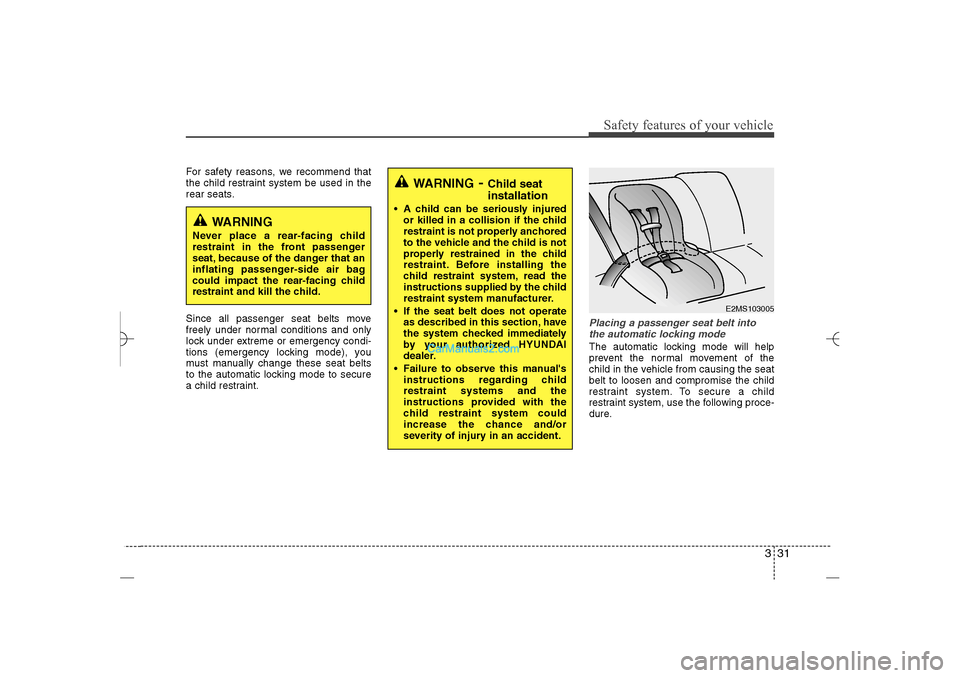
Placing a passenger seat belt into
the automatic locking mode The automatic locking mode will help
prevent the normal movement of the
child in the vehicle from causing the seat
belt to loosen and compromise the child
restraint system. To secure a child
restraint system, use the following proce-
dure.
WARNING
- Child seat
installation
A child can be seriously injured
or killed in a collision if the child
restraint is not properly anchored
to the vehicle and the child is not
properly restrained in the child
restraint. Before installing the
child restraint system, read the
instructions supplied by the child
restraint system manufacturer.
If the seat belt does not operate
as described in this section, have
the system checked immediately
by your authorized HYUNDAI
dealer.
Failure to observe this manual's
instructions regarding child
restraint systems and the
instructions provided with the
child restraint system could
increase the chance and/or
severity of injury in an accident.
WARNING
Never place a rear-facing child
restraint in the front passenger
seat, because of the danger that an
inflating passenger-side air bag
could impact the rear-facing child
restraint and kill the child.
E2MS103005
YF HMA 3.qxp 5/16/2011 4:15 PM Page 31
Page 95 of 410

Features of your vehicle14 4
This system is designed to provide pro-
tection from unauthorized entry into the
vehicle. This system is operated in three
stages: the first is the "Armed" stage, the
second is the "Theft-alarm" stage, and
the third is the "Disarmed" stage. If trig-
gered, the system provides an audible
alarm with blinking of the hazard warning
lights.
Armed stageUsing the smart keyPark the vehicle and stop the engine.
Arm the system as described below.
1. Turn off the engine.
2. Make sure that all doors, the engine
hood and trunk lid are closed and
latched.
3.
Lock the doors by pressing the button of
the front outside door handle with the
smart key in your possession.
After completion of the steps above, the
hazard warning lights and chime will
operate once to indicate that the system
is armed.
If any door remains open, the doors won't
lock and the chime will sound for 3 sec-
onds. Close the door and try again to lock
the doors.
If trunk lid or engine hood remains open,
the hazard warning lights and chime
won't operate and theft-alarm will not
arm. After this, trunk lid and engine hood
are closed, the hazard warning lights
blink once.
CAUTION
The transmitter is designed to
give you years of trouble-free
use, however it can malfunction if
exposed to moisture or static
electricity. If you are unsure how
to use your transmitter or replace
the battery, contact an authorized
HYUNDAI dealer.
Using the wrong battery can
cause the transmitter to malfunc-
tion. Be sure to use the correct
battery.
To avoid damaging the transmit-
ter, don't drop it, get it wet, or
expose it to heat or sunlight.
CAUTION
An inappropriately disposed bat-
tery can be harmful to the environ-
ment and human health.
Dispose the battery according to
your local law(s) or regulation.
THEFT-ALARM SYSTEM
Armed
stage
Theft-alarm
stage
Disarmed
stage
YF HMA 4a-111.qxp 1/16/2012 6:28 PM Page 14
Page 96 of 410
415
Features of your vehicle
Lock the doors by pressing the lock but-
ton on the smart key.
After completion of the steps above, the
hazard warning lights and chime will
operate once to indicate that the system
is armed.
If any door, trunk lid or engine hood
remains open, the hazard warning lights
and chime won't operate and theft-alarm
will not arm. After this, if all doors, trunk
lid and engine hood are closed, the haz-
ard warning lights blink once.
Using the transmitterPark the vehicle and stop the engine.
Arm the system as described below.
1. Turn off the engine and remove the
ignition key from the ignition switch.
2. Make sure that all doors, the engine
hood and trunk lid are closed and
latched.
3. Lock the doors by pressing the lock
button on the transmitter.
After completion of the steps above, the
hazard warning lights will blink once to
indicate that the system is armed. If the
lock button is pressed once more within 4
seconds, hazard warning lights blink and
the horn sounds once to confirm that the
system is armed.
If any door, trunk lid or engine hood
remains open, the hazard warning lights
(or/and horn) won't operate and theft-
alarm will not arm. After this, if all doors,
trunk lid and engine hood are closed, the
hazard warning lights blink once.
Using the mechanical keyPark the vehicle and stop the engine.
Arm the system as described below.
1. Turn off the engine and remove the key
from the ignition switch(if equipped).
2. Make sure that all doors, the engine
hood and trunk lid are closed and
latched.
3. Lock the doors by inserting the key into
the key hole on the front outside door
handle and turning the key toward the
front of the vehicle.
If any door, trunk lid or engine hood
remains open, the theft-alarm will not
arm.✽ ✽
NOTICEIf you lock or unlock the doors by using
the mechanical key, the hazard warning
light and chime sound won't operate.
YF HMA 4a-111.qxp 1/16/2012 6:28 PM Page 15
Page 101 of 410

Features of your vehicle20 4 If the key is in the ignition switch and
front door is open, the doors will not
lock even though the front portion (1)
of central door lock switch is pressed.
If the smart key is in the vehicle and
any door is open, the doors will not
lock even though the front portion(1) of
central door lock switch is pressed.
Impact sensing door unlock system
(if equipped)All doors will be automatically unlocked
when the impact is delivered to impact
sensors while the ignition switch is ON.
However, the doors may not be unlocked
if mechanical problems occur with the
door lock system or battery.✽ ✽
NOTICEYou can activate or deactivate some auto
door lock/unlock features in the vehicle
setting as follows;
• Speed sensing auto door lock
• Auto door unlock by unlocking the
driver's door
• Auto door unlock when the ignition
key is removed from the ignition
switch or the smart key is removed
from the smart key holder.
• Auto door lock/unlock by shifting the
transmission shift lever out of P
(Park) or into P (Park)
If you want to activate or deactivate
some door lock/unlock feature, refer to
the “vehicle setting” in this chapter.
WARNING
- Unlocked
vehicles
Leaving your vehicle unlocked can
invite theft or possible harm to you
or others from someone hiding in
your vehicle while you are gone.
Always remove the ignition key,
engage the parking brake, close all
windows and lock all doors when
leaving your vehicle unattended.
WARNING
- Unattended
children
An enclosed vehicle can become
extremely hot, causing death or
severe injury to unattended chil-
dren or animals who cannot escape
the vehicle. Furthermore, children
might operate features of the vehi-
cle that could injure them, or they
could encounter other harm, possi-
bly from someone gaining entry to
the vehicle. Never leave children or
animals unattended in your vehicle.
WARNING -
Doors
The doors should always be fully
closed and locked while the vehi-
cle is in motion to prevent acci-
dental opening of the door.
Locked doors will also discour-
age potential intruders when the
vehicle stops or slows.
Be careful when opening doors
and watch for vehicles, motorcy-
cles, bicycles or pedestrians
approaching the vehicle in the
path of the door. Opening a door
when something is approaching
can cause damage or injury.
YF HMA 4a-111.qxp 1/16/2012 6:28 PM Page 20
Page 144 of 410

463
Features of your vehicle
Low brake vacuum pressure warning
(2.0 TGDI engine only, if equipped)
If the warning light remains on, it may
indicate that the brake vacuum pump has
any problem. Therefore you should avoid
high speed driving or sudden stop, and
you should depress the brake pedal
deeper and harder than usual in braking.
Make sure to have the brake system
checked and repaired by an authorized
HYUNDAI dealer.
Low tire pressure
telltale The low tire pressure telltale illuminates
when one or more of your tires is signifi-
cantly underinflated.
The low tire pressure telltale will illumi-
nate after it blinks for approximately one
minute when there is a problem with the
Tire Pressure Monitoring System.
If this occurs, have the system checked
by an authorized HYUNDAI dealer as
soon as possible.
For details, refer to the TPMS on chapter
6.
WARNING
- Low tire pres-
sure
Significantly low tire pressure
makes the vehicle unstable and can
contribute to loss of vehicle control
and increased braking distances.
Continued driving on tires with low
pressure will cause the tires to
overheat and fail.
WARNING
- Safe stopping
The TPMS cannot alert you to
severe and sudden tire damage
caused by external factors.
If you feel any vehicle instability,
immediately take your foot off the
accelerator, apply the brakes
gradually and with light force,
and slowly move to a safe posi-
tion off the road.
WARNING
Continuous braking while driving
on steep or long downhill may
cause to descend the vacuum
level in brake booster for a time
and turn on the warning light. In
this case, shift down the trans-
mission. If the warning light illu-
minate continuously, stop the
vehicle in the safe location and
wait until the warning light goes
off.
Driving the vehicle with a warn-
ing light on is dangerous. If the
brake warning light remains on,
have the brakes checked and
repaired immediately by an
authorized HYUNDAI dealer.
YF HMA 4a-111.qxp 1/16/2012 6:31 PM Page 63