2013 Hyundai Sonata center
[x] Cancel search: centerPage 26 of 410
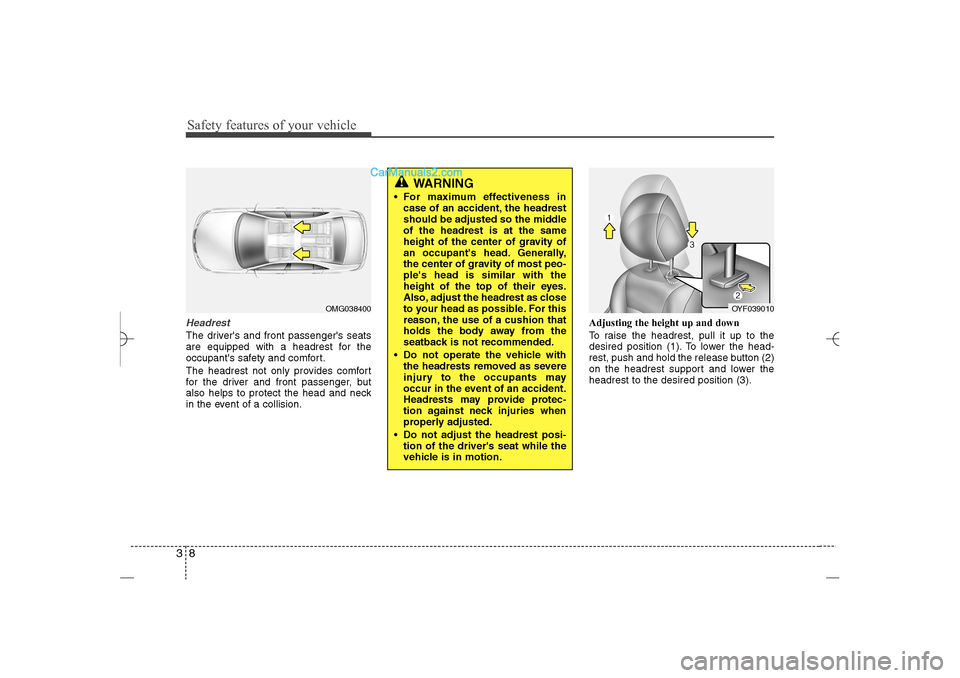
Safety features of your vehicle8 3HeadrestThe driver's and front passenger's seats
are equipped with a headrest for the
occupant's safety and comfort.
The headrest not only provides comfort
for the driver and front passenger, but
also helps to protect the head and neck
in the event of a collision.Adjusting the height up and down
To raise the headrest, pull it up to the
desired position (1). To lower the head-
rest, push and hold the release button (2)
on the headrest support and lower the
headrest to the desired position (3).
OYF039010
WARNING
For maximum effectiveness in
case of an accident, the headrest
should be adjusted so the middle
of the headrest is at the same
height of the center of gravity of
an occupant's head. Generally,
the center of gravity of most peo-
ple's head is similar with the
height of the top of their eyes.
Also, adjust the headrest as close
to your head as possible. For this
reason, the use of a cushion that
holds the body away from the
seatback is not recommended.
Do not operate the vehicle with
the headrests removed as severe
injury to the occupants may
occur in the event of an accident.
Headrests may provide protec-
tion against neck injuries when
properly adjusted.
Do not adjust the headrest posi-
tion of the driver's seat while the
vehicle is in motion.
OMG038400
YF HMA 3.qxp 5/16/2011 4:13 PM Page 8
Page 28 of 410
Safety features of your vehicle10 3During mild weather or under conditions
where the operation of the seat warmer
is not needed, keep the switches in the
"OFF" position.
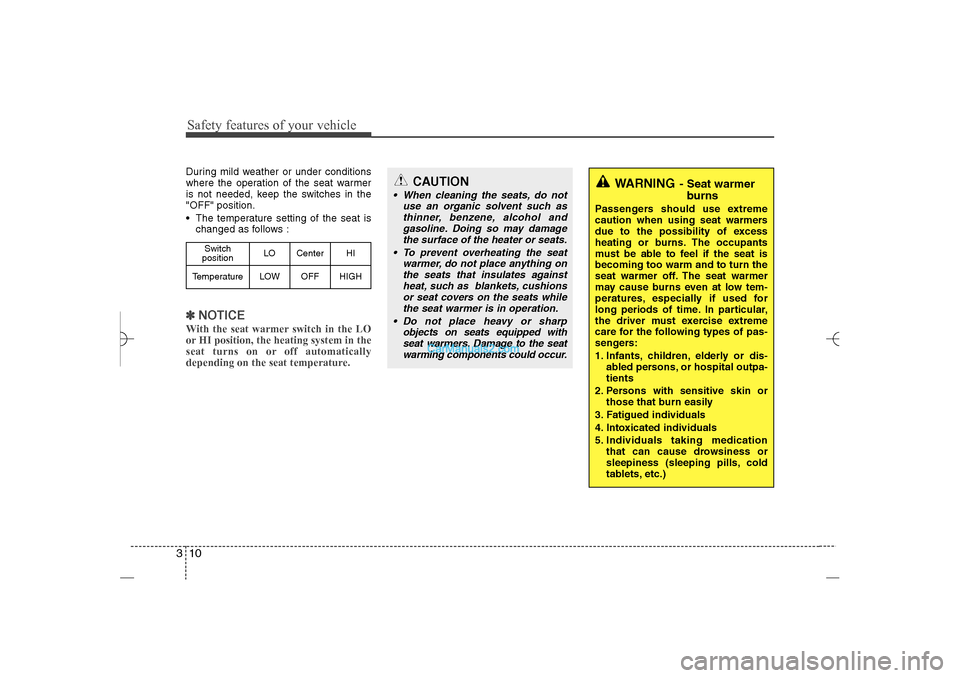
The temperature setting of the seat is
changed as follows :✽ ✽
NOTICEWith the seat warmer switch in the LO
or HI position, the heating system in the
seat turns on or off automatically
depending on the seat temperature.
CAUTION
When cleaning the seats, do not
use an organic solvent such as
thinner, benzene, alcohol and
gasoline. Doing so may damage
the surface of the heater or seats.
To prevent overheating the seat
warmer, do not place anything on
the seats that insulates against
heat, such as blankets, cushions
or seat covers on the seats while
the seat warmer is in operation.
Do not place heavy or sharp
objects on seats equipped with
seat warmers. Damage to the seat
warming components could occur.
WARNING
- Seat warmer
burns
Passengers should use extreme
caution when using seat warmers
due to the possibility of excess
heating or burns. The occupants
must be able to feel if the seat is
becoming too warm and to turn the
seat warmer off. The seat warmer
may cause burns even at low tem-
peratures, especially if used for
long periods of time. In particular,
the driver must exercise extreme
care for the following types of pas-
sengers:
1. Infants, children, elderly or dis-
abled persons, or hospital outpa-
tients
2. Persons with sensitive skin or
those that burn easily
3. Fatigued individuals
4. Intoxicated individuals
5. Individuals taking medication
that can cause drowsiness or
sleepiness (sleeping pills, cold
tablets, etc.)
Switch
positionLO Center HI
Temperature
LOW
OFF
HIGH
YF HMA 3.qxp 5/16/2011 4:13 PM Page 10
Page 30 of 410
Safety features of your vehicle12 3
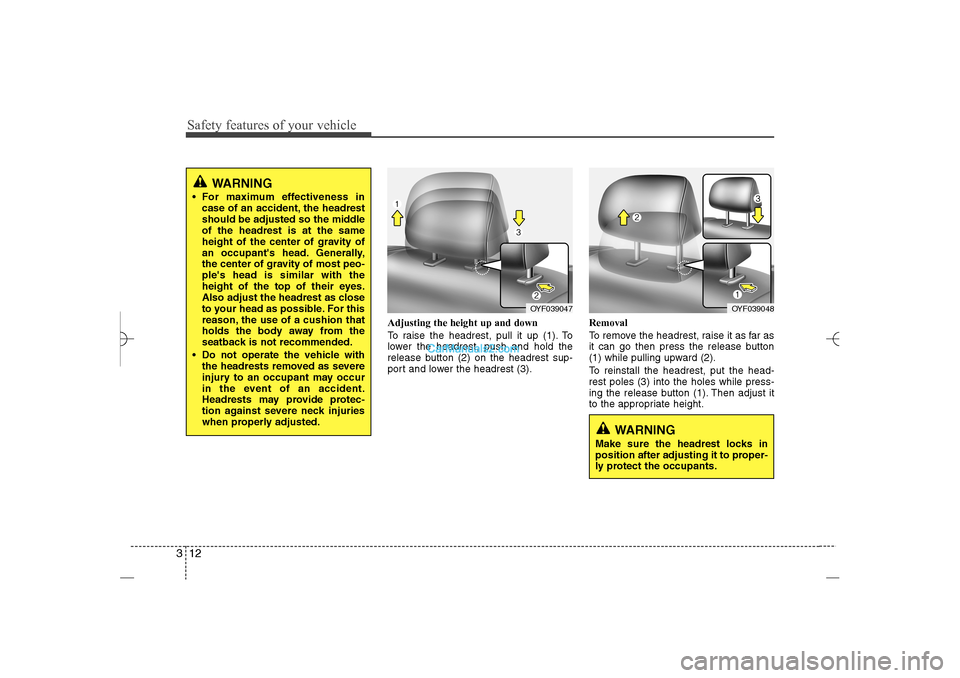
Adjusting the height up and down
To raise the headrest, pull it up (1). To
lower the headrest, push and hold the
release button (2) on the headrest sup-
port and lower the headrest (3).Removal
To remove the headrest, raise it as far as
it can go then press the release button
(1) while pulling upward (2).
To reinstall the headrest, put the head-
rest poles (3) into the holes while press-
ing the release button (1). Then adjust it
to the appropriate height.
OYF039047
OYF039048
WARNING
Make sure the headrest locks in
position after adjusting it to proper-
ly protect the occupants.
WARNING
For maximum effectiveness in
case of an accident, the headrest
should be adjusted so the middle
of the headrest is at the same
height of the center of gravity of
an occupant's head. Generally,
the center of gravity of most peo-
ple's head is similar with the
height of the top of their eyes.
Also adjust the headrest as close
to your head as possible. For this
reason, the use of a cushion that
holds the body away from the
seatback is not recommended.
Do not operate the vehicle with
the headrests removed as severe
injury to an occupant may occur
in the event of an accident.
Headrests may provide protec-
tion against severe neck injuries
when properly adjusted.
YF HMA 3.qxp 5/16/2011 4:14 PM Page 12
Page 32 of 410
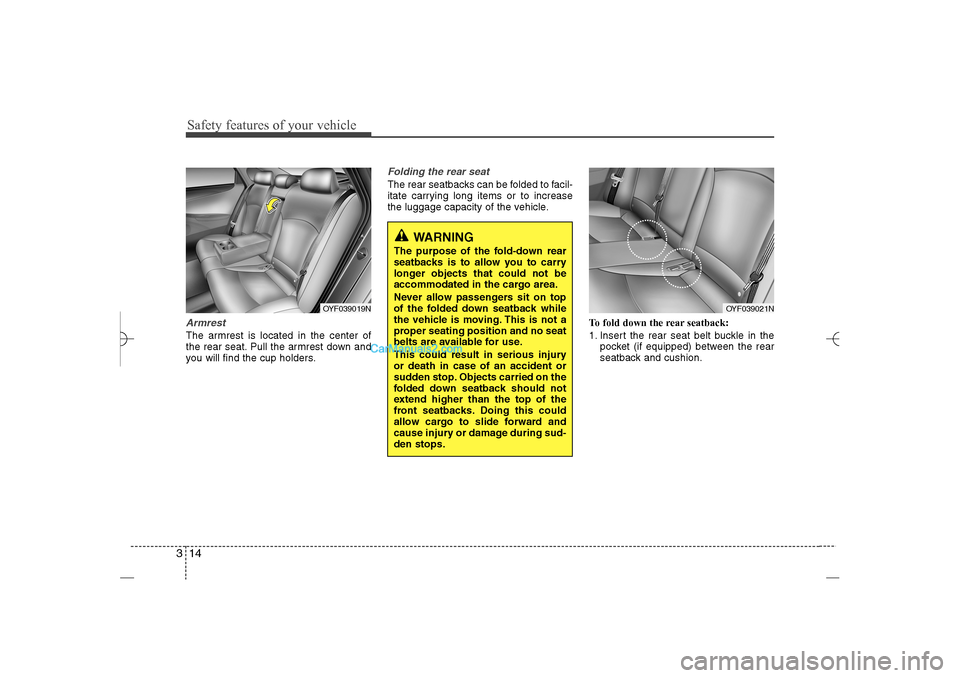
Safety features of your vehicle14 3ArmrestThe armrest is located in the center of
the rear seat. Pull the armrest down and
you will find the cup holders.
Folding the rear seatThe rear seatbacks can be folded to facil-
itate carrying long items or to increase
the luggage capacity of the vehicle.
To fold down the rear seatback:
1. Insert the rear seat belt buckle in the
pocket (if equipped) between the rear
seatback and cushion.
WARNING
The purpose of the fold-down rear
seatbacks is to allow you to carry
longer objects that could not be
accommodated in the cargo area.
Never allow passengers sit on top
of the folded down seatback while
the vehicle is moving. This is not a
proper seating position and no seat
belts are available for use.
This could result in serious injury
or death in case of an accident or
sudden stop. Objects carried on the
folded down seatback should not
extend higher than the top of the
front seatbacks. Doing this could
allow cargo to slide forward and
cause injury or damage during sud-
den stops.
OYF039021N
OYF039019N
YF HMA 3.qxp 5/16/2011 4:14 PM Page 14
Page 37 of 410
319
Safety features of your vehicle
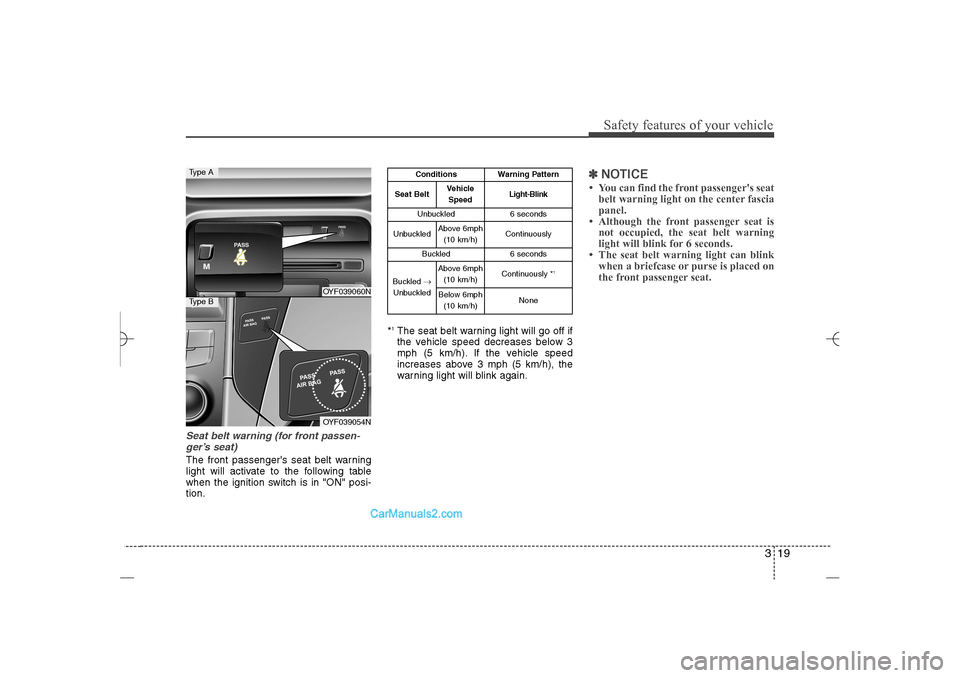
Seat belt warning (for front passen-
ger’s seat)The front passenger's seat belt warning
light will activate to the following table
when the ignition switch is in "ON" posi-
tion.*
1The seat belt warning light will go off if
the vehicle speed decreases below 3
mph (5 km/h). If the vehicle speed
increases above 3 mph (5 km/h), the
warning light will blink again.
✽ ✽
NOTICE• You can find the front passenger's seat
belt warning light on the center fascia
panel.
• Although the front passenger seat is
not occupied, the seat belt warning
light will blink for 6 seconds.
• The seat belt warning light can blink
when a briefcase or purse is placed on
the front passenger seat.
Conditions
Warning Pattern
Seat Belt
Vehicle
Speed
Light-Blink
Unbuckled
6 seconds
Unbuckled
Above 6mph
(10 km/h)
Continuously
Buckled
6 seconds
Buckled →
Unbuckled
Above 6mph
(10 km/h)
Continuously *
1
Below 6mph
(10 km/h)
None
OYF039060NOYF039054N
Type AType B
YF HMA 3.qxp 5/16/2011 4:14 PM Page 19
Page 40 of 410
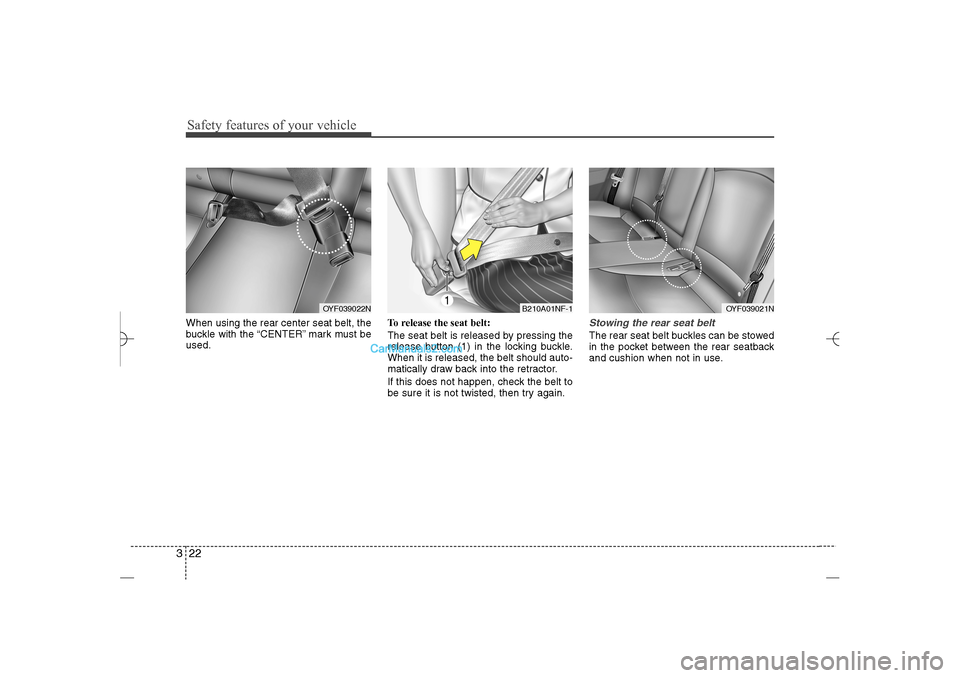
Safety features of your vehicle22 3When using the rear center seat belt, the
buckle with the “CENTER” mark must be
used.To release the seat belt:
The seat belt is released by pressing the
release button (1) in the locking buckle.
When it is released, the belt should auto-
matically draw back into the retractor.
If this does not happen, check the belt to
be sure it is not twisted, then try again.
Stowing the rear seat belt The rear seat belt buckles can be stowed
in the pocket between the rear seatback
and cushion when not in use.
OYF039022N
B210A01NF-1
OYF039021N
YF HMA 3.qxp 5/16/2011 4:14 PM Page 22
Page 45 of 410
327
Safety features of your vehicle
If the shoulder belt portion slightly touch-
es the child’s neck or face, try placing the
child closer to the center of the vehicle. If
the shoulder belt still touches their face
or neck they need to be returned to a
child restraint system.
Pregnant womenThe use of a seat belt is recommended
for pregnant women to lessen the chance
of injury in an accident. When a seat belt
is used, the lap belt portion should be
placed as low and snugly as possible on
the hips, not across the abdomen. For
specific recommendations, consult a
physician.Injured personA seat belt should be used when an
injured person is being transported.
When this is necessary, you should con-
sult a physician for recommendations.
One person per beltTwo people (including children) should
never attempt to use a single seat belt.
This could increase the severity of
injuries in case of an accident.Do not lie downTo reduce the chance of injuries in the
event of an accident and to achieve max-
imum effectiveness of the restraint sys-
tem, all passengers should be sitting up
and the front and rear seats should be in
an upright position when the car is mov-
ing. A seat belt cannot provide proper
protection if the person is lying down in
the rear seat or if the front and rear seats
are in a reclined position.
WARNING
- Pregnant
women
Pregnant women must never place
the lap portion of the safety belt
over the area of the abdomen
where the unborn child is located
or above the abdomen where the
belt could seriously injure or even
cause the death of the unborn child
during an impact.
WARNING
- Shoulder belts
on small children
Never allow a shoulder belt to be
in contact with a child’s neck or
face while the vehicle is in
motion.
If seat belts are not properly worn
and adjusted on children, there is
a risk of death or serious injury.
YF HMA 3.qxp 5/16/2011 4:14 PM Page 27
Page 50 of 410
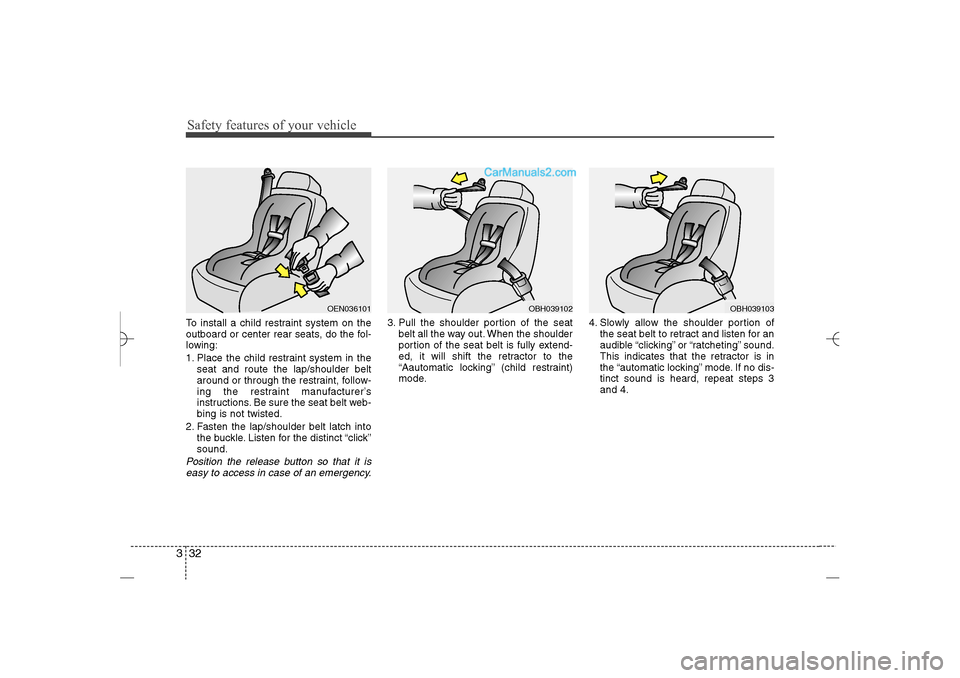
Safety features of your vehicle32 3To install a child restraint system on the
outboard or center rear seats, do the fol-
lowing:
1. Place the child restraint system in the
seat and route the lap/shoulder belt
around or through the restraint, follow-
ing the restraint manufacturer’s
instructions. Be sure the seat belt web-
bing is not twisted.
2. Fasten the lap/shoulder belt latch into
the buckle. Listen for the distinct “click”
sound.Position the release button so that it is
easy to access in case of an emergency.
3. Pull the shoulder portion of the seat
belt all the way out. When the shoulder
portion of the seat belt is fully extend-
ed, it will shift the retractor to the
“Aautomatic locking” (child restraint)
mode.4. Slowly allow the shoulder portion of
the seat belt to retract and listen for an
audible “clicking” or “ratcheting” sound.
This indicates that the retractor is in
the “automatic locking” mode. If no dis-
tinct sound is heard, repeat steps 3
and 4.
OBH039102
OEN036101
OBH039103
YF HMA 3.qxp 5/16/2011 4:15 PM Page 32