Page 158 of 414
Features of your vehicle
92
4
Trunk room lamp
The trunk room lamp comes on when the
trunk is opened. Glove box lamp
The glove box lamp comes on when the
glove box is opened.
The position lights or headlights must be
ON for the glove box lamp to function.Vanity mirror lamp (if equipped)
Pull the sunvisor downward and you can
ON or OFF the vantity mirror lamp as
pushing the button.
: To turn the lamp ON.
To turn the lamp OFF.
OBK049056OBK049057OTD049088
CAUTION
The trunk room lamp comes on as
long as the trunk lid opens. To pre-vent unnecessary charging systemdrain, close the trunk lid securelyafter using the trunk room.
CAUTION
To prevent unnecessary charging
system drain, turn off the lamp by pushing O button after using thelamp.
Page 278 of 414

543
Driving your vehicle
Driving at night
Because night driving presents more
hazards than driving in the daylight, here
are some important tips to remember:
Slow down and keep more distancebetween you and other vehicles, as it
may be more difficult to see at night,
especially in areas where there may
not be any street lights. Adjust your mirrors to reduce the glare
from other driver's headlights.
Keep your headlights clean and prop- erly aimed on vehicles not equippedwith the automatic headlight aiming
feature. Dirty or improperly aimed
headlights will make it much more diffi-cult to see at night.
Avoid staring directly at the headlights of oncoming vehicles. You could be
temporarily blinded, and it will take
several seconds for your eyes to read-
just to the darkness.
Driving in the rain
Rain and wet roads can make driving
dangerous, especially if you’re not pre-
pared for the slick pavement. Here are a
few things to consider when driving in the
rain:
A heavy rainfall will make it harder tosee and will increase the distance
needed to stop your vehicle, so slow
down.
Keep your windshield wiping equip- ment in good shape. Replace your
windshield wiper blades when they
show signs of streaking or missingareas on the windshield.
OBK052022LOBK059021
Page 279 of 414

Driving your vehicle
44
5
If your tires are not in good condition,
making a quick stop on wet pavement
can cause a skid and possibly lead to
an accident. Be sure your tires are in
good shape.
Turn on your headlights to make it eas- ier for others to see you.
Driving too fast through large puddles can affect your brakes. If you must go
through puddles, try to drive through
them slowly.
If you believe you may have gotten your brakes wet, apply them lightly
while driving until normal braking oper-
ation returns. Driving in flooded areas
Avoid driving through flooded areas
unless you are sure the water is no high-
er than the bottom of the wheel hub.
Drive through any water slowly. Allowadequate stopping distance because
brake performance may be affected.
After driving through water, dry the
brakes by gently applying them several
times while the vehicle is moving slowly.
Driving off-road
Drive carefully off-road because your
vehicle may be damaged by rocks or
roots of trees. Become familiar with the
off-road conditions where you are going
to drive before you begin driving.
Highway driving
Tires
Adjust the tire inflation pressures to
specification. Low tire inflation pressures
will result in overheating and possible
failure of the tires.
Avoid using worn or damaged tires which
may result in reduced traction or tire fail-
ure.
✽✽
NOTICE
Never exceed the maximum tire infla-
tion pressure shown on the tires.
OBK022001
Page 358 of 414
751
Maintenance
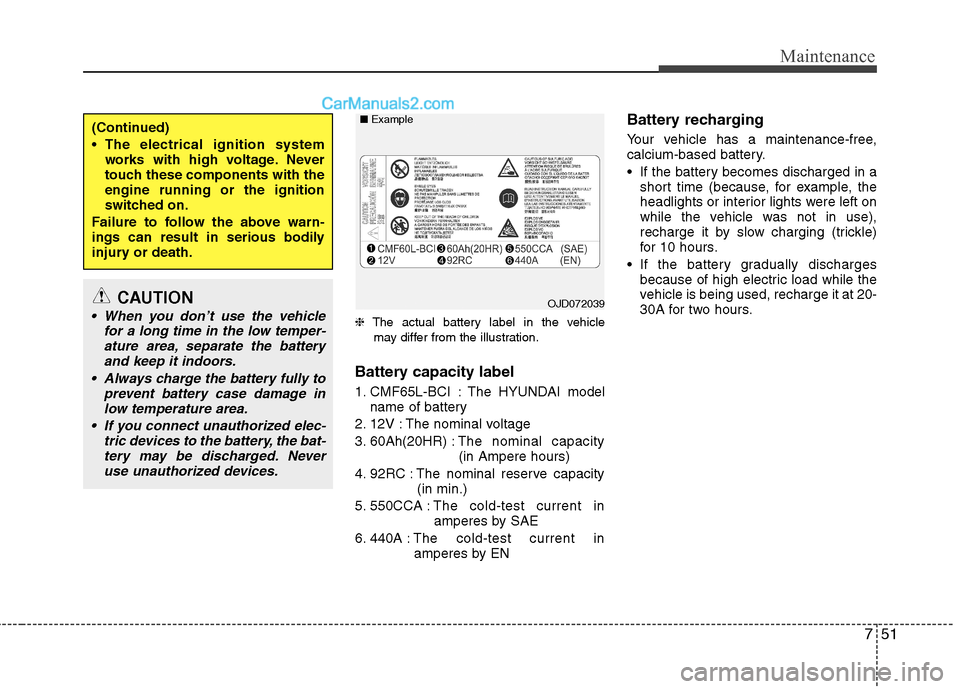
❈The actual battery label in the vehicle
may differ from the illustration.
Battery capacity label
1. CMF65L-BCI : The HYUNDAI model name of battery
2. 12V : The nominal voltage
3. 60Ah(20HR) : The nominal capacity
(in Ampere hours)
4. 92RC : The nominal reserve capacity (in min.)
5. 550CCA : The cold-test current in
amperes by SAE
6. 440A : The cold-test current in
amperes by EN Battery recharging
Your vehicle has a maintenance-free,
calcium-based battery.
If the battery becomes discharged in a
short time (because, for example, the
headlights or interior lights were left on
while the vehicle was not in use),
recharge it by slow charging (trickle)
for 10 hours.
If the battery gradually discharges because of high electric load while the
vehicle is being used, recharge it at 20-
30A for two hours.
(Continued)
The electrical ignition systemworks with high voltage. Never
touch these components with theengine running or the ignition
switched on.
Failure to follow the above warn-
ings can result in serious bodily
injury or death.
CAUTION
When you don’t use the vehicle for a long time in the low temper-ature area, separate the batteryand keep it indoors.
Always charge the battery fully to prevent battery case damage in
low temperature area.
If you connect unauthorized elec- tric devices to the battery, the bat-tery may be discharged. Neveruse unauthorized devices.OJD072039
■
Example
Page 371 of 414

Maintenance
64
7
Instrument panel fuse replace- ment
1. Turn the ignition switch and all other
switches off.
2. Open the fuse panel cover.
3. Pull the suspected fuse straight out. Use the removal tool provided in the
main fuse box in the engine compart-ment.
4. Check the removed fuse; replace it if it is blown.
5. Push in a new fuse of the same rating, and make sure it fits tightly in the clips.
If it fits loosely, we recommend that you
consult an authorized HYUNDAI dealer.
If you do not have a spare, use a fuse of the same rating from a circuit you may not need for operating the vehicle, suchas the cigarette lighter fuse.
If the headlights or other electrical com-
ponents do not work and the fuses are
OK, check the fuse panel in the engine
compartment. If a fuse is blown, it mustbe replaced.
OBK079019
CAUTION
When replacing a blown fuse or relay with a new one, make sure
the new fuse or relay fits tightlyinto the clips. The incomplete fas-tening fuse or relay may cause the vehicle wiring and electric
systems damage and a possiblefire.
Do not remove fuses, relays and terminals fastened with bolts or
nuts. The fuses, relays and termi-nals may be fastened incomplete-ly, and it may cause a possiblefire. If fuses, relays and terminals
fastened with bolts or nuts are blown, consult with an authorizedHYUNDAI dealer.
Do not input any other objects except fuses or relays into
fuse/relay terminals such as adriver or wiring. It may cause con-tact failure and system malfunc-tion.
Page 384 of 414
777
Maintenance
1. Open the hood.
2. Disconnect the negative battery cable.3. Loosen the retaining bolts .
- Head lights assembly : 2 EA
- Air duct : 4 EA
- Front bumper upper board : 2 EA
- Front bumper under cover : 2 EA
- Front bumper cover : 1 EA
4. Remove the air duct.
5. Pull the front bumper cover out. (1)
6. Pull the headlights assembly out to thefront of the vehicle. (2)
7. Disconnect the power connector(s) from the back of the headlight assem-
bly.
OBK072052
OBK072053
OBK072054
OBK072055
Page 407 of 414

Specifications & Consumer information
2
8
DIMENSIONS BULB WATTAGE
Item mm (in)
Overall length 4,630 (182.2)
Overall width 1,865 (73.4)
Overall height 1,385 (54.5)
Front tread 1,605 (63.2) / 1,601 (63.0)*1
Rear tread 1,625 (64.0) / 1,621 (63.8)*1
Wheelbase 2,820 (111)
ENGINE
Item Gasoline 2.0 Gasoline 3.8
Displacement [cc(cu.in)] 1,998
(121.9) 3,778
(230.5)
Bore x Stroke [mm(in)] 86 x 86
(3.38 x 3.38) 96 x 87
(3.78 x 3.42)
Firing order 1-3-4-2 1-2-3-4-5-6
No. of cylinders 4, In-line 6, V-Type
Light Bulb Wattage Bulb type
Headlights (Low) 55 or
35 (HID) H7*
1
Headlights (High) 55 H7LL
Front turn signal lights 21 PY21WLL
Front fog lights 35 H8L
Front position lightsLEDLED
Daytime running lights*LEDLED
Rear fog light* (Driver side only) 21 H21W
Stop and tail lights LED LED
Rear turn signal lights 21 P21WL
Back-up lights 16 W16W
High mounted stop light* LED LED
License plate lights 5 W5WL
Map lamps 10 W10W
Luggage lamp 5 FESTOON
Glove box lamp 5 FESTOON
Vanity mirror lamps* 5 FESTOON
Side repeater lights* LED LED
* : if equipped * 1
: For Europe - H7HPLL
Except Europe - H7LL
*
1
: with R19 tire

