Page 337 of 403

725
Maintenance
Air cleaner filter
A Genuine HYUNDAI air cleaner filter is
recommended when the filter is
replaced.
Spark plugs
Make sure to install new spark plugs of
the correct heat range.
Valve clearance
Inspect excessive valve noise and/or
engine vibration and adjust if necessary.
An authorized HYUNDAI dealer should
perform the operation.
Cooling system
Check cooling system components, such
as radiator, coolant reservoir, hoses and
connections for leakage and damage.
Replace any damaged parts.
Coolant
The coolant should be changed at the
intervals specified in the maintenance
schedule.
Automatic transaxle fluid
Automatic transaxle fluid should not be
checked under normal usage conditions.
But in severe conditions, the fluid should
be changed at an authorized HYUNDAI
dealer in accordance to the scheduled
maintenance at the beginning of this
chapter.
✽NOTICE
Automatic transaxle fluid color is basi-
cally red.
As the vehicle is driven, the automatic
transaxle fluid will begin to look darker.
It is normal condition and you should
not judge the need to replace the fluid
based upon the changed color.
CAUTION
The use of a non-specified fluid
could result in transaxle malfunc-
tion and failure.
Use only specified automatic
transaxle fluid. (Refer to
“Recommended lubricants and
capacities” in section 8.)WARNING
Do not disconnect and inspect
spark plugs when the engine is hot.
You may burn yourself.
Page 339 of 403
727
Maintenance
ENGINE OIL
Checking the engine oil level
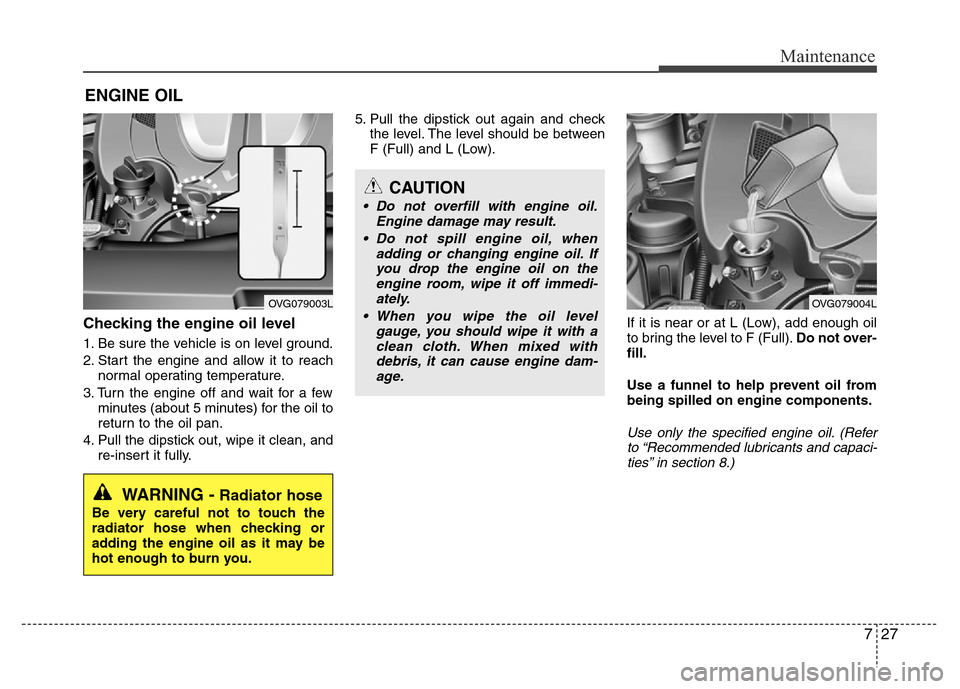
1. Be sure the vehicle is on level ground.
2. Start the engine and allow it to reach
normal operating temperature.
3. Turn the engine off and wait for a few
minutes (about 5 minutes) for the oil to
return to the oil pan.
4. Pull the dipstick out, wipe it clean, and
re-insert it fully.5. Pull the dipstick out again and check
the level. The level should be between
F (Full) and L (Low).
If it is near or at L (Low), add enough oil
to bring the level to F (Full).Do not over-
fill.
Use a funnel to help prevent oil from
being spilled on engine components.
Use only the specified engine oil. (Refer
to “Recommended lubricants and capaci-
ties” in section 8.)
WARNING - Radiator hose
Be very careful not to touch the
radiator hose when checking or
adding the engine oil as it may be
hot enough to burn you.
OVG079003L
CAUTION
• Do not overfill with engine oil.
Engine damage may result.
• Do not spill engine oil, when
adding or changing engine oil. If
you drop the engine oil on the
engine room, wipe it off immedi-
ately.
• When you wipe the oil level
gauge, you should wipe it with a
clean cloth. When mixed with
debris, it can cause engine dam-
age.
OVG079004L
Page 343 of 403
731
Maintenance
BRAKE FLUID
Checking the brake fluid level
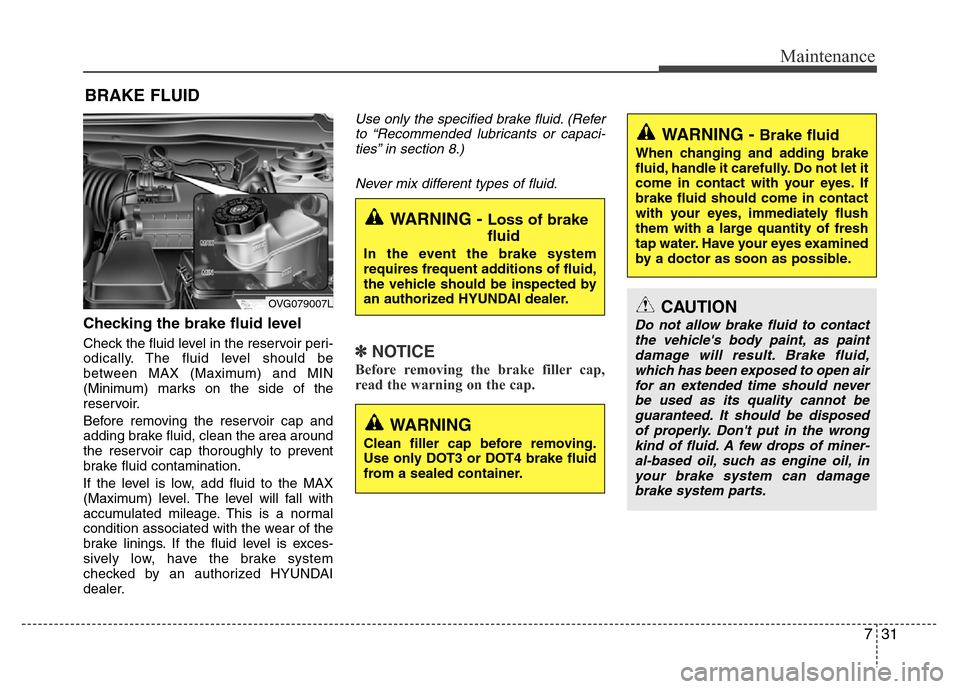
Check the fluid level in the reservoir peri-
odically. The fluid level should be
between MAX (Maximum) and MIN
(Minimum) marks on the side of the
reservoir.
Before removing the reservoir cap and
adding brake fluid, clean the area around
the reservoir cap thoroughly to prevent
brake fluid contamination.
If the level is low, add fluid to the MAX
(Maximum) level. The level will fall with
accumulated mileage. This is a normal
condition associated with the wear of the
brake linings. If the fluid level is exces-
sively low, have the brake system
checked by an authorized HYUNDAI
dealer.
Use only the specified brake fluid. (Refer
to “Recommended lubricants or capaci-
ties” in section 8.)
Never mix different types of fluid.
✽NOTICE
Before removing the brake filler cap,
read the warning on the cap.
WARNING - Brake fluid
When changing and adding brake
fluid, handle it carefully. Do not let it
come in contact with your eyes. If
brake fluid should come in contact
with your eyes, immediately flush
them with a large quantity of fresh
tap water. Have your eyes examined
by a doctor as soon as possible.
WARNING - Loss of brake
fluid
In the event the brake system
requires frequent additions of fluid,
the vehicle should be inspected by
an authorized HYUNDAI dealer.
CAUTION
Do not allow brake fluid to contact
the vehicle's body paint, as paint
damage will result. Brake fluid,
which has been exposed to open air
for an extended time should never
be used as its quality cannot be
guaranteed. It should be disposed
of properly. Don't put in the wrong
kind of fluid. A few drops of miner-
al-based oil, such as engine oil, in
your brake system can damage
brake system parts.
OVG079007L
WARNING
Clean filler cap before removing.
Use only DOT3 or DOT4 brake fluid
from a sealed container.
Page 344 of 403
Maintenance
32 7
POWER STEERING FLUID (IF EQUIPPED)
Checking the power steering fluid
level
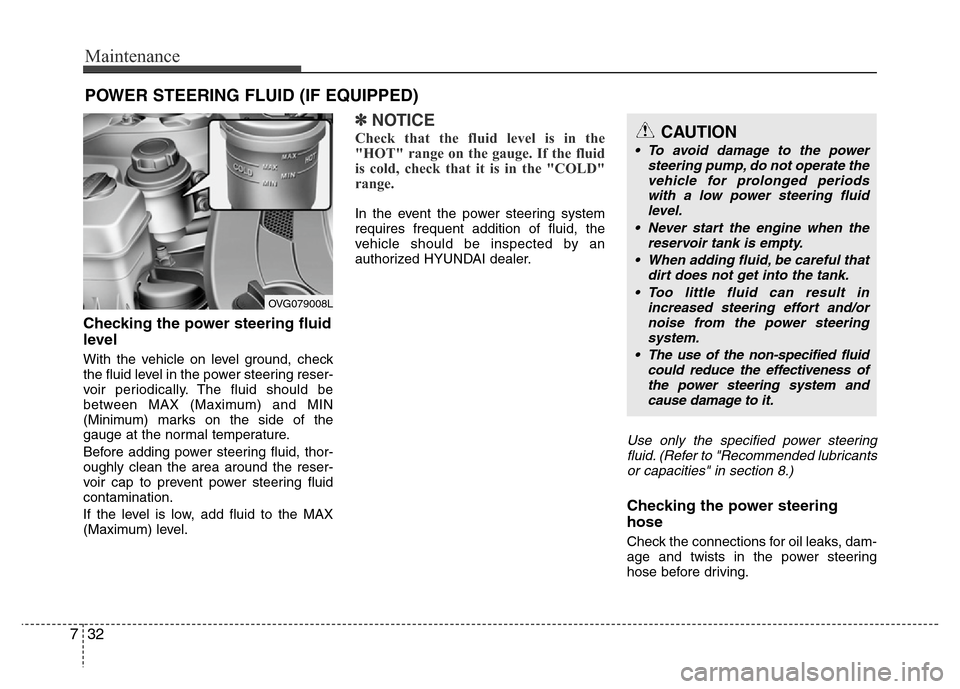
With the vehicle on level ground, check
the fluid level in the power steering reser-
voir periodically. The fluid should be
between MAX (Maximum) and MIN
(Minimum) marks on the side of the
gauge at the normal temperature.
Before adding power steering fluid, thor-
oughly clean the area around the reser-
voir cap to prevent power steering fluid
contamination.
If the level is low, add fluid to the MAX
(Maximum) level.
✽NOTICE
Check that the fluid level is in the
"HOT" range on the gauge. If the fluid
is cold, check that it is in the "COLD"
range.
In the event the power steering system
requires frequent addition of fluid, the
vehicle should be inspected by an
authorized HYUNDAI dealer.
Use only the specified power steering
fluid. (Refer to "Recommended lubricants
or capacities" in section 8.)
Checking the power steering
hose
Check the connections for oil leaks, dam-
age and twists in the power steering
hose before driving.
CAUTION
• To avoid damage to the power
steering pump, do not operate the
vehicle for prolonged periods
with a low power steering fluid
level.
• Never start the engine when the
reservoir tank is empty.
• When adding fluid, be careful that
dirt does not get into the tank.
• Too little fluid can result in
increased steering effort and/or
noise from the power steering
system.
• The use of the non-specified fluid
could reduce the effectiveness of
the power steering system and
cause damage to it.
OVG079008L
Page 395 of 403
8
Engine / 8-2
Dimensions / 8-2
Bulb wattage / 8-2
Tires and wheels / 8-3
Load and speed capacity tires / 8-3
Weight and volume / 8-4
Recommended lubricants and capacities / 8-5
Vehicle identification number (VIN) / 8-7
Vehicle certification label / 8-8
Tire specification and pressure label / 8-8
Engine number / 8-8
Air conditioner compressor label / 8-9
Declaration of conformity / 8-9
Specifications & Consumer information
Page 399 of 403

85
Specifications & Consumer information
RECOMMENDED LUBRICANTS AND CAPACITIES
*1Refer to the recommended SAE viscosity numbers on the next page.
*2Engine oils labeled Energy Conserving Oil are now available. Along with other additional benefits, they contribute to fuel economy by reducing
the amount of fuel necessary to overcome engine friction. Often, these improvements are difficult to measure in everyday driving, but in a year’s
time, they can offer significant cost and energy savings.
*
3Yellow engine oil dipstick
*4Red engine oil dipstick
*5If the API service SM engine oil is not available in your country, you are able to use API service SL.
To help achieve proper engine and powertrain performance and durability, use only lubricants of the proper quality. The correct
lubricants also help promote engine efficiency that results in improved fuel economy.
These lubricants and fluids are recommended for use in your vehicle.
Lubricant Volume Classification
Engine oil *
1*2
(drain and refill)
Recommends2.4LWith oil cooler4.6 l(4.86 US qt.) *
3
API Service SM *5,
ILSAC GF-4 or above4.8 l(5.07 US qt.) *4
Without oil cooler4.5 l(4.76 US qt.) *3
4.7 l(4.97 US qt.) *4
3.0L5.7 l(6.02 US qt.)
Engine oil
consumptionNormal driving conditionMAX. 1l /1500 km-
Severe driving conditionMAX. 1l /1000 km-
Automatic transaxle
fluid2.4L7.1 l(7.50 US qt.)
MICHANG ATF SP-IV, SK ATF SP-IV
NOCA ATF SP-IV, HYUNDAI genuine ATF SP-IV
3.0L7.8 l(8.24 US qt.)
Power steering fluid0.9 l(0.95 US qt.)
PSF-4
Coolant2.4L6.8 l(7.18 US qt.)
Mixture of antifreeze and water (Ethylene glycol
base coolant for aluminum radiator)
3.0L8.4 l(8.87 US qt.)
Brake fluid0.7~0.8 l (0.7~0.8 US qt.)
FMVSS116 DOT-3 or DOT-4
Fuel70 l(18.49 US gal.)
-