Page 232 of 402
Driving your vehicle
12 5
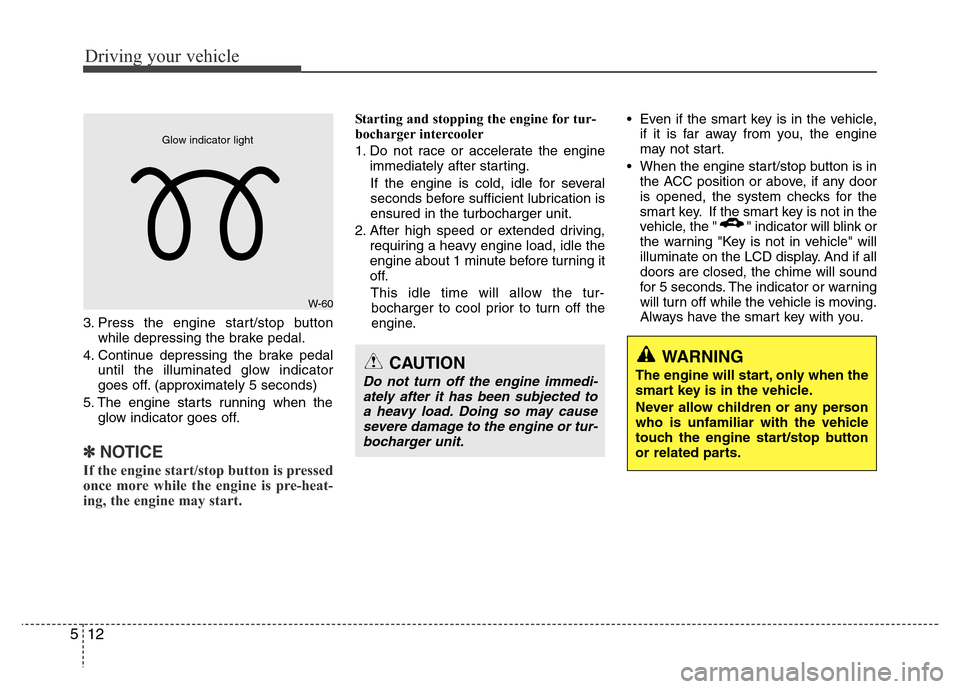
3. Press the engine start/stop button
while depressing the brake pedal.
4. Continue depressing the brake pedal
until the illuminated glow indicator
goes off. (approximately 5 seconds)
5. The engine starts running when the
glow indicator goes off.
✽ NOTICE
If the engine start/stop button is pressed
once more while the engine is pre-heat-
ing, the engine may start.
Starting and stopping the engine for tur-
bocharger intercooler
1. Do not race or accelerate the engine
immediately after starting.
If the engine is cold, idle for several
seconds before sufficient lubrication is
ensured in the turbocharger unit.
2. After high speed or extended driving,
requiring a heavy engine load, idle the
engine about 1 minute before turning it
off.
This idle time will allow the tur-
bocharger to cool prior to turn off the
engine.• Even if the smart key is in the vehicle,
if it is far away from you, the engine
may not start.
• When the engine start/stop button is in
the ACC position or above, if any door
is opened, the system checks for the
smart key. If the smart key is not in the
vehicle, the " " indicator will blink or
the warning "Key is not in vehicle" will
illuminate on the LCD display. And if all
doors are closed, the chime will sound
for 5 seconds. The indicator or warning
will turn off while the vehicle is moving.
Always have the smart key with you.
WARNING
The engine will start, only when the
smart key is in the vehicle.
Never allow children or any person
who is unfamiliar with the vehicle
touch the engine start/stop button
or related parts.CAUTION
Do not turn off the engine immedi-
ately after it has been subjected to
a heavy load. Doing so may cause
severe damage to the engine or tur-
bocharger unit.
W-60
Glow indicator light
Page 233 of 402

513
Driving your vehicle
✽ NOTICE
• If the battery is weak or the smart key
does not work correctly, you can start
the engine by pressing the engine
start/stop button with the smart key.
• When the stop lamp fuse is blown, you
can't start the engine normally.
Replace the fuse with a new one. If it
is not possible, you can start the
engine by pressing the engine start/
stop button for 10 seconds while it is
in the ACC position. The engine can
start without depressing the brake
pedal. But for your safety always
depress the brake pedal before start-
ing the engine.
CAUTION
Do not press the engine start/stop
button for more than 10 seconds
except when the stop lamp fuse is
blown.
CAUTION
If the engine stalls while the vehicle
is in motion, do not attempt to move
the shift lever to the P (Park) posi-
tion. If the traffic and road condi-
tions permit, you may put the shift
lever in the N (Neutral) position
while the vehicle is still moving and
press the engine start/stop button
in an attempt to restart the engine.
ORB050007
Page 234 of 402

Driving your vehicle
14 5
Manual transaxle operation
The manual transaxle has 6 forward
gears.
This shift pattern is imprinted on the shift
knob. The transaxle is fully synchronized
in all forward gears so shifting to either a
higher or a lower gear is easily accom-
plished.
Press the clutch pedal down fully while
shifting, then release it slowly.
If your vehicle is equipped with an igni-
tion lock switch, the engine will not start
when starting the engine without
depressing the clutch pedal. (if equipped)
The gearshift lever must be returned to
the neutral position before shifting into R
(Reverse). Push the button located
immediately below the shift knob and pull
the gearshift lever to the left sufficiently,
and then shift into the reverse (R) gear
position.
Make sure the vehicle is com-
pletely stopped before shifting into R
(Reverse).
Never operate the engine with the
tachometer (rpm) in the red zone.
MANUAL TRANSAXLE (IF EQUIPPED)
CAUTION
• When downshifting from fifth
gear to fourth gear, caution
should be taken not to inadver-
tently press the gear shift lever
sideways in such a manner that
second gear is engaged. Such a
drastic downshift may cause the
engine speed to increase to the
point that the tachometer will
enter the red-zone. Such over-
revving of the engine may possi-
bly cause engine damage.
• Do not downshift more than 2
gears or downshift the gear when
the engine is running at high
speed (5,000 RPM or higher).
Such a downshifting may damage
the engine.
ORB051001N
The button (1) must be pulled up while
moving the shift lever. The shift lever can be moved without
pulling the button (1).
Page 245 of 402

525
Driving your vehicle
Releasing the parking brake
To release the parking brake, first apply
the foot brake and pull up the parking
brake lever slightly. Secondly depress the
release button (1) and lower the parking
brake lever (2) while holding the button.If the parking brake does not release or
does not release all the way, have the
system checked by an authorized
HYUNDAI dealer.
Check the brake warning light by turning
the ignition switch ON (do not start the
engine). This light will be illuminated
when the parking brake is applied with
the ignition switch in the START or ON
position.
Before driving, be sure the parking brake
is fully released and the brake warning
light is off.
If the brake warning light remains on
after the parking brake is released while
engine is running, there may be a mal-
function in the brake system. Immediate
attention is necessary.
If at all possible, cease driving the vehi-
cle immediately. If that is not possible,
use extreme caution while operating the
vehicle and only continue to drive the
vehicle until you can reach a safe loca-
tion or repair shop.
ORB050002
WARNING
• To prevent unintentional move-
ment when stopped and leaving
the vehicle, do not use the
gearshift lever in place of the
parking brake. Set the parking
brake AND make sure the
gearshift lever is securely posi-
tioned in 1st (First) gear or R
(Reverse) for manual transaxle
equipped vehicles and in P (Park)
for automatic transaxle equipped
vehicles.
• Never allow anyone who is unfa-
miliar with the vehicle to touch
the parking brake. If the parking
brake is released unintentionally,
serious injury may occur.
• All vehicles should always have
the parking brake fully engaged
when parking to avoid inadver-
tent movement of the vehicle
which can injure occupants or
pedestrians.
WK-23
Page 365 of 402

Maintenance
74 7
DescriptionSymbolFuse ratingProtected component
IG1IG110A
ATM Shift Lock Control Module, EPS Control Module, Tire Pressure Monitoring Module,
Electro Chromic Mirror, SBR Control Module, Seat Belt Reminder Indicator, Rear Parking
Assist Buzzer, Stop Lamp Switch(Gasoline), Rheostat, Fuel Filter Warning Sensor (Diesel),
Rear Parking Assist Sensor Side LH/RH, Rear Parking Assist Sensor Center LH/RH
ABS10AABS Control Module, ESP Control Module, ESP Off Switch, E/R Fuse & Relay Box
(Multipurpose Check Connector)
B/UP LAMPB/UP
LAMP10ABack-Up Lamp Switch
ECU10AECM, Mass Air Flow Sensor (Diesel), Smart Key Control Module
4SPARE4SPARE10A-
HAZARD15AHazard Relay, Hazard Switch
1PDM25ASmart Key Control Module
SUNROOF15ASunroof Motor
2PDM10ASmart Key Control Module, Start/Stop Button Switch
TCU15ATCM (Diesel), Pulse Generator 'A'/'B', Vehicle Speed Sensor, Transaxle Range Switch
5SPARE5SPARE15A-
IG2IG210ABCM, Power Window Relay, Smart Key Control Module, A/C Control Module, Instrument
Cluster, Sunroof Motor, Head Lamp Leveling Device Switch, Head Lamp LH/RH
WIPER FRT25AMultifunction Switch, Front Wiper Motor
DR LOCK20ADoor Lock/Unlock Relay, Tail Gate Unlock Relay, Driver Door Lock Actuator
Page:
< prev 1-8 9-16 17-24