Page 337 of 488
336
uuTowing a TraileruTowing Preparation
Driving
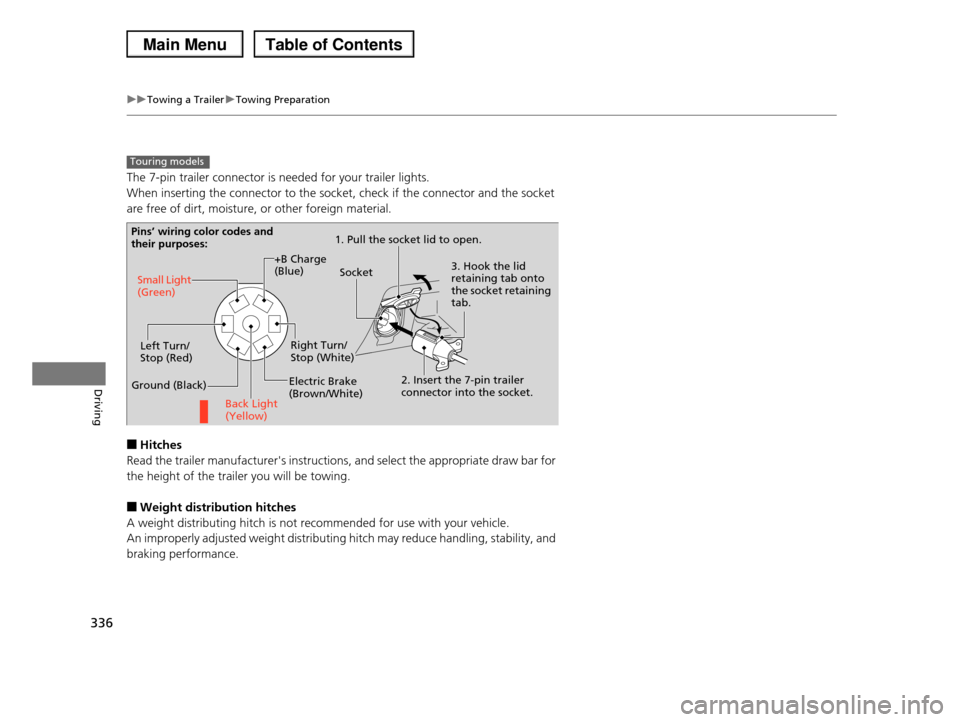
The 7-pin trailer connector is needed for your trailer lights.
When inserting the connector to the socket, check if the connector and the socket
are free of dirt, moisture, or other foreign material.
■Hitches
Read the trailer manufacturer's instructions, and select the appropriate draw bar for
the height of the trailer you will be towing.
■Weight distribution hitches
A weight distributing hitch is not recommended for use with your vehicle.
An improperly adjusted weight distributing hitch may reduce handling, stability, and
braking performance.
Touring models
Pins’ wiring color codes and their purposes:1. Pull the socket lid to open.
3. Hook the lid retaining tab onto the socket retaining tab.
2. Insert the 7-pin trailer connector into the socket.
Socket
Back Light (Yellow)
Left Turn/Stop (Red)
Electric Brake (Brown/White)
Right Turn/Stop (White)
Ground (Black)
Small Light (Green)
+B Charge (Blue)
Page 342 of 488

341
uuOff-Highway Driving GuidelinesuAvoiding Trouble
Driving
Avoiding Trouble
•Check Out Your Vehicle before you leave the pavement and make sure that all
scheduled maintenance has been completed. Pay special attention to the
condition of the tires, and check the tire pressures.
•Remember the route you choose presents limits (too steep or bumpy), you have
limits (driving skill and comfort), and your vehicle has limits (traction, stability, and
power). Failing to recognize these limits will likely put you and your passengers in
a hazardous situation.
•Accelerating and Braking should be done slowly and gradually. Trying to start
or stop too fast can cause a loss of traction and you could lose control.
•Avoiding Obstacles and Debris in the road reduces the likelihood of a rollover
or damage to your suspension or other components.
•Driving on Slopes increasing your risk of a rollover, particularly if you attempt to
drive across a slope that is too steep. Going straight or down a slope is usually the
safest. If you can’t clearly see all conditions or obstacles on a slope, walk it before
you drive it. If there is any doubt whether you can safely pass, don’t try it. Find
another route. If you get stuck when climbing, do not try to turn around. Back
down slowly following the same route you took up the hill.
•Crossing a Stream - Avoid driving through deep water. If you encounter water
in your route (a small stream or large puddle, for example), evaluate it carefully
before going ahead. Make sure it is shallow, flowing slowly, and has firm ground
underneath. If you are not sure of the depth or the ground, turn around and find
another route. Driving through deep water can also damage your vehicle. The
water can get into the transmission and differential, diluting the lubricant and
causing an eventual failure. It can also wash the grease out of the wheel bearings.
•If You Get Stuck, carefully go in the direction that you think will get you
unstuck. Do not spin the tires as this will only make things worse and could
damage the transmission. If you are unable to free yourself, your vehicle will need
to be towed. Front and rear tow hooks are provided for this purpose.
Page 435 of 488
434
Handling the Unexpected
Tools
Types of Tools
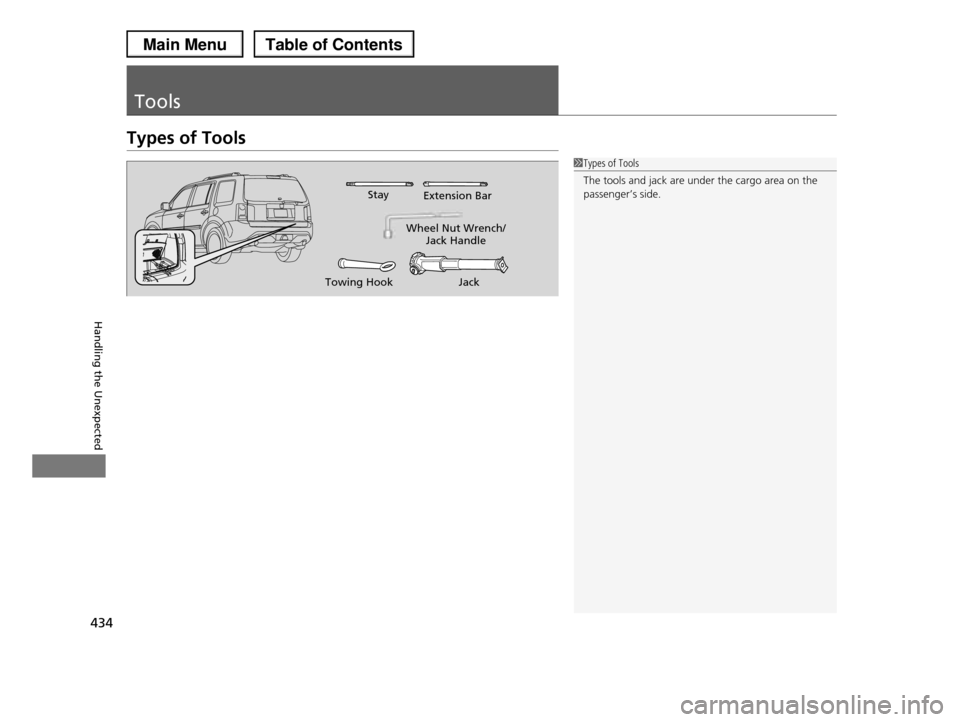
1Types of Tools
The tools and jack are under the cargo area on the passenger’s side.
Wheel Nut Wrench/Jack Handle
JackTowing Hook
StayExtension Bar
Page 461 of 488
460
uuEmergency TowinguIf Your Vehicle Gets Stuck
Handling the Unexpected
If Your Vehicle Gets Stuck
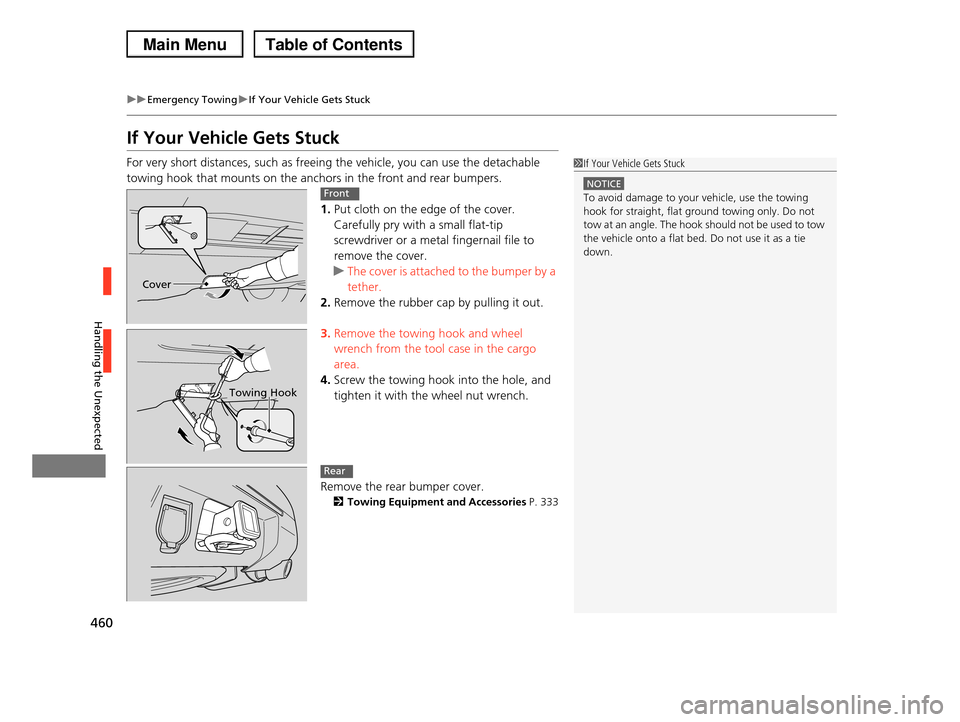
For very short distances, such as freeing the vehicle, you can use the detachable
towing hook that mounts on the anchors in the front and rear bumpers.
1.Put cloth on the edge of the cover.
Carefully pry with a small flat-tip
screwdriver or a metal fingernail file to
remove the cover.
uThe cover is attached to the bumper by a
tether.
2.Remove the rubber cap by pulling it out.
3.Remove the towing hook and wheel
wrench from the tool case in the cargo
area.
4.Screw the towing hook into the hole, and
tighten it with the wheel nut wrench.
Remove the rear bumper cover.
2Towing Equipment and Accessories P. 333
1If Your Vehicle Gets Stuck
NOTICE
To avoid damage to your vehicle, use the towing
hook for straight, flat ground towing only. Do not
tow at an angle. The hook should not be used to tow the vehicle onto a flat bed. Do not use it as a tie
down.
Cover
Front
Towing Hook
Rear