Page 183 of 433
182Controls
Heating and Cooling
*
Using Vents, Heating and A/C
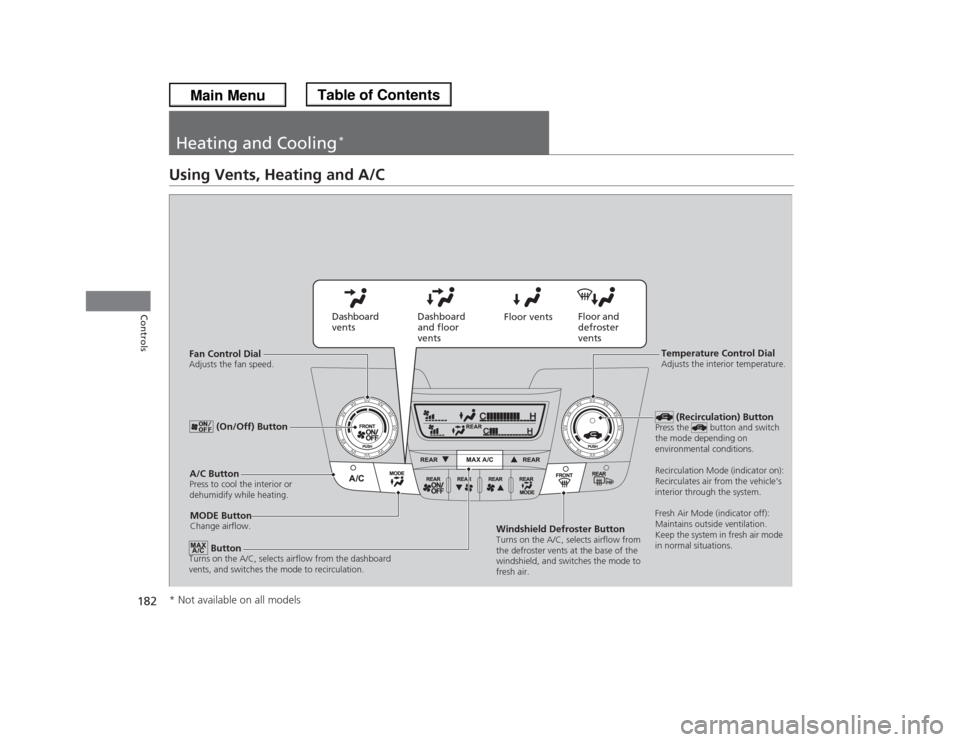
MODE ButtonChange airflow.
Floor and
defroster
vents Floor vents Dashboard
and floor
vents Dashboard
vents
Fan Control Dial
Adjusts the fan speed.
Button
Turns on the A/C, selects airflow from the dashboard
vents, and switches the mode to recirculation.A/C ButtonPress to cool the interior or
dehumidify while heating.
Windshield Defroster ButtonTurns on the A/C, selects airflow from
the defroster vents at the base of the
windshield, and switches the mode to
fresh air.
Temperature Control DialAdjusts the interior temperature.
(Recirculation) Button
Press the button and switch
the mode depending on
environmental conditions.
Recirculation Mode (indicator on):
Recirculates air from the vehicle’s
interior through the system.
Fresh Air Mode (indicator off):
Maintains outside ventilation.
Keep the system in fresh air mode
in normal situations.
(On/Off) Button
* Not available on all models
Page 184 of 433
Continued
183
uuHeating and Cooling
*uUsing Vents, Heating and A/C
Controls
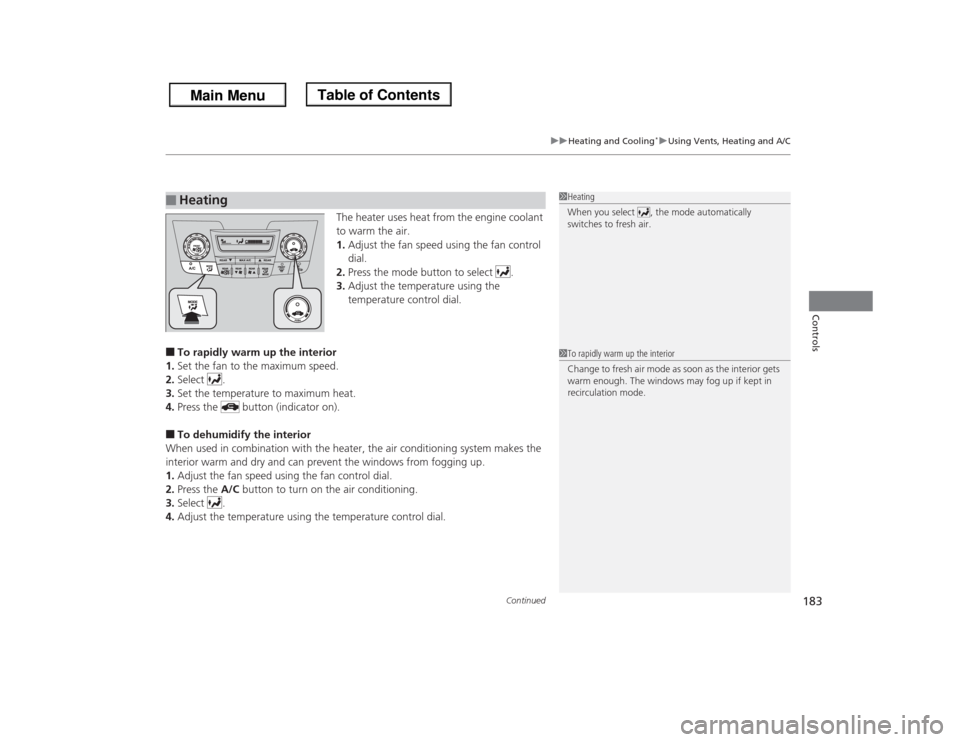
The heater uses heat from the engine coolant
to warm the air.
1.Adjust the fan speed using the fan control
dial.
2.Press the mode button to select .
3.Adjust the temperature using the
temperature control dial.
■To rapidly warm up the interior
1.Set the fan to the maximum speed.
2.Select .
3.Set the temperature to maximum heat.
4.Press the button (indicator on).■To dehumidify the interior
When used in combination with the heater, the air conditioning system makes the
interior warm and dry and can prevent the windows from fogging up.
1.Adjust the fan speed using the fan control dial.
2.Press the A/C button to turn on the air conditioning.
3.Select .
4.Adjust the temperature using the temperature control dial.■
Heating
1Heating
When you select , the mode automatically
switches to fresh air.1To rapidly warm up the interior
Change to fresh air mode as soon as the interior gets
warm enough. The windows may fog up if kept in
recirculation mode.
Page 185 of 433
uuHeating and Cooling
*uUsing Vents, Heating and A/C
184Controls
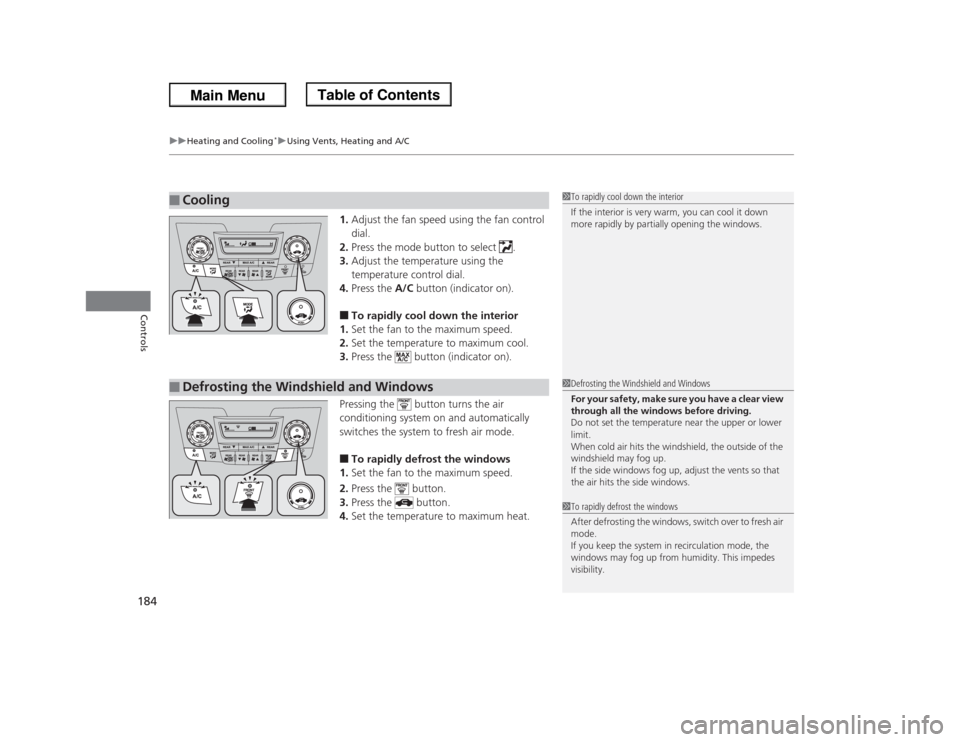
1.Adjust the fan speed using the fan control
dial.
2.Press the mode button to select .
3.Adjust the temperature using the
temperature control dial.
4.Press the A/C button (indicator on).■To rapidly cool down the interior
1.Set the fan to the maximum speed.
2.Set the temperature to maximum cool.
3.Press the button (indicator on).
Pressing the button turns the air
conditioning system on and automatically
switches the system to fresh air mode.■To rapidly defrost the windows
1.Set the fan to the maximum speed.
2.Press the button.
3.Press the button.
4.Set the temperature to maximum heat.
■
Cooling
1To rapidly cool down the interior
If the interior is very warm, you can cool it down
more rapidly by partially opening the windows.
■
Defrosting the Windshield and Windows
1Defrosting the Windshield and Windows
For your safety, make sure you have a clear view
through all the windows before driving.
Do not set the temperature near the upper or lower
limit.
When cold air hits the windshield, the outside of the
windshield may fog up.
If the side windows fog up, adjust the vents so that
the air hits the side windows.1To rapidly defrost the windows
After defrosting the windows, switch over to fresh air
mode.
If you keep the system in recirculation mode, the
windows may fog up from humidity. This impedes
visibility.
Page 186 of 433
185
uuHeating and Cooling
*uRear A/C Controls
Controls
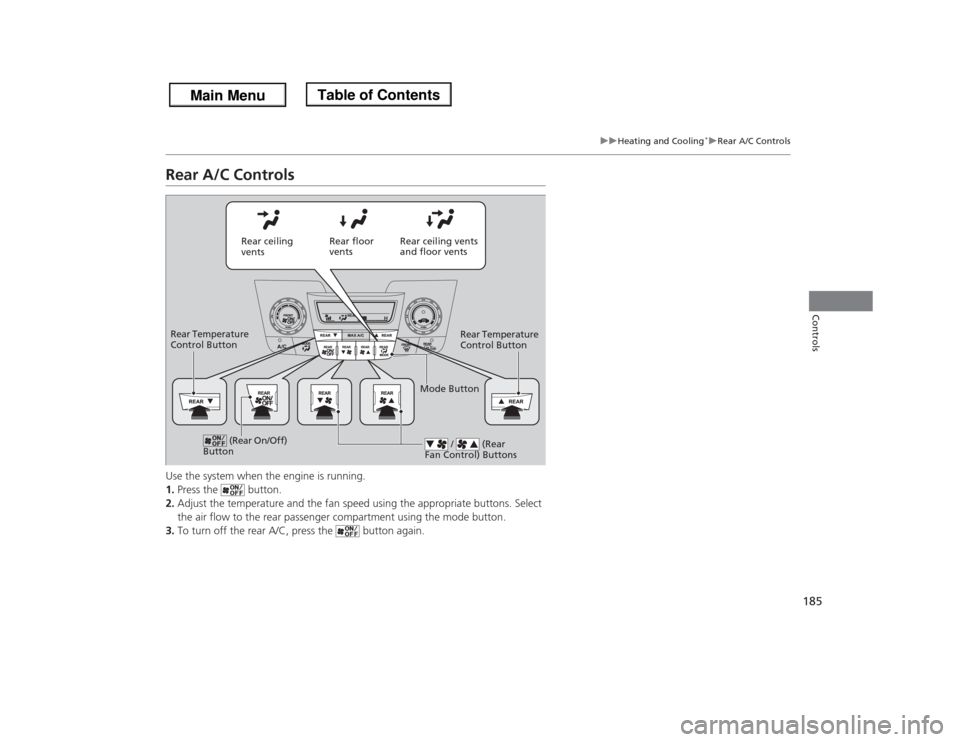
Rear A/C ControlsUse the system when the engine is running.
1.Press the button.
2.Adjust the temperature and the fan speed using the appropriate buttons. Select
the air flow to the rear passenger compartment using the mode button.
3.To turn off the rear A/C, press the button again.
Rear ceiling
ventsRear floor
ventsRear ceiling vents
and floor vents
Rear Temperature
Control Button Rear Temperature
Control Button
(Rear On/Off)
Button
/ (Rear
Fan Control) Buttons
Mode Button
Page 291 of 433
290
uuTowing a TraileruTowing Your Vehicle
Driving
•Monitor your temperature gauge. If it nears the red (Hot) mark, turn off the
heating and cooling system
*/climate control system
* and reduce speed. Pull to the
side of the road safely to cool down the engine if necessary.
•Shift to the
(d
or position (depending on models) if the transmission shifts
frequently.
Towing Your VehicleYour vehicle is not designed to be towed behind a motor home. If your vehicle needs
to be towed in an emergency, refer to the emergency towing information.2Emergency Towing P. 409■
Driving in Hilly Terrain
D4
* Not available on all models
Page 292 of 433

291
Continued
Driving
When DrivingStarting the Engine
1.Make sure the parking brake is applied.
2.Check that the shift lever is in
(P
, then
depress the brake pedal.
uAlthough it is possible to start the vehicle
in
(N
, it is safer to start it in
(P
.
1Starting the Engine
Keep your foot firmly on the brake pedal when
starting the engine.
The engine is harder to start in cold weather and in
thinner air found at altitudes above 8,000 feet (2,400
meters).
When starting the engine in cold weather, turn off all
electrical accessories such as the lights, heating and
cooling system
*/climate control system
*, and rear
defogger in order to reduce battery drain.
If you live in a region where winter is extremely cold,
an engine block heater will improve starting and
warming of the engine. If temperatures consistently
below -22
°F (-30
°C) are expected, the coolant
mixture should be charged to a higher concentration
to prevent freezing. Consult a dealer for details.
If the exhaust system sounds abnormal or you can
smell exhaust gas inside the vehicle, have your vehicle
checked by a dealer. There may be a problem with
the engine or exhaust system.
Brake Pedal
* Not available on all models
Page 324 of 433

323
Maintenance
This chapter discusses basic maintenance.
Before Performing Maintenance
Inspection and Maintenance ............ 324Safety When Performing Maintenance..... 325Parts and Fluids Used in Maintenance
Service ........................................... 326
Maintenance Minder™.................... 327
Maintenance Under the HoodMaintenance Items Under the Hood ..... 335Opening the Hood ........................... 336
Recommended Engine Oil ................ 337
Oil Check ......................................... 338
Adding Engine Oil ............................ 339Changing the Engine Oil and Oil Filter ..... 340
Engine Coolant ................................ 342
Transmission Fluid ............................ 344
Brake Fluid ....................................... 345
Power Steering Fluid Check.............. 346
Refilling Window Washer Fluid......... 346
Replacing Light Bulbs....................... 347Checking and Maintaining Wiper Blades
.... 358
Checking and Maintaining Tires
Checking Tires ................................. 362Tire and Loading Information Label ...... 363Tire Labeling .................................... 363DOT Tire Quality Grading (U.S. Vehicles)....... 365Wear Indicators................................ 367Tire Service Life ................................ 367
Tire and Wheel Replacement ........... 368
Tire Rotation .................................... 369
Winter Tires ..................................... 370
Battery............................................... 371
Remote Transmitter Care................. 372
Remote Control and Wireless
Headphone Care
*........................... 374
Heating and Cooling System
*/Climate
Control System
* Maintenance....... 376
Cleaning
Interior Care .................................... 377
Exterior Care.................................... 379
* Not available on all models
Page 343 of 433
342
uuMaintenance Under the HooduEngine Coolant
Maintenance
Engine CoolantThis coolant is premixed with 50% antifreeze and 50% water. Do not add any
straight antifreeze or water.
We recommend you check the engine coolant level every time you refuel. Check the
reserve tank first. If it is completely empty, also check the coolant level in the
radiator. Add the engine coolant accordingly.
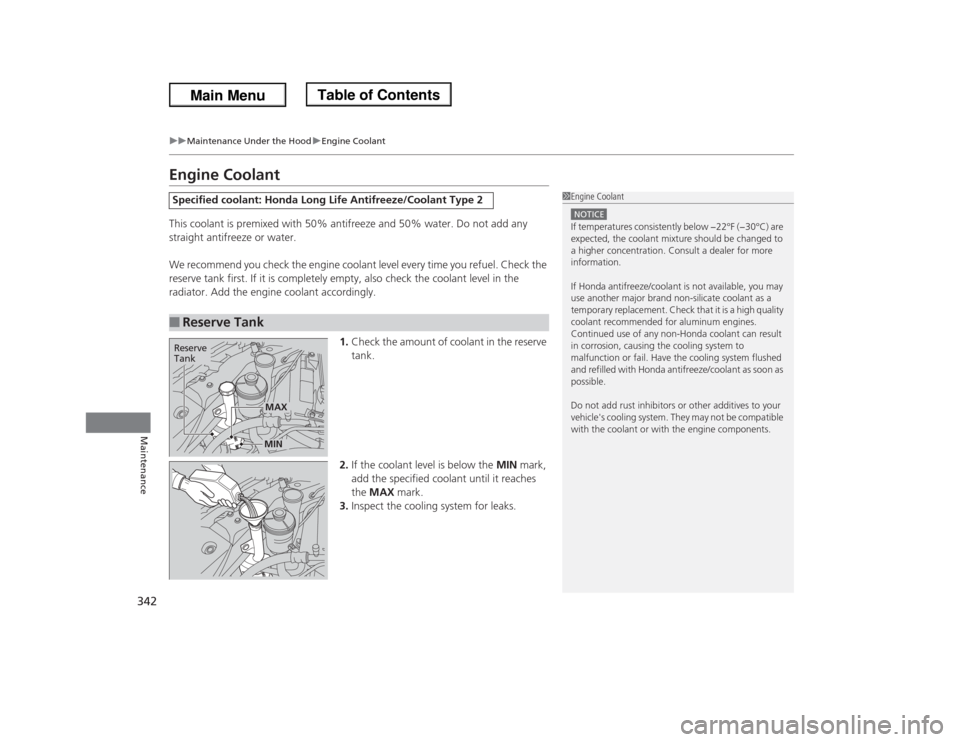
1.Check the amount of coolant in the reserve
tank.
2.If the coolant level is below the MIN mark,
add the specified coolant until it reaches
the MAX mark.
3.Inspect the cooling system for leaks.Specified coolant: Honda Long Life Antifreeze/Coolant Type 2■
Reserve Tank
1Engine CoolantNOTICEIf temperatures consistently below −22°F (−30°C) are
expected, the coolant mixture should be changed to
a higher concentration. Consult a dealer for more
information.
If Honda antifreeze/coolant is not available, you may
use another major brand non-silicate coolant as a
temporary replacement. Check that it is a high quality
coolant recommended for aluminum engines.
Continued use of any non-Honda coolant can result
in corrosion, causing the cooling system to
malfunction or fail. Have the cooling system flushed
and refilled with Honda antifreeze/coolant as soon as
possible.
Do not add rust inhibitors or other additives to your
vehicle's cooling system. They may not be compatible
with the coolant or with the engine components.
Reserve
Tank
MAXMIN