Page 285 of 411

The engine coolant temperature
becomes low.
Thepressureonthebrakepedalis
repeatedly applied and released
slightly during a stop.
The ECON button is off, and the
dif f erence between the ambient
temperature and the temperature
setting of the climate control
system becomes signif icant.
Theclimatecontrolsystemstarts
to dehumidif y the interior
The engine automatically
restarts when:
The brake pedal is released.
Under the f ollowing conditions, the
engine restarts even if the brake
pedal is pressed:
The shift position is changed
to R or L.
The accelerator pedal is pressed
The pressure to the brake pedal is
reduced and the vehicle starts
moving while stopped on an incline.
The IMA battery charge
becomes low.
The engine may not stop automatically
under the f ollowing conditions:
The windshield defroster button
is pressed.
TheECONbuttonisoff,andthere
is a signif icant dif f erence between
the ambient temperature and the
temperature setting of the climate
control system.
The climate control system is
dehumidif ying the air.
The vehicle is stopped by braking
suddenly.
When the ECON button is on, the
engine is more likely to stop. See
page f or the ECON button.
127
Auto Idle Stop
282
12/07/13 17:13:10 31TM8630_287
Bef ore DrivingTOC
2013 Insight
Page 286 of 411
If the auto idle stop function turns
of f the engine f or a long time, the
charge of the IMA and 12 volt
batteries becomes low, and the
engine may not restart automatically.
Always turn the ignition switch to
the LOCK (0) position, set the
parking brake, and remove the key if
you are getting out of the vehicle.Thetimethatautoidlestopis
activated may be reduced if you
operate the windshield wipers with
the climate control system on.
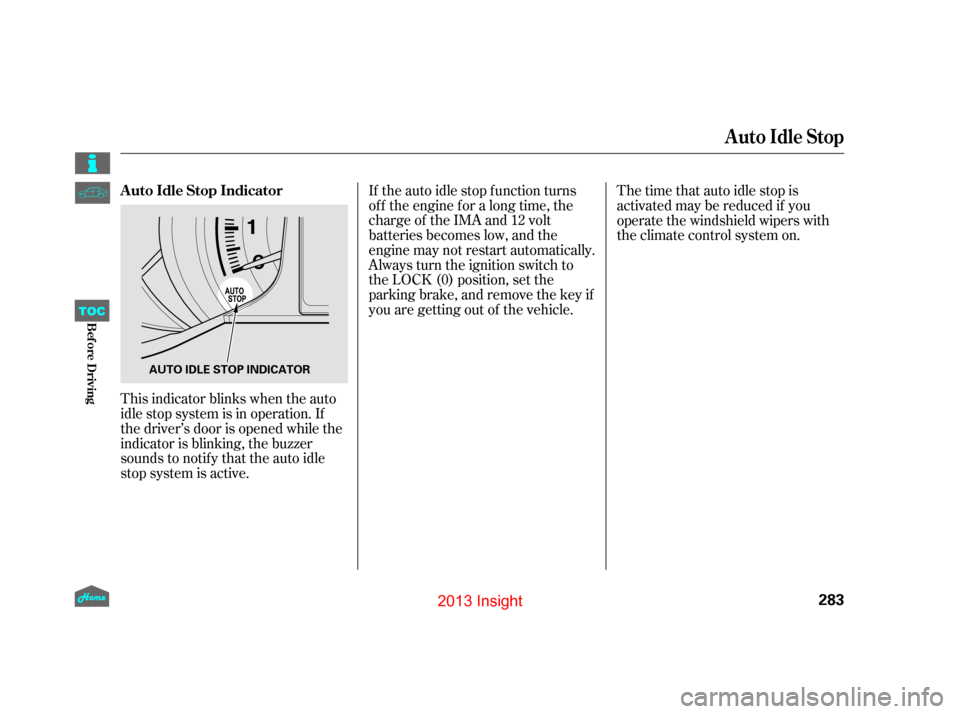
This indicator blinks when the auto
idle stop system is in operation. If
the driver’s door is opened while the
indicator is blinking, the buzzer
sounds to notif y that the auto idle
stop system is active. A uto Idle Stop Indicator
Auto Idle Stop
283
AUTO IDLE STOP INDICATOR
12/07/13 17:13:16 31TM8630_288
Bef ore DrivingTOC
2013 Insight
Page 287 of 411

If the vehicle is facing downhill,
turn the front wheels toward
the curb.
Make sure the parking brake is
f ully released bef ore driving away.
Driving with the parking brake
partially set can overheat or
damage the rear brakes.
Set the parking brake bef ore you put
the transmission in Park. This keeps
the vehicle from moving and putting
pressure on the parking mechanism
in the transmission. Always use the parking brake when
you park your vehicle. Make sure
the parking brake is set f irmly, or
your vehicle may roll if it is parked
on an incline.
Place any packages, valuables, etc.
in the cargo area or take them
with you. Turn of f the lights. Make sure the windows are closed.
Lock the doors and the hatch.
If the vehicle is facing uphill,
turn the front wheels away
from the curb. Never park over dry leaves, tall
grass, or other f lammable
materials. The hot three way
catalytic converter could cause
these materials to catch on fire. Check the indicator on the
instrument panel to verif y that the
security system is set.
LX and EX models
Parking T ips
Parking
284
12/07/13 17:13:24 31TM8630_289
Bef ore DrivingTOC
2013 Insight
Page 288 of 411

Your vehicle is equipped with f ront
disc brakes. The brakes on the rear
wheels are drum. A power assist
helps reduce the ef f ort needed on
thebrakepedal.TheABShelpsyou
retain steering control when braking
very hard.
Resting your f oot on the pedal keeps
the brakes applied lightly, builds up
heat, reduces their ef f ectiveness and
reduces brake pad lif e. In addition,
f uel economy can be reduced. It also
keeps your brake lights on all the
time, conf using drivers behind you.Check the brakes after driving
through deep water. Apply the
brakes moderately to see if they f eel
normal. If not, apply them gently and
f requently until they do. Be extra
cautious in your driving.
Constant application of the brakes
when going down a long hill builds
up heat and reduces their
ef f ectiveness. Use the engine to
assist the brakes by taking your f oot
of f the accelerator and downshif ting
to a lower speed.
Braking System
285
12/07/13 17:13:29 31TM8630_290
Bef ore DrivingTOC
2013 Insight
Page 289 of 411

The hydraulic system that operates
the brakes has two separate circuits.
Each circuit works diagonally across
the vehicle (the lef t-f ront brake is
connected with the right-rear brake,
etc.). If one circuit should develop a
problem, you will still have braking
at two wheels.If the brake pads need replacing, you
will hear a distinctive, metallic
screeching sound when you apply
the brake pedal. If you do not have
the brake pads replaced, they will
screech all the time. It is normal f or
the brakes to occasionally squeal or
squeak when you apply them.
The following features are
also equipped:
With the shift lever in D, S or L, this
f eature applies brake pressure
brief ly as you release the brake
pedal to prevent the vehicle f rom
moving unexpectedly.
This f eature helps you apply the
brakes with less f orce during an
emergency braking situation.
Creep Aid System
Brake-Assist
Braking System Design Brake Pad Wear Indicators
Braking System
286
12/07/13 17:13:36 31TM8630_291
Bef ore DrivingTOC
2013 Insight
Page 290 of 411

The anti-lock brake system (ABS)
helpspreventthewheelsfrom
locking up, and helps you retain
steering control by pumping the
brakes rapidly, much f aster than a
person can do it.
The electronic brake distribution
(EBD) system, which is part of the
ABS, also balances the f ront-to-rear
braking distribution according to
vehicle loading.Let the ABS work f or you by always
keeping f irm, steady pressure on the
brake pedal. This is sometimes
ref erred to as ‘‘stomp and steer.’’
You will f eel a pulsation in the brake
pedal when the ABS activates, and
you may hear some noise. This is
normal: it is the ABS rapidly
pumpingthebrakes.Ondry
pavement, you will need to press on
thebrakepedalveryhardbeforethe
ABS activates. However, you may
feel the ABS activate immediately if
you are trying to stop on snow or ice.If this indicator comes on, the anti-
lock f unction of the braking system
has shut down. The brakes still work
like a conventional system, but
without anti-lock. You should have
your dealer inspect your vehicle as
soon as possible.
When the ABS indicator comes on,
you will also see a ‘‘CHECK ABS
SYSTEM’’ message on the multi-
inf ormation display.
If the ABS indicator comes on while
driving, test the brakes as shown on
page
.
366You should never pump the brake pedal.
CONT INUED
ABS Indicator
Anti-lock Brakes (ABS)
287
12/07/13 17:13:44 31TM8630_292
Bef ore DrivingTOC
2013 Insight
Page 291 of 411

If the ABS indicator and the brake
system indicator come on together,
and the parking brake is f ully
released, the EBD system may also
be shut down.
Test your brakes as instructed on
page. If the brakes feel normal,
drive slowly and have your vehicle
repaired by your dealer as soon as
possible. Avoid sudden hard braking
which could cause the rear
wheels to lock up and possibly
lead to a loss of control. Always steer moderately
when you are braking hard. Severe
or sharp steering wheel movement
can still cause your vehicle to veer
into oncoming traffic or off the road.
on loose or
uneven surfaces, such as gravel or
such as trying to take a
corner too f ast or making a sudden
lane change. Always drive at a It only helps with steering
control during braking.
366 Important Saf ety Reminders ABS cannot prevent a loss of
stability.
A vehicle with A BS may require a
longer distance to stop
A BS will not prevent a skid that
results f rom changing direction
abruptly, A BS does not reduce the time or
distance it takes to stop the
vehicle.
Anti-lock Brakes (ABS)
288
12/07/13 17:13:50 31TM8630_293
safe speed for the road and
weather conditions. anti-lock. or snow, than a vehicle without
Bef ore DrivingTOC
2013 Insight
Page 296 of 411

If this indicator comes on while
driving, pull to the side of the road
when it is saf e, and turn of f the
engine. Reset the system by
restarting the engine. If the VSA
system indicator stays on or comes
back on while driving, have the VSA
system inspected by your dealer.
If the indicator does not come on
when the ignition switch is turned to
the ON (II) position, there may be a
problem with the VSA system. Have
your dealer inspect your vehicle as
soon as possible. When VSA activates, you will see the
VSA system indicator blink.
The vehicle stability assist (VSA)
system helps to stabilize the vehicle
during cornering if the vehicle turns
more or less than desired. It also
assists you in maintaining traction
while accelerating on loose or
slippery road surf aces. It does this
by regulating the engine’s output and
by selectively applying the brakes.
When VSA activates, you may notice
that the engine does not respond to
the accelerator in the same way it
does at other times. There may also
be some noise f rom the VSA
hydraulic system. You will also see
the VSA activation indicator blink.
The VSA system cannot enhance the
vehicle’s driving stability in all
situations and does not control your
vehicle’s entire braking system. It is
still your responsibility to drive and
corner at reasonable speeds and to
leave a sufficient margin of safety. When VSA is off, the VSA OFF
indicator comes on as a reminder.
The VSA system indicator will also
come on when there is a problem in
the hill start assist system. For more
inf ormation, see
page.
The main f unction of the
VSA system is generally known as
Electronic Stability Control (ESC).
The system also includes a traction
control f unction.
When the VSA system indicator
comes on, you will also see a
‘‘CHECK VSA SYSTEM’’ or
‘‘CHECK HILL START ASSIST
SYSTEM’’ message on the multi-
inf ormation display. 295
Vehicle Stability Assist
(VSA ) System Indicator VSA OFF Indicator
Vehicle Stability A ssist (VSA), aka Electronic Stability Control (ESC), System
293
NOTE:
12/07/13 17:14:27 31TM8630_298
Bef ore DrivingTOC
2013 Insight