Page 2 of 286

Contents
Child Safety P. 49 Exhaust Gas Hazard P. 61 Safety Labels P. 62
Opening and Closing the Tailgate P. 88Security System P. 90
Operating the Switches Around the Steering Wheel P. 94 Adjusting the Mirrors P. 102
Interior Lights/Interior Convenience Items P. 111 Heating and Cooling *
P. 118
Audio Error Messages P. 135 General Information on the Audio System P. 137
When Driving P. 161 Braking P. 181 Parking Your Vehicle P. 185
Accessories and Modifications P. 190
Maintenance Under the Hood P. 199 Replacing Light Bulbs P. 212
Checking and Maintaining Tires P. 222 Battery P. 231 Remote Transmitter Care *
P. 232
Cleaning P. 234
Engine Does Not Start P. 250 Jump Starting P. 251 Shift Lever Does Not Move P. 253
Fuses P. 260 Emergency Towing P. 264
Devices that Emit Radio Waves P. 271 Reporting Safety Defects P. 272
Authorized Manuals P. 277 Customer Service Information P. 278
Quick Reference GuideP. 2
Safe DrivingP. 21
Instrument PanelP. 63
ControlsP. 75
FeaturesP. 121
DrivingP. 153
MaintenanceP. 191
Handling the UnexpectedP. 237
InformationP. 267
IndexP. 279
Note: All page numbers referenced in this document are hyperlinked.
2013 Fit Online Reference Owner's Manual
Page 6 of 286
5
Quick Reference Guide
❙Seat Belt to Secure a Child Seat (P57)
❙Seat Belt (Installing a Child Seat) (P56)
❙Sun Visors
❙Vanity Mirrors
❙Map Lights*
(P111)
❙USB Adapter Cable *
(P123)
❙Seat Belts (P26)
❙Side Airbags (P41)
❙Side Curtain Airbags (P44)
❙Coat Hook (P116)
❙Grab Handle
❙Ceiling Light (P111)
❙Seat Belt with Detachable Anchor (P31)
❙Rear Seat (P108)
❙LATCH to Secure a Child Seat (P54)
❙Front Seat
(P103)
❙Rear Side Pocket (Right Side)
❙Cargo Floor Box *
(P115)
❙Cargo Area Light (P112)
* Not available on all models
Main Menu
Page 9 of 286
8
Quick Reference Guide
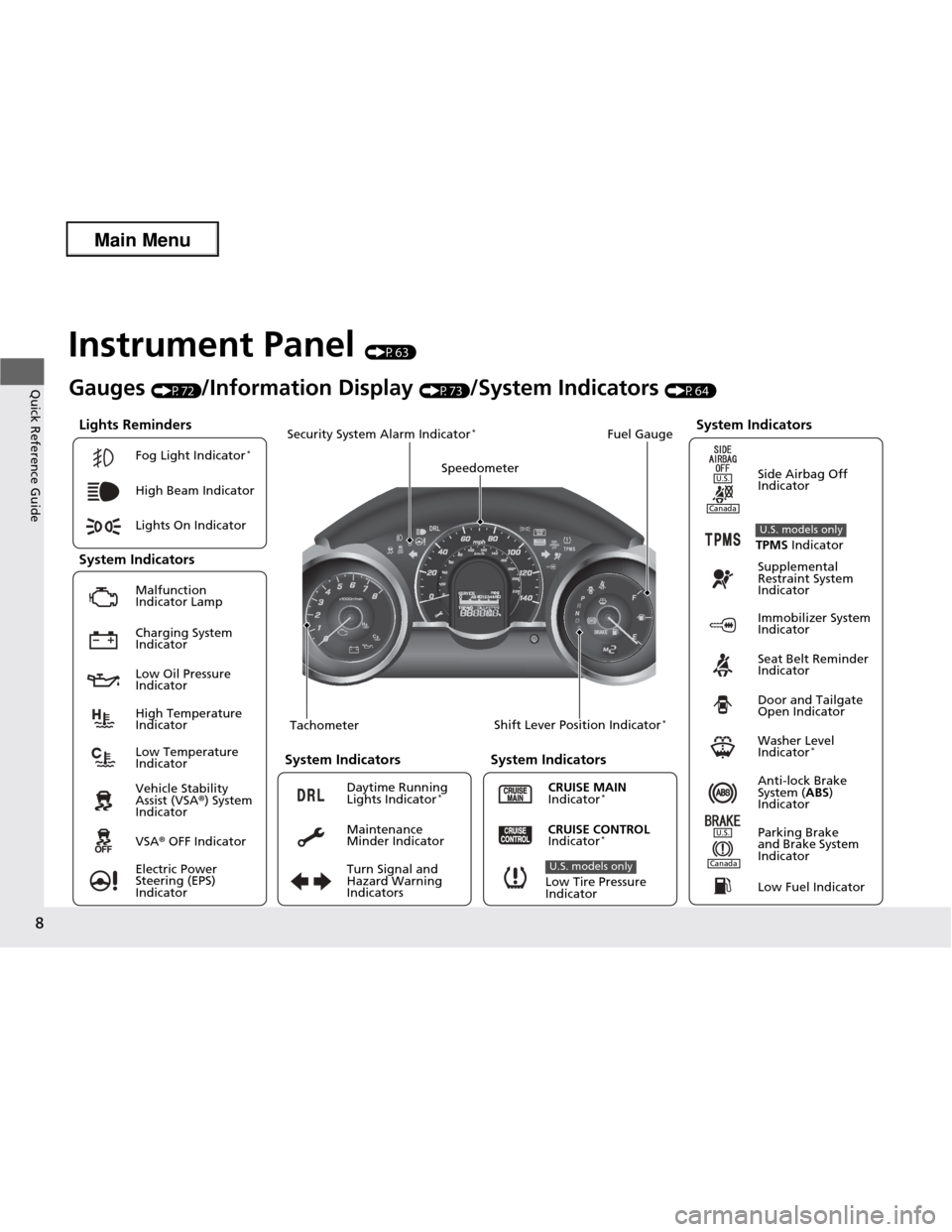
Instrument Panel (P63)
Lights Reminders
Malfunction
Indicator Lamp Low Oil Pressure Indicator Anti-lock Brake
System (ABS)
Indicator
Vehicle Stability Assist (VSA
®) System
Indicator VSA ® OFF Indicator
Electric Power Steering (EPS) Indicator
Lights On Indicator
High Beam Indicator
Immobilizer System
Indicator
Seat Belt Reminder
Indicator
System Indicators
CRUISE MAIN
Indicator * Supplemental
Restraint System
Indicator
Side Airbag Off
Indicator
Door and Tailgate
Open Indicator
Tachometer Speedometer
Fuel Gauge
Security System Alarm Indicator *
Shift Lever Position Indicator *
Low Fuel Indicator
Gauges
(P72)/Information Display (P73)/System Indicators (P64)
Turn Signal and Hazard Warning Indicators
High Temperature Indicator
Low Temperature Indicator
System Indicators System Indicators
Low Tire Pressure
Indicator
U.S. models only
Parking Brake
and Brake System
IndicatorCRUISE CONTROL
Indicator * System Indicators
Charging System Indicator
U.S.
U.S.
Canada
TPMS
Indicator
U.S. models only
Washer Level
Indicator *
Daytime Running Lights Indicator
*
Maintenance
Minder Indicator
Fog Light Indicator
*
Canada
Main Menu
Page 19 of 286
18
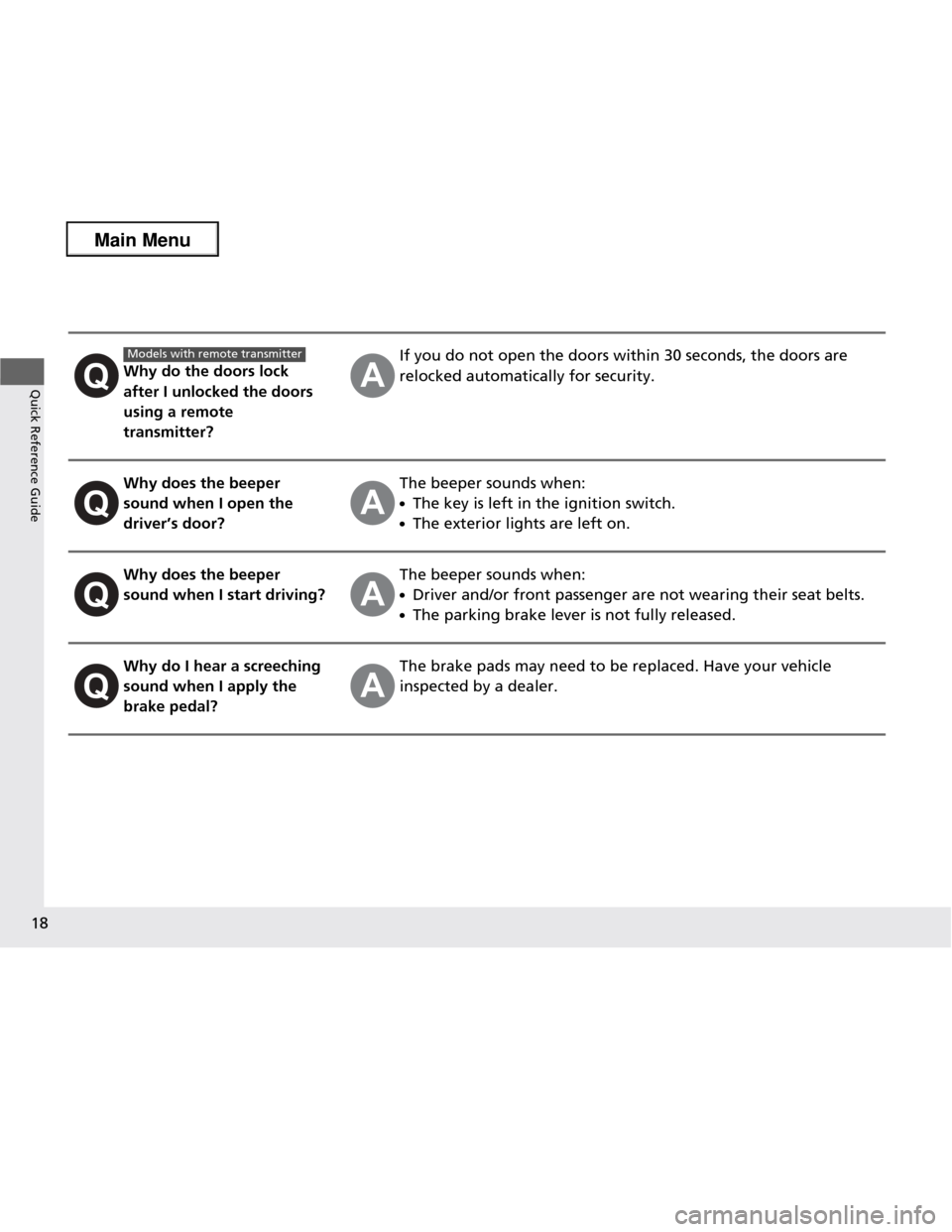
Quick Reference GuideWhy do the doors lock
after I unlocked the doors
using a remote
transmitter?
If you do not open the doors within 30 seconds, the doors are
relocked automatically for security.
Why does the beeper
sound when I open the driver’s door?The beeper sounds when: ●The key is left in the ignition switch.
● The exterior lights are left on.
Why does the beeper
sound when I start driving?The beeper sounds when: ●Driver and/or front passeng er are not wearing their seat belts.
● The parking brake lever is not fully released.
Why do I hear a screeching
sound when I apply the
brake pedal?The brake pads may need to be replaced. Have your vehicle
inspected by a dealer.
Models with remote transmitter
Main Menu
Page 30 of 286
29
uuSeat BeltsuFastening a Seat Belt
Continued
Safe Driving
Fastening a Seat Belt
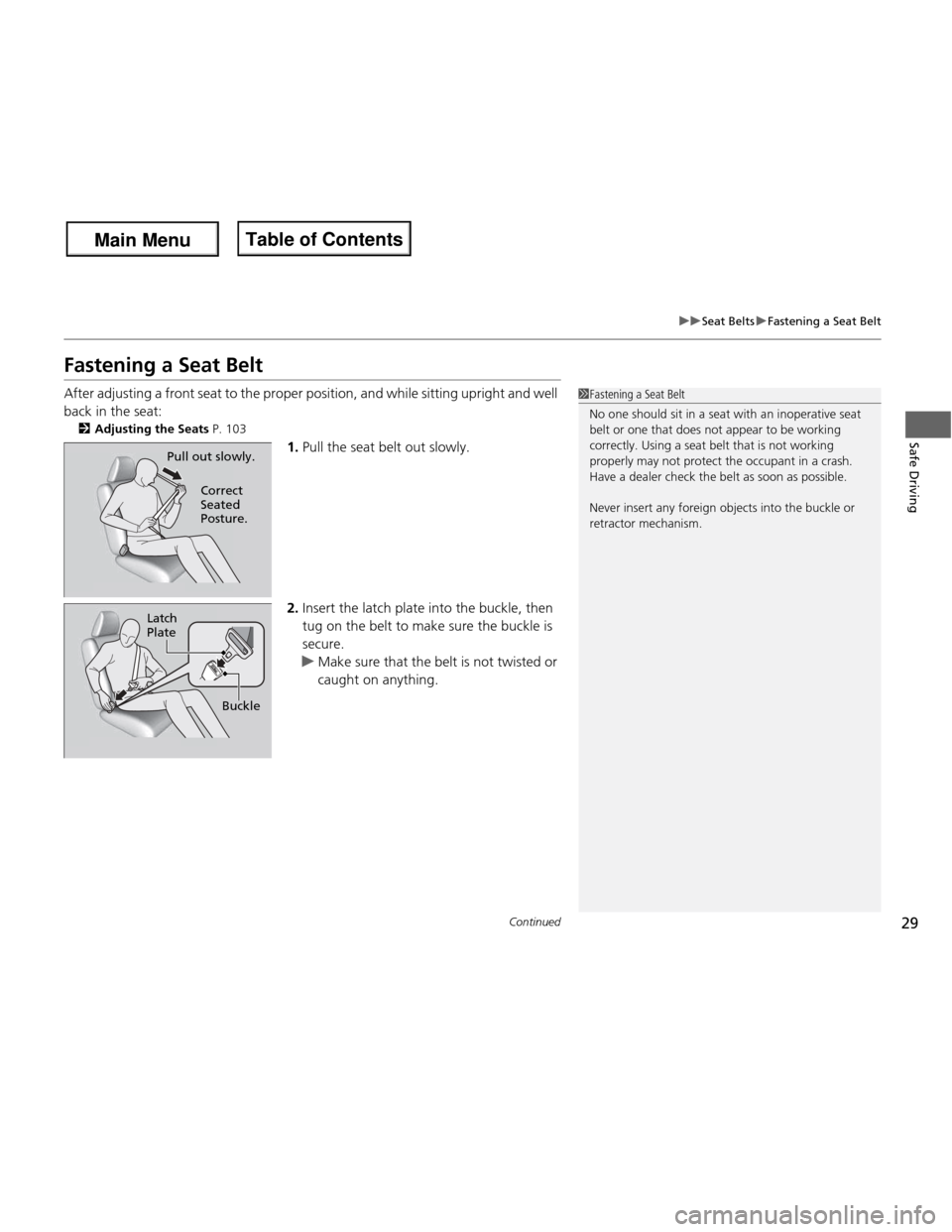
After adjusting a front seat to the proper position, and while sitting upright and well back in the seat:2 Adjusting the Seats P. 103
1.Pull the seat belt out slowly.
2. Insert the latch plate into the buckle, then
tug on the belt to make sure the buckle is secure.
uMake sure that the belt is not twisted or
caught on anything.
1Fastening a Seat Belt
No one should sit in a seat with an inoperative seat
belt or one that does not appear to be working
correctly. Using a seat belt that is not working
properly may not protect the occupant in a crash.
Have a dealer check the belt as soon as possible.
Never insert any foreign objects into the buckle or
retractor mechanism.
Pull out slowly.
Correct
Seated Posture.
Latch Plate
Buckle
Main MenuTable of Contents
Page 31 of 286
uuSeat BeltsuFastening a Seat Belt
30
Safe Driving
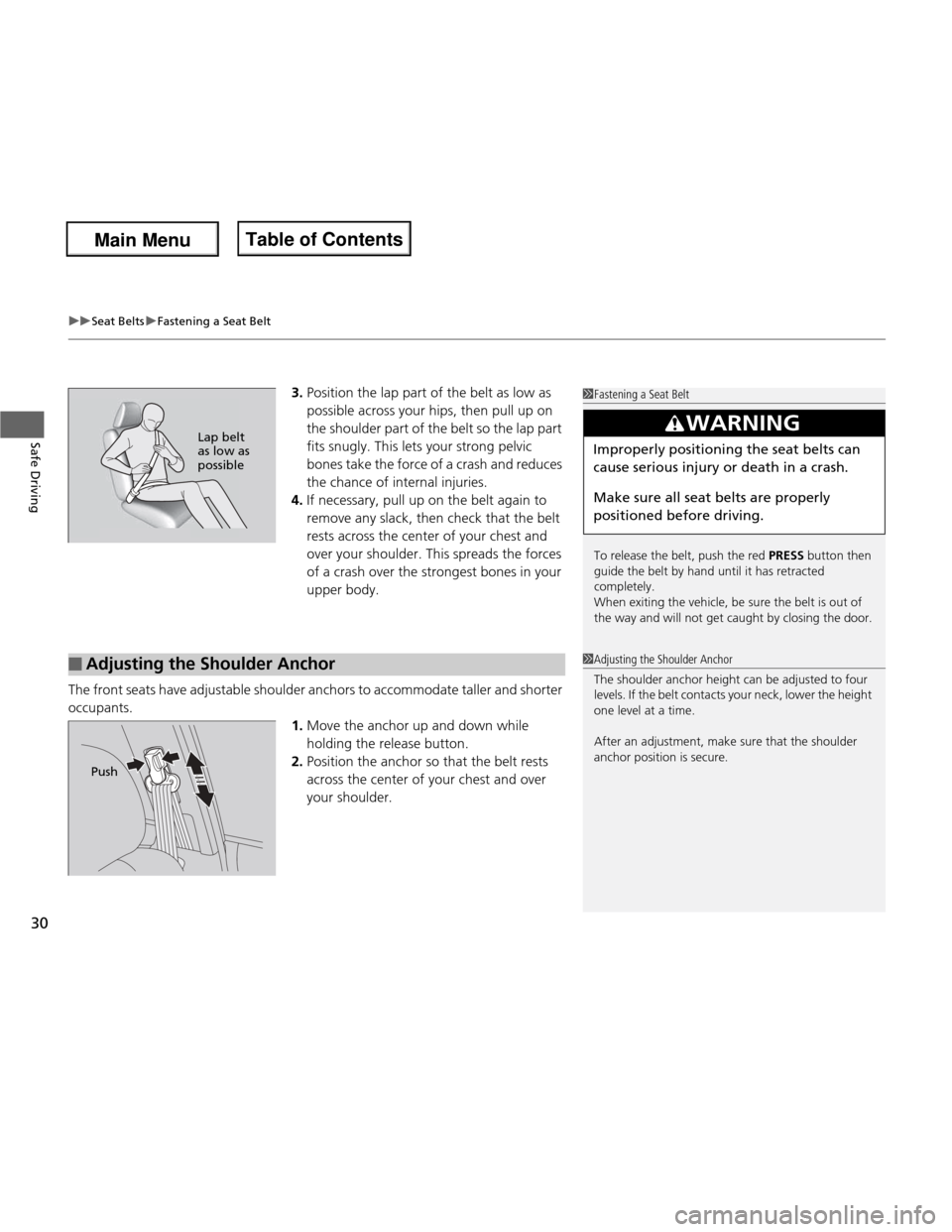
3. Position the lap part of the belt as low as
possible across your hips, then pull up on
the shoulder part of the belt so the lap part
fits snugly. This lets your strong pelvic
bones take the force of a crash and reduces the chance of internal injuries.
4. If necessary, pull up on the belt again to
remove any slack, then check that the belt
rests across the center of your chest and
over your shoulder. This spreads the forces
of a crash over the strongest bones in your
upper body.
The front seats have adjustable shoulder anchors to accommodate taller and shorter
occupants. 1.Move the anchor up and down while
holding the release button.
2. Position the anchor so that the belt rests
across the center of your chest and over
your shoulder.1Fastening a Seat Belt
To release the belt, push the red PRESS button then
guide the belt by hand until it has retracted
completely.
When exiting the vehicle, be sure the belt is out of
the way and will not get caught by closing the door.
3WARNING
Improperly positioning the seat belts can
cause serious injury or death in a crash.
Make sure all seat belts are properly
positioned before driving.Lap belt as low as
possible
■Adjusting the Shoulder Anchor1Adjusting the Shoulder Anchor
The shoulder anchor height can be adjusted to four
levels. If the belt contacts your neck, lower the height
one level at a time. After an adjustment, make sure that the shoulder
anchor position is secure.
Push
Main MenuTable of Contents
Page 51 of 286

uuChild SafetyuProtecting Child Passengers
50
Safe Driving
• Any child who is too small to wear a seat belt correctly must be restrained in an
approved child seat that is properly secured to the vehicle using either the lap belt
portion of the lap/shoulder belt or the lower anchors of the LATCH system.
• Never hold a child on your lap because it is impossible to protect them in the
event of a collision.
• Never put a seat belt over yourself and a child. During a crash, the belt would
likely press deep into the child and cause serious or fatal injuries.
• Never let two children use the same seat belt. Both children could be very
seriously injured in a crash.
• Do not allow children to operate the doors, windows or seat adjustments.
• Do not leave children in the vehicle unattend ed, especially in hot weather when
the inside of the vehicle can get hot enough to kill them. They could also activate
vehicle controls causing it to move unexpectedly.1Protecting Child Passengers
To deactivate a lockable retractor, release the buckle
and allow the seat belt to wind up all the way.
To remind you of the passenger’s front airbag
hazards and child safety, your vehicle has warning
labels on the dashboard (U.S. models) and on the
front visors. Please read and follow the instructions
on these labels. 2 Safety Labels P. 62
3WARNING
Allowing a child to play with a seat belt or
wrap one around their neck can result in
serious injury or death.
Instruct children not to play with any seat
belt and make sure any unused seat belt a
child can reach is bu ckled, fully retracted,
and locked.
Main Menu
Main MenuTable of Contents
Page 52 of 286
51
uuChild SafetyuSafety of Infants and Small Children
Continued
Safe Driving
Safety of Infants and Small Children
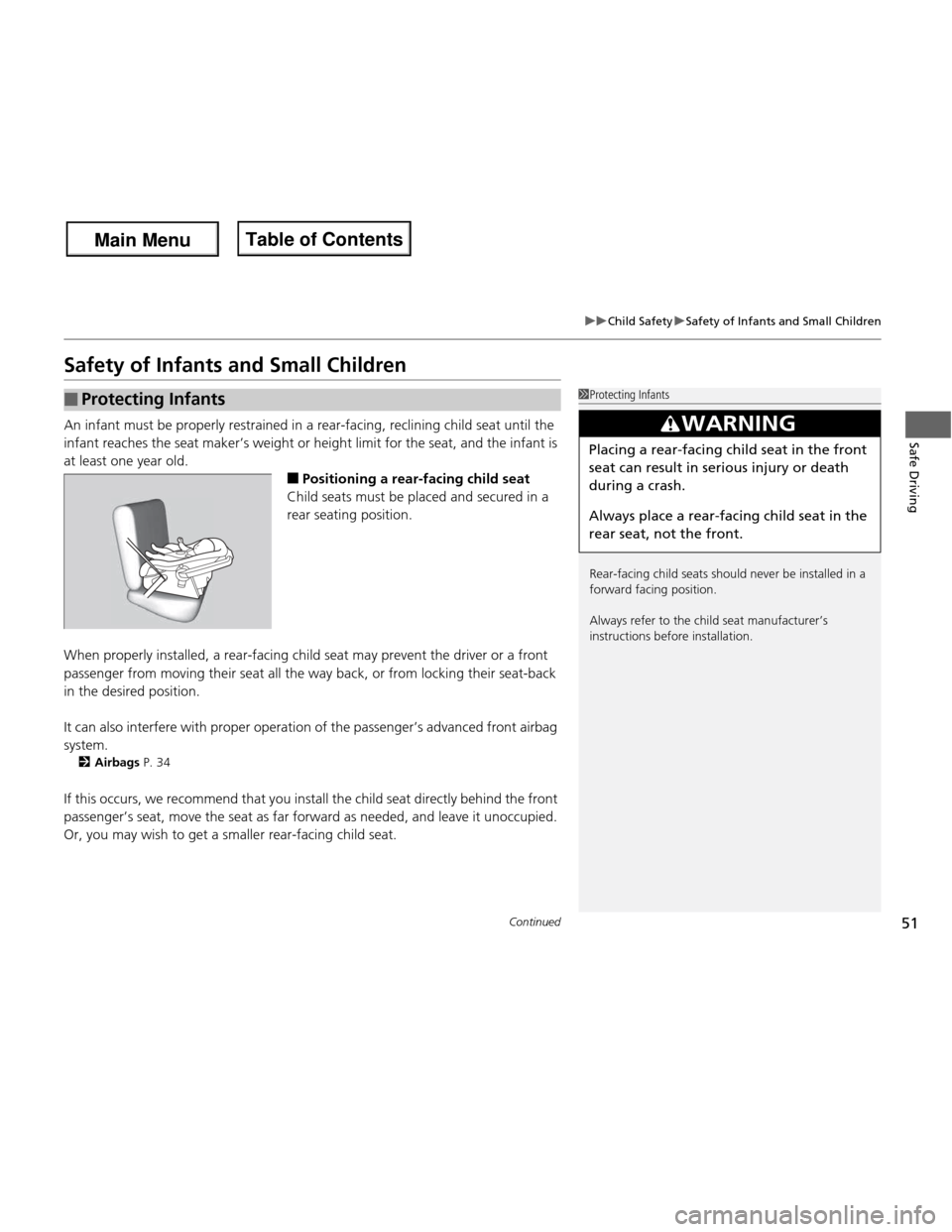
An infant must be properly restrained in a rear-facing, reclining child seat until the
infant reaches the seat maker’s weight or height limit for the seat, and the infant is
at least one year old.■Positioning a rear-facing child seat
Child seats must be placed and secured in a
rear seating position.
When properly installed, a rear-facing child seat may prevent the driver or a front
passenger from moving their seat all the way back, or from locking their seat-back in the desired position.
It can also interfere with proper operation of the passenger’s advanced front airbag
system. 2 Airbags P. 34
If this occurs, we recommend that you install the child seat directly behind the front
passenger’s seat, move the seat as far forward as needed, and leave it unoccupied. Or, you may wish to get a smaller rear-facing child seat.
■Protecting Infants1Protecting Infants
Rear-facing child seats should never be installed in a
forward facing position.
Always refer to the chi ld seat manufacturer’s
instructions before installation.
3WARNING
Placing a rear-facing child seat in the front
seat can result in serious injury or death
during a crash.
Always place a rear-facing child seat in the
rear seat, not the front.
Main Menu
Main MenuTable of Contents