Page 237 of 286

uuCleaninguExterior Care
236
Maintenance
A good coat of automotive body wax helps protect your vehicle’s paint from the
elements. Wax will wear off over time and expose your vehicle’s paint to the
elements, so reapply as necessary.
If you get gasoline, oil, engine coolant, or battery fluid on resin coated parts, they
may be stained or the coating may peel. Promptly wipe it away using a soft cloth and clean water.
Wipe using a glass cleaner.
Aluminum is susceptible to deterio ration caused by salt and other road
contaminants. Use a sponge and mild de tergent to wipe away promptly.
Be careful not to use harsh chemicals (including some commercial wheel cleaners) or
a stiff brush. They can damage the clear coat of the aluminum alloy wheels that
helps keep the aluminum from corroding and tarnishing.
■Applying Wax
■Maintaining the Bumpers and Other Resin Coated Parts
■Cleaning the Window
■Maintaining Aluminum Wheels *
1Applying Wax
NOTICE
Chemical solvents and strong cleaners can damage
the paint, metal, and plastic on your vehicle. Wipe up
spills immediately.
1Maintaining the Bumpers and Other Resin Coated Parts
Ask a dealer about the correct coating material when
you want to repair the painted surface of the parts made of resin.
1Cleaning the Window
Wires are mounted to the inside of the rear window.
Wipe along the same direction as the wires with a
soft cloth so as not to damage them.
* Not available on all models
Main Menu
Main MenuTable of Contents
Page 238 of 286

237
Handling the UnexpectedThis chapter explains how to handle unexpected troubles.
Tools
Types of Tools .................................. 238
If a Tire Goes Flat
Changing a Flat Tire *
....................... 239
Temporarily Repairing a Flat Tire....... 245
Engine Does Not Start Checking the Engine ........................ 250
Jump Starting .................................... 251
Shift Lever Does Not Move .............. 253
Overheating How to Handle Overheating ............. 254 Indicator, Coming On/Blinking
If the Low Oil Pressure Indicator Comes On................................................ 256
If the Charging System Indicator Comes
On ................................................. 256
If the Malfunction Indicator Lamp Comes On or Blinks ..................................... 257
If the Brake System Indicator Comes On .. 258
If the EPS System Indicator Comes On258
If the Low Tire Pressure Indicator Comes On ................................................. 259
If the TPMS Indicator Comes On ...... 259 Fuses
Fuse Locations ................................. 260
Inspecting and Changing Fuses ........ 263
Emergency Towing ........................... 264
Main Menu
Main Menu
Page 243 of 286

uuIf a Tire Goes FlatuChanging a Flat Tire*
242
Handling the Unexpected
1. Place the jack under the jacking point
closest to the tire to be changed.
2. Turn the end bracket (as shown in the
image) clockwise until the top of the jack
contacts the jacking point.
uMake sure that the jacking point tab is
resting in the jack notch.
3. Raise the vehicle, using the jack handle bar
and the jack handle, until the tire is off the
ground.
■How to Set Up the Jack1How to Set Up the Jack
Do not use the jack with people or luggage in the
vehicle.
Use the jack provided in your vehicle.
Other jacks may not support the weight (“load”) or their shape may not match.
The following instructions must be followed to use the jack safely.
• Do not use while the engine is running.
• Use only where the ground is firm and level.
• Use only at the jacking points.
• Do not get in the vehicle while using the jack.
• Do not put anything on top of or underneath the
jack.
3WARNING
The vehicle can easily roll off the jack,
seriously injuring anyone underneath.
Follow the directions for changing a tire
exactly, and never get under the vehicle
when it is supported only by the jack.
Jack Handle Bar Wheel Nut
Wrench as Jack Handle
Main Menu
Main MenuTable of Contents
Page 248 of 286

Continued247
uuIf a Tire Goes FlatuTemporarily Repairing a Flat Tire
Handling the Unexpected
6.Remove the bottle cap from the bottle
adapter.
7. Attach the air compressor hose onto the
bottle adapter. Screw it until it is tight.
8. Plug in the compressor to the accessory power socket. Be careful not to pinch the
cord in a door or window.
9. Turn the ignition switch to ACCESSORY
(q .
uIn freezing temperatures, start the
engine on and leave it running while
the flat tire is being serviced.
2 Carbon Monoxide Gas P. 61
10. Turn the air compressor on to inflate the tire.
uThe compressor starts injecting sealant
and air into the tire.
11. Inflate the tire.
12. After the air pressure reaches to 33 psi
(230 kPa), turn off the kit.
uCheck the air pressure gauge on the air
compressor.
1Injecting Sealant and Air
NOTICE
Operating the pump for more than 15 minutes may
cause it to overheat and become permanently damaged.
Until the sealant injectio n is complete, the pressure
shown on the pressure gauge will appear higher than
actual. After the sealan t injection is complete the
pressure will drop and then begin to rise again as the
tire is inflated with air. Th is is normal. To accurately
measure the air pressure using the gauge, turn the air
compressor off only after the sealant injection is complete.
3WARNING
Running the engine with the vehicle in an
enclosed or even partly enclosed area can
cause a rapid build-up of toxic carbon
monoxide.
Breathing this colorless, odorless gas can
cause unconsciousness and even death. Only run the engi ne to power the air
compressor with the vehicle outdoors.
Bottle Adapter
Air Compressor Hose Bottle Cap
Air Compressor Switch
OFF
ON
Main Menu
Main MenuTable of Contents
Page 251 of 286

250
Handling the Unexpected
Engine Does Not Start
Checking the Engine
If the engine does not start, turn the ignition switch to START
(e and check the
starter.
Starter conditionChecklist
Starter doesn’t turn or turns over slowly.
The battery may be dead. Check
each of the items on the right and
respond accordingly.Check brightness of the interior light.
Turn on interior lights and check brightness. ● If the interior lights are dim or do not come on at all
2Battery P. 231
● If the interior lights come on normally 2 Inspecting and Changing Fuses P. 263
The starter turns over normally
but the engine doesn’t start.
There may be a problem with the
fuse. Check each of the items on
the right and respond accordingly.Review the engine start procedure.
Follow its instructions, and try to start the engine again. 2 Starting the Engine P. 161
Check the immobilizer system indicator.
When the immobilizer system indicator is blinking, the engine cannot be started.
2Immobilizer System P. 90
Check the fuel level. There should be enough fuel in the tank. 2 Fuel Gauge P. 72
Check the fuse.
Check all fuses, or have the vehicle checked by a dealer.
2Inspecting and Changing Fuses P. 263
If the problem continues:
2 Emergency Towing P. 264
1Checking the Engine
If you must start the vehicle immediately, use an assisting vehicle to jump start it.
2 Jump Starting P. 251
Main Menu
Main MenuTable of Contents
Page 252 of 286
251
Continued
Handling the Unexpected
Jump Starting
Turn off the power to electric devices, such as audio and lights. Turn off the engine,
then open the hood.
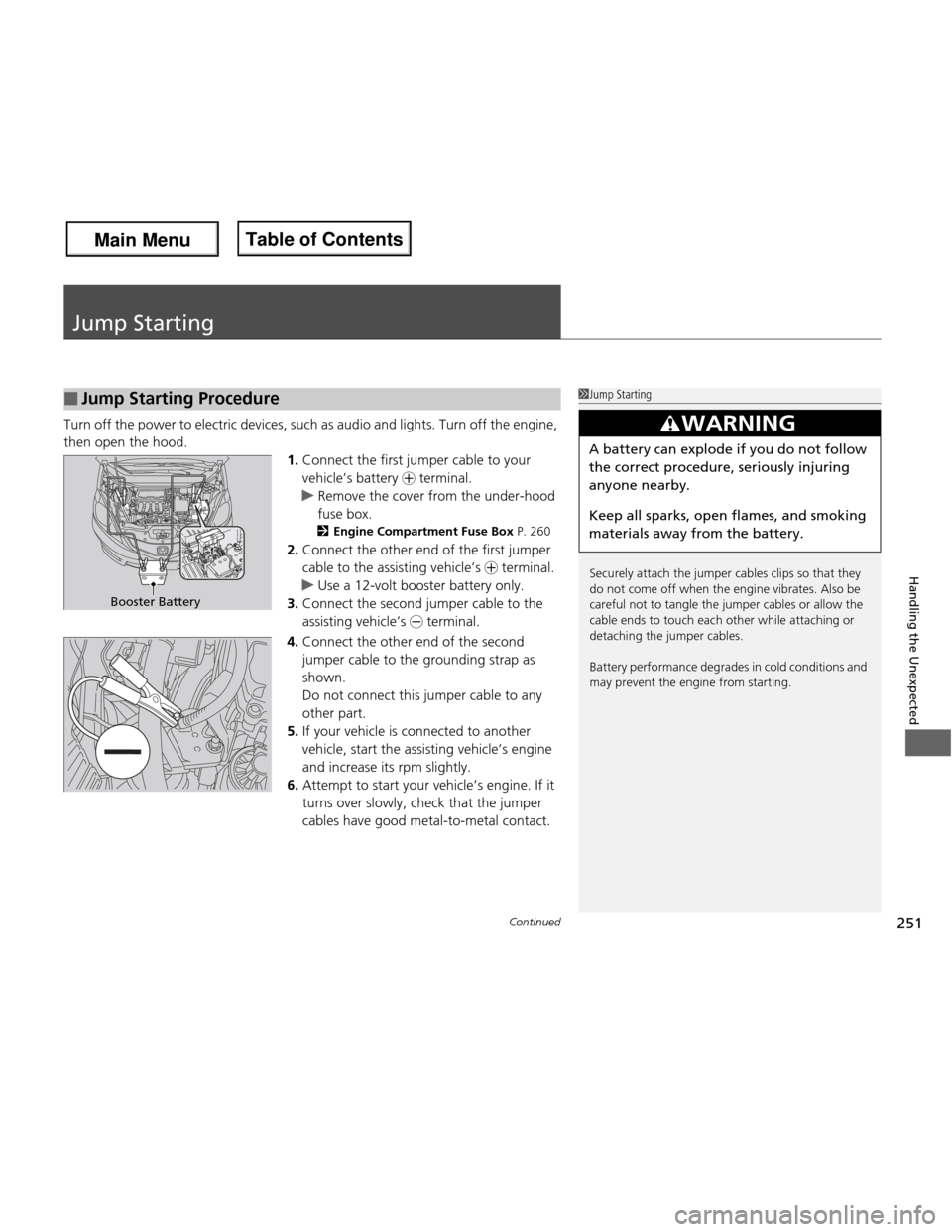
1.Connect the first jumper cable to your vehicle’s battery + terminal.
uRemove the cover from the under-hood fuse box.
2 Engine Compartment Fuse Box P. 260
2. Connect the other end of the first jumper
cable to the assisting vehicle’s + terminal.
uUse a 12-volt booster battery only.
3. Connect the second jumper cable to the
assisting vehicle’s - terminal.
4. Connect the other end of the second
jumper cable to the grounding strap as
shown.
Do not connect this jumper cable to any other part.
5. If your vehicle is co nnected to another
vehicle, start the assisting vehicle’s engine
and increase its rpm slightly.
6. Attempt to start your vehicle’s engine. If it
turns over slowly, check that the jumper cables have good metal-to-metal contact.
■Jump Starting Procedure1Jump Starting
Securely attach the jumper cables clips so that they
do not come off when the engine vibrates. Also be
careful not to tangle the jumper cables or allow the
cable ends to touch each other while attaching or
detaching the jumper cables.
Battery performance degrades in cold conditions and
may prevent the engine from starting.
3WARNING
A battery can explode if you do not follow the correct procedure, seriously injuring anyone nearby.
Keep all sparks, open flames, and smoking
materials away from the battery.
Booster Battery
Main Menu
Main MenuTable of Contents
Page 253 of 286
252
uuJump Startingu
Handling the Unexpected
Once your vehicle’s engine has started, remove the jumper cables in the following order. 1.Disconnect the jumper cable from your vehicle’s ground.
2. Disconnect the other end of the jumper cable from the assisting vehicle’s battery
- terminal.
3. Disconnect the jumper cable from your vehicle’s battery + terminal.
4. Disconnect the other end of the jumper cable from the assisting vehicle’s battery
+ terminal.
Have your vehicle inspected by a nearby service station or a dealer.
■What to Do After the Engine Starts
Main Menu
Main MenuTable of Contents
Page 255 of 286
254
Handling the Unexpected
Overheating
How to Handle Overheating
Overheating symptoms are as follows: •The high temperature indicator comes on or the engine suddenly loses power.
• Steam or spray comes out of the engine compartment.
■ First thing to do
1. Immediately park the vehicle in a safe place.
2. Turn off all accessories and turn on the hazard warning lights.
uNo steam or spray present: Keep the engine running and open the hood.
uSteam or spray is present: Turn off the engine and wait until it subsides.
Then open the hood.
1How to Handle Overheating
NOTICE
Continuing to drive with the high temperature
indicator on may damage the engine.
3WARNING
Steam and spray from an overheated
engine can seriously scald you.
Do not open the ho od if steam is coming
out.
Main Menu
Main MenuTable of Contents