2013 HONDA CROSSTOUR tires
[x] Cancel search: tiresPage 504 of 573

503
uuChecking and Maintaining TiresuTire and Wheel Replacement
Maintenance
Tire and Wheel Replacement
Replace your tires with radials of the same size, load range, speed rating, and
maximum cold tire pressure rating (as shown on the tire’s sidewall). Using tires of a
different size or construction can cause the ABS and VSA® (vehicle stability assist)
system to work incorrectly.
It is best to replace all four tires at the same time. If that isn’t possible, replace the
front or rear tires in pairs.
Make sure that the wheel’s specifications match those of the original wheels.
If you replace a wheel, only use TPMS specified wheels approved for your vehicle.
1Tire and Wheel Replacement
3WARNING
Installing improper tires on your vehicle can
affect handling and stability. This can cause
a crash in which you can be seriously hurt or
killed.
Always use the size and type of tires
recommended in this owner
Page 505 of 573
504
uuChecking and Maintaining TiresuTire Rotation
Maintenance
Tire Rotation
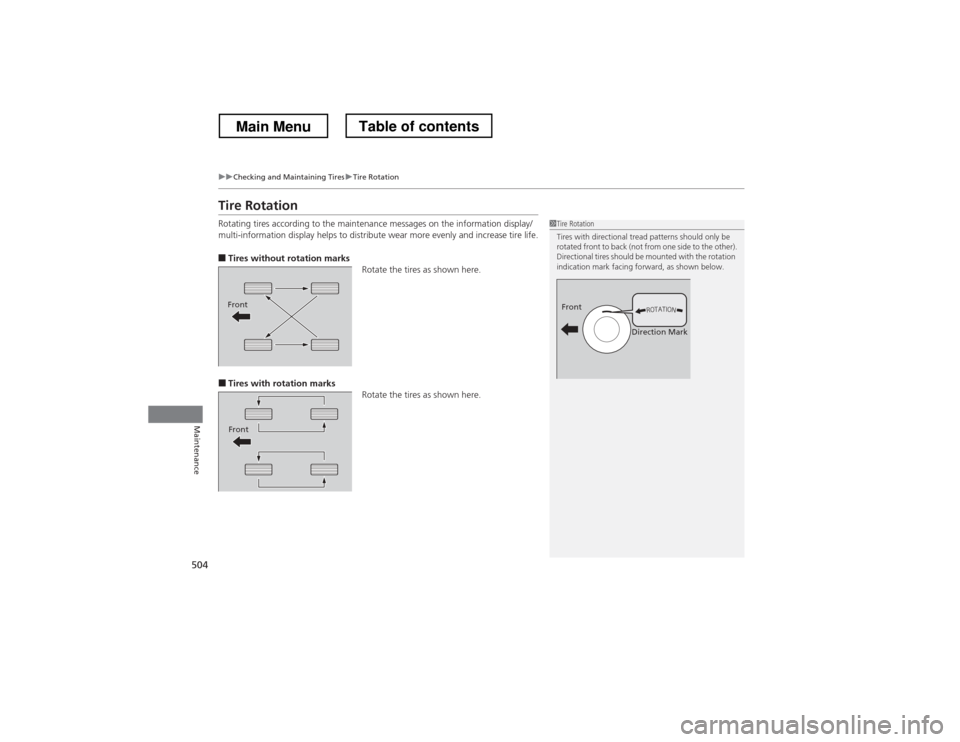
Rotating tires according to the maintenance messages on the information display/
multi-information display helps to distribute wear more evenly and increase tire life. ■Tires without rotation marks
Rotate the tires as shown here.
■ Tires with rotation marks
Rotate the tires as shown here.
1Tire Rotation
Tires with directional tread patterns should only be
rotated front to back (not from one side to the other).
Directional tires should be mounted with the rotation
indication mark facing forward, as shown below.
Front
Direction MarkFront
Front
Main MenuTable of contents
Page 506 of 573
505
uuChecking and Maintaining TiresuWinter Tires
Maintenance
Winter Tires
If driving on snowy or frozen roads, mount all season marked M+S tires, snow tires,
or tire chains; reduce speed; and maintain sufficient distance between vehicles when
driving.
Be particularly careful when operating the steering wheel or brakes to prevent
skidding.
Use tire chains, snow tires, or all season tires when necessary or according to the law.
When mounting, refer to the following points.
For winter tires: • Select the size and load ranges that are the same as the original tires.
• Mount the tires to all four wheels.
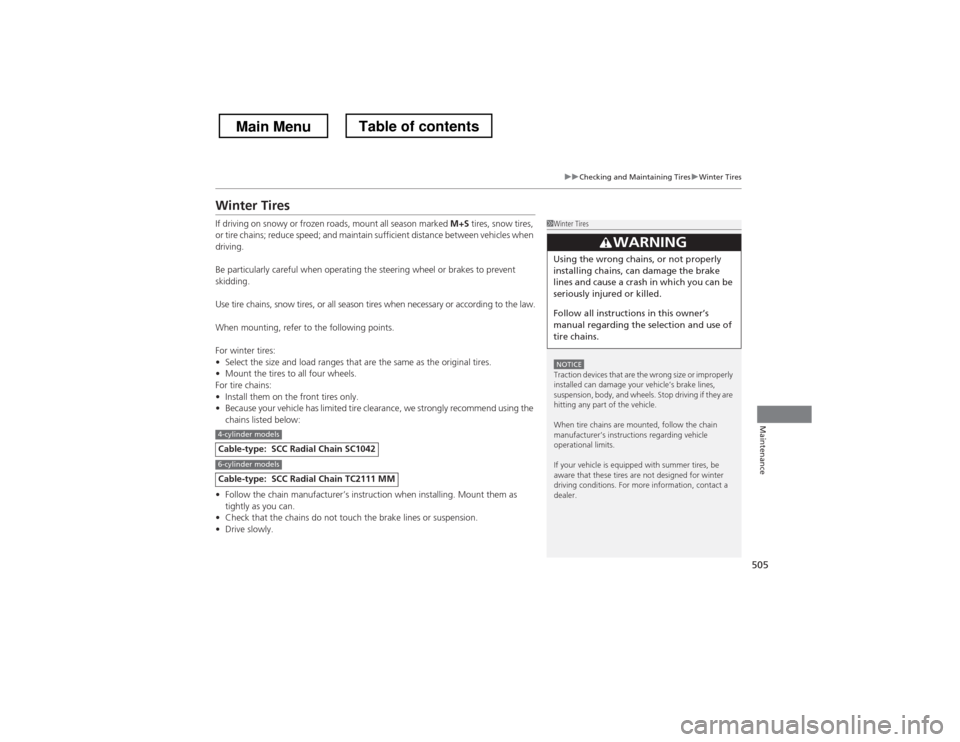
For tire chains:• Install them on the front tires only.
• Because your vehicle has limited tire clearance, we strongly recommend using the
chains listed below:
• Follow the chain manufacturer’s instruction when installing. Mount them as
tightly as you can.
• Check that the chains do not touch the brake lines or suspension.
• Drive slowly.
Cable-type: SCC Radial Chain SC1042
Cable-type: SCC Radial Chain TC2111 MM
1Winter Tires
NOTICETraction devices that are the wrong size or improperly
installed can damage your vehicle’s brake lines,
suspension, body, and wheels. Stop driving if they are
hitting any part of the vehicle.
When tire chains are mounted, follow the chain
manufacturer’s instructions regarding vehicle
operational limits.
If your vehicle is equipped with summer tires, be
aware that these tires are not designed for winter
driving conditions. For more information, contact a dealer.
3WARNING
Using the wrong chains, or not properly
installing chains, can damage the brake
lines and cause a crash in which you can be
seriously injured or killed.
Follow all instruction s in this owner
Page 518 of 573

517
Continued
Handling the Unexpected
If a Tire Goes Flat
Changing a Flat Tire
If a tire goes flat while driving, grasp the steering wheel firmly, and brake gradually
to reduce speed. Then, stop in a safe place. Replace the flat tire with a compact
spare tire. Go to a dealer as soon as possible to have the full-size tire repaired or
replaced. 1.
Park the vehicle on firm, level, and non-slippery surface and apply the parking
brake.
2. Move the shift lever to
(P .
3. Turn on the hazard warning lights and turn the ignition switch to LOCK (0*1
.
*1: Models with the smart entry system have an ENGINE START/STOP button instead of an
ignition switch.
1Changing a Flat Tire
Periodically check the tire pressure of the compact
spare. It should be set to the specified pressure.
Specified Pressure: 60 psi (420 kPa, 4.2 kgf/cm 2
)
When driving with the compact spare tire, keep the
vehicle speed under 50 mph (80 km/h). Replace with
a full-size tire as soon as possible.
The compact spare tire and wheel in your vehicle are
specifically for this model.
Do not use them with another vehicle.
Do not use another type of compact spare tire or
wheel with your vehicle.
Do not mount tire chains on a compact spare tire.
If a chain-mounted front tire goes flat, remove one of
the full-size rear tires and replace it with the compact
spare tire. Remove the flat front tire and replace it
with the full-size tire that was removed from the rear.
Mount the tire chains on the front tire.
Do not use a puncture-repairing agent on a flat tire,
as it can damage the tire pressure sensor.
Main MenuTable of contents
Page 538 of 573

537
uuIndicator, Coming On/BlinkinguIf the Low Tire Pressure Indicator Comes On
Handling the Unexpected
If the Low Tire Pressure Indicator Comes On■Reasons for the indicator to come on
A tire pressure is significantly low. If the compact spare tire is installed,
the indicator stays on for a while, and then goes off after driving a few
miles (kilometers).
■ What to do when the indicator comes on
Stop your vehicle in a safe place. Check the tire pressure and adjust the
pressure to the specified level. The specified tire pressure is on a label on
the driver side doorjamb.
If the TPMS Indicator Comes On
■Reasons for the indicator to come on
• Comes on when there is a problem with the TPMS.
• If the compact spare is installed, the indicator comes on after driving
for a few miles (kilometers).
■ What to do when the indicator comes on
Have the tire inspected by a dealer as soon as possible. If the compact
spare tire causes the indicator to come on, change the tire to a full-size
tire. The indicator goes off after driving a few miles (kilometers).
1If the Low Tire Pressure Indicator Comes On
NOTICEDriving on an extremely underinflated tire can cause
it to overheat. An overheated tire can fail. Always
inflate your tires to the prescribed level.
Main MenuTable of contents
Page 543 of 573
542
Handling the Unexpected
Emergency Towing
Call a professional towing service if you need to tow your vehicle. ■Flat bed equipment
The operator loads your vehicle on the back of a truck.
This is the best way to transport your vehicle.
■ Wheel lift equipment
The tow truck uses two pivoting arms that go under the front tires and lift them off
the ground. The rear tires remain on the ground. This is an acceptable way to
tow your vehicle.1Emergency Towing
NOTICETrying to lift or tow your vehicle by the bumpers will
cause serious damage. The bumpers are not designed
to support the vehicle’s weight.
NOTICEImproper towing such as towing behind a
motorhome or other motor vehicle can damage the
transmission.
Never tow your vehicle with just a rope or chain.
It is very dangerous, since ropes or chains may shift
from side to side or break.
All models
2WD models
Main MenuTable of contents
Page 557 of 573

556
uuWarranty Coveragesu
Information
Replacement Battery Limited Warranty – provides prorated coverage for a
replacement battery purchased from a dealer.
Replacement Muffler Lifetime Limited Warranty – provides coverage for as
long as the purchaser of the muffler owns the vehicle.
Restrictions and exclusions apply to all these warranties. Please read the 2013 Honda
warranty information booklet that came with your vehicle for precise information on
warranty coverages. Your vehicle’s original tires are covered by their manufacturer.
Tire warranty information is in a separate booklet. ■ Canadian Owners
Please refer to the 2013 warranty manual that came with your vehicle.
Main MenuTable of contents
Page 568 of 573
567
Index
N
Numbers (Identification)......................... 550
O
Odometer ................................................... 84
Oil (Engine) .............................................. 472
Adding ................................................... 475
Checking ................................................ 473
Displaying Oil Life ................................... 465
Low Oil Pressure Indicator ................. 70, 534
Recommended Engine Oil ....................... 472
Viscosity.................................................. 472
Opening/Closing
Hood ...................................................... 471
Moonroof ............................................... 113
Power Windows...................................... 110
Tailgate................................................... 105
Outside Temperature ................................ 86
Adjusting .................................................. 86
Overheating ............................................. 532
P
Paddle Shifters (Sequential Shift Mode) ..................................................... 430
Pandora ®.......................................... 208, 261
Panic Mode ............................................... 109
Parking ..................................................... 453
Parking Brake ........................................... 449 Parking Brake and Brake System
Indicator ............................................ 70, 536
Passenger Airbag Off Indicator ................. 51
Passing Indicators ..................................... 119
Power Windows ........................................ 110
Precautions While Driving ....................... 424
Rain......................................................... 424
Pregnant Women ....................................... 37
Puncture (Tire) .......................................... 517
R
Radiator .................................................... 479
Radio (AM/FM) .......................... 171, 193, 232
Radio (XM ®) ...................................... 197, 236
Radio Data System (RDS) .......... 172, 195, 234
RDS (Radio Data System) .......... 172, 195, 234
Readiness Codes (Emissions Testing) ....... 553
Rear Defogger/Heated Door Mirror Button ..................................................... 126
Rear Seats (Folding Down) ....................... 139
Rearview Mirror ........................................ 130
Refueling ................................................... 456
Fuel Gauge ................................................ 83
Gasoline .................................. 456, 546, 548
Low Fuel Indicator ..................................... 72
Regulations ............................... 447, 500, 551
Remote Transmitter ................................... 94
Replacement Battery .................................................... 507
Bulbs ....................................................... 484 Front Wiper Blade Rubber ....................... 493
Fuses ............................................... 538, 539
Rear Wiper Blade Rubber......................... 495
Tires ........................................................ 503
Reporting Safety Defects ......................... 552
Resetting a Trip Meter ............................... 85
S
Safe Driving ................................................ 27
Safety Check ............................................... 31
Safety Labels ............................................... 67
Safety Message ........................................... 25
Seat Belts .................................................... 32
Adjusting the Shoulder Anchor.................. 36
Automatic Seat Belt Tensioners ................. 34
Checking................................................... 38
Fastening .................................................. 35
Installing a Child Seat with a Lap/ Shoulder Seat Belt ................................... 61
Pregnant Women ...................................... 37
Reminder .................................................. 33
Warning Indicator ............................... 33, 71
Seat Heaters .............................................. 153
Seats .......................................................... 133
Adjusting ................................................ 133
Driver’s Seat Lumbar Support .................. 133
Front Seats .............................................. 133
Rear Seats ............................................... 139
Seat Heaters ............................................ 153
Main Menu