2013 HONDA CIVIC SEDAN ignition
[x] Cancel search: ignitionPage 324 of 368

322
uuIf a Tire Goes Flat uTemporarily Repairing a Flat Tire
Handling the Unexpected
Temporarily Repairing a Flat Tire
This vehicle is not equipped with a spare tire. If the tire has a large cut or is otherwise
severely damaged, you will need to have the vehicle towed. If the tire only has a
small puncture, from a nail fo r instance, you can use the temporary tire repair kit so
that you can drive to the nearest servic e station for a more permanent repair.
If a tire goes flat while driving, grasp the steering wheel firmly, and brake gradually
to reduce speed. Then stop in a safe place.
1. Park the vehicle on firm, level, and non- slippery surface and apply the parking
brake.
2. Put the shift lever in
(P.
3. Turn on the hazard warning lights and turn the ignition switch to LOCK
(0.
u When towing a trailer, unhitch the trailer.
■Getting Ready to Temporar ily Repair the Flat Tire
Models with tire repair kit
1Temporarily Repairing a Flat Tire
The kit should not be used in the following situations.
Instead, contact a dealer or a roadside assistant to
have the vehicle towed.
•The tire sealant has expired.•More than two tires are punctured.•The puncture or cut is larger than 3/16 inch (4mm).•The tire side wall is dama ged or the puncture is
outside the tire contact area.
•Damage has been caused by driving with the tire
extremely under inflated.
•The tire bead is no longer seated.•The rim is damaged.
Do not remove a nail or screw that punctured the
tire. If you remove it from the tire, you may not be
able to repair the puncture using the kit.
NOTICEDo not use a puncture-repairing agent other than the
one provided in the kit that came with your vehicle. If
a different agent is used, you may permanently
damage the tire pressure sensor.
When the puncture is:Kit Use
Smaller than 3/16 inch
(4 mm)Yes
Larger than 3/16 inch (4 mm)No
Contact
Area
Instruction
Manual
Air Only Hose (Black) Speed Restriction Label Repair Notification Label
Pressure Relief
Button Inflator Switch
Selector Switch
SEALANT/AIR side Sealant/Air Ho se (Clear) AIR ONLY side
Power Plug
Pressure Gauge
Tire Sealant
Expiration Date
Page 336 of 368

334
Handling the Unexpected
Shift Lever Does Not Move
Follow the procedure below if you cannot move the shift lever out of the (P
position.
1.Set the parking brake.
2. Remove the key from the ignition switch.
3. Wrap a cloth around the tip of a small flat-
tip screwdriver. Put it into the shift lock
release slot as shown in the image, and
remove the cover.
4. Insert the key into the shift lock release slot.
5. While pushing the key down, press the shift
lever release button and place the shift lever
into
(N.
u The lock is now released. Have the shift
lever checked by a dealer as soon as
possible.
■Releasing the Lock
Automatic transmission models
Slot
Cover
Release
Button
Shift Lock
Release Slot
Page 343 of 368
341Continued
Handling the Unexpected
Fuses
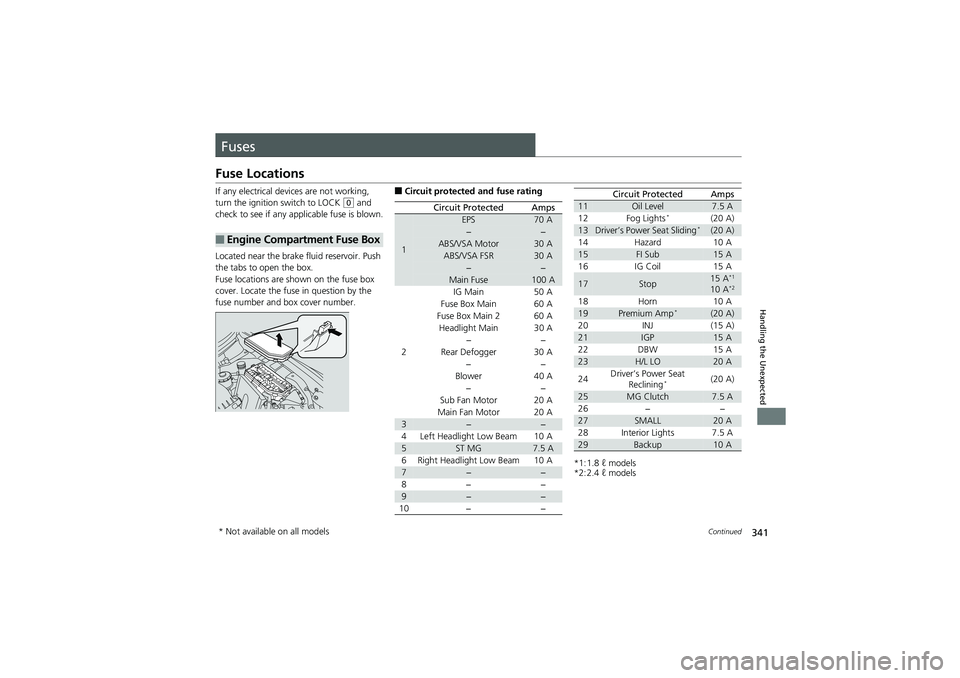
Fuse Locations
If any electrical devices are not working,
turn the ignition switch to LOCK
(0 and
check to see if any appl icable fuse is blown.
Located near the brake fluid reservoir. Push
the tabs to open the box.
Fuse locations are shown on the fuse box
cover. Locate the fuse in question by the
fuse number and box cover number.
■Engine Compartment Fuse Box
■Circuit protected and fuse rating
Circuit ProtectedAmps
1
EPS70 A
−−
ABS/VSA Motor30 A
ABS/VSA FSR30 A
−−
Main Fuse100 A
2
IG Main50 A
Fuse Box Main 60 A
Fuse Box Main 260 A
Headlight Main 30 A
−−
Rear Defogger 30 A −−
Blower 40 A −−
Sub Fan Motor 20 A
Main Fan Motor 20 A
3−−
4 Left Headlight Low Beam 10 A
5ST MG7.5 A
6 Right Headlight Low Beam 10 A
7−−
8− −
9−−
10 − −
*1:1.8 ℓ models
*2:2.4 ℓ models
11Oil Level7.5 A
12 Fog Lights*(20 A)
13Driver’s Power Seat Sliding*(20 A)
14 Hazard 10 A
15FI Sub15 A
16 IG Coil 15 A
17Stop15 A*1
10 A*2
18 Horn 10 A
19Premium Amp*(20 A)
20 INJ (15 A)
21IGP15 A
22 DBW 15 A
23H/L LO20 A
24 Driver’s Power Seat
Reclining
*(20 A)
25MG Clutch7.5 A
26 − −
27SMALL20 A
28 Interior Lights 7.5 A
29Backup10 A
Circuit ProtectedAmps
* Not available on all models
Page 345 of 368

343
uuFuses uInspecting and Changing Fuses
Handling the Unexpected
Inspecting and Changing Fuses
1. Turn the ignition switch to LOCK (0. Turn
headlights and all accessories off.
2. Remove the fuse box cover.
3. Check the large fuse in the engine
compartment.
u If the fuse is blown, use a Phillips-head
screwdriver to remo ve the screw and
replace it with a new one.
4. Inspect the small fuses in the engine
compartment and the vehicle interior.
u If there is a burned out fuse, remove it
with the fuse puller an d replace it with a
new one.1 Inspecting and Changing Fuses
NOTICEReplacing a fuse with one that has a higher rating
greatly increases the chances of damaging the
electrical system.
Replace fuse with a spare fuse of the same specified
amperage.
Confirm the specified amperage using the charts on
P. 341 to 342.
There is a fuse puller on the back of the engine
compartment fuse box cover.
Combined
Fuse Blown Fuse
Fuse Puller
Page 355 of 368

353Continued
Information
Emissions Testing
Testing of Readiness Codes
Your vehicle uses “readiness codes,” as part of its onboard self diagnostic system.
Some states refer to these codes during te sting to see if your vehicle's emissions
components are working properly.
The codes may not be read if you go throug h the testing just after the battery has
gone dead or been disconnected.
To check if they are set, turn the ignition switch to ON
(w, without starting the
engine. The malfunction indicator lamp will come on for several seconds. If it then
goes off, the readiness codes are set. If it blinks five times, the readiness codes are
not set.
If you are required to have your vehicle te sted before the readiness codes are ready,
prepare the vehicle for retest ing by doing the following:
1. Fill the gas tank to approximately 3/4 full.
2. Park the vehicle and leave the e ngine off for 6 hours or more.
3. Make sure the ambient temperature is between 40°F and 95°F (4°C and 35°C).
4. Start the engine without touching the ac celerator pedal, and let it idle for 20
seconds.
5. Keep the vehicle in
(P (automatic transmission) or (N (manual transmission).
Increase the engine speed to 2,000 rpm, and hold it there for about 3 minutes.
6. Let the engine idle with your foot off the accelerator for 20 seconds.
1Testing of Readiness Codes
The readiness codes are eras ed when the battery is
disconnected, and set again on ly after several days of
driving under a variety of conditions.
If a testing facility determ ines that the readiness
codes are not set, you may be requested to return at
a later date to complete the test.
If the testing facility dete rmines the readiness codes
are still not set, see a dealer.
Page 364 of 368

362
Index
Gauges......................................................... 77
Gear Shift Lever Positions Automatic Transmission ........................... 227
Manual Transmission ............................... 230
Glass (care) ................................................ 312
Glove Box .................................................. 136
H
Halogen Bulbs ................................... 282, 286
Handling the Unexpected ........................ 313
HandsFreeLink ® (HFL) ............................... 181
Automatic Import of Ce llular Phonebook and
Call History ............................................ 197
Automatic Transferring ... ......................... 195
Caller’s ID Information ............................. 195
HFL Buttons ............................................. 181
HFL Menus .............................................. 183
HFL Status Display.................................... 182
Limitations for Manual Operation ............ 182
Making a Call .......................................... 201
Options During a Call .............................. 206
Phone Setup ............................................ 188
Receiving a Call ....................................... 205
Speed Dial ............................................... 198
Text Message................................... 193, 207
To Clear the System ................................. 196
To Create a Security PIN........................... 194
Hazard Warning Button ............................... 2
Head Restraints ......................................... 130 Headlights
................................................. 118
Aiming .................................................... 282
Automatic Operation....... ........................ 119
Dimming ....... .............................. .... 118, 121
Operating................................................ 118
Heaters (Seat) ........................................... 141
Heating and Cooling System ................... 142
Cooling ................................................... 144
Defrosting the Windshield and Windows ........................................ 145
Dust and Pollen Filter............................... 308
Heating ................................................... 143
HFL (HandsFreeLink ®)............................... 181
High Beam Indicator .................................. 72
I
Identification Numbers ............................ 350
Engine and Transmission ......................... 350
Vehicle Identification .... ........................... 350
Ignition Switch ......................................... 117
Illumination Control ................................. 123
Knob ....................................................... 123
i-MID ........................................................... 81
Immobilizer System .................................. 112
Indicator.................................................... 73
Indicators .................................................... 66
ABS (Anti-lock Brake System)..................... 69
Charging System ............. .................. 67, 337
CRUISE CONTROL ............................. 74, 234
CRUISE MAIN .................................... 74, 233 Daytime Running Lights ..
.......................... 71
Door Open.......................................... 29, 70
ECON Mode ..................................... 74, 232
EPS (Electric Power Steering) System ............................................ 71, 339
Fog Light .................................................. 72
High Beam ................................................ 72
High Temperature ..................................... 69
Immobilizer System .................... ............... 73
i-VTEC ................................................ 74, 78
Lights On .................................................. 72
Low Fuel ................................................... 68
Low Oil Pressure ............................... 66, 337
Low Temperature...................................... 73
Low Tire Pressure/TPMS ............ 71, 238, 239
Maintenance Minder......................... 74, 257
Malfunction Indicator Lamp .............. 67, 338
Parking Brake and Brake System ....... 66, 339
REV..................................................... 74, 78
Seat Belt Reminder.............................. 31, 68
Security System Alarm............................... 73
Shift Lever Position.................................... 67
Supplemental Restraint System ........... 47, 69
System Message ....................................... 72
Transmission ............................................. 68
Trunk Open .............................................. 71
Turn Signal ............................................... 72
VSA ® (Vehicle Stability Assist)
System ............................................ 70, 236
VSA ® OFF.......................................... 70, 237
Washer Level ............................................ 74