Page 426 of 595
425
uuTowing a Trailer uDriving Safely with a Trailer
Continued
Driving
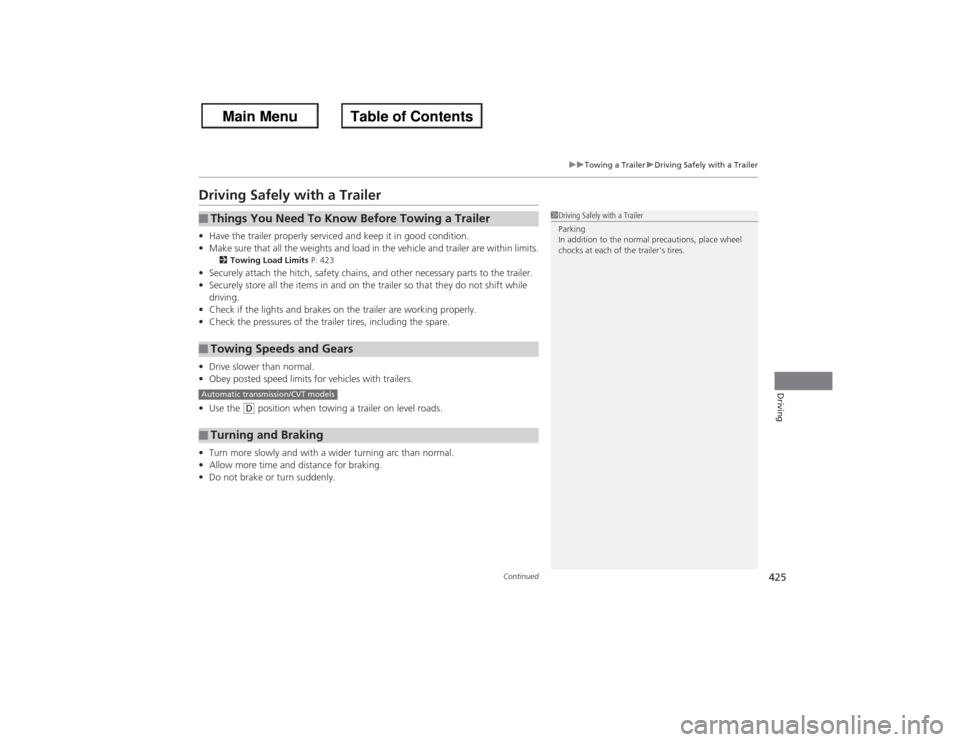
Driving Safely with a Trailer• Have the trailer properly serviced and keep it in good condition.
• Make sure that all the weights and load in the vehicle and trailer are within limits.
2 Towing Load Limits P. 423
•Securely attach the hitch, safety chains, and other necessary parts to the trailer.
• Securely store all the items in and on the trailer so that they do not shift while
driving.
• Check if the lights and brakes on the trailer are working properly.
• Check the pressures of the trailer tires, including the spare.
• Drive slower than normal.
• Obey posted speed limits for vehicles with trailers.
• Use the
(D position when towing a trailer on level roads.
• Turn more slowly and with a wider turning arc than normal.
• Allow more time and distance for braking.
• Do not brake or turn suddenly.
■Things You Need To Kn ow Before Towing a Trailer■Towing Speeds and Gears■Turning and Braking
1Driving Safely with a Trailer
Parking
In addition to the normal precautions, place wheel
chocks at each of the trailer's tires.
Automatic transmission/CVT models
Page 483 of 595

482Driving
Fuel EconomyImproving Fuel EconomyFuel economy depends on several conditions, including driving conditions, your
driving habits, the condition of your vehicle, and loading. Depending on these and
other conditions, you may or may not achieve the rated fuel economy of this vehicle.
You can optimize your fuel economy with proper maintenance of your vehicle.
Always maintain your vehicle in accordance with the messages displayed on the
information display
*/multi-information display
*.
• Use the recommended viscosity engine oil, displaying the API Certification Seal.
• Maintain the specified tire pressure.
• Do not load the vehicle with excess cargo.
• Keep your vehicle clean. A buildup of s now or mud on your vehicle's underside
adds weight and increases wind resistance.
■Maintenance and Fuel Economy
1 Improving Fuel Economy
Direct calculation is the recommended method to
determine actual fuel consumed while driving.
In Canada, posted fuel economy numbers are
established following a simulated test. For more
information on how this test is performed, please visit
http://oee.nrcan.gc.ca/
Miles driven Gallons of
fuel Miles per
Gallon
100 Liter Kilometers L per 100 km
* Not available on all models
Page 527 of 595

52 6
uu Checking and Maintaining Tires uTire and Loading Information Label
Maintenance
Tire and Loading Information LabelThe label attached to the driver’s doorjamb provides necessary tire and loading
information.Tire Labeling
The tires that came on your vehicle have a
number of markings. Those you should be
aware of are described below.
Whenever tires are replaced, they should be replaced with tires of the same size.
1 Tire and Loading Information Label
The tire and loading information label attached to the
driver’s doorjamb contains:aThe number of people your vehicle can carry.bThe total weight your vehicle can carry. Do not
exceed this weight.cThe original tire sizes for front, rear, and spare.dThe proper cold tire pressure for front, rear, and
spare.
Label
ExampleExample
Tire Size
Tire
Identification
Number (TIN)
Maximum
Tire Load
Maximum
Tire Pressure
Tire Size■Tire Sizes
1 Tire Sizes
Following is an example of tire size with an
explanation of what each component means.
215/55R17 94V
215: Tire width in millimeters.
55: Aspect ratio (the tire’s section height as a
percentage of its width).
R: Tire construction code (R indicates radial).
17: Rim diameter in inches.
94: Load index (a numerical code associated with the
maximum load the tire can carry).
V: Speed symbol (an alphabetical code indicating the
maximum speed rating).
Page 549 of 595

uuIf a Tire Goes Flat uChanging a Flat Tire
548Handling the Unexpected
1. Place the jack under the jacking point
closest to the tire to be changed.
2. Turn the end bracket (as shown in the
image) clockwise until the top of the jack
contacts the jacking point.
u Make sure that the jacking point tab is
resting in the jack notch.
3. Raise the vehicle, using the jack handle bar
and the jack handle, until the tire is off the
ground.
■How to Set Up the Jack
1How to Set Up the Jack
Do not use the jack with people or luggage in the
vehicle.
Use the jack provided in your vehicle.
Other jacks may not support the weight (“load”) or
their shape may not match.
The following instructions must be followed to use
the jack safely.•Do not use while the engine is running.•Use only where the ground is firm and level.•Use only at the jacking points.•Do not get in the vehicle while using the jack.•Do not put anything on top of or underneath the
jack.
3
WARNING
The vehicle can easily roll off the jack,
seriously injuring anyo ne underneath.
Follow the directions for changing a tire
exactly, and never get under the vehicle
when it is supported only by the jack.
Jack
Handle
Bar Wheel Nut
Wrench as Jack Handle
Page 568 of 595
567Handling the Unexpected
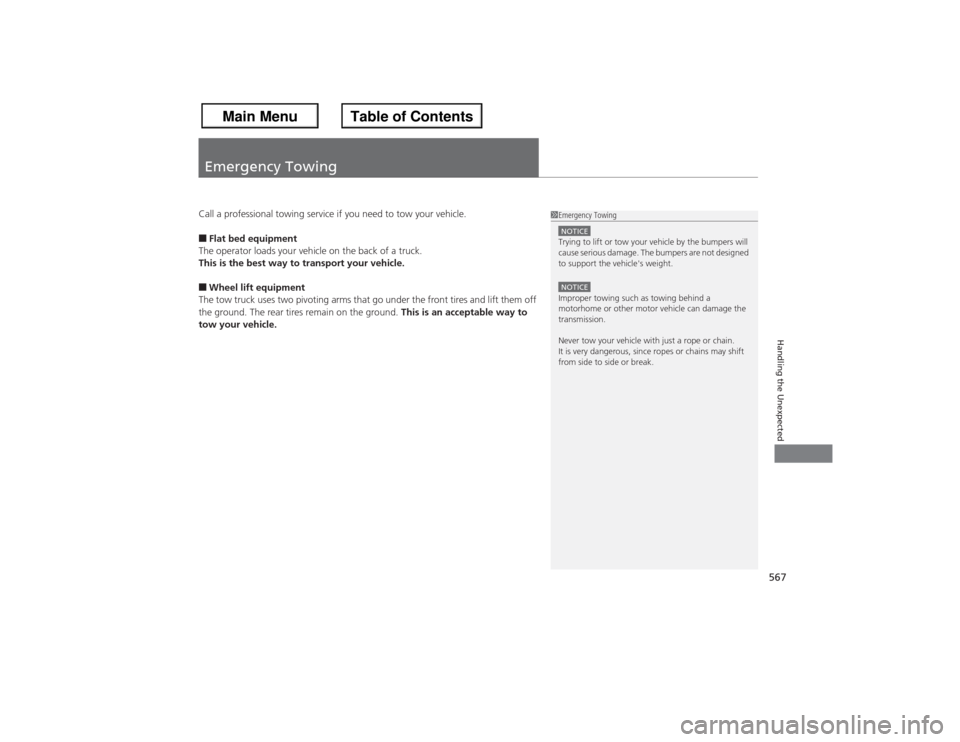
Emergency TowingCall a professional towing service if you need to tow your vehicle.■Flat bed equipment
The operator loads your vehicle on the back of a truck.
This is the best way to transport your vehicle.■Wheel lift equipment
The tow truck uses two pivoting arms that go under the front tires and lift them off
the ground. The rear tires remain on the ground. This is an acceptable way to
tow your vehicle.
1 Emergency TowingNOTICETrying to lift or tow your vehicle by the bumpers will
cause serious damage. The bumpers are not designed
to support the vehicle's weight.NOTICEImproper towing such as towing behind a
motorhome or other motor vehicle can damage the
transmission.
Never tow your vehicle with just a rope or chain.
It is very dangerous, since ropes or chains may shift
from side to side or break.
Page 571 of 595

570Information
Specifications■Vehicle Specifications*1: LX models
*2: Except LX modelsModel
Honda Accord Sedan
No. of Passengers:
Front 2
Rear 3
Total 5
Weights:Gross Vehicle
Weight Rating
U.S.: 4,200 lbs (1,905 kg)
*1
4,321 lbs (1,960 kg)
*2
Canada: 1,930 kg
*1
1,980 kg
*2
Gross Axle Weight
Rating (Front)
U.S.: 2,249 lbs (1,020 kg)
*1
2,315 lbs (1,050 kg)
*2
Canada: 1,030 kg
*1
1,065 kg
*2
Gross Axle Weight
Rating (Rear)
U.S.: 2,006 lbs (910 kg)
*1
2,050 lbs (930 kg)
*2
Canada: 910 kg
*1
930 kg
*2
Air Conditioning:
Refrigerant Type HFC-134a (R-134a)
Charge Quantity 15.0 – 16.8 oz (425 – 475 g)
Lubricant Type ND-OIL 84-cylinder models
■ Engine Specifications
■ Fuel
■ Battery*3: Canadian models■Washer FluidDisplacement
144 cu-in (2,356 cm
3)
Spark Plugs NGK DILKAR7G11GS
DENSO DXE22HQR-D11S
Fuel:
Type
Unleaded gasoline, Pump octane number
of 87 or higher
Fuel Tank Capacity 17.2 US gal (65 ℓ)
Capacity/Type
36AH(5)/45AH(20)
38AH(5)/47AH(20)
52AH(5)/65AH(20)
*3
Tank Capacity
U.S.: 2.6 US qt (2.5 ℓ)
Canada: 5.12 US qt (4.85 ℓ)
■ Light BulbsHeadlights (Low Beam)
55W (H11)
LED*
Headlights (High Beam) 60W (HB3)Fog Lights
*
35W (H8)
Parking Lights
*
5W
Parking/Daytime Running Lights
*
LED
Front Turn Signal/Side Marker Lights 24/2.2CP (Amber)
Side Turn Signal Lights
(on Door Mirrors)
*
LED
Brake/Taillights/Rear Side Marker
Lights
*
21/5W
Brake/Taillights
*
LED
Rear Side Marker Lights
*
LED
Taillights
3CP
LED*
Back-Up Lights 16WRear Turn Signal Lights
21W (Amber)
High-Mount Brake Light LED
Rear License Plate Lights
5W
Trunk Light 5W
Interior Lights
Map Lights
8W
Ceiling Light
8W
Vanity Mirror Lights
*1.4W
Courtesy Lights
*
2CP
* Not available on all models
Page 573 of 595

572
uu Specifications u
Information
■Vehicle SpecificationsModel
Honda Accord Sedan
No. of Passengers:
Front 2
Rear 3
Total 5
Weights:Gross Vehicle
Weight Rating
U.S.: 4,542 lbs (2,060 kg)
Canada: 2,060 kg
Gross Axle Weight
Rating (Front)
U.S.: 2,491 lbs (1,130 kg)
Canada: 1,130 kg
Gross Axle Weight
Rating (Rear)
U.S.: 2,072 lbs (940 kg)
Canada: 940 kg
Air Conditioning:
Refrigerant Type HFC-134a (R-134a)
Charge Quantity 15.0 – 16.8 oz (425 – 475 g)
Lubricant Type ND-OIL 8
6-cylinder models
■ Engine Specifications
■ Fuel
■ Battery
■ Washer FluidDisplacement
212 cu-in (3,471 cm
3)
Spark Plugs NGK ILZKR7B11
DENSO SXU22HCR11
Fuel:
Type
Unleaded gasoline, Pump octane number
of 87 or higher
Fuel Tank Capacity 17.2 US gal (65 ℓ)
Capacity/Type
60AH(5)/72AH(20)
Tank Capacity
U.S.: 2.6 US qt (2.5 ℓ)
Canada: 5.12 US qt (4.85 ℓ)
■ Light BulbsHeadlights (Low Beam)
55W (H11)
LED*
Headlights (High Beam) 60W (HB3)Fog Lights
35W (H8)
Parking Lights
*
5W
Parking/Daytime Running Lights
*
LED
Front Turn Signal/Side Marker Lights 24/2.2CP (Amber)
Side Turn Signal Lights
(on Door Mirrors)
LED
Brake/Taillights LED
Rear Side Marker Lights
LED
Taillights LED
Back-Up Lights
16W
Rear Turn Signal Lights 21W (Amber)
High-Mount Brake Light
LED
Rear License Plate Lights 5W
Trunk Light
5W
Interior Lights
Map Lights
8W
Ceiling Light
8W
Vanity Mirror Lights
1.4W
Courtesy Lights
2CP
* Not available on all models
Page:
< prev 1-8 9-16 17-24