Page 558 of 595
557Handling the Unexpected
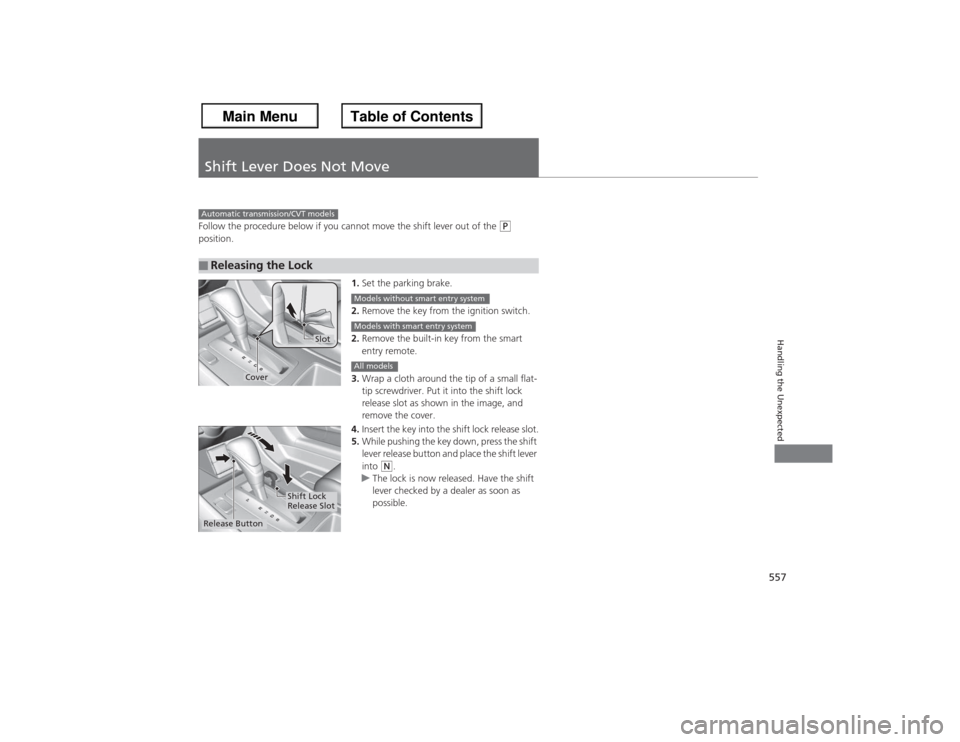
Shift Lever Does Not MoveFollow the procedure below if you cannot move the shift lever out of the
(P
position.
1.Set the parking brake.
2. Remove the key from the ignition switch.
2. Remove the built-in key from the smart
entry remote.
3. Wrap a cloth around the tip of a small flat-
tip screwdriver. Put it into the shift lock
release slot as shown in the image, and
remove the cover.
4. Insert the key into the shift lock release slot.
5. While pushing the key down, press the shift
lever release button and place the shift lever
into
(N.
u The lock is now released. Have the shift
lever checked by a dealer as soon as
possible.
■Releasing the LockAutomatic transmission/CVT models
Slot
Cover
Models without smart entry systemModels with smart entry systemAll models
Release Button
Shift Lock
Release Slot
Page 563 of 595

562
uu Indicator, Coming On/BlinkinguIf the Brake System Indicator (Red) Comes On
Handling the Unexpected
If the Brake System Indicator (Red) Comes On
■Reasons for the indicator to come on
• The brake fluid is low.
• There is a malfunction in the brake system.■What to do when the indicato r comes on while driving
Press the brake pedal lightly to check pedal pressure.
• If normal, check the brake fluid level the next time you stop.
• If abnormal, take immediate action. If necessary, downshift the
transmission to slow the ve hicle using engine braking.
If the EPS System Indicator Comes On
■Reasons for the indicator to come on
• Comes on when there is a problem with the EPS system.
• If you depress the accelerator pedal repeatedly to increase the engine
speed while the engine is idling, the indicator comes on, and
sometimes the steering wheel becomes harder to operate.■What to do when th e indicator comes on
Stop the vehicle in a safe place and restart the engine.
If the indicator comes on and stays on, immediately have your vehicle
inspected by a dealer.
1 If the Brake System Indicator (Red) Comes On
Have your vehicle repaired immediately.
It is dangerous to drive with low brake fluid. If there
is no resistance from the brake pedal, stop
immediately in a safe place. If necessary downshift
the gears.
If the brake system indicator and ABS indicator come
on simultaneously, the electronic brake distribution
system is not working. This can result in vehicle
instability under sudden braking.
Have your vehicle inspected by a dealer immediately.
U.S.
Canada
1 If the EPS System Indicator Comes OnNOTICEIf you repeatedly turn the steering wheel at an
extremely low speed, or hold the steering wheel on
the full left or right position for a while, the system
heats up. The system goes into a protective mode,
and limits its performance. The steering wheel
becomes harder and harder to operate. Once the
system cools down, EPS is restored. Repeated
operation under these conditions can eventually
damage the system.
Page 565 of 595

564Handling the Unexpected
FusesFuse LocationsIf any electrical devices are not working,
turn the ignition switch to LOCK
(0*1 and
check to see if any applicable fuse is blown.
Located near the brake fluid reservoir. Push
the tabs to open the box.
Fuse locations are shown on the fuse box
cover. Locate the fuse in question by the
fuse number and box cover number.
■Circuit protected and fuse rating■Engine Compartment Fuse Box
Circuit Protected
Amps
1
Battery
125 A
2
EPS
70 A
Fuse Box Main 1 (60 A)
Fuse Box Option 1
(40 A)
−−
−
−
ABS/VSA FSR 40 A
ABS/VSA Motor 30 A
3
−
−
−
−
−
−
−
−
4 Front Fog Light
*
(15 A)
5
Horn
10 A
6 Stop Light 10 A
7
FI Sub
15 A
8 DRL (7.5 A)
9
IG Coil
15 A
10 Injector
*2
20 A
11
Hazard
15 A
12 Fuse Box Main 2 60 A
Fuse Box Option 2 (40 A)
IG Main 1 50 A
30 A
*4
IG Main 2
*4
30 A
Sub Fan Motor 20 A
*2
30 A
*3
Headlight Low Beam Main 30 A
Fuse Box 30 A
Wiper Motor 30 A
Main Fan Motor 30 A Starter Motor
*4
30 A
13
Rear Defogger
40 A
14 Heater Motor 40 A
15
FI Main
15 A
Circuit Protected
Amps
*1:
Models with the smart entry system have an
ENGINE START/STOP button instead of an
ignition switch.
*2:4-cylinder models
*3:6-cylinder models
*4:Models with smart entry system
*5:Models with LED low beam headlights 16 Heated Door Mirror
*
(10 A)
17
MG Clutch
7.5 A
18 DBW 15 A
19
Small Light
20 A
20 Interior Light 7.5 A
21
Back Up
10 A
22 Audio 10 A
23
Fan Timer
7.5 A
24 Right Headlight Low Beam 10 A
15 A
*5
25
Left Headlight Low Beam
10 A
15 A
*5
26 − −
Circuit Protected
Amps
* Not available on all models
Page 571 of 595

570Information
Specifications■Vehicle Specifications*1: LX models
*2: Except LX modelsModel
Honda Accord Sedan
No. of Passengers:
Front 2
Rear 3
Total 5
Weights:Gross Vehicle
Weight Rating
U.S.: 4,200 lbs (1,905 kg)
*1
4,321 lbs (1,960 kg)
*2
Canada: 1,930 kg
*1
1,980 kg
*2
Gross Axle Weight
Rating (Front)
U.S.: 2,249 lbs (1,020 kg)
*1
2,315 lbs (1,050 kg)
*2
Canada: 1,030 kg
*1
1,065 kg
*2
Gross Axle Weight
Rating (Rear)
U.S.: 2,006 lbs (910 kg)
*1
2,050 lbs (930 kg)
*2
Canada: 910 kg
*1
930 kg
*2
Air Conditioning:
Refrigerant Type HFC-134a (R-134a)
Charge Quantity 15.0 – 16.8 oz (425 – 475 g)
Lubricant Type ND-OIL 84-cylinder models
■ Engine Specifications
■ Fuel
■ Battery*3: Canadian models■Washer FluidDisplacement
144 cu-in (2,356 cm
3)
Spark Plugs NGK DILKAR7G11GS
DENSO DXE22HQR-D11S
Fuel:
Type
Unleaded gasoline, Pump octane number
of 87 or higher
Fuel Tank Capacity 17.2 US gal (65 ℓ)
Capacity/Type
36AH(5)/45AH(20)
38AH(5)/47AH(20)
52AH(5)/65AH(20)
*3
Tank Capacity
U.S.: 2.6 US qt (2.5 ℓ)
Canada: 5.12 US qt (4.85 ℓ)
■ Light BulbsHeadlights (Low Beam)
55W (H11)
LED*
Headlights (High Beam) 60W (HB3)Fog Lights
*
35W (H8)
Parking Lights
*
5W
Parking/Daytime Running Lights
*
LED
Front Turn Signal/Side Marker Lights 24/2.2CP (Amber)
Side Turn Signal Lights
(on Door Mirrors)
*
LED
Brake/Taillights/Rear Side Marker
Lights
*
21/5W
Brake/Taillights
*
LED
Rear Side Marker Lights
*
LED
Taillights
3CP
LED*
Back-Up Lights 16WRear Turn Signal Lights
21W (Amber)
High-Mount Brake Light LED
Rear License Plate Lights
5W
Trunk Light 5W
Interior Lights
Map Lights
8W
Ceiling Light
8W
Vanity Mirror Lights
*1.4W
Courtesy Lights
*
2CP
* Not available on all models
Page 572 of 595

571
uu Specifications u
Continued
Information
■Brake/Clutch Fluid
■ Automatic Transmission (CVT) Fluid
■ Manual Transmission FluidSpecified
Honda Heavy Duty Brake Fluid DOT 3
Specified
HCF-2
Capacity Change 3.7 US qt (3.5 ℓ)
Specified
Honda Manual Transmission Fluid
Capacity Change 2.0 US qt (1.9 ℓ)
■ Engine Oil
■ Engine CoolantRecommended
·Genuine Honda Motor Oil 0W-20
·API Premium-grade 0W-20 detergent oil
Capacity Change 4.2 US qt (4.0 ℓ)
Change
including
filter
4.4 US qt (4.2 ℓ)
Specified
Honda Long-Life Antifreeze/Coolant Type2
Ratio 50/50 with distilled water
Capacity
1.65 US gal (6.25 ℓ)
(change including the remaining
0.17 US gal (0.64 ℓ) in the reserve tank)
■ Tire*1: U.S. LX models
*2: U.S. EX, EX-L models and Canadian LX, EX, EX-L models
*3: U.S. Sport models and Canadian Sport, Touring modelsRegular
Size
205/65R16 95H
*1
215/55R17 94V
*2
235/45R18 94V
*3
Pressure
psi (kPa [kgf/cm
2])
Front
33 (230 [2.3])
*1
33 (225 [2.3])
*2, *3
Rear
32 (220 [2.2])
*1, *3
33 (225 [2.3])
*2
Compact
Spare Size T125/80D16 97M
Pressure
psi (kPa [kgf/cm
2])
60 (420 [4.2])
Wheel Size
Regular
16 x 7J
*1
17 x 7 1/2J
*2
18 x 8J
*3
Compact Spare
16 x 4T
Page 573 of 595

572
uu Specifications u
Information
■Vehicle SpecificationsModel
Honda Accord Sedan
No. of Passengers:
Front 2
Rear 3
Total 5
Weights:Gross Vehicle
Weight Rating
U.S.: 4,542 lbs (2,060 kg)
Canada: 2,060 kg
Gross Axle Weight
Rating (Front)
U.S.: 2,491 lbs (1,130 kg)
Canada: 1,130 kg
Gross Axle Weight
Rating (Rear)
U.S.: 2,072 lbs (940 kg)
Canada: 940 kg
Air Conditioning:
Refrigerant Type HFC-134a (R-134a)
Charge Quantity 15.0 – 16.8 oz (425 – 475 g)
Lubricant Type ND-OIL 8
6-cylinder models
■ Engine Specifications
■ Fuel
■ Battery
■ Washer FluidDisplacement
212 cu-in (3,471 cm
3)
Spark Plugs NGK ILZKR7B11
DENSO SXU22HCR11
Fuel:
Type
Unleaded gasoline, Pump octane number
of 87 or higher
Fuel Tank Capacity 17.2 US gal (65 ℓ)
Capacity/Type
60AH(5)/72AH(20)
Tank Capacity
U.S.: 2.6 US qt (2.5 ℓ)
Canada: 5.12 US qt (4.85 ℓ)
■ Light BulbsHeadlights (Low Beam)
55W (H11)
LED*
Headlights (High Beam) 60W (HB3)Fog Lights
35W (H8)
Parking Lights
*
5W
Parking/Daytime Running Lights
*
LED
Front Turn Signal/Side Marker Lights 24/2.2CP (Amber)
Side Turn Signal Lights
(on Door Mirrors)
LED
Brake/Taillights LED
Rear Side Marker Lights
LED
Taillights LED
Back-Up Lights
16W
Rear Turn Signal Lights 21W (Amber)
High-Mount Brake Light
LED
Rear License Plate Lights 5W
Trunk Light
5W
Interior Lights
Map Lights
8W
Ceiling Light
8W
Vanity Mirror Lights
1.4W
Courtesy Lights
2CP
* Not available on all models
Page 574 of 595
573
uu Specifications u
Information
■Brake Fluid
■ Automatic Transmission FluidSpecified
Honda Heavy Duty Brake Fluid DOT 3
Specified
Honda ATF DW-1
(automatic transmission fluid)
Capacity Change 3.3 US qt (3.1 ℓ)
■ Engine Oil
■ Engine CoolantRecommended
·Genuine Honda Motor Oil 0W-20
·API Premium-grade 0W-20 detergent oil
Capacity Change 4.2 US qt (4.0 ℓ)
Change
including
filter
4.5 US qt (4.3 ℓ)
Specified
Honda Long-Life Antifreeze/Coolant Type2
Ratio 50/50 with distilled water
Capacity
1.7 US gal (6.5 ℓ)
(change including the remaining
0.17 US gal (0.64 ℓ) in the reserve tank)
■ Tire*1: U.S. models and Canadian EX-L V6 models
*2: Canadian V6 Touring modelsRegular
Size
215/55R17 94V
*1
235/45R18 94V
*2
Pressure
psi (kPa [kgf/cm
2])
33 (225 [2.3])
FrontRear
33 (225 [2.3])
*1
32 (220 [2.2])
*2
Compact
Spare Size T125/80D16 97M
Pressure
psi (kPa [kgf/cm
2])
60 (420 [4.2])
Wheel Size
Regular
17 x 7 1/2J
*1
18 x 8J
*2
Compact Spare
16 x 4T
Page 579 of 595
578
uuEmissions Testing uTesting of Readiness Codes
Information
7. Select a nearby, lightly traveled major highway where you can maintain a speed
of 50 to 60 mph (80 to 97 km/h) for at least 20 minutes. Drive on the highway in (D (automatic/CVT) or 5th (manual). Do not use cruise control. When traffic
allows, drive for 90 seconds without moving the accelerator pedal. (Vehicle speed
may vary slightly; this is okay.) If you cannot do this for a continuous 90 seconds
because of traffic conditions, drive for at least 30 seconds, then repeat it two
more times (for a total of 90 seconds).
8. Drive in city/suburban traffic for at least 10 minutes. When traffic conditions
allow, let the vehicle coast for several seconds without using the accelerator pedal
or the brake pedal.
9. Park the vehicle and leave the engine off for 30 minutes.