2013 FORD TRANSIT CONNECT fuel cap
[x] Cancel search: fuel capPage 153 of 321

Preparing Your Vehicle
Note:Use only a 12–volt supply to start your vehicle.
Note:Do not disconnect the battery of the disabled vehicle as this could
damage the vehicle’s electrical system.
1. Park the booster vehicle close to the hood of the disabled vehicle
making sure the two vehicles do not touch. Set the parking brake on
both vehicles and stay clear of the engine cooling fan and other moving
parts.
2. Check all battery terminals. Remove the positive terminal cover
(if equipped) and any excessive corrosion before you attach the battery
cables. Ensure that vent caps are tight and level.
3. Turn the heater fan on in both vehicles to protect from any electrical
surges. Turn all other accessories off.
Connecting the Jumper Cables
WARNING:Do not connect the end of the second cable to the
negative (-) terminal of the battery to be jumped. A spark may
cause an explosion of the gases that surround the battery.
Note:Do not attach the negative (-) cable to fuel lines, engine rocker
covers, the intake manifold or electrical components as grounding points.
Note:In the illustration, the vehicle on the bottom is used to designate
the assisting (boosting) battery.
152Roadside Emergencies
2013 Transit Connect(tst)
Owners Guide gf, 2nd Printing, November 2012
USA(fus)
Page 178 of 321
Adding Engine Oil
Note:Do not remove the filler cap when the engine is running.
Note:Do not add engine oil further than the MAX mark. Oil levels above
the MAX mark may cause engine damage.
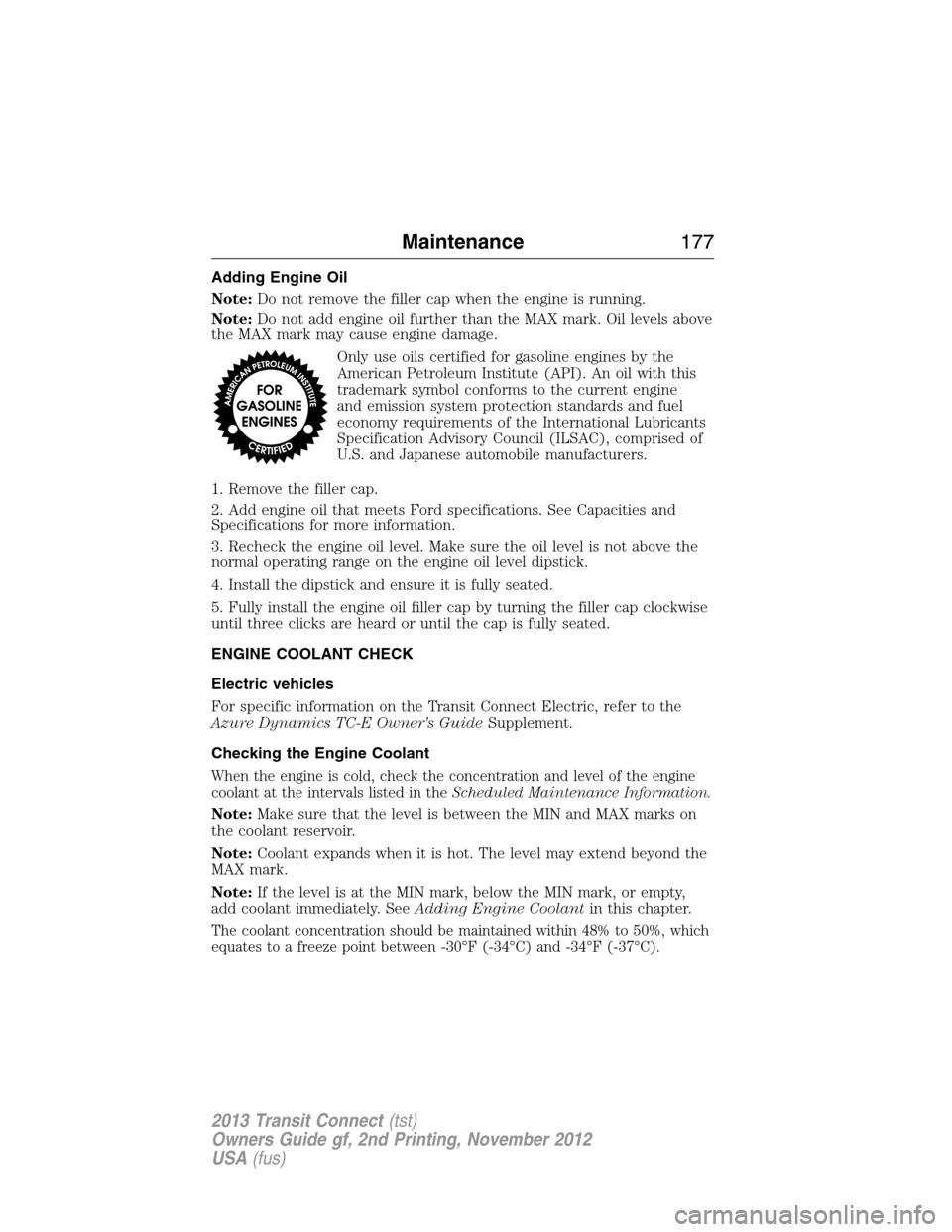
Only use oils certified for gasoline engines by the
American Petroleum Institute (API). An oil with this
trademark symbol conforms to the current engine
and emission system protection standards and fuel
economy requirements of the International Lubricants
Specification Advisory Council (ILSAC), comprised of
U.S. and Japanese automobile manufacturers.
1. Remove the filler cap.
2. Add engine oil that meets Ford specifications. See Capacities and
Specifications for more information.
3. Recheck the engine oil level. Make sure the oil level is not above the
normal operating range on the engine oil level dipstick.
4. Install the dipstick and ensure it is fully seated.
5. Fully install the engine oil filler cap by turning the filler cap clockwise
until three clicks are heard or until the cap is fully seated.
ENGINE COOLANT CHECK
Electric vehicles
For specific information on the Transit Connect Electric, refer to the
Azure Dynamics TC-E Owner’s GuideSupplement.
Checking the Engine Coolant
When the engine is cold, check the concentration and level of the engine
coolant at the intervals listed in theScheduled Maintenance Information.
Note:Make sure that the level is between the MIN and MAX marks on
the coolant reservoir.
Note:Coolant expands when it is hot. The level may extend beyond the
MAX mark.
Note:If the level is at the MIN mark, below the MIN mark, or empty,
add coolant immediately. SeeAdding Engine Coolantin this chapter.
The coolant concentration should be maintained within 48% to 50%, which
equates to a freeze point between -30°F (-34°C) and -34°F (-37°C).
Maintenance177
2013 Transit Connect(tst)
Owners Guide gf, 2nd Printing, November 2012
USA(fus)
Page 185 of 321

BRAKE FLUID CHECK
Fluid levels between the MIN and MAX lines are within the normal
operating range; there is no need to add fluid. If the fluid levels are
outside of the normal operating range, the performance of the system
could be compromised; seek service from your authorized dealer
immediately.
POWER STEERING FLUID CHECK
Check the power steering fluid at the proper intervals. Refer to
Scheduled Maintenance Information.
1. Start the engine and let it run until it reaches normal operating
temperature.
2. Turn the steering wheel left and right several times.
3. Turn the engine off.
4. Check the fluid level.
5. If the fluid is below the MIN line, add fluid in small amounts until it
reaches the correct level (between the MIN and MAX lines). Refer to
Capacities and Specificationsfor the proper fluid type.
Electric vehicles
For specific information on the Transit Connect Electric, refer to the
Azure Dynamics TC-E Owner’s GuideSupplement.
FUEL FILTER
Your vehicle is equipped with a lifetime fuel filter that is integrated with
the fuel tank. Regular maintenance or replacement is not needed.
WASHER FLUID CHECK
WARNING:If you operate your vehicle in temperatures below
40°F (5°C), use washer fluid with antifreeze protection. Failure
to use washer fluid with antifreeze protection in cold weather could
result in impaired windshield vision and increase the risk of injury or
accident.
Add fluid to fill the reservoir if the level is low. Only use a washer fluid
that meets Ford specifications. See the technical specifications chart in
theCapacities and Specificationschapter.
Note:The front and rear washer systems are supplied from the same
reservoir.
184Maintenance
2013 Transit Connect(tst)
Owners Guide gf, 2nd Printing, November 2012
USA(fus)
Page 244 of 321

ENGINE SPECIFICATIONS
Engine 2.0L I4 engine
Cubic inches 121
Required fuel Minimum 87 octane
Firing order 1–3–4–2
Ignition system C.O.P
Compression ratio 10.0:1
Spark plug gap .051 inch +/- .002
(1.3 mm +/- .05)
Engine drivebelt routing
Capacities and Specifications243
2013 Transit Connect(tst)
Owners Guide gf, 2nd Printing, November 2012
USA(fus)
Page 246 of 321

Item CapacityFord Part Name or
EquivalentFord Part Number /
Ford Specification
Windshield washer
fluidFill as requiredMotorcraft® Premium
Windshield Washer
Concentrate (US)
Motorcraft® Premium Quality
Windshield Washer Fluid
(Canada)ZC-32-A (US)
CXC-37-(A, B, D, and F)
(Canada) /
WSB-M8B16-A2
Fuel tank15.4 gallons
(58.3L)——
1Approximate dry fill capacity including transmission fluid cooling system, actual refill capacities
will vary based on vehicle application and transmission fluid cooling system (i.e. coolers size,
cooling lines, auxiliary cooler capacities). The amount of transmission fluid and fluid level should
be set by the indication on the dipstick’s normal operating range.2Automatic transmissions that require MERCON® LV should only use MERCON® LV fluid. Refer to
scheduled maintenanceto determine the correct service interval. Use of any fluid other than the
recommended fluid may cause transmission damage.3Use of synthetic or synthetic blend motor oil is not mandatory. Engine oil need only meet the
requirements of Ford specification WSS-M2C945-A, SAE 5W-20, and display the API Certification
mark.4Your engine has been designed to be used with Ford engine oil, which gives a fuel economy
benefit while maintaining the durability of your engine. Using oils other than the one specified can
result in longer engine cranking periods, reduced engine performance, reduced fuel economy and
increased emission levels.5Add the coolant type originally equipped in your vehicle.
Capacities and Specifications245
2013 Transit Connect(tst)
Owners Guide gf, 2nd Printing, November 2012
USA(fus)
Page 317 of 321

C
Capacities for refilling fluids ....244
CD ..........................................88–89
CD player ....................................86
Cell phone use ............................15
Changing a tire .........................235
Changing the air filter ..............188
Child safety seats
attaching with tether straps ....28
automatic locking mode
(retractor) .................................36
LATCH .......................................26
Child safety seats - booster
seats .............................................21
Cleaning your vehicle ...............201
engine compartment ..............203
instrument panel ....................205
interior .....................................204
plastic parts ............................202
washing ....................................201
waxing .....................................203
wheels ......................................206
wiper blades ............................204
Climate control (see Air
conditioning or Heating) ............94
Clock ......................................88–89
Console ......................................107
overhead ..................................107
Coolant ......................................177
checking and adding ..............177
refill capacities ........................244
specifications ..........................244
Customer Assistance ................149
Ford Extended Service
Plan ..................................251, 253
Getting roadside assistance ...149Getting the service
you need .................................155
Ordering additional owner’s
literature .................................161
Utilizing the
Mediation/Arbitration
Program ...................................159
D
Defrost .........................................94
rear window ..............................98
Dipstick
automatic transaxle fluid .......181
automatic transmission
fluid ..........................................181
engine oil .................................176
Doors
central unlocking ......................58
lubricant specifications ..........244
Driving under special
conditions ..................................124
through water .........................146
E
Electronic stability control ......129
Emergencies, roadside
jump-starting ..........................151
running out of fuel .................114
Emission control system ..........117
End user license agreement ....307
Engine ........................................243
cleaning ...................................203
coolant .....................................177
fail-safe cooling .......................180
lubrication specifications .......244
refill capacities ........................244
service points ..........................176
Engine block heater .................110
316Index
2013 Transit Connect(tst)
Owners Guide gf, 2nd Printing, November 2012
USA(fus)
Page 318 of 321
Engine compartment -
opening ......................................175
Engine oil
checking and adding ......176–177
dipstick ....................................176
filter, specifications ................246
refill capacities ........................244
specifications ..........................244
Event data recording ..................10
Exhaust fumes ..........................110
F
Fail safe cooling ........................180
Flexible Fuel Vehicle (FFV) ....112
Floor mats .................................147
Fluid capacities .........................244
Fog lamps ..............................71–72
Fuel
cap ...........................................115
capacity ...................................244
choosing the right fuel ...........113
filler funnel .............................114
filling your vehicle with fuel ..115
filter, specifications ........184, 246
fuel pump shut-off ..................151
octane rating ...................113, 243
quality ......................................113
running out of fuel .................114
safety information relating to
automotive fuels .....................112
Fuel and distance computer ......85
to empty indicator ....................85
trip distance ..............................85
trip/reset button .......................85
Fuel - flex fuel vehicle (FFV)...112
Fuses ..................................163–164G
Gas cap (see Fuel cap) ............115
Gauges .........................................78
odometer ...................................85
trip odometer ............................85
H
Hazard flashers .........................150
Headlamps ...........................70, 191
aiming ......................................189
bulb specifications ..................200
checking alignment ................189
flash to pass ..............................70
high beam .................................70
replacing bulbs .......................191
turning on and off ....................70
Head restraints .........................100
Heating ........................................94
Hood ..................................173, 175
I
Ignition ...............................109, 243
Illuminated visor mirror .............77
Inspection/maintenance (I/M)
testing ........................................119
Instrument panel
cleaning ...................................205
cluster ........................................79
J
Jack ............................................235
positioning ...............................235
storage .....................................235
Index317
2013 Transit Connect(tst)
Owners Guide gf, 2nd Printing, November 2012
USA(fus)