2013 FORD TAURUS parking brake
[x] Cancel search: parking brakePage 316 of 541
Fuel system
•Fill the fuel tank with high-quality fuel until the first automatic shutoff
of the fuel pump nozzle.
Note:During extended periods of vehicle storage (30 days or more), fuel
may deteriorate due to oxidation. Add a quality gas stabilizer product to
the vehicle fuel system whenever actual or expected storage periods
exceed 30 days. Follow the instructions on the additive label. The vehicle
should then be operated at idle speed to circulate the additive
throughout the fuel system.
Cooling system
•Protect against freezing temperatures.
•When removing vehicle from storage, check coolant fluid level.
Confirm there are no cooling system leaks, and fluid is at the
recommended level.
Battery
•Check and recharge as necessary. Keep connections clean.
•If storing your vehicle for more than 30 days without recharging the
battery, it may be advisable to disconnect the battery cables to ensure
battery charge is maintained for quick starting.
Note:If battery cables are disconnected, it will be necessary to reset
memory features.
Brakes
•Make sure brakes and parking brake are fully released.
Tires
•Maintain recommended air pressure.
Miscellaneous
•Make sure all linkages, cables, levers and pins under vehicle are
covered with grease to prevent rust.
•Move vehicles at least 25 feet (8 m) every 15 days to lubricate
working parts and prevent corrosion.
316Vehicle Care
2013 Taurus
Owners Guide gf, 1st Printing
USA(fus)
Page 341 of 541
•Winter weather driving capability
•Wet weather driving capability
•All-wheel driving capability (if applicable)
•Load leveling adjustment (if applicable)
When driving with the full-size dissimilar spare tire and wheel assembly,
additional caution should be given to:
•Towing a trailer
•Driving vehicles equipped with a camper body
•Driving vehicles with a load on the cargo rack
Drive cautiously when using a full-size dissimilar spare tire and wheel,
and seek service as soon as possible.
Tire Change Procedure
WARNING:When one of the front wheels is off the ground, the
transmission alone will not prevent the vehicle from moving or
slipping off the jack, even if the vehicle is in P (Park) (automatic
transmission) or R (Reverse) (manual transmission).
WARNING:To help prevent the vehicle from moving when you
change a tire, be sure the parking brake is set, then block (in
both directions) the wheel that is diagonally opposite (other side and
end of the vehicle) to the tire being changed.
WARNING:If the vehicle slips off the jack, you or someone else
could be seriously injured.
WARNING:Do not attempt to change a tire on the side of the
vehicle close to moving traffic. Pull far enough off the road to avoid
the danger of being hit when operating the jack or changing the wheel.
WARNING:To lessen the risk of personal injury, do not put any
part of your body under the vehicle while changing a tire. Do not
start the engine when your vehicle is on the jack. The jack is only
meant for changing the tire.
Wheels and Tires341
2013 Taurus
Owners Guide gf, 1st Printing
USA(fus)
Page 342 of 541

Note:Passengers should not remain in the vehicle when the vehicle is
being jacked.
1. Park on a level surface, set the parking brake and activate the hazard
flashers.
2. Place the gearshift lever in P (Park) and turn the engine off.
3. Lift the trunk cargo cover, and remove
the wing nut that secures the spare tire
by turning it counterclockwise.
4. Lift and remove the spare tire from
the trunk.
5. Remove the second wing nut that
secures the jack retention bracket by
turning it counterclockwise, remove the
jack kit from the vehicle.
6. Remove the jack and the wrench from
the felt bag. Fold down the wrench
socket to use to loosen the lug nuts and
to operate the jack.
Vehicle jacking
1. Block the diagonally opposite
wheel.
2. If your vehicle has wheel covers,
remove them with the lug wrench tip
and loosen each wheel lug nut
one-half turn counterclockwise. Do
not remove them until the wheel is raised off the ground.
3. The vehicle jacking points are shown here, and are depicted on the
yellow warning label on the jack.
342Wheels and Tires
2013 Taurus
Owners Guide gf, 1st Printing
USA(fus)
Page 346 of 541
General Information
WARNING:Failure to follow these guidelines could result in an
increased risk of loss of vehicle control, injury or death.
Note:Do not use the temporary mobility kit if a tire has become
severely damaged by driving the vehicle with a tire that has insufficient
air pressure. Only punctured areas located within the tire tread can be
sealed with the temporary mobility kit.
Do not attempt to repair punctures larger than
14inch (6.4 mm) or
damage to the tire’s sidewall. The tire may not completely seal.
Loss of air pressure may adversely affect tire performance. For this
reason:
•Note:Do not drive the vehicle above 50 mph (80 km/h).
•Note:Do not drive further than 120 miles (200 km). Drive only to the
closest Ford Motor Company authorized dealer or tire repair shop to
have your tire inspected.
•Drive carefully and avoid abrupt steering maneuvers.
•Periodically monitor tire inflation pressure in the affected tire; if the
tire is losing pressure, have the vehicle towed.
•Read the information in theTips for use of the temporary mobility
kitsection to ensure safe operation of the temporary mobility kit and
your vehicle.
Tips for Use of the Temporary Mobility Kit
Read the following list of tips to ensure safe operation of the temporary
mobility kit:
•Before operating the temporary mobility kit, make sure your vehicle is
safely off the road and away from moving traffic. Turn on the hazard
lights.
•Always set the parking brake to ensure the vehicle doesn’t move
unexpectedly.
•Do not remove any foreign objects, such as nails or screws, from the
tire.
•When using the temporary mobility kit, leave the engine running (only
if the vehicle is outdoors or in a well-ventilated area) so the
compressor doesn’t drain the vehicle’s battery.
•Do not allow the compressor to operate continuously for more than
15 minutes; this will help prevent the compressor from overheating.
346Wheels and Tires
2013 Taurus
Owners Guide gf, 1st Printing
USA(fus)
Page 348 of 541
First Stage: Reinflating the Tire with Sealing Compound and Air
WARNING:Do not stand directly over the temporary mobility kit
while inflating the tire. If you notice any unusual bulges or
deformations in the tire’s sidewall during inflation, stop and call
roadside assistance.
WARNING:If the tire doesn’t inflate to the recommended tire
pressure within 15 minutes, stop and call roadside assistance.
Preparation
Park the vehicle in a safe, level and secure area, away from moving
traffic. Turn the hazard lights on. Apply the parking brake and turn the
engine off. Inspect the flat tire for visible damage.
Sealant compound contains latex. To avoid any allergic reactions, use the
non-latex gloves located in the accessory box on the underside of the
temporary mobility kit housing.
Do not remove any foreign object that has pierced the tire. If a puncture
is located in the tire sidewall, stop and call roadside assistance.
1. Remove the valve cap from the tire valve.
2. Unwrap the clear tube from the compressor housing.
3. Remove the tube cap and fasten the metal connector of the tube to
the tire valve, turning clockwise. Make sure the connection is tightly
fastened.
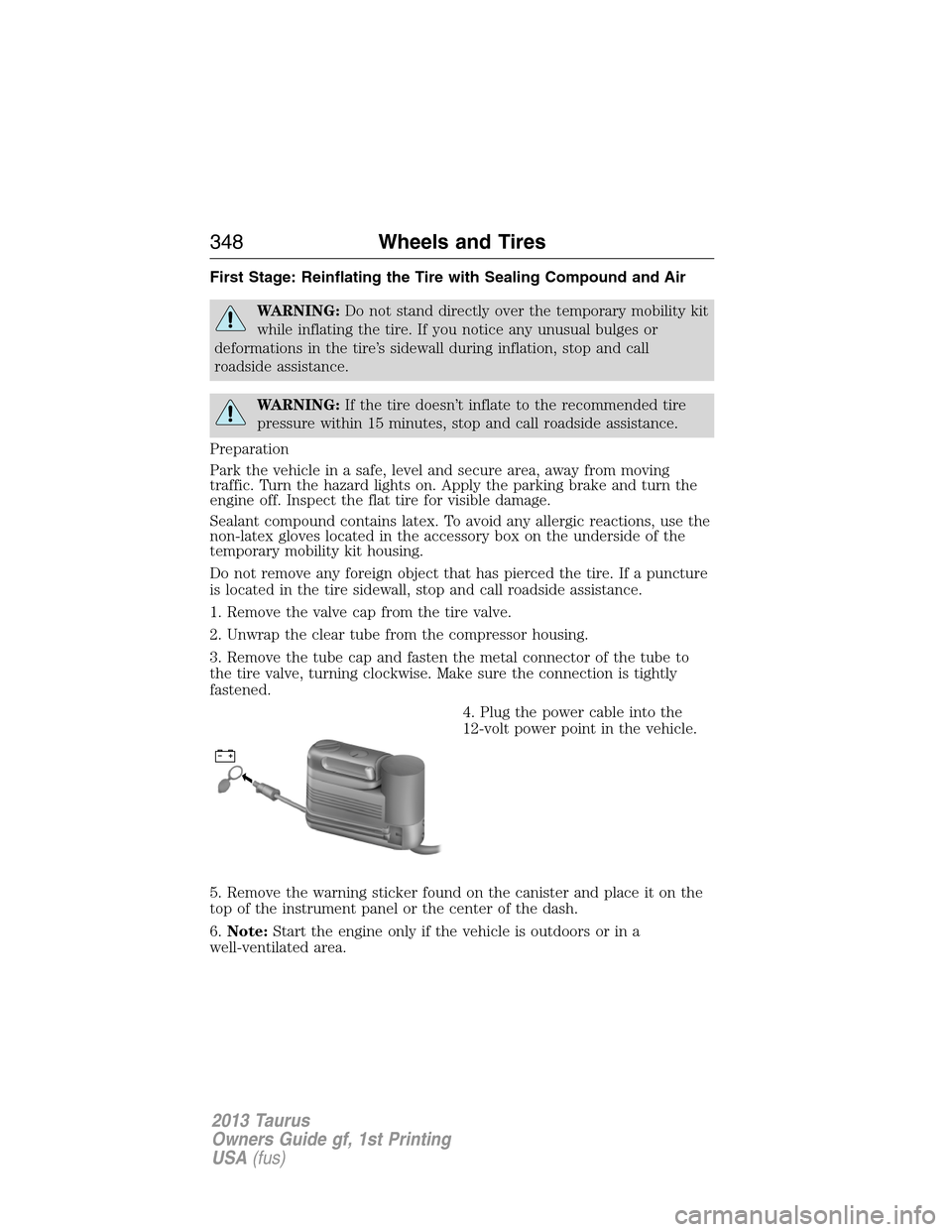
4. Plug the power cable into the
12-volt power point in the vehicle.
5. Remove the warning sticker found on the canister and place it on the
top of the instrument panel or the center of the dash.
6.Note:Start the engine only if the vehicle is outdoors or in a
well-ventilated area.
348Wheels and Tires
2013 Taurus
Owners Guide gf, 1st Printing
USA(fus)
Page 372 of 541
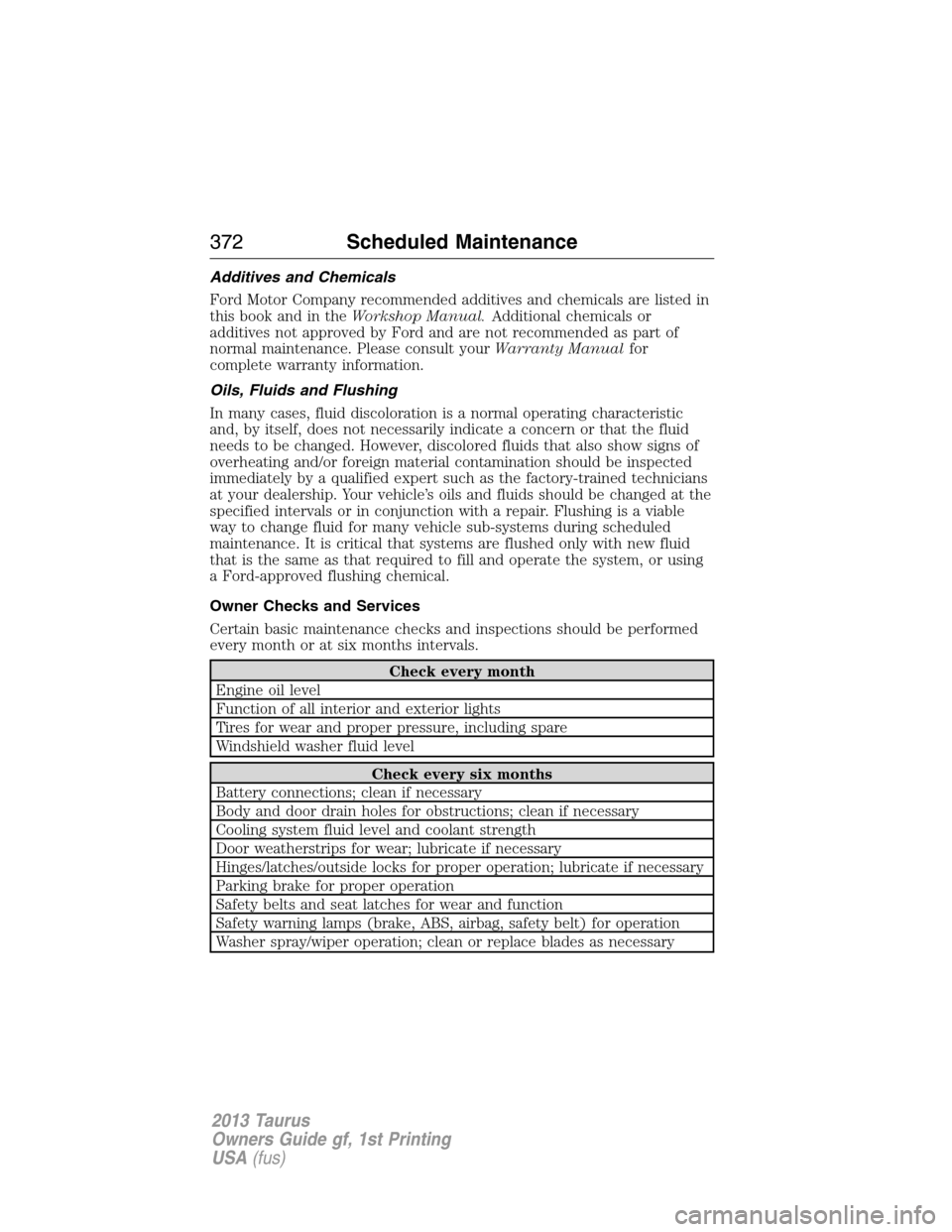
Additives and Chemicals
Ford Motor Company recommended additives and chemicals are listed in
this book and in theWorkshop Manual.Additional chemicals or
additives not approved by Ford and are not recommended as part of
normal maintenance. Please consult yourWarranty Manualfor
complete warranty information.
Oils, Fluids and Flushing
In many cases, fluid discoloration is a normal operating characteristic
and, by itself, does not necessarily indicate a concern or that the fluid
needs to be changed. However, discolored fluids that also show signs of
overheating and/or foreign material contamination should be inspected
immediately by a qualified expert such as the factory-trained technicians
at your dealership. Your vehicle’s oils and fluids should be changed at the
specified intervals or in conjunction with a repair. Flushing is a viable
way to change fluid for many vehicle sub-systems during scheduled
maintenance. It is critical that systems are flushed only with new fluid
that is the same as that required to fill and operate the system, or using
a Ford-approved flushing chemical.
Owner Checks and Services
Certain basic maintenance checks and inspections should be performed
every month or at six months intervals.
Check every month
Engine oil level
Function of all interior and exterior lights
Tires for wear and proper pressure, including spare
Windshield washer fluid level
Check every six months
Battery connections; clean if necessary
Body and door drain holes for obstructions; clean if necessary
Cooling system fluid level and coolant strength
Door weatherstrips for wear; lubricate if necessary
Hinges/latches/outside locks for proper operation; lubricate if necessary
Parking brake for proper operation
Safety belts and seat latches for wear and function
Safety warning lamps (brake, ABS, airbag, safety belt) for operation
Washer spray/wiper operation; clean or replace blades as necessary
372Scheduled Maintenance
2013 Taurus
Owners Guide gf, 1st Printing
USA(fus)
Page 376 of 541
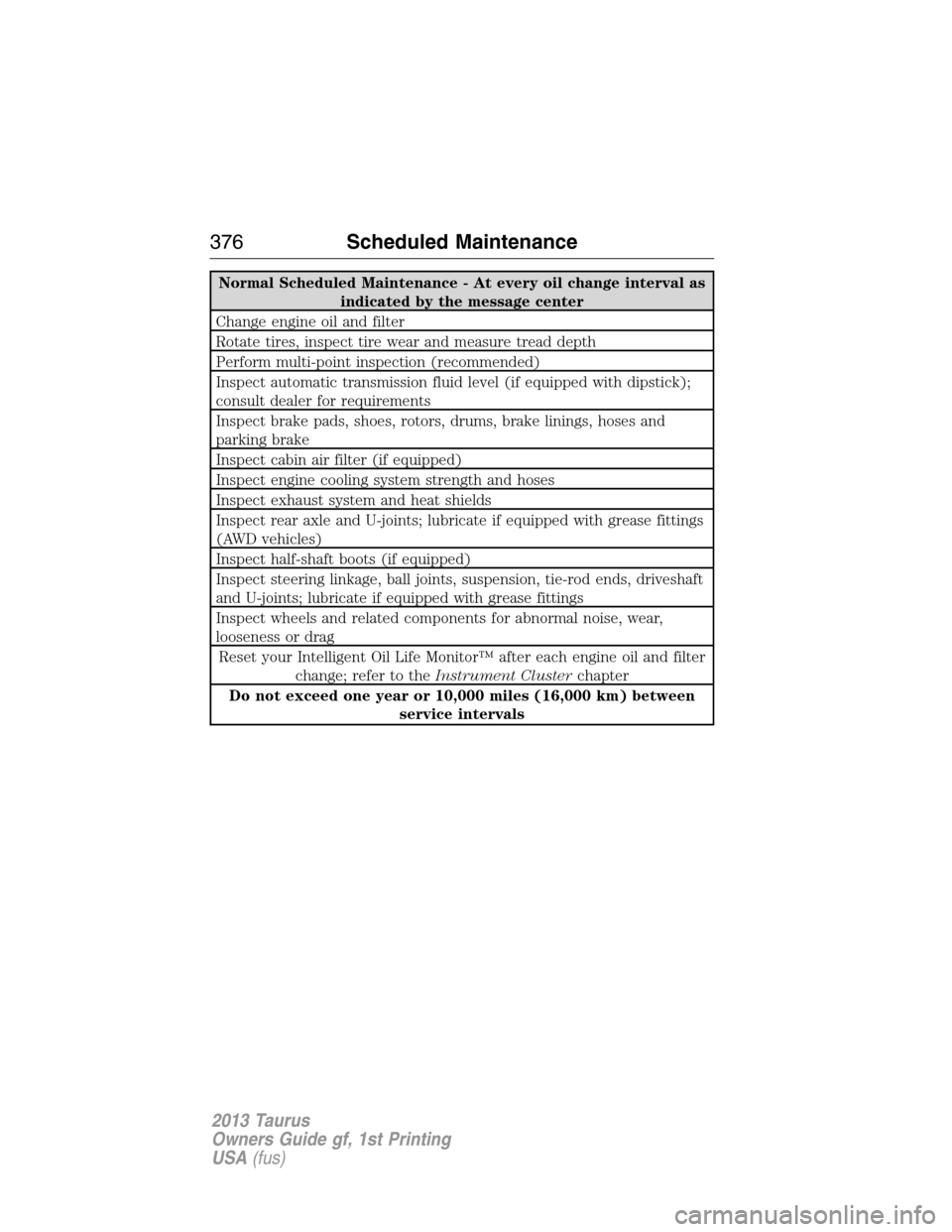
Normal Scheduled Maintenance - At every oil change interval as
indicated by the message center
Change engine oil and filter
Rotate tires, inspect tire wear and measure tread depth
Perform multi-point inspection (recommended)
Inspect automatic transmission fluid level (if equipped with dipstick);
consult dealer for requirements
Inspect brake pads, shoes, rotors, drums, brake linings, hoses and
parking brake
Inspect cabin air filter (if equipped)
Inspect engine cooling system strength and hoses
Inspect exhaust system and heat shields
Inspect rear axle and U-joints; lubricate if equipped with grease fittings
(AWD vehicles)
Inspect half-shaft boots (if equipped)
Inspect steering linkage, ball joints, suspension, tie-rod ends, driveshaft
and U-joints; lubricate if equipped with grease fittings
Inspect wheels and related components for abnormal noise, wear,
looseness or drag
Reset your Intelligent Oil Life Monitor™ after each engine oil and filter
change; refer to theInstrument Clusterchapter
Do not exceed one year or 10,000 miles (16,000 km) between
service intervals
376Scheduled Maintenance
2013 Taurus
Owners Guide gf, 1st Printing
USA(fus)
Page 535 of 541
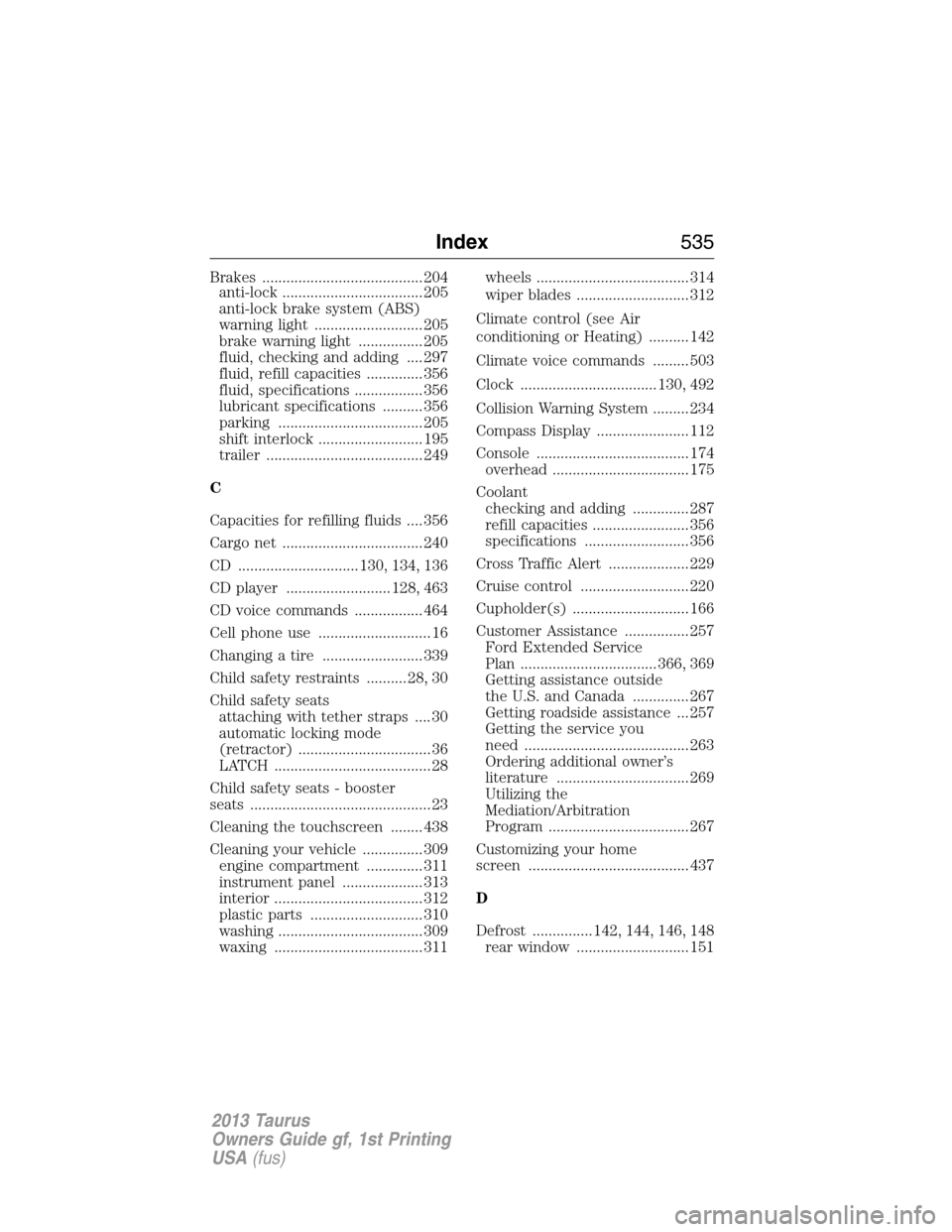
Brakes ........................................ 204
anti-lock ................................... 205
anti-lock brake system (ABS)
warning light ........................... 205
brake warning light ................ 205
fluid, checking and adding .... 297
fluid, refill capacities .............. 356
fluid, specifications ................. 356
lubricant specifications .......... 356
parking .................................... 205
shift interlock .......................... 195
trailer ....................................... 249
C
Capacities for refilling fluids .... 356
Cargo net ................................... 240
CD .............................. 130, 134, 136
CD player .......................... 128, 463
CD voice commands ................. 464
Cell phone use ............................ 16
Changing a tire ......................... 339
Child safety restraints .......... 28, 30
Child safety seats
attaching with tether straps .... 30
automatic locking mode
(retractor) ................................. 36
LATCH ....................................... 28
Child safety seats - booster
seats ............................................. 23
Cleaning the touchscreen ........ 438
Cleaning your vehicle ............... 309
engine compartment .............. 311
instrument panel .................... 313
interior ..................................... 312
plastic parts ............................ 310
washing .................................... 309
waxing ..................................... 311wheels ...................................... 314
wiper blades ............................ 312
Climate control (see Air
conditioning or Heating) .......... 142
Climate voice commands ......... 503
Clock .................................. 130, 492
Collision Warning System ......... 234
Compass Display ....................... 112
Console ...................................... 174
overhead .................................. 175
Coolant
checking and adding .............. 287
refill capacities ........................ 356
specifications .......................... 356
Cross Traffic Alert .................... 229
Cruise control ........................... 220
Cupholder(s) ............................. 166
Customer Assistance ................ 257
Ford Extended Service
Plan .................................. 366, 369
Getting assistance outside
the U.S. and Canada .............. 267
Getting roadside assistance ... 257
Getting the service you
need ......................................... 263
Ordering additional owner’s
literature ................................. 269
Utilizing the
Mediation/Arbitration
Program ................................... 267
Customizing your home
screen ........................................ 437
D
Defrost ............... 142, 144, 146, 148
rear window ............................ 151
Index535
2013 Taurus
Owners Guide gf, 1st Printing
USA(fus)