2013 FORD SUPER DUTY fuel cap
[x] Cancel search: fuel capPage 2 of 95
Introduction
2
Instrument Cluster
6
Starting and Stopping the Engine
8
Fuel and Refueling
14
Brakes
44
Towing
45
Roadside Emergencies
46
Maintenance
48
Vehicle Care
64
Capacities and Specifications
66
Scheduled Maintenance
70
Normal scheduled maintenance and log 75
Index
93
The information contained in this publication was correct at the time of going to
print. In the interest of continuous development, we reserve the right to change
specifications, design or equipment at any time without notice or obligation. No
part of this publication may be reproduced, transmitted, stored in a retrieval
system or translated into any language in any form by any means without our
written permission. Errors and omissions excepted.
© Ford Motor Company 2012
Table of Contents
1
2013 Diesel(67l)
Supplement, 1st Printing
USA(fus)
Page 11 of 95
STOPPING THE ENGINE
Turn the ignition to the off position.
To prolong engine life (especially after extended high speed, high
ambient temperature, or high GVW/GCW operation, such as heavy loads
and/or heavy trailers), it is recommended that a hot engine be idled for
3-5 minutes. This allows the turbocharged engine to cool down. For more
information on GVW/GCW, see theLoad Carryingchapter in your
Owner’s Manual.
COLD WEATHER OPERATION
Note:Idling in cold weather does not heat the engine to its normal
operating temperature. Long periods of idling, especially in cold weather,
can cause a buildup of deposits which can cause engine damage.
Changing to a lighter grade engine oil also makes starting easier under
these conditions. Refer toEngine oil specificationsin theMaintenance
chapter of this supplement.
Diesel fuel is adjusted seasonally for cold temperatures. Diesel fuel which
has not been properly formulated for the ambient conditions may gel
which can clog the fuel filters. One indication that the fuel filter(s) may
be clogged is if the engine starts, stalls after a short time, and then does
not restart. If you have been using biodiesel, you may need to use a fuel
with lower biodiesel content, try another brand, or discontinue using
biodiesel. Do not use alcohol based additives to correct fuel gelling. This
may result in damage to the fuel injectors/system. Use the proper
anti-gel & performance improver product as listed in theTechnical
Specificationssection in theCapacities and Specificationschapter.
Your vehicle is equipped with a diesel fuel conditioner module (DFCM)
which recirculates fuel from the engine to help prevent fuel filter
clogging. To avoid engine fuel starvation during cold weather operation
of 32°F (0°C) or below, it is recommended that the fuel level in your
tank should not be allowed to drop below
14full. This helps prevent air
from entering the fuel system and stalling the engine.
Your vehicle is equipped with a an SCR system which uses diesel exhaust
fluid (DEF) to operate properly. DEF must be replenished at certain
intervals. When filling the vehicle’s DEF tank in cold weather, special
care must be taken to prevent damage to the DEF tank. For proper cold
weather fill procedure, seeSelective Catalytic Reduction (SCR) System
in theFuel and Refuelingchapter.
Starting and Stopping the Engine
10
2013 Diesel(67l)
Supplement, 1st Printing
USA(fus)
Page 14 of 95
Operation in Standing Water
Ingestion of water into the diesel engine can result in immediate and
severe damage to the engine. If driving through water, slow down to
avoid splashing water into the intake. If the engine stalls, and ingestion
of water into the engine is suspected, do not try to restart the engine.
Consult your dealer for service immediately.
The fuel tank is vented to atmosphere by valves on top of the tank and
through the fuel cap. If water reaches this level water may be pulled into
the fuel tank. Water in the fuel can cause performance issues and
damage the fuel injection system.
Engine Block Heater (If Equipped)
Refer to theStarting and Stopping the Enginechapter in your
Owner’s Manual.
Rapid Heat Supplemental Heating System (If Equipped)
Note:Additional aftermarket electrical loads operated during engine
warm up may impact the performance of the rapid heat supplemental
heater.
The optional rapid heat feature is an electrically powered device that is
designed to provide supplemental heat during engine warm up. For
maximum effectiveness mid to low blower speed is recommended during
initial warm up. When operating in automatic mode (when equipped) the
climate control unit determines the appropriate blower speed for existing
conditions.
Starting and Stopping the Engine
13
2013 Diesel(67l)
Supplement, 1st Printing
USA(fus)
Page 18 of 95
DIESEL FUEL ADDITIVES
It should not be necessary to add any aftermarket additives to your fuel
tank if you use a properly formulated diesel fuel. Aftermarket additives
can damage the injector system or engine.
Use Motorcraft® cetane booster or an equivalent cetane booster additive
if you suspect fuel has low cetane. Use Motorcraft® anti-gel &
performance improver or an equivalent additive if there is fuel gelling.
Do not use alcohol based additives to improve cetane quality, to prevent
fuel gelling or any other use. The use of alcohol additives may result in
damage to the fuel injectors/system. refer to theTechnical
specificationssection in theCapacities and Specificationschapter for
more information.
Repairs to correct the effects of using an aftermarket product that does
not meet Ford specifications in your fuel may not be covered by your
warranty.
Note:Ultra Low Sulfur Diesel fuel is designed to meet the emissions
standards for the 6.7L engine and is backward compatible as well (i.e.,
can be used in Ford 7.3L, 6.9L, 6.4L and 6.0L diesel engines in Ford
vehicles).
FUELING TIPS
WARNING:Do not use starting fluid such as ether or gasoline
in the diesel air intake system. Such fluids can cause immediate
explosive damage to the engine and possible personal injury.
Truck stops have pumps and nozzles designed for larger, heavy-duty
trucks. When refueling at truck stops: if the nozzle shuts off repeatedly
when refueling, wait 5–10 seconds; then use a slower rate of flow (don’t
depress the nozzle trigger as far).
If air is allowed to enter the fuel system (during fuel filter change or if
you run out of fuel) the engine will purge the trapped air as it runs. To
purge the air sooner: prior to engine start, prime the system by turning
the key to on for 30 seconds then to off. Repeat this several times. The
engine may run rough and produce white smoke while air is in the
system. This is normal and should correct itself in a short time.
An engine that suddenly becomes noisy or operates poorly after a fuel fill
could be using substandard fuel (i.e., high water content, low cetane
rating or gasoline in the fuel). Diesel fuel should be purchased from a
reputable station which sells a large amount of diesel fuel.
Fuel and Refueling
17
2013 Diesel(67l)
Supplement, 1st Printing
USA(fus)
Page 19 of 95
Care should be taken whenever diesel fuel is stored. Use only clean,
approved containers which will prevent the entry of dirt or water.
Diesel fuel must not be stored in a galvanized container. The fuel will
dissolve the zinc in a galvanized container. The zinc will then remain in
the solution until it is run through the engine where it will be deposited
in the fuel injectors causing expensive-to-repair damage.
Diesel fuel dispensing nozzle fill rate
This truck is equipped with a fuel fill pipe which is able to accept fuel up
to 20 gallons per minute from a 1
18fuel dispensing nozzle. Pumping fuel
at greater flow rates may result in premature nozzle shut-off or spitback.
Fuel filler cap
WARNING:The fuel system may be under pressure. If the fuel
filler cap is venting vapor or if you hear a hissing sound, wait
until it stops before completely removing the fuel filler cap. Otherwise,
fuel may spray out and injure you or others.
WARNING:If you do not use the proper fuel filler cap,
excessive pressure or vacuum in the fuel tank may damage the
fuel system or cause the fuel cap to disengage in a collision, which may
result in possible personal injury.
Note:If you must replace the fuel filler cap, replace it with a fuel filler
cap that is designed for your vehicle. The vehicle warranty may be void
for any damage to the fuel tank or fuel system if the correct genuine
Ford or Motorcraft® fuel filler cap is not used.
Your fuel tank filler cap has an indexed design with a 1/4 turn on/off feature.
When fueling your vehicle:
1. Turn the engine off.
2. Carefully turn the filler cap counterclockwise until it spins off.
3. Pull to remove the cap from the fuel filler pipe.
4. To install the cap, align the tabs on the cap with the notches on the
filler pipe.
5. Turn the filler cap clockwise 1/4 of a turn until it clicks at least once.
Fuel and Refueling
18
2013 Diesel(67l)
Supplement, 1st Printing
USA(fus)
Page 24 of 95
Filling the DEF tank
WARNING:Make sure that DEF does not come into contact
with eyes, skin or clothing. Should DEF contact your eyes, flush
them with plenty of water and contact a physician. Clean affected skin
with soap and water. If DEF is swallowed, drink plenty of water and
contact a physician immediately.
WARNING:Refill DEF in a well-ventilated area. When opening
the cap on the DEF tank or bottle containing DEF, ammonia
vapors may escape. The vapors can be irritating to skin, eyes and
mucous membranes. Inhaling ammonia vapors can cause burning to the
eyes, throat and nose and cause coughing and watery eyes.
Note:Do not put DEF in the fuel tank. This can cause engine damage
not covered by your vehicle’s warranty.
Note:Immediately wipe away any DEF that has spilled on painted
surfaces with water and a damp cloth to prevent damage to the paint.
Your vehicle is equipped with a DEF tank with a blue-capped filler port
located next to the diesel fuel fill inlet. The tank can be filled using a
nozzle at a DEF filling station (similar to fuel fill) or using a DEF bottle
with a spout. Motorcraft® DEF bottles are recommended as they are
designed to be spill proof and will stop the flow of DEF when the tank is
full. Other aftermarket bottles can be used, but they should have a seal
on the spout and an internal vent tube to achieve best fill performance
and prevent overfilling. Overfilling your DEF tank can cause damage to
the tank. For DEF capacity, see theCapacities and Specifications
chapter.
You can purchase DEF at your authorized dealer, most highway truck
stops or you can contact roadside assistance for help in finding a retailer
that sells DEF. See theCustomer Assistancechapter in theOwner’s
Manualfor more information. In addition, there is a government website
locator for DEF at the following web address that can be used to find the
nearest location to purchase DEF: http://www.afdc.energy.gov/afdc/
locator/def.
Fuel and Refueling
23
2013 Diesel(67l)
Supplement, 1st Printing
USA(fus)
Page 25 of 95
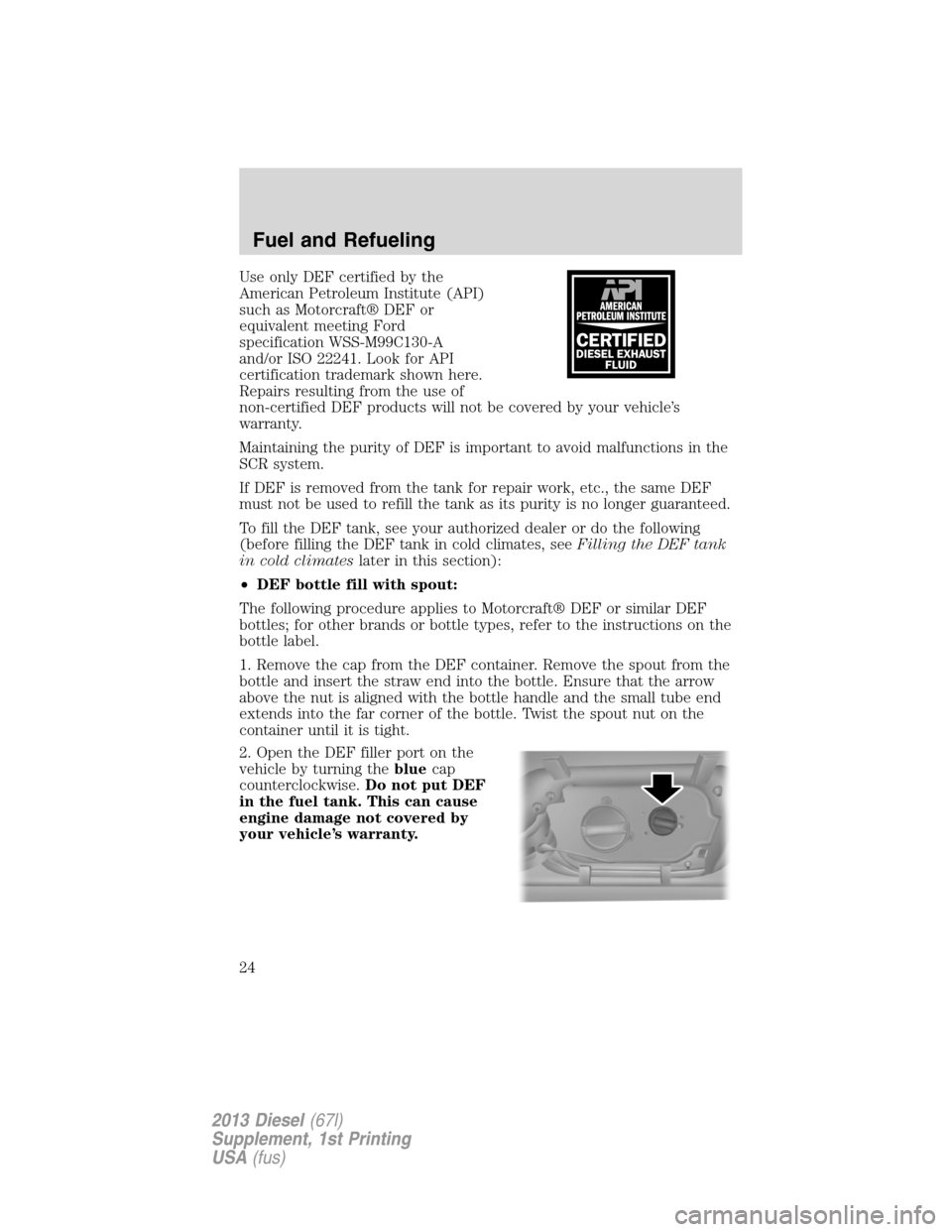
Use only DEF certified by the
American Petroleum Institute (API)
such as Motorcraft® DEF or
equivalent meeting Ford
specification WSS-M99C130-A
and/or ISO 22241. Look for API
certification trademark shown here.
Repairs resulting from the use of
non-certified DEF products will not be covered by your vehicle’s
warranty.
Maintaining the purity of DEF is important to avoid malfunctions in the
SCR system.
If DEF is removed from the tank for repair work, etc., the same DEF
must not be used to refill the tank as its purity is no longer guaranteed.
To fill the DEF tank, see your authorized dealer or do the following
(before filling the DEF tank in cold climates, seeFilling the DEF tank
in cold climateslater in this section):
•DEF bottle fill with spout:
The following procedure applies to Motorcraft® DEF or similar DEF
bottles; for other brands or bottle types, refer to the instructions on the
bottle label.
1. Remove the cap from the DEF container. Remove the spout from the
bottle and insert the straw end into the bottle. Ensure that the arrow
above the nut is aligned with the bottle handle and the small tube end
extends into the far corner of the bottle. Twist the spout nut on the
container until it is tight.
2. Open the DEF filler port on the
vehicle by turning thebluecap
counterclockwise.Do not put DEF
in the fuel tank. This can cause
engine damage not covered by
your vehicle’s warranty.
Fuel and Refueling
24
2013 Diesel(67l)
Supplement, 1st Printing
USA(fus)
Page 27 of 95
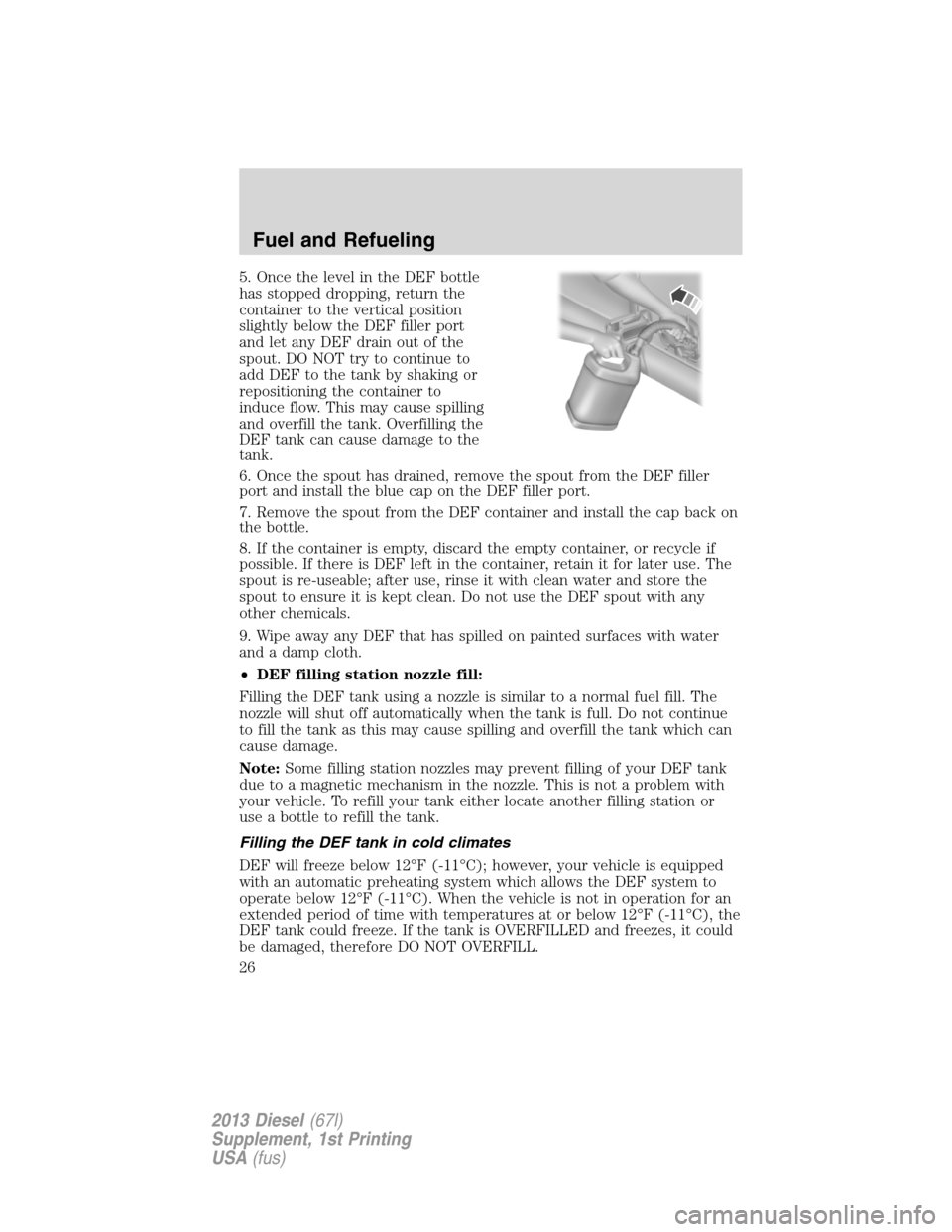
5. Once the level in the DEF bottle
has stopped dropping, return the
container to the vertical position
slightly below the DEF filler port
and let any DEF drain out of the
spout. DO NOT try to continue to
add DEF to the tank by shaking or
repositioning the container to
induce flow. This may cause spilling
and overfill the tank. Overfilling the
DEF tank can cause damage to the
tank.
6. Once the spout has drained, remove the spout from the DEF filler
port and install the blue cap on the DEF filler port.
7. Remove the spout from the DEF container and install the cap back on
the bottle.
8. If the container is empty, discard the empty container, or recycle if
possible. If there is DEF left in the container, retain it for later use. The
spout is re-useable; after use, rinse it with clean water and store the
spout to ensure it is kept clean. Do not use the DEF spout with any
other chemicals.
9. Wipe away any DEF that has spilled on painted surfaces with water
and a damp cloth.
•DEF filling station nozzle fill:
Filling the DEF tank using a nozzle is similar to a normal fuel fill. The
nozzle will shut off automatically when the tank is full. Do not continue
to fill the tank as this may cause spilling and overfill the tank which can
cause damage.
Note:Some filling station nozzles may prevent filling of your DEF tank
due to a magnetic mechanism in the nozzle. This is not a problem with
your vehicle. To refill your tank either locate another filling station or
use a bottle to refill the tank.
Filling the DEF tank in cold climates
DEF will freeze below 12°F (-11°C); however, your vehicle is equipped
with an automatic preheating system which allows the DEF system to
operate below 12°F (-11°C). When the vehicle is not in operation for an
extended period of time with temperatures at or below 12°F (-11°C), the
DEF tank could freeze. If the tank is OVERFILLED and freezes, it could
be damaged, therefore DO NOT OVERFILL.
Fuel and Refueling
26
2013 Diesel(67l)
Supplement, 1st Printing
USA(fus)