2013 FORD MUSTANG check engine
[x] Cancel search: check enginePage 35 of 63
ENGINE OIL RECOMMENDATION
Use Motorcraft® SAE 5W-50 full synthetic or an equivalent SAE 5W-50
full synthetic oil meeting Ford specification WSS-M2C931-B.
Do not use supplemental engine oil additives, cleaners or other engine
treatments. They are unnecessary and could lead to engine damage that
is not covered by Ford warranty.
Change your engine oil and filter according to the appropriate schedule
listed in thescheduled maintenance information.
CHECKING THE ENGINE OIL
Refer to thescheduled maintenance informationfor the appropriate
intervals for checking the engine oil.
1. Make sure the vehicle is on level ground.
2. Turn the engine off and wait 15 minutes for the oil to drain into the
oil pan.
3. Set the parking brake and make sure the gearshift is securely latched
in first gear.
4. Open the hood. Protect yourself from engine heat.
Maintenance
35
2013 05+ Mustang(197)
Supplement, 1st Printing
USA(fus)
Page 36 of 63
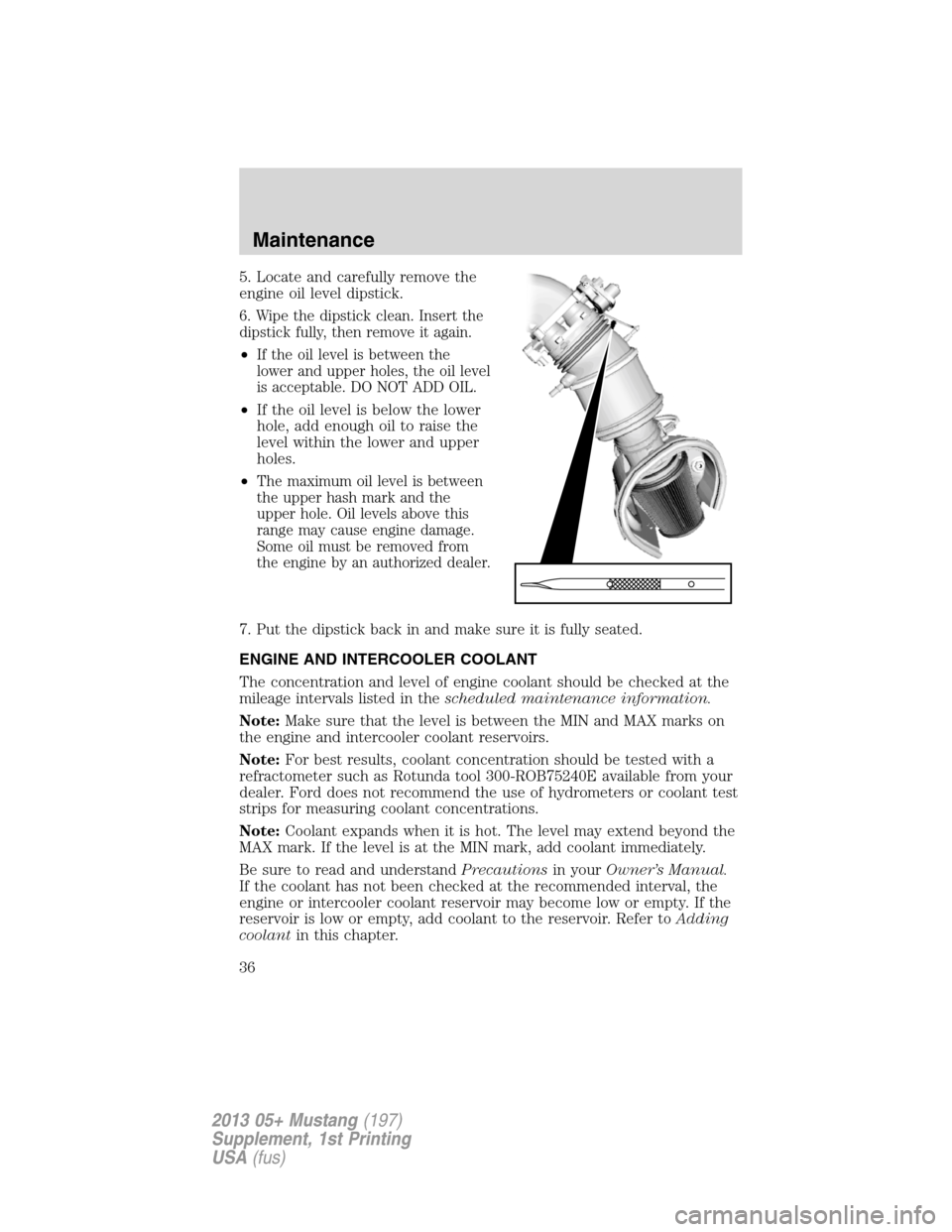
5. Locate and carefully remove the
engine oil level dipstick.
6. Wipe the dipstick clean. Insert the
dipstick fully, then remove it again.
•If the oil level is between the
lower and upper holes, the oil level
is acceptable. DO NOT ADD OIL.
•If the oil level is below the lower
hole, add enough oil to raise the
level within the lower and upper
holes.
•
The maximum oil level is between
the upper hash mark and the
upper hole. Oil levels above this
range may cause engine damage.
Some oil must be removed from
the engine by an authorized dealer.
7. Put the dipstick back in and make sure it is fully seated.
ENGINE AND INTERCOOLER COOLANT
The concentration and level of engine coolant should be checked at the
mileage intervals listed in thescheduled maintenance information.
Note:Make sure that the level is between the MIN and MAX marks on
the engine and intercooler coolant reservoirs.
Note:For best results, coolant concentration should be tested with a
refractometer such as Rotunda tool 300-ROB75240E available from your
dealer. Ford does not recommend the use of hydrometers or coolant test
strips for measuring coolant concentrations.
Note:Coolant expands when it is hot. The level may extend beyond the
MAX mark. If the level is at the MIN mark, add coolant immediately.
Be sure to read and understandPrecautionsin yourOwner’s Manual.
If the coolant has not been checked at the recommended interval, the
engine or intercooler coolant reservoir may become low or empty. If the
reservoir is low or empty, add coolant to the reservoir. Refer toAdding
coolantin this chapter.
Maintenance
36
2013 05+ Mustang(197)
Supplement, 1st Printing
USA(fus)
Page 38 of 63
A large amount of water without engine coolant may be added, in case of
emergency, to reach a vehicle service location. In this instance, the
cooling system must be drained, chemically cleaned with Motorcraft®
Premium Cooling System Flush, and refilled with prediluted coolant as
soon as possible. Water alone (without engine coolant) can cause engine
damage from corrosion, overheating or freezing.
•Note:Do not use alcohol, methanol or brine or any engine coolants
mixed with alcohol or methanol antifreeze (coolant). Alcohol and
other liquids can cause engine damage from overheating or freezing.
•Note:Do not add extra inhibitors or additives to the coolant. These
can be harmful and compromise the corrosion protection of the engine
coolant.
Unscrew the cap slowly. Any pressure will escape as you unscrew the
cap.
Add prediluted engine coolant meeting the Ford specification. See
Capacities and Specificationsfor more information. Whenever coolant
has been added, the coolant level in the coolant reservoir should be
checked the next few times you drive the vehicle. If necessary, add
enough prediluted coolant to bring the coolant level to the proper level
and concentration.
Coolant and Intercooler Refill Procedure
The following procedure should be used when refilling the cooling
system after it has been drained or become extremely low.
1. Remove the pressure relief cap from the coolant reservoir as
previously outlined.
2. Slowly add prediluted coolant to the coolant reservoir until the coolant
level is between the MIN and MAX marks on the reservoir.
3. Reinstall the pressure relief cap.
4. Start and idle the engine until the upper radiator hose is warm (this
indicates the thermostat is open and coolant is flowing through the
entire system).
5. Shut the engine off and let it cool.
6. Remove the pressure relief cap from the coolant reservoir as
previously outlined.
Maintenance
38
2013 05+ Mustang(197)
Supplement, 1st Printing
USA(fus)
Page 39 of 63
7. Add prediluted coolant to the coolant reservoir until the coolant level
is between the MIN and MAX marks on the reservoir.
8. Reinstall the pressure relief cap.
9. Check the coolant level in the reservoir before you drive your vehicle
the next few times (with the engine cool).
10. If necessary, add prediluted coolant to the coolant reservoir until the
coolant level is between the MIN and MAX marks on the reservoir.
Whenever coolant has been added, the coolant level in the coolant
reservoir should be checked the next few times you drive the vehicle. If
necessary, add prediluted coolant to bring the coolant level to the proper
level.
If you have to add more than 1.0 quart (1.0 liter) of coolant per month,
have your dealer check the cooling system. Your cooling system may
have a leak. Operating an engine with a low level of coolant can result in
engine overheating and possible engine damage.
ENGINE SPARK PLUG INTERVAL
To keep your high performance engine operating at peak performance,
the spark plug service interval is every 45,000 miles (72,000 kilometers).
See the Motorcraft® Part Numbers chart for the specific spark plug
application.
OCTANE RECOMMENDATIONS
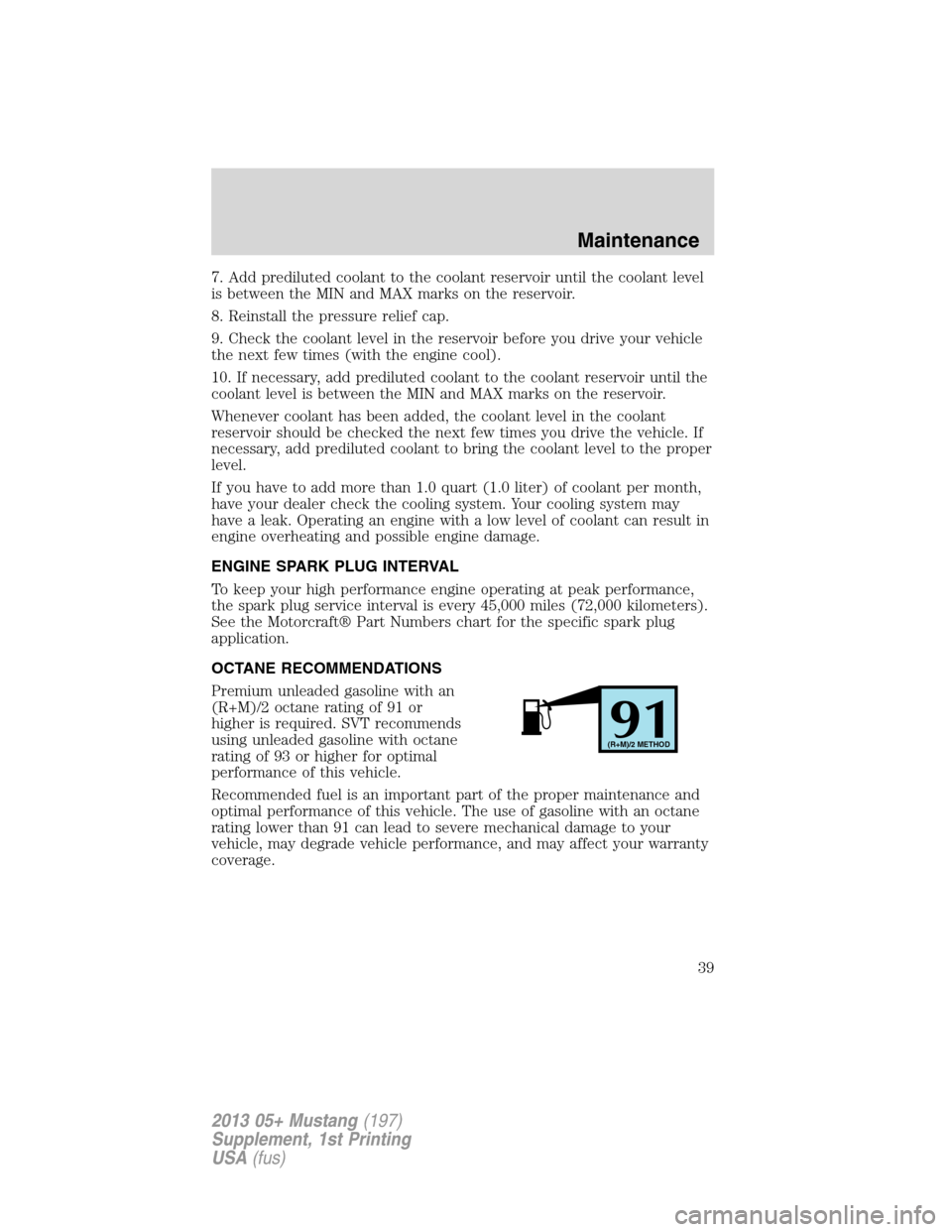
Premium unleaded gasoline with an
(R+M)/2 octane rating of 91 or
higher is required. SVT recommends
using unleaded gasoline with octane
rating of 93 or higher for optimal
performance of this vehicle.
Recommended fuel is an important part of the proper maintenance and
optimal performance of this vehicle. The use of gasoline with an octane
rating lower than 91 can lead to severe mechanical damage to your
vehicle, may degrade vehicle performance, and may affect your warranty
coverage.
91(R+M)/2 METHOD
Maintenance
39
2013 05+ Mustang(197)
Supplement, 1st Printing
USA(fus)
Page 43 of 63

Item CapacityFord part name or
equivalentFord part number /
Ford Specification
Transmission fluid
without cooler
3,4
3.6 quarts (3.4L)
Motorcraft®
MERCON® V ATFXT-5-QM /
MERCON® V
Transmission fluid with
cooler
3,4
4.1 quarts (3.9L)
Windshield washer fluid Fill as requiredMotorcraft® Premium
Windshield Washer
Concentrate (US) /
Premium Quality
Windshield Washer Fluid
(Canada)ZC-32-A (US)
CXC-37-(A, B, D, and F)
(Canada) /
WSB-M8B16–A2/--
1Add the coolant type originally equipped in your vehicle.2Rear axle lubricants do not need to be checked or changed unless a leak is suspected, service is
required or the axle assembly has been submerged in water. The axle lubricant should be changed
any time the rear axle has been submerged in water. For vehicles with a cooler, the axle pump
must be running to perform the service refill.
Fill 1/4-9/16 inch (6-14 millimeters) below bottom of fill hole.3The TREMEC 6060 6-speed manual transmission on your Shelby GT500 uses MERCON® V
automatic transmission fluid. Make sure that the correct MERCON® V ATF automatic transmission
fluid is used as indicated on the label on your transmission.4Service refill capacity is determined by filling the transmission to the bottom of the filler hole with
the vehicle on a level surface. For vehicles with a transmission cooler, the engine must be running,
the clutch pedal must be released, and the transmission must be in neutral to perform the service
refill.
Capacities and Specifications
43
2013 05+ Mustang(197)
Supplement, 1st Printing
USA(fus)
Page 48 of 63
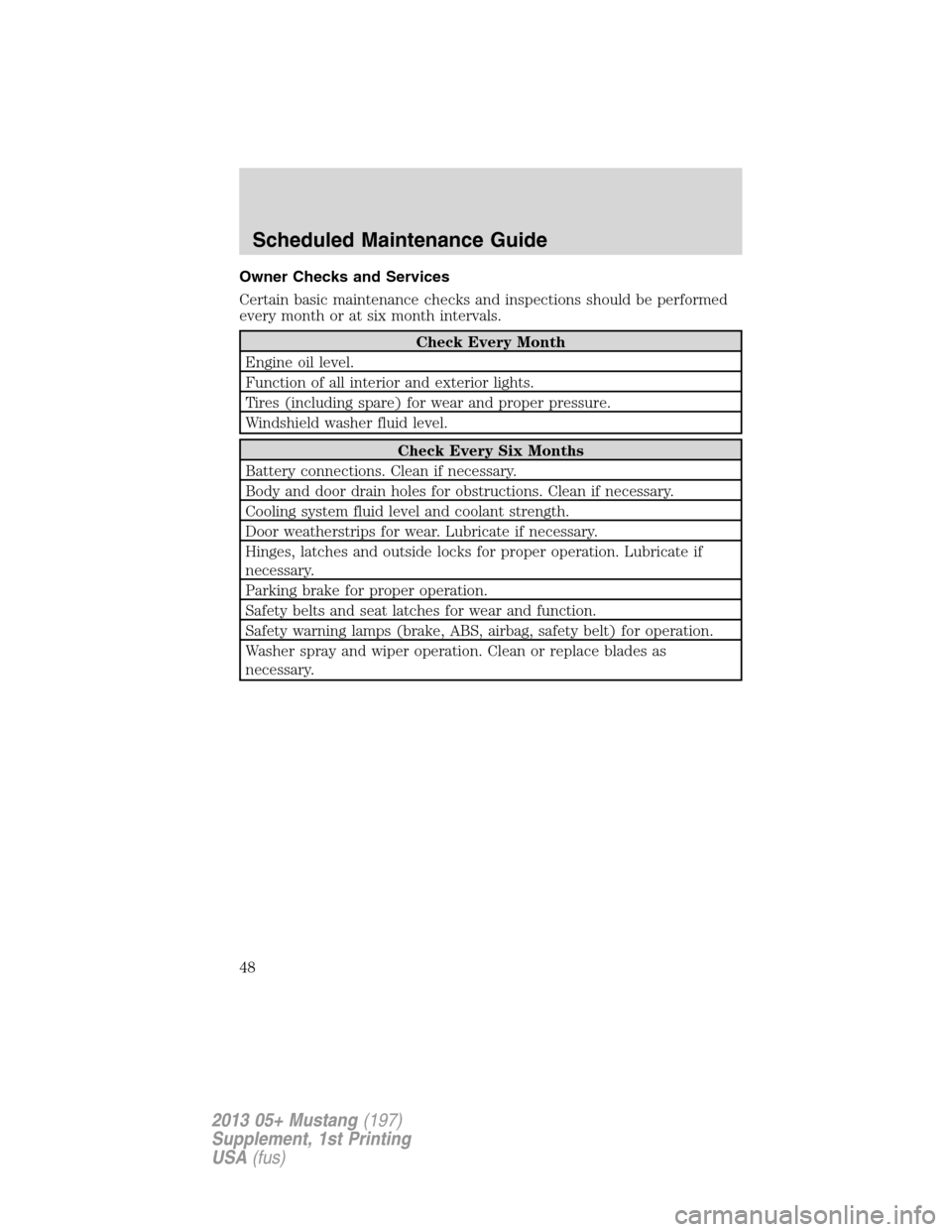
Owner Checks and Services
Certain basic maintenance checks and inspections should be performed
every month or at six month intervals.
Check Every Month
Engine oil level.
Function of all interior and exterior lights.
Tires (including spare) for wear and proper pressure.
Windshield washer fluid level.
Check Every Six Months
Battery connections. Clean if necessary.
Body and door drain holes for obstructions. Clean if necessary.
Cooling system fluid level and coolant strength.
Door weatherstrips for wear. Lubricate if necessary.
Hinges, latches and outside locks for proper operation. Lubricate if
necessary.
Parking brake for proper operation.
Safety belts and seat latches for wear and function.
Safety warning lamps (brake, ABS, airbag, safety belt) for operation.
Washer spray and wiper operation. Clean or replace blades as
necessary.
Scheduled Maintenance Guide
48
2013 05+ Mustang(197)
Supplement, 1st Printing
USA(fus)
Page 49 of 63
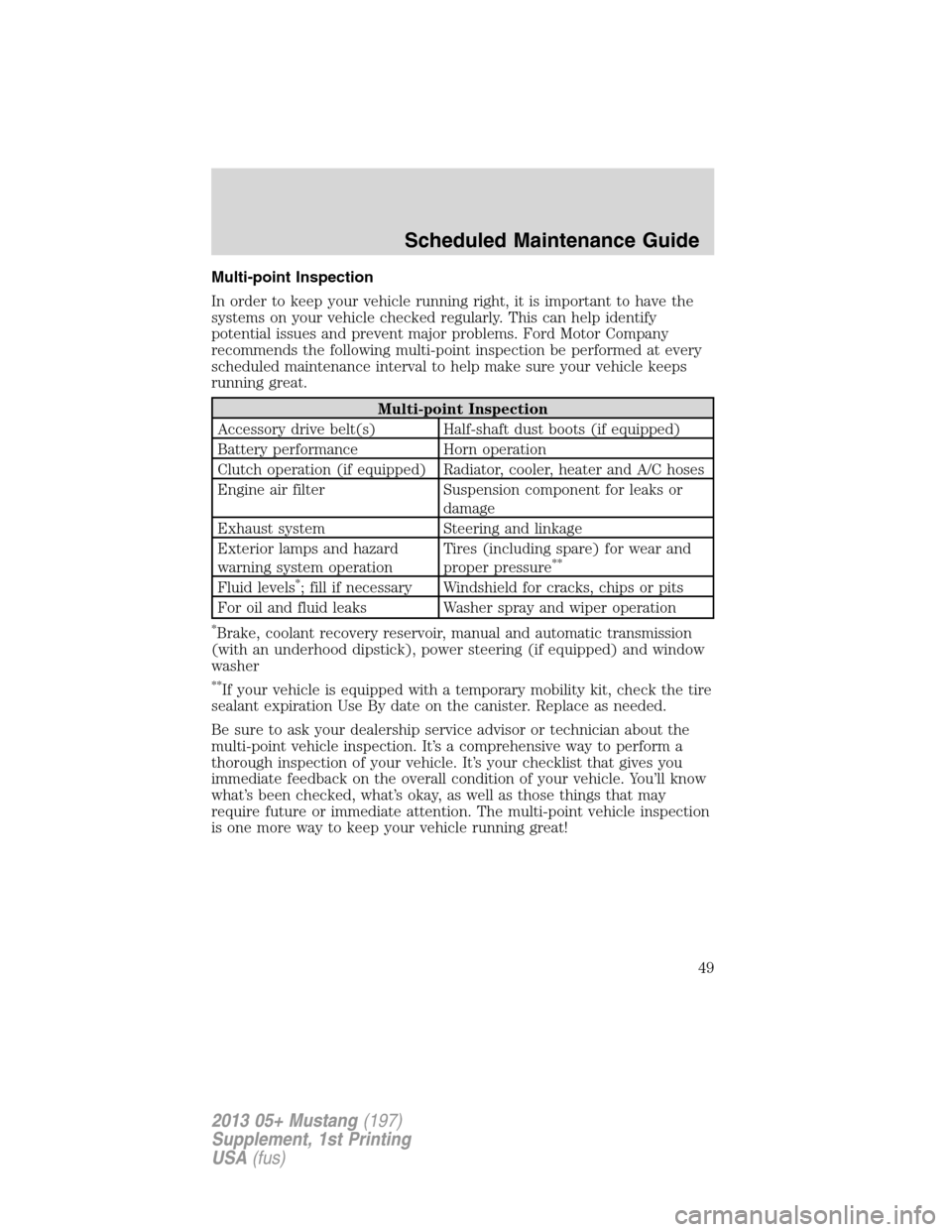
Multi-point Inspection
In order to keep your vehicle running right, it is important to have the
systems on your vehicle checked regularly. This can help identify
potential issues and prevent major problems. Ford Motor Company
recommends the following multi-point inspection be performed at every
scheduled maintenance interval to help make sure your vehicle keeps
running great.
Multi-point Inspection
Accessory drive belt(s) Half-shaft dust boots (if equipped)
Battery performance Horn operation
Clutch operation (if equipped) Radiator, cooler, heater and A/C hoses
Engine air filter Suspension component for leaks or
damage
Exhaust system Steering and linkage
Exterior lamps and hazard
warning system operationTires (including spare) for wear and
proper pressure
**
Fluid levels*; fill if necessary Windshield for cracks, chips or pits
For oil and fluid leaks Washer spray and wiper operation
*Brake, coolant recovery reservoir, manual and automatic transmission
(with an underhood dipstick), power steering (if equipped) and window
washer
**If your vehicle is equipped with a temporary mobility kit, check the tire
sealant expiration Use By date on the canister. Replace as needed.
Be sure to ask your dealership service advisor or technician about the
multi-point vehicle inspection. It’s a comprehensive way to perform a
thorough inspection of your vehicle. It’s your checklist that gives you
immediate feedback on the overall condition of your vehicle. You’ll know
what’s been checked, what’s okay, as well as those things that may
require future or immediate attention. The multi-point vehicle inspection
is one more way to keep your vehicle running great!
Scheduled Maintenance Guide
49
2013 05+ Mustang(197)
Supplement, 1st Printing
USA(fus)
Page 60 of 63
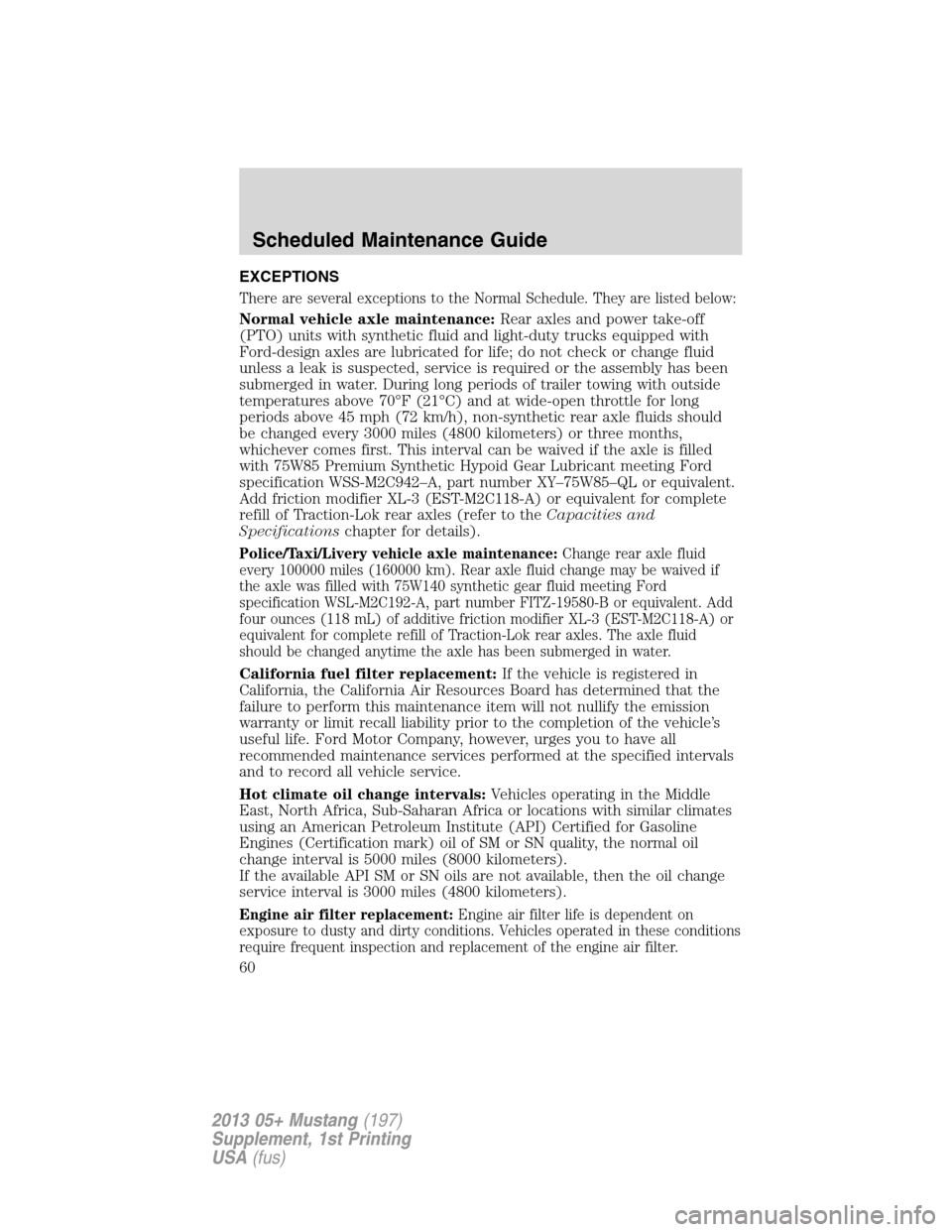
EXCEPTIONS
There are several exceptions to the Normal Schedule. They are listed below:
Normal vehicle axle maintenance:Rear axles and power take-off
(PTO) units with synthetic fluid and light-duty trucks equipped with
Ford-design axles are lubricated for life; do not check or change fluid
unless a leak is suspected, service is required or the assembly has been
submerged in water. During long periods of trailer towing with outside
temperatures above 70°F (21°C) and at wide-open throttle for long
periods above 45 mph (72 km/h), non-synthetic rear axle fluids should
be changed every 3000 miles (4800 kilometers) or three months,
whichever comes first. This interval can be waived if the axle is filled
with 75W85 Premium Synthetic Hypoid Gear Lubricant meeting Ford
specification WSS-M2C942–A, part number XY–75W85–QL or equivalent.
Add friction modifier XL-3 (EST-M2C118-A) or equivalent for complete
refill of Traction-Lok rear axles (refer to theCapacities and
Specificationschapter for details).
Police/Taxi/Livery vehicle axle maintenance:Change rear axle fluid
every 100000 miles (160000 km). Rear axle fluid change may be waived if
the axle was filled with 75W140 synthetic gear fluid meeting Ford
specification WSL-M2C192-A, part number FITZ-19580-B or equivalent. Add
four ounces (118 mL) of additive friction modifier XL-3 (EST-M2C118-A) or
equivalent for complete refill of Traction-Lok rear axles. The axle fluid
should be changed anytime the axle has been submerged in water.
California fuel filter replacement:If the vehicle is registered in
California, the California Air Resources Board has determined that the
failure to perform this maintenance item will not nullify the emission
warranty or limit recall liability prior to the completion of the vehicle’s
useful life. Ford Motor Company, however, urges you to have all
recommended maintenance services performed at the specified intervals
and to record all vehicle service.
Hot climate oil change intervals:Vehicles operating in the Middle
East, North Africa, Sub-Saharan Africa or locations with similar climates
using an American Petroleum Institute (API) Certified for Gasoline
Engines (Certification mark) oil of SM or SN quality, the normal oil
change interval is 5000 miles (8000 kilometers).
If the available API SM or SN oils are not available, then the oil change
service interval is 3000 miles (4800 kilometers).
Engine air filter replacement:Engine air filter life is dependent on
exposure to dusty and dirty conditions. Vehicles operated in these conditions
require frequent inspection and replacement of the engine air filter.
Scheduled Maintenance Guide
60
2013 05+ Mustang(197)
Supplement, 1st Printing
USA(fus)